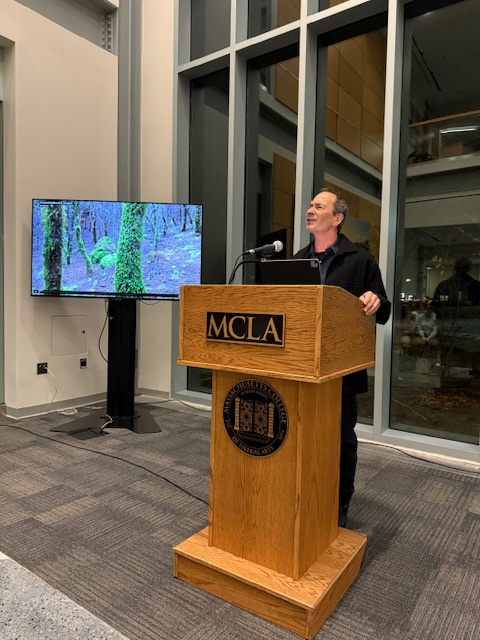
I wrote a profile of poet Forrest Gander for Berkshire Magazine back in the Fall of 2024, when he was visiting poet at MCLA in North Adams, MA. I’ve been personally and deeply engaged with Forrest’s poetry and nonfiction since his first book, Rush to the Lake, came out from Alice James Books in 1988. And I thoroughly enjoyed spending some concentrated time with his body of work, along with his latest book, Mojave Ghost: A Novel Poem, which New Directions published that year, in preparation for the article.
“The basic gesture of my writing is a listening,” poet Forrest Gander has written. “The great capacity of language is to bring us into proximity with one another.”
In Mojave Ghost, Gander is listening hard: to the desert, to the dead, and to the layered silences between. More sentence-based and more nakedly elegiac than anything he has published before, the book traces a movement from Arkansas into California, and along the San Andrea Fault, following geological and personal fault lines simultaneously.
Gander was born in 1956 in Barstow, in the Mojave Desert itself. His mother talked about the desert often, and he didn’t return until after she was gone. Her stories about Rainbow Basin, the fossils she collected there, and the landscape she loved, run through the book like an underground current. So does grief for his partner of 35 years, the poet C.D. Wright, who died suddenly in 2016. In Mojave Ghost, the pronouns slip and the addressee shifts; it may be his late mother, his late partner, or Ashwini Bhat, the sculptor he married in 2020. “Science tells us that although we may feel ourselves as a unified, authentic self, we’re actually a collaboration of conflicting voices,” Gander told me in an interview. “That’s something I’ve come to intuitively feel.”
What holds it all together is the landscape and what landscape does to time. While hiking along the San Andreas, Gander realized that looking at the terrain around him, he was also seeing past and present at once. “Those two conflations of past and present — of the personal and the geological — form the currents in Mojave Ghost.”
Memory has long been active in his work. In the new book, he asks:
Is it odd that what we remember
is confined so often to particular moments
like still images ripped from a film?
“My memory of my late mother’s face can be more real for me, more exact, more present even than the face of someone I’m talking with now,” he says. “In our minds, whatever had once been possible can be so again.”
Asked what he hopes readers take away from his poetry, Gander offers something close to a credo: “Thought-feeling. Feeling-thought. Western culture divides feeling from thought, but there are single words in Chinese and Japanese for heart/mind.” He agrees with Ezra Pound that “only emotion endures.”
“No one cares about how much money some investor made in 600 BCE, but we do care about even the small fragments of Sappho’s poems,” Gander says. “That’s about as much of a miracle as the world offers us.”
The following section from Mojave Ghost is shared with the author’s permission:
Because the tree line opens contours of meanings
other than the ones for which we’re prepared,
we treat it with suspicion.
When he smiled and shook his head no, his face
connoted the presumption that you and I live in a different world.
He took us in like the scent of a dead animal.
But how to sustain attentiveness? How to keep
the mind from dropping its needle
into the worn grooves of association?
My art, you said in passing, is nothing much
more than the discipline of an embodied life.
Articulating nuance. The delicate
palette. You paint details
with a tiny brush you made yourself
of hair plucked from your forearm.
They distrust me, you said, because
they can tell I prefer my work to their own.
Which is when I tucked a red anemone
under your pillow to bring you good dreams. What
else did you say?
Fair enough. It is a marriage of equals and without degree.
Your trace on me
like rope marks on the well’s mouth.
Here, have a thought.
As for our misfit status: as Brecht observed,
the palace of canonical culture is built on—
Not to interpret. To feel life course through you.
—Forrest Gander, from Mojave Ghost
Here’s a link to my Berkshire Magazine profile: Forrest Gander
My Year in Writing 2025
November 29, 2025
This is the time of year—between my birthday and year’s end—when I take stock of my writing life over the past 12 months. A trend that’s continued this year: I’ve continue to be very Berkshire-focused as we approach the fourth anniversary of our move up here. As I told one of my students at Berkshire Community College this semester, where I’ve been teaching Principles of Marketing, filling in for a professor on her sabbatical, “This is my time to give back and go hyperlocal…”
I’ve also continued to write for Berkshire Magazine—eighteen in total and sometimes as many as 4-5 articles per issue (!), causing me to joke with my editor, Anastasia Stanmeyer, “Do you have any other writers?” In addition to having the cover story in one issue this year, Anastasia generously wrote about me in her editor’s note in the Fall issue accompanied by this photo.

I’m still shopping around my book of essays, The Others in Me: On the Azores & Ancestry, Poetry & Identity, and am building a new series of essays about life on our little beaver pond in the Berkshires, which I’m calling “To Learn Attention: Encounters in the Anthropocene Backyard,” several of which were published earlier this year.
While we didn’t get to the Azores for the second year in a row—something I hope to remedy in 2026—we had a wonderfully inspiring trip to Paris in late March-early April. Overall, it’s been a productive year. Here are some of the highlights:
“A Modern Log Cabin: Industrial Chic Meets Rustic Warmth,” in Berkshire Magazine, Spring 2025
“Betting Big on the Outdoors: Paul Jahinge Leads the State’s Outdoor Recreation Vision” (profile), in Berkshire Magazine, Spring 2025
“Matt Rubiner: An Unconventional Path to Cheese Mastery” (Q&A) in Culture: The word on cheese, Spring 2025
“Ancestral Echoes: Exploring Aracelis Girmay’s An Experiment in Voices,” in Berkshire Magazine, May-June 2025
“Poetic Sweat: Bill T. Jones and His Company Return to Jacob’s Pillow” (profile), in Berkshire Magazine, May-June 2025
Attended MAPS’ Psychedelic Science Conference in Denver, CO, reporting on several future stories and features. (June)
“My Wife Gave Me Magic Mushrooms For My 60th Birthday. It Transformed My Life In Ways I Never Expected,” HuffPost, June 2025 (The response to this piece was absolutely amazing. My editor at HuffPost wrote that something like 250,000 people read it the first weekend it was published, with “an average read time of 2:46 minutes (the site average for a story is 0:40, so to get folks to stay on your piece for close to three minutes is AMAZING and means that most people read all the way through… a huge feat in today’s ‘click in and click out’ digital world).” I heard from people all over the country: people who needed to hear the message of my tory and who now have hope that there’s something out there that may be able to help them. I feel especially blessed to have published this piece this year.)
Psychedelic Healing in Practice: A conversation with Scott Edward Anderson on AdvisorShares’ AlphaNooner podcast. (July)

Opinion: Don’t let New Bedford erase its Portuguese soul – “ The proposed closure of Casa da Saudade isn’t just a budget cut, it’s cultural erasure. The library has been the beating heart of Portuguese American identity in one of America’s most Lusophone cities.(Opinion), in New Bedford Light (July)
“A Building That Dances: The Reimagined Doris Duke Theatre Takes Flight,” feature in Berkshire Magazine, July 2025
“A Landmark Farewell: Stephen Petronio in his company’s final bow this summer at Jacob’s Pillow” (Q&A), in Berkshire Magazine, July 2025
“Paul Elie on Literature, Faith, and the Culture of Encounter” (Q&A), in Berkshire Magazine, July 2025
“A Homecoming: Richard Blake Creates Great Barrington’s W.E.B. Du Bois Monument” (profile), in Berkshire Magazine, July 2025
“A Conversation Before the Conversation: A talk with Jayne Anne Phillips ahead of her visit to the Mount” (Q&A), in Berkshire Magazine, July 2025
“Threads of Time: Alvin Ailey American Dance Theater Returns to Jacob’s Pillow After 62 Years” (Cover story), in Berkshire Magazine, August 2025
“The Power of Words: The WIT Literary Festival Returns with a Bold Call for Civic Engagement Through Literature,” in Berkshire Magazine, August 2025
Four essays from “To Learn Attention: Encounters in the Anthropocene Backyard” in La Picciolétta Bárca, August 2025
“From Investment to Impact: Mill Town’s Blueprint for a Stronger Pittsfield and Berkshire County” (feature), in Berkshire Magazine, Fall 2025
“A Recipe for Community: Williams College’s Log Lunch brings people together over food and ideas,” in Berkshire Magazine, Fall 2025
“Making Public Lands Welcome to All: An interview with newly appointed DCR Commissioner Nicole LaChapelle” (Q&A), in Berkshire Magazine, Fall 2025
“Cheesemaking Tradition Meets Innovation in the Azores” (feature) in Culture: The word on cheese, Fall 2025
Featured poet in reading at Hot Plate Brewing Company in Pittsfield, along with Susan Buttenweiser, Anna Lotto, Matthew Zanoni Müller, and Lara Tupper. (September)
“(Take) Home (or Dine In) for the Holidays: Your guide to Thanksgiving Dining in the Berkshires” in Berkshire Magazine, Holiday 2025
“Ice Dreams Really Do Come True: Community, Competition, and Cold Weather Fun in the Berkshires” (feature) in Berkshire Magazine, Holiday 2025
“Giving Back Locally: Supporting Organizations that Strengthen Our Community” in Berkshire Magazine, Holiday 2025
“Driving Community: Berkshire Auto Dealerships are Expanding, Thriving, and Staying True to Their Roots” (feature) in Berkshire Magazine, Holiday 2025
I also started working on a new sequence of poems, “Aquapelagos,” exploring themes of islands as ancestral territories and identity markers. We’ll see where that goes…
And I continued to curate and host the Berkshire Nature Talk Series at West Stockbridge Historical Society. We had four programs this year featuring Nicaela Haig of MassAudubon, Chip Blake on the birds of the Berkshires, Thomas Tyning on reptiles and snakes, and Brian Donohue on building with local forests. The program was funded in part by grants from the Alford-Egremont, Richmond, Stockbridge, and West Stockbridge cultural councils, local agencies which are supported by the Mass Cultural Council, a state agency.
A productive year. Hope to keep getting my fix in 2026!
—SEA
National Poetry Month 2025, Week One: e.e. cummings’ “Paris;this April sunset completely utters”
April 7, 2025

April in Paris. It sounds almost cliché. And yet…we just returned from a wonderful week there celebrating our anniversary over food and wine and art and miles upon miles of walking. All with the most glorious weather imaginable and all the signs of Spring having sprung.
Samantha and I have been to Paris together before, and we’ve been there in other incarnations prior to our knowing each other, but this trip felt different. It was as if we were seeing Paris anew or for the first time, even when we went to places we’d been before.
And, unlike in the famous song composed by Vernon Duke and lyricist E.Y. Harburg, there was no rain. There’s rain in this poem by e.e. cummings, which also features some of his characteristic challenges to conventional punctuation.
Here is cumming’s “Paris;this April sunset completely utters”:
Paris;this April sunset completely utters
utters serenely silently a cathedral
before whose upward lean magnificent face
the streets turn young with rain,
spiral acres of bloated rose
coiled within cobalt miles of sky
yield to and heed
the mauve
of twilight(who slenderly descends,
daintily carrying in her eyes the dangerous first stars)
people move love hurry in a gently
arriving gloom and
see!(the new moon
fills abruptly with sudden silver
these torn pockets of lame and begging colour)while
there and here the lithe indolent prostitute
Night,argues
with certain houses
— e.e. cummings
My Year in Writing 2024
December 9, 2024
This is the time of year—between my birthday and year’s end—when I take stock of my writing life over the past 12 months. A trend I’ve noticed this year is that I’ve become very Berkshire-focused as I approach the third anniversary of our move up here. I see that as a good thing; it means I’m digging into our community more and focusing on what’s closest to me.
I’ve also had the opportunity to explore more magazine writing—features, profiles, and interviews—through my work with Berkshire Magazine, which has allowed me to engage with and write about Michael Pollan, Mark C. Taylor, Camille A. Brown, Forrest Gander, and Ruth Reichl, among others. Thanks, Anastasia Stanmeyer!
And the Azores continues to be a focus—even though we didn’t return to the islands this year for the first time since 2021. We’ll have to change that in 2025! Overall, it’s been a productive year. Here are some of the highlights:
“Seeking My Roots Through a Painter’s Eyes” (essay), in Revista Islenha, Issue 73, in Madeira, Portugal. (January)
Led a writing workshop at Herman Melville’s Arrowhead titled, “Cultivating Deep Attention,” helping participants explore the art of profound concentration and how it can enhance their writing process and equip them with the tools and mindset needed to harness the power of deep attention in their writing journey. Workshop (February)
Launched “Berkshire Nature Talk Series” at West Stockbridge Historical Society with Leila Philip, author of Beaverland, kicking off the program. Featured three more talks throughout the year on birds, bears, and mushrooms. (February)

“A Philosopher’s Secret Garden: Mark C. Taylor and His Landscape of Ideas,” (lecture/presentation), delivered at “After the Human: Thinking for the Future,” UCSB Humanities & Social Change Center (March)
Featured poet at the first annual Poesia: A Celebration of Portuguese Poetry, Culture, & Fall River Poets, presented by Viva Fall River and Newport Poetry, at the Gates of the City, Fall River Heritage State Park, and the Fall River Visitors Center. (April)

“The British Invasion: The Royal Ballet Takes Over Jacob’s Pillow,” (article), Berkshire Magazine (May/June)
“Keep on Trocking: Les Ballets Trockadero de Monte Carlo Kicks Off Jacob’s Pillow 2024 Season,” (article), Berkshire Magazine (May/June)
Creative nonfiction mentor, Adroit Journal Summer Mentorship Program, mentored two students for the third year. (June-July)
“Cathy Park Hong: “On Minor Feelings, and writing poetry & prose,” (Q&A), Berkshire Magazine (July)
“Emily Wilson: On Translating Homer—and his lessons for today,” (Q&A), Berkshire Magazine (July)
“A Philosopher’s Secret Garden: Mark C. Taylor’s Landscape of Ideas,” (profile), Berkshire Magazine (July)
“Storytelling Through Dance: Camille A. Brown’s Vision & Voice,” (profile), Berkshire Magazine (July)
Hosted a Poetry booth at West Stockbridge Zucchini Festival where festival goers wrote “zucchrositc” poems – yes, acrostics using the word zucchini! (August)
“Getting Back to the Garden: Michael Pollan’s Long, Strange Trip,” (profile), Berkshire Magazine (August)
“Jennifer Egan: On The Candy House, storytelling, and genre,” (Q&A), Berkshire Magazine (September)
“Every Meal is a Story: A Peek into Ruth Reichl’s World of Food,” (profile), Berkshire Magazine (September)
“Lenox Rising: A Berkshire Town’s Resilience and Renewal,” (article), Berkshire Magazine (September)
Catalog essay for “NEXUS 2.0.1: Contemporary Landscape Paintings by Paul Paiement,” Ethan Cohen Gallery, NYC, October 10-November 23. (October)
“Prayer House,” (poem), Speaking for Everyone: An Anthology of “We” Poems (October)
“Six Poems by Pedro da Silveira from A ilha e o mundo,” (translations), Gávea-Brown: A Bilingual Journal of Portuguese-North American Letters and Studies, (October)
Featured Author of the Month, Casa da Saudade Branch Library, New Bedford Free Public Library, New Bedford, MA (October)

My poem, “Wanting,” reprinted in Poetry is Bread: The Anthology, edited by Tina Cane, published by Nirala Press, India (October)
“Massachusetts Voter Endorses Ballot Measure #4,” (Op-Ed), Lucid News (November)
“Letter to America: The psychedelic renaissance,” (essay), Terrain.org (November)
“The Power of Listening: Forrest Gander’s Poetry of Memory and Place,” (profile), Berkshire Magazine (November)
“A Massachusetts Voter Reflects on the Failure of Psychedelics Ballot Question 4,” (Op-Ed), Lucid News (December)
“First Impressions of the Açores,” (essay), Gávea-Brown: A Bilingual Journal of Portuguese-North American Letters and Studies (December)
A productive year, indeed—hoping to keep it alive in 2025!
—SEA

I’ve been writing these National Poetry Month emails/posts for the past 27 years and each year I think it’s going to be my last. Will anyone miss them if I stop? Does anyone really read them? But then I get such great messages in response to a post, and it keeps me going. Sometimes, I hear from someone I haven’t heard from in a long time, and it makes all the difference.
Today, I got a phone call from an old friend, Andrew Coulter, in Wyoming—we go back to our early days with The Nature Conservancy over 30 years ago. He called me after having read my Week Four post and explained he was going to send me an email to tell me how much he enjoyed getting the poems every year. But then he thought, “I’ll just pick up the phone and call him.”
We talked for about half an hour, got caught up on each other’s lives, and had a few laughs over some of our shared stories and history. I know we both hung up with smiles on our faces. It’s a good reminder to reach out to people we care about—we’re all so busy that it’s easy to lose touch, to let the years pass by without connecting with old friends.
Andrew’s call also reminded me that I usually post a Bonus Week poem, typically one of my own, at the end of every Poetry Month. “You can have a Bonus Poem in May,” Andrew said. So, why not? Here goes. (Thanks, Andrew.)
My poem “Doubting Finches” started, like many of my poems, from a simple observation made in 2009. A pair of house finches had set up a nest in the porch light of my old house in Philadelphia. I had the image of the nesting house finch couple and the intricacy of what I observed in the nest, but it didn’t amount to much more. I worked on the poem for quite a while before it came together—a few years, actually —and it finally went beyond the original inspiration.
The poem languished until I found there was more to the story. This was around two years later, at the tail end of a marriage, and I was about to embark on a new life where that house would no longer be mine. It was a time of turmoil, uncertainty, grief, and yet, also, a certain joy and anticipation. I wasn’t running away from something this time; I was running towards something.
The finished poem appeared in the UK online journal, Zoomorphic, in 2017, thanks to the wonderful Welsh poet, Susan Richardson. It also appears in my book, Wine-Dark Sea: New & Selected Poems & Translations, published by Shanti Arts in 2022.
Here is my poem, “Doubting Finches”:
The house finch nest in my porch light
has a curious architecture,
made entirely of found things:
dried seed heads from last year’s columbine,
dusky strands of my daughter’s hair,
small sticks, rose thorns, bits of string,
a gold thread from a cigarette pack wrapper.
Inside, wool-lined, cotton and fleece,
it holds three eggs, blue with tawny flecks.
The female finch sits on the nest
for an unusually long time; so long,
I fear she is mistaken or my messing
with the nest has disrupted gestation.
She picked her mate for the redness
of his head and chest, proxy for feeding prowess.
(I guess.)
In a few weeks all will be gone:
cherry blossoms drifting on air,
dogwoods blooming, oaks leafing out,
and the female finch finding another mate,
to start a second family this season.
Who was it that said, “Doubt is a privilege
of the faithful”? At least, I think someone
said it or should have. Then it was me,
me finding another mate, another home,
another reason. And I saw they swept out
the finch nest from that old porch light
as soon as I was gone.
–Scott Edward Anderson
Ekphrastic Poems: Can they stand alone?
February 26, 2011

Black Angus, Cooperstown by Paul Niemiec, Jr. (used by permission of the artist)
Caroline Mary Crew, writing about ekphrastic poetry in her always engaging blog, Flotsam, asks, “Can the poem stand apart from the painting?”
She cites some worthy examples of various approaches and “types” of ekphrastic poems, including famous examples by Auden, Keats, and O’Hara, as well as a poem that was completely unknown to me, Monica Youn’s “Stealing The Scream.”
I was intrigued by Caroline’s question and sent her an example of my own, “Fallow Field,” which was not quite an ekphrastic poem by strictest definition — that is, a poem that comments upon another artwork, because Joshua Sheldon’s photograph and my poem were created at the same moment.
It occurred to me that another of my poems, “Black Angus, Winter,” was also a kind of ekphrastic poem, of the type Caroline categorizes as narrative/monologue.
This poem, which was part of a group that won The Nebraska Review Award, was inspired in part by the landscape of central New York State, where I spent summers in the mid-1980s. There was much to inspire: rolling hills, dairy and cattle farms, cornfields, and old, often dilapidated farm buildings.
The poem also found inspiration and a launching-off point in a painting by a friend, Paul Niemiec, to whom the poem is dedicated. (Reproduced above.)
Here is my poem
“Black Angus, Winter”
I.
The angus rap their noses
on the ice–
fat, gentle fists
rooting water
from the trough.
They kick up clods of dirt
as a madrigal of shudders
ripples their hides.
II.
The barn needs painting,
it’s chipped like ice
from an ice-cutter’s axe.
The fence also needs work,
posts leaning, wire slack.
The Angus keep still–
they’re smarter than we think,
know all about electricity.
III.
I cross the barnyard
on my way back from the pond,
ice skates keeping time
against the small of my back.
The sting of the air
is tempered by the heat of manure.
Through the barn door:
Veal calf jabbing at her mother’s udder.
(For Paul Niemiec)
–Scott Edward Anderson
##

When the Spirit Moves You, Go With It
November 18, 2010

Gladys Taylor (on right), with her companion Ga Morrill, in Brookfield, Vermont
Back in November 2002 I was a poet-in-residence at the Millay Colony in upstate New York. I went up there with the kernels of a big, ambitious new project in mind — my poetic sequence called “Dwelling.”
One day, November 17th to be exact, I took a break from writing and went for a hike in the woods. In the middle of the woods I had a kind of vision of my childhood.
I was in the woods with Gladys Taylor, who we called Aunt Gladys and who looked after me those days. Really, I was her protegé. (I have two slim books of stories she wrote about my exploits as a toddler.)
Suddenly, as rarely happens, I had one of those bolts of inspiration and was compelled to run back to my studio. I sat down at the desk, grabbed my notebook, and wrote furiously. Some 250 lines later, I put down my pencil and went to the communal dining hall. When I got back after dinner and read what I had written, I thought some of it was pretty good.
The best of it was the story of Gladys’s “education” of me — I always say that everything I learned, I learned from Gladys Taylor.
Wanting to acknowledge Gladys in a dedication, I looked up her birth date on the Social Security Death Index (she died in 1986). It turned out, I was writing the poem on what would have been her 100th birthday! (This past Wednesday would have been her 108th.)
As a dear friend of mine said to me once, “Coincidence is God’s way of remaining mysterious.”
Here is my poem, which was a runner-up for the Robert Frost Foundation Poetry Award a few years ago:
The Postlude
“What dwelling shall receive me?…The earth is all before me.”
–Wordsworth, “The Prelude”
I am a child, crawling around in the leaves
With Gladys Taylor while she names the trees,
parts the grasses, digs into the earth with a gardener’s trowel.
She picks out worms and slugs, millipedes
And springtails, which we see with a “Berlese funnel.”
Busy decomposers working their busy tasks,
Turning waste into energy, leaf litter into soil again.
Gladys names things for me: “That oak,
That maple there, that sassafras, smell its roots.”
“Root beer!” I exclaim,
Her laughter peeling away into the hills. Later,
With Comstock’s Handbook of Nature Study
On the table next to the unending jigsaw puzzle,
Gladys opens to “The Oaks,” reading or reciting:
“The symbol of strength since man first gazed
Upon its noble proportions…” Then she sings Virgil,
Full in the midst of his own strength he stands
Stretching his brawny arms and leafy hands,
His shade protects the plains, his head the hills commands.
Leaves and acorns spread across the table,
Each divided to its source, as if cataloguing specimens:
The white and chestnut oaks, red and scarlet,
Every oak in the neighborhood, sketching the leaves,
Tracing and coloring them. Then questions, such questions:
“Where did we see this one growing?” “How tall?”
“Are the branches crooked or straight?”
“Round leaves or pointy?”
And then a game of matching
Acorn to leaf; a most difficult lesson — as difficult
As those jigsaw puzzles for a boy lacking patience
Or attention. Outdoors again, to learn attention,
Naming the birds that came to eat at the feeder:
Chickadee, sparrow, nuthatch, tufted titmouse,
The ubiquitous jay.
“The mockingbird, hear
How he makes fun of all the other birds.” Now
Thrasher, now robin, the sweet sweet sweet,
Very merry cheer of the song sparrow,
Or the flicker’s whicka whicka wick-a-wick.
Then a jay’s piercing caw, a cat’s meow,
This was all the mocker’s doing! And wide-eyed,
I stare, as Gladys seems to call birds to her side.
“The robin tells us when it’s going to rain,
Not just when spring is come,” she says. “Look
How he sings as he waits for worms to surface.”
That summer, rowing around the pond
By Brookfield’s floating bridge, I saw a beaver
Slap the water with its tail, and then swim around the boat,
As if in warning. Under water a moment later he went,
Only to appear twenty yards away, scrambling up the bank,
Back to his busy work. “Busy as a beaver,” Gladys laughs.
Then a serious tone, “You know that beavers gathered
The mud with which the earth was made?”
(I later learned this was Indian legend; to her
There was little difference among the ways of knowing.)
All around the pond the beavers made of the creek,
The sharp points of their handiwork: birches broken
For succulent shoots, twigs, leaves and bark bared.
“When they hear running water, they’ve just got
To get back to work!” Beavers moving across
The water, noses up, branches in their teeth,
Building or repairing dams or adding to their lodges,
Lodges that look like huts Indians might have used.
I watched for them — beavers and Indians — when
Out on the water, and once I remember a beaver
Jumping clear out of the water over the bow of the rowboat!
Later, wading in the mud shallows by the pond’s pebbly edge,
I came out of the water to find leeches covering my feet,
Filling the spaces between my toes. Screaming, fascinated,
I learned that they sucked blood, little bloodsuckers,
A kind of worm, which were once used to reduce fever.
That was me to Gladys Taylor’s teaching,
Wanting to soak up everything she had to give me.
We picked pea pods out of the garden, shelled
On the spot, our thumbs a sort prying-spoon,
And ate blackberries by the bushel or bellyful,
Probably blueberries, too, I don’t know. And
Seeing the milkweed grown fat with its milk,
I popped it open, squirting the white viscous
Juice at my brother. Gladys always found
A caterpillar on the milkweed leaves, tiger stripes
Of black, white, and yellow. “Monarchs,” she said,
“The most beautiful butterfly you’ll ever see.”
I looked incredulously at the caterpillar, believing,
Because she was Gladys, but not believing her,
That this wiggly, worm-like thing could be a butterfly.
Later, she found a chrysalis and took the leaf
And twig from which it hung. She placed it atop
A jar on the picnic table, and each day we waited
— waited for what? I didn’t know. Until one day,
It was empty, a hollow, blue-green emerald shell,
And I almost cried. “Look, out in the meadow,”
She instructed. Hundreds, it seemed like
Thousands, of monarch butterflies flitting about,
From flower to flower!
The wooly-bear
Was easier to study. We put it in a jar with a twig
And fresh grass every day; it curled and slept and ate
Until one day it climbed, climbed to the top
Of the twig and spun a cocoon from its own hairs.
There it stayed for weeks, until at last I thought it dead.
But then, emerging from its silky capsule, a hideous sight:
Gray, tawny, dull–a tiger moth! Nothing like the cute
And fuzzy reddish-brown and black teddy bear we’d found.
“This is magic,” said Gladys. “Nature’s magic.”
And I believed her, believe her still, that there is some magic
In nature speaking within us when we are in it, of it, let it in–
Science may explain this all away, physics or biology,
But nothing will shake my faith in this:
That the force of nature, the inner fire, anima mundi,
Gaia, or whatever you may call it, is alive within each
Being and everything with which we share this earth.
My Mother Earth was Gladys Taylor, and she
Taught me these things, and about poetry and art,
In the few, brief years we had together. Gladys
Taught me how to look at the world — to pay attention.
Thus began my education from Nature’s bosom:
A woman, childless herself (I believe) who,
In her dungarees and work-shirt, took a child
Under her wing and gave him gold,
Gave him his desire for dwelling on this earth.
(For Gladys Taylor, 17 November 1902-18 March 1986)
–Scott Edward Anderson
Two Poems of the Beach
August 1, 2010

My dog Calvin on the beach at Oak Island, NC
I’ve been on vacation this past week on the North Carolina Coast.
Oak Island is one of the south-facing islands that are not part of the more famous Outer Banks and neither as far south nor as celebrated as Myrtle Beach.
We like it there because it is quiet and sleepy in an old-fashioned way. It is a far drive from Philadelphia, but these days you need to go pretty far to get far away.
Being on the beach reminded me of two poems I wrote about other Atlantic Coastal vacations, back in the early 90s.
The first, “Gleanings,” was written in Ocean Grove, New Jersey, and appeared in an anthology called “Under a Gull’s Wing: Poems and Photographs of the Jersey Shore.” It was written for two old friends, Jim Supplee and Diane Stiglich:
“Gleanings”
Look at the two of them, bent
to the early morning tide.
They cull glass from the sandy surf.
Strange and wonderful alchemists,
who search for the elusive blue
of medicine bottles, caressing
emerald imitators from “Old Latrobe,”
or amber sea urchins
left there like whelks at low tide.
They discard broken bits of crockery,
forsaken like jetsam of the sands.
Beach glass is opaque
with a false clarity:
Polished by sand and sea,
the edges don’t cut
like our lives, lived elsewhere,
out beyond the last sandbar,
where plate tectonics rule the waves.
The second poem was written down the coast a bit in Chincoteague, Virginia. Chincoteague is famous for its wild horses and for its mosquitoes. But I chose a couple of other focal points in my poem “Spartina,” which later appeared in the magazine Philadelphia Stories:
“Spartina”
Herring gull dragged from the cordgrass by a bay cat,
who drops the sputtering gull under a tree.
The gull’s left wing and leg are broken — right wing thrashing,
body turning round a point, compass tracing a circle.
Wild chorus of gulls tracing the same circle in salt haze
only wider, concentric, thirty feet overhead.
The cat lying down in shade, making furtive stabs,
powerful paws slapping down motion.
The cat’s feral, calico-covered muscles ebb and shudder
in the bay breeze. She is Spartina, waving in wind or water.
Now she yawns indelicately, fur and feathers
lofting on the incoming tide.
The gull plants his beak in the sand,
tethered, like all of us, to fate.
–Scott Edward Anderson
##
I hope your vacation plans take you to a coast somewhere. “The sea is a cleanser,” as a good friend wrote to me recently.
Let’s hope that’s true, for the sake of the Gulf Coast.
Magpies, Alaska, and my poem “Naming”
July 9, 2010

Magpie by Diane Stiglich (collection of the author).
Almost a decade ago, the Alaska Quarterly Review published a poem of mine called “Naming.” I thought of it today because a good friend mentioned it in a message to me on Twitter. (She had overheard a conversation about magpies I was having with another friend.)
I’m not around magpies much these days, living on the East Coast. I miss them. Magpies, all corvids, really, are a totem for me (bears, especially polar bears are my other totem). Highly intelligent birds with bad reputations, they are a lot of fun.
Gary Snyder once told me and a group of other students that we should find totems for our poetry, “this is the world of nature, myth, archetype, and ecosystem that we must all investigate.” He also told us to “fear not science,” to know what’s what in the ecosystem, to study mind and language, and that our work should be grounded in place. Most of all, he instructed, “be crafty and get the work done.”
Advice that also, curiously enough, reminds me of magpies.
Here is my poem “Naming”:
The way a name lingers in the snow
when traced by hand.
The way angels are made in snow,
all body down,
arms moving from side to ear to side to ear—
a whisper, a pause;
the slight, melting hesitation–
The pause in the hand as it moves
over a name carved in black granite.
The “Chuck, Chuck, Chuck,”
of great-tailed grackles
at southern coastal marshes,
or the way magpies repeat,
“Meg, Meg, Meg”–
The way the rib cage of a whale
resembles the architecture of I. M. Pei.
The way two names on a page
separated by thousands of lines,
pages, bookshelves, miles, can be connected.
The way wind hums through cord grass;
rain on bluestem, on mesquite–
The tremble in the sandpiper
as it skitters over tidal mudflats,
tracking names in the wet silt,
silt that has been building
since Foreman lost to Ali,
since Troy fell — building until
we forget names altogether–
The way children, who know only
syllables endlessly repeated,
connect one moment to the next by
humming, humming, humming–
The way magpies connect branches
into thickets for their nesting–
The curve of thumb as it caresses
the letters in the name of a loved one
on the printed page, connecting
each letter with a trace of oil
from fingerprint to fingerprint,
again and again and again—
Scott Edward Anderson
Alaska Quarterly Review, Summer 2001
Here is an Mp3 recording of me reading “Naming” Live at the Writers House, University of Pennsylvania, on September 22, 2008: Scott Edward Anderson’s “Naming” (Note: there is a 10-second delay at the beginning of the file.)
Postscript: And here is a filmpoem of “Naming” made by Alastair Cook in 2011: Naming
Robert Hass and sharing poetry among generations
May 31, 2010
A curious thing happened to me yesterday in New York City. Robert Hass read at Poets House and gave a program for children in the morning. I took my six-year-old son, Walker, with me because he’s started writing poems (he’s got me beat by 3 years!) and we spent the day in the City alone together.

Bob Hass reading Walker's poem
When I told Walker we were going to see and hear one of my poetry teachers, he said, “That’s cool, because he taught you and now you’re teaching me and when I have children I’ll teach them…it’s like we’re keeping it going.”
Indeed, it felt like that when I introduced Bob to my son. Bob has grandchildren Walker’s age and it wasn’t lost on me that there was something transpiring between our three generations.
Walker brought one of his poems to share with Bob and handed it to him in an envelope. During the program, in which Bob was reading poems by children from his River of Words project, he pulled out Walker’s poem and asked if Walker wanted to read it. Walker shyly declined and Bob asked for permission to read it to the audience. Walker beamed. (So did I.)
Bob read Walker’s poem and declared, “This is a real poem.” We both smiled. It was a magical moment to have a mentor appreciate the work of your son. I was really feeling blessed that morning.

Bob and Walker
Later, after wandering around Tribeca and the wonderful riverside parks along the Hudson, Walker and I sat on the rocks behind Poets House in the newly opened South Teardrop Park and listened to Bob and his wife Brenda Hillman read their poems into the late afternoon. What a magical day.
Here is Walker’s poem, “The Snow I’ve Been Waiting For”:
The Snow that crunches beneath my feet.
Oh the wonderful snow, snow, snow.
The snow that tastes so wonderful.
The snow, the snow, the snow.
The snow I’ve been waiting for all along,
The snow I’ve been waiting for all year.
The snow, the snow, the snow.
The Snow I’ve been waiting for.
–Walker Anderson, 6
Related articles by Zemanta
- On Poetry: Robert Hass’s Empathy and Desire (nytimes.com)
- Editorial Notebook: Further Thoughts of a Novice E-Reader (nytimes.com)
- Poets House Launches New Poetry Project At Five Major Zoos Across America (prweb.com)
![Reblog this post [with Zemanta]](https://i0.wp.com/img.zemanta.com/reblog_e.png)
 Scott Edward Anderson
 Scott Edward Anderson's Poetry Blog