National Poetry Month 2026, Week Five: My poem, “The Quaker Graveyard in Plymouth Meeting”
April 27, 2026
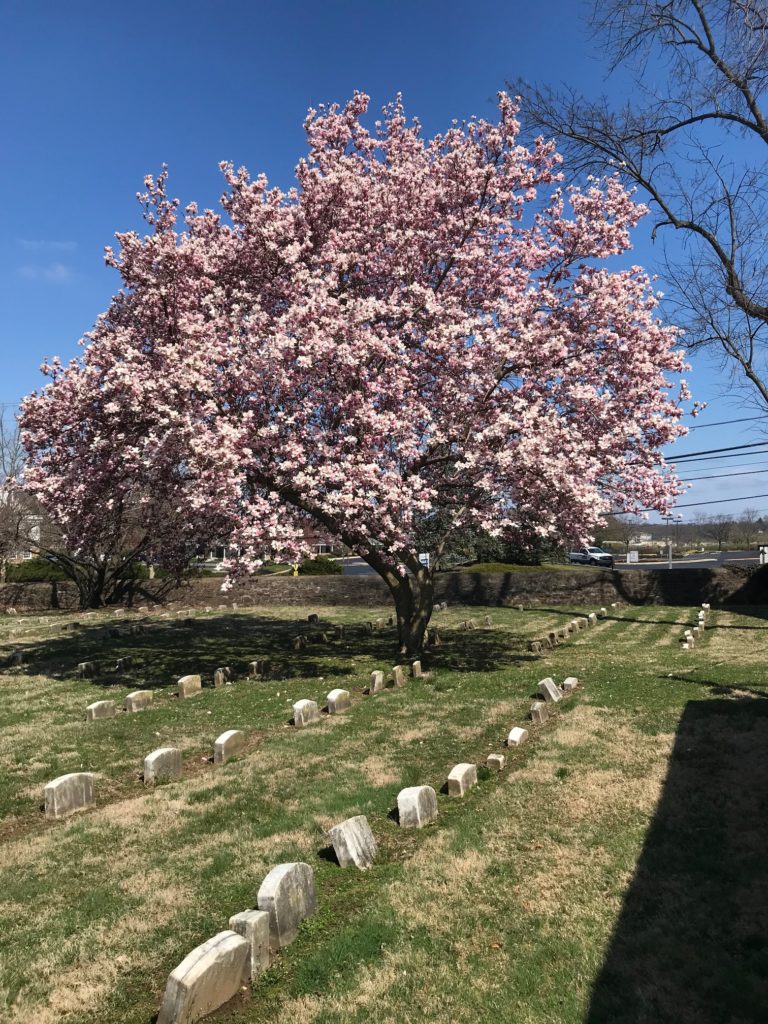
My son Walker went to a Quaker school outside of Philadelphia for 2nd through 4th grades, Plymouth Meeting Friends School. For Poetry Month on April 27, 2011, I came to his class at the invitation of his primary teacher, Debbie Bakan, to explore writing poetry in the graveyard on the campus. The students were instructed to observe, take notes, and write poems. I did too.
I was recently reminded of the poem I wrote that morning, “The Quaker Graveyard in Plymouth Meeting,” which I sent to Debbie and her assistant Liz, so they could share it with the students when they read their own poems in class later that week. Looking at the original, I note that, while I later removed a superfluous couplet that sat like a sore thumb between the two six-line stanzas, the rest remains exactly as it was written—or perhaps dictated to me by spirits—in the graveyard.
The title and epigraph are a nod to a famous poem by Robert Lowell, “The Quaker Graveyard in Nantucket,” which was written in the memory of Lowell’s cousin Warren Winslow, who died at sea during World War II. Here is my poem, “The Quaker Graveyard in Plymouth Meeting,” which appears in my book Wine-Dark Sea: New & Selected Poems & Translations:
The Quaker Graveyard in Plymouth Meeting
“The Lord survives the rainbow of His will.” – Robert Lowell
A field of marble and granite boulders,

Grave markers of long dead Friends;

Their stones sunk in the ground or sinking,

Becoming one with the earth—

“Coulston,” “Skeen,” and “Livesey”;

“Tomlinson,” “Webster,” and “Foulke.”


My eye is caught by a pinwheel spinning

Propped up by a fresh-cut stone:

The grave of a toddler, named

For a tree that weeps.

Her gifts too early left this Earth;

Her body returned too soon.


(in memory of “Willow Ann Donaldson, Aug 5, 2007-Dec 27, 2008”)
–Scott Edward Anderson
27 April 2011
PMFS grounds
For Debbie & Liz’s class
Last weekend, Samantha and I returned to Block Island for the first time in fourteen years. The last visit was a threshold moment — I was about to step into a big new role with Ernst & Young’s Cleantech Group. This time, we were marking Samantha’s turn: on Monday, she’ll become the new Executive Director of the Nonprofit Center of the Berkshires.
Block Island was the first island we ever visited together and, as always, there’s something about being surrounded by water — the sound of the sea, the weather doing whatever it wants — that resets something deep within you. We needed it. We were also on an island that meant a lot to her father, who passed away 25 years ago on April 16th, so we were feeling his presence as well. (I wrote a poem on that date in 2013, referring back to the 10th anniversary of his passing, which you can read here.)
We didn’t know there was a poetry festival happening on the island until we overheard a fellow B&B guest mention it on Thursday afternoon. That’s how we found ourselves, last Friday, walking into the Island Free Library to hear Rhode Island’s Poet Laureate, Colin Channer, read. I didn’t know his work before that afternoon. I’m so glad I do now.
Channer is a natural in front of an audience — a storyteller as much as a poet, with a presence that makes you feel like the poem is being invented as he’s reading it. He teaches at Brown University, but we learned he’s spent time in our corner of the world too: he was a resident at the Amy Clampitt house in Lenox and used to frequent No. 6 Depot, our local coffee shop in West Stockbridge. (He even name-checks the Berkshires and Melville’s house, Arrowhead, in the poem below — Arrowhead, where I led a workshop a couple of years ago, and where Melville looked out at Greylock and saw the shape of a whale.) The world keeps folding back on itself.
Born in Jamaica in 1963 and educated there and at Hunter College in New York, Channer has published ten books, including two poetry collections: Console (Farrar, Straus and Giroux, 2023), a finalist for the New England Book Award and shortlisted for the PEN/Voelcker Award, and Providential (Akashic Books/Peepal Tree, 2015), shortlisted for the OCM Bocas Prize for Caribbean Literature. He read from both on Friday.
The poem I’m sharing, “Spumante,” begins with a beached whale, encountered on a foggy winter walk before daybreak, glimpsed first as a distant shape and then, as the speaker draws closer, as something that cracks him open. The whale becomes a portal: into grief, into Blackness and the history of the hunted, into music, into a kind of love of which the speaker didn’t know he was capable.
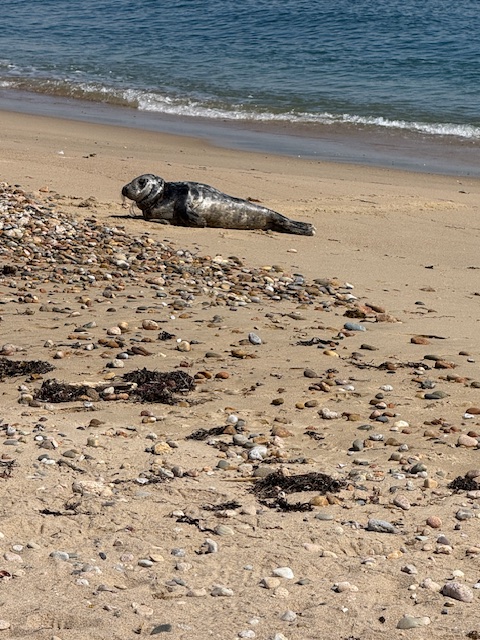
We had our own encounter with a stranded sea creature that weekend. Walking along the shore out near the North Light, we came across a juvenile gray seal tangled in fishing netting, the line wrapped tight around its neck — alive, but struggling. We called Mystic Aquarium across the Sound, who alerted the Block Island Maritime Institute, and a rescue team was mobilized.
Back out there the following day, we stumbled across the crew loading the crated seal into a truck for transport to Mystic. I won’t pretend that didn’t feel a little miraculous. The seal has since been disentangled, treated for infection, and is reported to be — and we love this — “very sassy.” Reading “Spumante” again after that weekend, the line “I know what it’s like to be mammal” hits differently.
Here is Colin Channer’s poem, “Spumante”:
Weeks diffuse into each other like
they’re sprayed; jetted, they shoot certain:
days, times, doodles, kept appointments,
next is lull, pool, fading, flash-disperse.
I was shook and shocked by death,
chanced upon it on a winter walk,
proof of plod for miles behind me
swept in fog, a wet so thick
it blended with the snow that
settled plenty on the sand. It
was not yet daybreak, and I’d driven
miles to walk and think,
find peace in sweat and sea racket,
that ancient wise asthmatic sound.
The light took its lazy time for lifting.
In the shift I saw a darker shaping
than the gray—at two miles a boat
of some proportion, at quarter mile a whale.
Since then I’ve been lamenting,
moving as if held in gel.
At night I dream it, see it stretched
across the wrack of high tide,
belly to the stars—flung shells and gravel—
throat-part grooved, fins unflappable,
balletic flukes symmetric
in their pointing, how they fused:
all this in half-light, all this in sea dirge,
wet air matte, toned silver,
and I hunched in the hood of my parka,
God-awed before shavasana,
stilled as if the glassy eye that looked to me
had fixed me in a century of tintype.
Ah-gah-pay. I’ve only recently discovered
love of animals—well, Killy, Nan, and Rebus,
three dogs. Now I’ve partly taken leave
of language, have given incoherence due.
I know what it’s like to be mammal
filled with deepest ocean sounds:
oblivion, solitude, stillness
intermitted by quake roar,
tectonic slipping, lava fissures,
ship propellers drilling,
the human croons of whales.
There is slave in me, fat heritage,
no fluke I’m invested with hurt,
echo of the hunted, located, natural
rights redacted, meagered to resource.
All is flux as I’m collapsing
love and distance, moving through the gel,
my life, edging the canals of my city,
clomping up its hills, memory aerosol,
head in self cloud, getting Melville
as I should have, watching at him
contemplate the vista from a landlocked house,
hills becoming pods of transmigrating giants:
Greylock. Berkshire range.
There’s thirst for music in this less than solid
state. Ampless back in my office,
I knee-prop my Fender, ancient black thing.
Strum it casual, weep;
suck salt in darkness, fingers guessy,
lazing up the sound. Still, something
brusque runs up me: shuddered
wood, that deep flesh shook
that makes string music fuse to you.
The thumbing further breaks the thing in me.
I know what now love is,
know tentative for sure its
incoherence, jelly analog, is mine for life.
The windows stay black and phlegmatic
as the air outside begins to heave with rain.
I hum, thumbing, fashion something of a home,
some succor, pulse quick but steady as I deep dive
to dub. With it comes the baleen
wheeze of mouth organs, plangent blue whoop.
I am dub and dub is water.
Exile, I wish you could have lived in me,
plunging, life spumante. I’d slip my hold
on you like magma shot for islands
every single time you breach.
—Colin Channer
Here’s a link to this poem as it appeared in the New Yorker, including a recorded reading by the author: “Spumante”.
The poem appears in his collection Console.
Copyright © 2020 by Colin Channer.
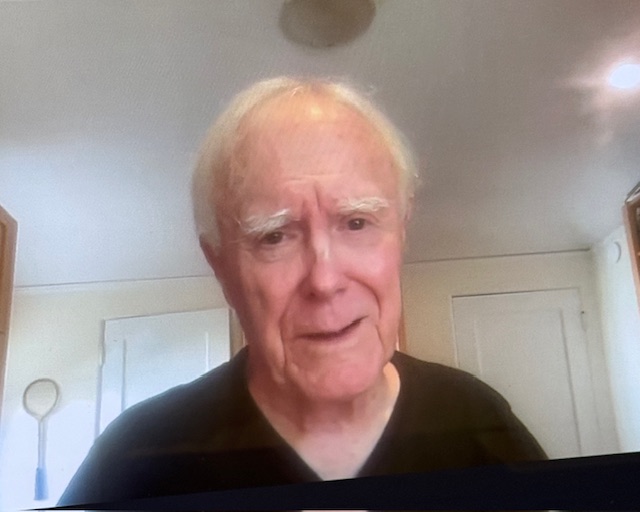
Last night, we watched poet Robert Hass in conversation with John Freeman and Jesse Nathan as part of Alta Journal’s California Book Club. They were discussing Hass’s second book of poetry, Praise (1979), which was also the first book of his that I picked up a long, long time ago.
As I’ve written elsewhere, his work is discursive and familiar, philosophical and grounded in the natural world. Reading a Hass poem is like having a conversation with the poet. He also possesses an amazing ability to conjure and recite poems from memory.
Once, at the Dodge Poetry Festival in New Jersey, I heard him offer up—as if from thin air —half a dozen haiku by Basho, Issa, Buson, and others. His knowledge of poetry and poetic form is virtually unparalleled among contemporary American poets, which is likely the reason he was chosen as U.S. Poet Laureate for two consecutive terms starting in 1995, and why he later won a MacArthur Foundation “genius” grant.
Thirty years ago, during his first term as Laureate, he started the column “Poet’s Choice,” at The Washington Post, which inspired this annual National Poetry Month exercise from me a year later.
I also had the pleasure of studying with Hass, at a pivotal time for my poetry, in a program run by the Community of Writers—again, a long, long time ago.
At the time, Hass pointed out that I was writing in two completely different styles, a formal work that used more archaic diction and syntax, and a simpler more direct, more colloquial style. He said that I wrote in both equally well, but that it might be time to choose between the two. “Or not,” he offered, like a Zen master wanting to leave the decision up to me.
I chose the path more plain spoken and it made all the difference. All these years later, I have much to be thankful for from his advice.
We also had a funny exchange—I wonder if he remembers it that way, if he remembers it at all—when I asked him whether I should pursue an MFA.
“That depends upon whether you want to teach,” he answered.
“Oh, I don’t think you can teach poetry,” I said, rather cheekily. He had been doing that very thing for 20 years by then, I realized later.
“Then you should go out and experience the world,” he responded, without missing a beat. “You’ll have more to write about.” I followed his advice.
One more Bob Hass memory, before I share one of his poems. I’ve written about this in more detail here. When my son Walker was 6, he started having an interest in writing poems. Bob was giving a program at Poets House in New York and I took Walker, who brought one of his poems to give to Bob. Bob read Walker’s poem and said, “This is a real poem!” Walker beamed. Bob read it aloud during his talk, which seemed to bring everything full circle.
“Meditation at Lagunitas,” from his book Praise, has become a kind of signature poem in his oeuvre—indeed, I saw many comments during the livestream that this poem changed lives.
Here is Robert Hass’s “Meditation at Lagunitas”:
All the new thinking is about loss.
In this it resembles all the old thinking.
The idea, for example, that each particular erases
the luminous clarity of a general idea. That the clown-
faced woodpecker probing the dead sculpted trunk
of that black birch is, by his presence,
some tragic falling off from a first world
of undivided light. Or the other notion that,
because there is in this world no one thing
to which the bramble of blackberry corresponds,
a word is elegy to what it signifies.
We talked about it late last night and in the voice
of my friend, there was a thin wire of grief, a tone
almost querulous. After a while I understood that,
talking this way, everything dissolves: justice,
pine, hair, woman, you and I. There was a woman
I made love to and I remembered how, holding
her small shoulders in my hands sometimes,
I felt a violent wonder at her presence
like a thirst for salt, for my childhood river
with its island willows, silly music from the pleasure boat,
muddy places where we caught the little orange-silver fish
called pumpkinseed. It hardly had to do with her.
Longing, we say, because desire is full
of endless distances. I must have been the same to her.
But I remember so much, the way her hands dismantled bread,
the thing her father said that hurt her, what
she dreamed. There are moments when the body is as numinous
as words, days that are the good flesh continuing.
Such tenderness, those afternoons and evenings,
saying blackberry, blackberry, blackberry.
—Robert Hass
National Poetry Month 2026, Week Two: Patricia Smith’s “Annie Pearl Smith Discovers Moonlight”
April 10, 2026
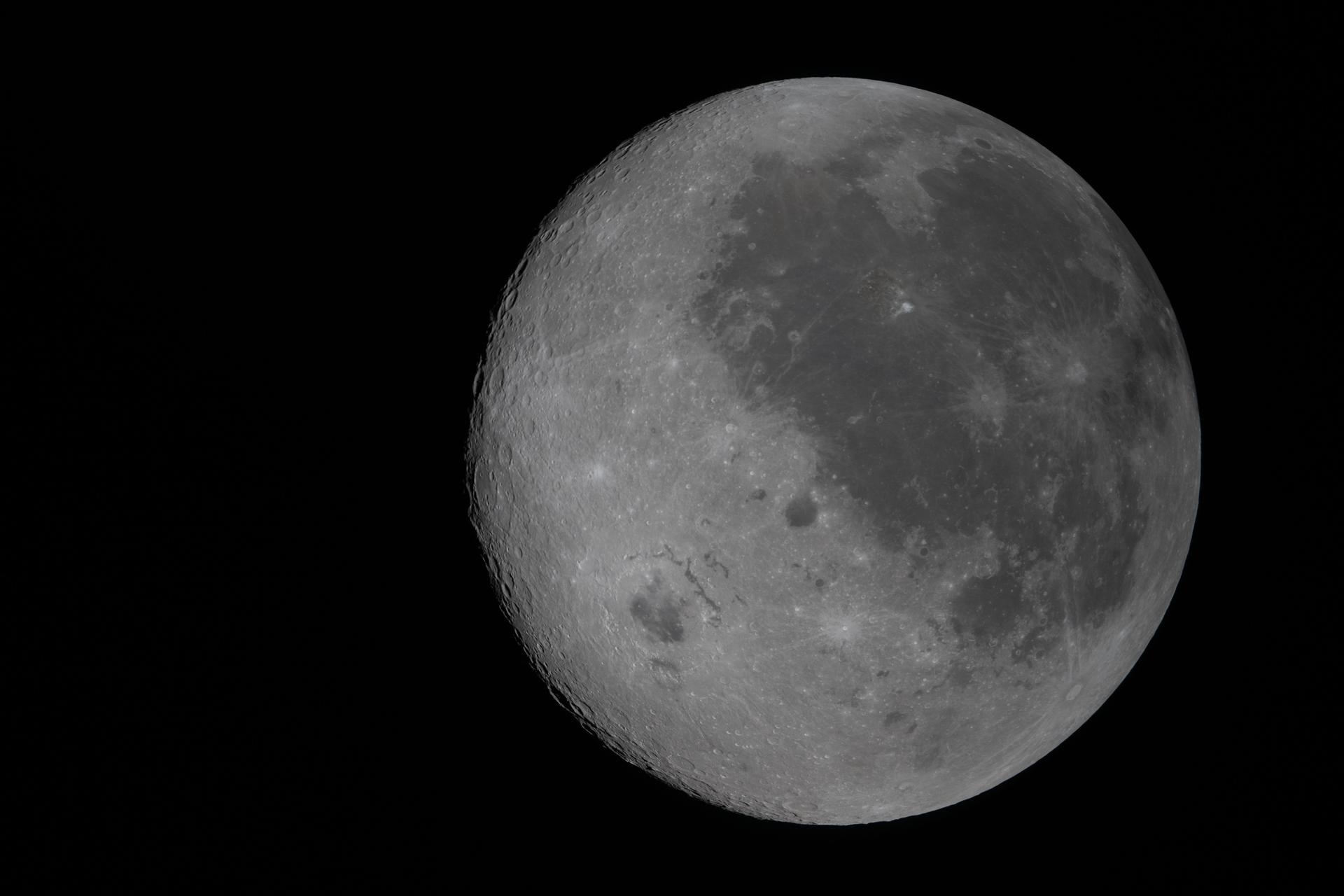
This week, for the first time in more than fifty years, human beings flew around the moon. NASA’s Artemis II crew—Reid Wiseman, Victor Glover, Christina Koch, and Jeremy Hansen—completed a historic lunar flyby on April 6, setting a new record for the farthest distance from Earth any human has ever traveled. Tonight, they will return to Earth, with splashdown scheduled for 8:07 PM ET.
During their pass around the far side, the astronauts photographed surface features rarely or never seen by human eyes, with shadows stretching across crater rims in ways that reveal depth and texture invisible under full illumination. The images they sent back are extraordinary. And yet, even now, even with all of it—the high resolution, the data, the technology that Apollo could not have imagined—the moon retains something that resists explanation. Some quality of wonder that better pictures only deepen.
I’ve been thinking about that wonder all week, and of this poem by Patricia Smith, which is about her mother, the moon, and so much more. Smith is one of the most important poets working in America today. Her most recent collection, The Intentions of Thunder: New and Selected Poems (Scribner, 2025), won the 2025 National Book Award for Poetry. She is a recipient of the Ruth Lilly Poetry Prize for Lifetime Achievement, a Guggenheim fellow, an inductee of the American Academy of Arts & Sciences, and a four-time individual champion of the National Poetry Slam.
Smith’s work has always moved between the intimate and the historical, between the body and the world, finding in one the precise shape of the other. “Annie Pearl Smith Discovers Moonlight” does something equally, quietly devastating: it inhabits the perspective of a Black woman in 1969 who doesn’t believe men have landed on the moon.
Her mother, the Annie Pearl of the title, isn’t superstitious or uninformed. She is a woman who has been deceived before, by men, by the country, by the ordinary promises of ordinary life. She worked for twenty years in a candy factory and counted out her dollars—presumably for the collection plate—with the expectation of a heavenly reward. For heaven to be real, she knows, it can’t be touched, named, walked upon. It can’t be the “ten o’clock news.”
What makes the poem so remarkable is that the poet refuses to condescend to Annie Pearl, even as her 13-year-old self, sitting across the dinner table—her foot kicked gently beneath the table by her father to conspire or keep her quiet or both—feels the thrill of the moon landing unraveling inside her. Both women hold something true: the moon is both the cold rock beneath Armstrong’s boot and the luminous, unreachable promise the older woman has been clutching all her life.
That tension, between the empirical and the sacred, between what science can photograph, count, analyze and yet can’t contain, is exactly what I find myself sitting with this week, of all weeks, as new images of the lunar surface arrive, a crater gets named for the late wife of one of the crew, the astronauts head home full of awe, and the moon hangs above us, old and new at once. Like after the original lunar landing, we will never see the moon the same way again.
Here is Patricia Smith’s “Annie Pearl Smith Discovers Moonlight”:
My mother, the sage of Aliceville, Alabama,
didn't believe that men had landed on the moon.
“'They can do anything with cameras,”
she hissed to anyone and everyone who'd listen,
even as moonrock crackled
beneath Neil Armstrong’s puffed boot.
While the gritty film spun and rewound and we
heard the snarled static of “One small step,”
my mother pouted and sniffed
and slammed skillets into the sink.
She was not impressed.
After all, it was 1969, a year fat with deceit.
So many miracles
had proven mere staging for lesser dramas.

But why this elaborate prank
staged in a desert “somewhere out west,”
where she insisted the cosmic gag unfolded?
“'They are trying to fool us.”
No one argued, since she seemed near tears,
remembering the nervy deceptions of her own skin—
mirrors that swallowed too much,
men who blessed her with touch only as warning.
A woman reduced to juices, sensation and ritual,
my mother saw the stars only as signals for sleep.
She had already been promised the moon.

And heaven too. Somewhere above her head
she imagined bubble-cheeked cherubs
lining the one and only road to salvation,
angels with porcelain faces and celestial choirs
wailing gospel brown enough to warp the seams of paradise.
But for heaven to be real, it could not be kissed,
explored,
strolled upon
or crumbled in the hands of living men.
It could not be the 10 o’clock news,
the story above the fold,
the breathless garble of a radio “special report.”

My mother had twisted her tired body into prayerful knots,
worked twenty years in a candy factory,
dipping wrinkled hands into vats of lumpy chocolate,
and counted out dollars with her thin, doubled vision,
so that a heavenly seat would be plumped for her coming.
Now the moon,
the promised land’s brightest bauble,
crunched plainer than sidewalk beneath ordinary feet.
And her Lord just lettin’ it happen.

“Ain’t nobody mentioned God in all this,” she muttered
over a hurried dinner of steamed collards and cornbread.
“That’s how I know they ain’t up there.
Them stars, them planets ain’t ours to mess with.
The Lord woulda showed Hisself if them men
done punched a hole in my heaven.”
Daddy kicked my foot beneath the table;
we nodded, we chewed, we swallowed.
Inside me, thrill unraveled;
I imagined my foot touching down on the jagged rock,
blessings moving like white light through my veins.

Annie Pearl Smith rose from sleep that night
and tilted her face full toward a violated paradise.
My father told me how she whispered in tongues,
how she ached for a sign
she wouldn’t have to die to believe.

Now I watch her clicking like a clock toward deliverance,
and I tell her that heaven still glows wide and righteous
with a place waiting just for her,
fashioned long ago by that lumbering dance
of feet both human and holy.
—
Patricia Smith’s “Annie Pearl Smith Discovers Moonlight” originally appeared in AGNI 36 (1992) and in Big Towns, Big Talk (Zoland Books, 1992); and, most recently, in The Intentions of Thunder: New and Selected Poems (Scribner Poetry, 2025).
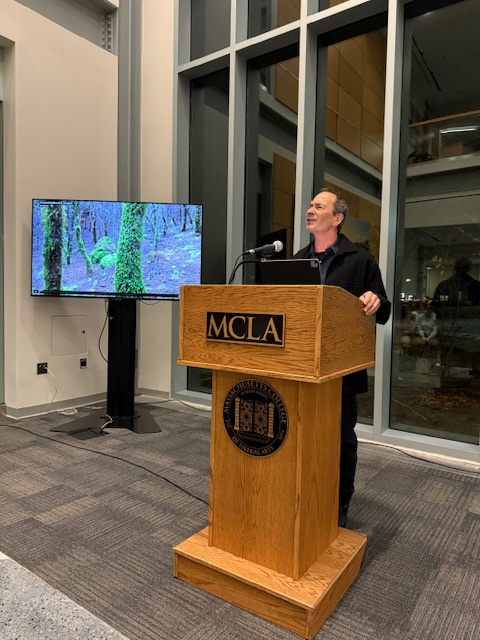
I wrote a profile of poet Forrest Gander for Berkshire Magazine back in the Fall of 2024, when he was visiting poet at MCLA in North Adams, MA. I’ve been personally and deeply engaged with Forrest’s poetry and nonfiction since his first book, Rush to the Lake, came out from Alice James Books in 1988. And I thoroughly enjoyed spending some concentrated time with his body of work, along with his latest book, Mojave Ghost: A Novel Poem, which New Directions published that year, in preparation for the article.
“The basic gesture of my writing is a listening,” poet Forrest Gander has written. “The great capacity of language is to bring us into proximity with one another.”
In Mojave Ghost, Gander is listening hard: to the desert, to the dead, and to the layered silences between. More sentence-based and more nakedly elegiac than anything he has published before, the book traces a movement from Arkansas into California, and along the San Andrea Fault, following geological and personal fault lines simultaneously.
Gander was born in 1956 in Barstow, in the Mojave Desert itself. His mother talked about the desert often, and he didn’t return until after she was gone. Her stories about Rainbow Basin, the fossils she collected there, and the landscape she loved, run through the book like an underground current. So does grief for his partner of 35 years, the poet C.D. Wright, who died suddenly in 2016. In Mojave Ghost, the pronouns slip and the addressee shifts; it may be his late mother, his late partner, or Ashwini Bhat, the sculptor he married in 2020. “Science tells us that although we may feel ourselves as a unified, authentic self, we’re actually a collaboration of conflicting voices,” Gander told me in an interview. “That’s something I’ve come to intuitively feel.”
What holds it all together is the landscape and what landscape does to time. While hiking along the San Andreas, Gander realized that looking at the terrain around him, he was also seeing past and present at once. “Those two conflations of past and present — of the personal and the geological — form the currents in Mojave Ghost.”
Memory has long been active in his work. In the new book, he asks:
Is it odd that what we remember
is confined so often to particular moments
like still images ripped from a film?
“My memory of my late mother’s face can be more real for me, more exact, more present even than the face of someone I’m talking with now,” he says. “In our minds, whatever had once been possible can be so again.”
Asked what he hopes readers take away from his poetry, Gander offers something close to a credo: “Thought-feeling. Feeling-thought. Western culture divides feeling from thought, but there are single words in Chinese and Japanese for heart/mind.” He agrees with Ezra Pound that “only emotion endures.”
“No one cares about how much money some investor made in 600 BCE, but we do care about even the small fragments of Sappho’s poems,” Gander says. “That’s about as much of a miracle as the world offers us.”
The following section from Mojave Ghost is shared with the author’s permission:
Because the tree line opens contours of meanings
other than the ones for which we’re prepared,
we treat it with suspicion.
When he smiled and shook his head no, his face
connoted the presumption that you and I live in a different world.
He took us in like the scent of a dead animal.
But how to sustain attentiveness? How to keep
the mind from dropping its needle
into the worn grooves of association?
My art, you said in passing, is nothing much
more than the discipline of an embodied life.
Articulating nuance. The delicate
palette. You paint details
with a tiny brush you made yourself
of hair plucked from your forearm.
They distrust me, you said, because
they can tell I prefer my work to their own.
Which is when I tucked a red anemone
under your pillow to bring you good dreams. What
else did you say?
Fair enough. It is a marriage of equals and without degree.
Your trace on me
like rope marks on the well’s mouth.
Here, have a thought.
As for our misfit status: as Brecht observed,
the palace of canonical culture is built on—
Not to interpret. To feel life course through you.
—Forrest Gander, from Mojave Ghost
Here’s a link to my Berkshire Magazine profile: Forrest Gander
 Scott Edward Anderson
