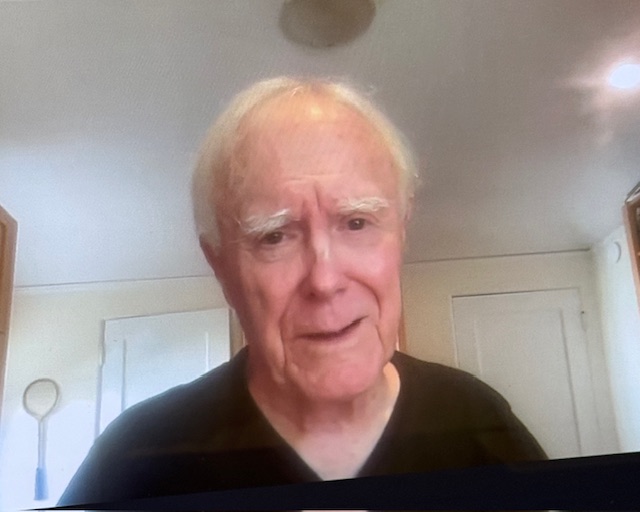
Last night, we watched poet Robert Hass in conversation with John Freeman and Jesse Nathan as part of Alta Journal’s California Book Club. They were discussing Hass’s second book of poetry, Praise (1979), which was also the first book of his that I picked up a long, long time ago.
As I’ve written elsewhere, his work is discursive and familiar, philosophical and grounded in the natural world. Reading a Hass poem is like having a conversation with the poet. He also possesses an amazing ability to conjure and recite poems from memory.
Once, at the Dodge Poetry Festival in New Jersey, I heard him offer up—as if from thin air —half a dozen haiku by Basho, Issa, Buson, and others. His knowledge of poetry and poetic form is virtually unparalleled among contemporary American poets, which is likely the reason he was chosen as U.S. Poet Laureate for two consecutive terms starting in 1995, and why he later won a MacArthur Foundation “genius” grant.
Thirty years ago, during his first term as Laureate, he started the column “Poet’s Choice,” at The Washington Post, which inspired this annual National Poetry Month exercise from me a year later.
I also had the pleasure of studying with Hass, at a pivotal time for my poetry, in a program run by the Community of Writers—again, a long, long time ago.
At the time, Hass pointed out that I was writing in two completely different styles, a formal work that used more archaic diction and syntax, and a simpler more direct, more colloquial style. He said that I wrote in both equally well, but that it might be time to choose between the two. “Or not,” he offered, like a Zen master wanting to leave the decision up to me.
I chose the path more plain spoken and it made all the difference. All these years later, I have much to be thankful for from his advice.
We also had a funny exchange—I wonder if he remembers it that way, if he remembers it at all—when I asked him whether I should pursue an MFA.
“That depends upon whether you want to teach,” he answered.
“Oh, I don’t think you can teach poetry,” I said, rather cheekily. He had been doing that very thing for 20 years by then, I realized later.
“Then you should go out and experience the world,” he responded, without missing a beat. “You’ll have more to write about.” I followed his advice.
One more Bob Hass memory, before I share one of his poems. I’ve written about this in more detail here. When my son Walker was 6, he started having an interest in writing poems. Bob was giving a program at Poets House in New York and I took Walker, who brought one of his poems to give to Bob. Bob read Walker’s poem and said, “This is a real poem!” Walker beamed. Bob read it aloud during his talk, which seemed to bring everything full circle.
“Meditation at Lagunitas,” from his book Praise, has become a kind of signature poem in his oeuvre—indeed, I saw many comments during the livestream that this poem changed lives.
Here is Robert Hass’s “Meditation at Lagunitas”:
All the new thinking is about loss.
In this it resembles all the old thinking.
The idea, for example, that each particular erases
the luminous clarity of a general idea. That the clown-
faced woodpecker probing the dead sculpted trunk
of that black birch is, by his presence,
some tragic falling off from a first world
of undivided light. Or the other notion that,
because there is in this world no one thing
to which the bramble of blackberry corresponds,
a word is elegy to what it signifies.
We talked about it late last night and in the voice
of my friend, there was a thin wire of grief, a tone
almost querulous. After a while I understood that,
talking this way, everything dissolves: justice,
pine, hair, woman, you and I. There was a woman
I made love to and I remembered how, holding
her small shoulders in my hands sometimes,
I felt a violent wonder at her presence
like a thirst for salt, for my childhood river
with its island willows, silly music from the pleasure boat,
muddy places where we caught the little orange-silver fish
called pumpkinseed. It hardly had to do with her.
Longing, we say, because desire is full
of endless distances. I must have been the same to her.
But I remember so much, the way her hands dismantled bread,
the thing her father said that hurt her, what
she dreamed. There are moments when the body is as numinous
as words, days that are the good flesh continuing.
Such tenderness, those afternoons and evenings,
saying blackberry, blackberry, blackberry.
—Robert Hass
 Scott Edward Anderson
