National Poetry Month 2026, Week Four: “Spumante” by Colin Channer
April 24, 2026
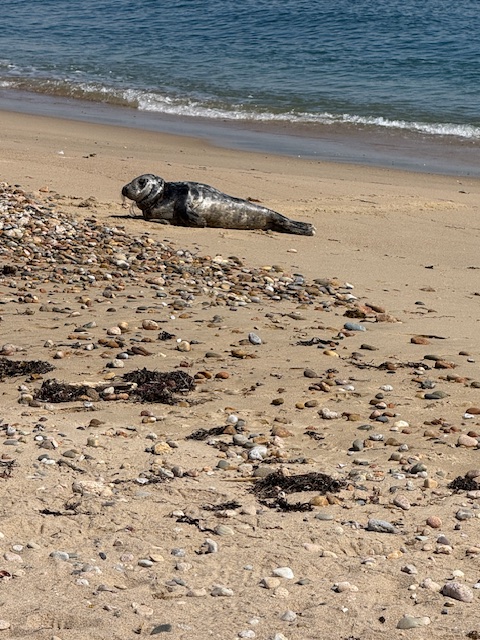
Last weekend, Samantha and I returned to Block Island for the first time in fourteen years. The last visit was a threshold moment — I was about to step into a big new role with Ernst & Young’s Cleantech Group. This time, we were marking Samantha’s turn: on Monday, she’ll become the new Executive Director of the Nonprofit Center of the Berkshires.
Block Island was the first island we ever visited together and, as always, there’s something about being surrounded by water — the sound of the sea, the weather doing whatever it wants — that resets something deep within you. We needed it. We were also on an island that meant a lot to her father, who passed away 25 years ago on April 16th, so we were feeling his presence as well. (I wrote a poem on that date in 2013, referring back to the 10th anniversary of his passing, which you can read here.)
We didn’t know there was a poetry festival happening on the island until we overheard a fellow B&B guest mention it on Thursday afternoon. That’s how we found ourselves, last Friday, walking into the Island Free Library to hear Rhode Island’s Poet Laureate, Colin Channer, read. I didn’t know his work before that afternoon. I’m so glad I do now.
Channer is a natural in front of an audience — a storyteller as much as a poet, with a presence that makes you feel like the poem is being invented as he’s reading it. He teaches at Brown University, but we learned he’s spent time in our corner of the world too: he was a resident at the Amy Clampitt house in Lenox and used to frequent No. 6 Depot, our local coffee shop in West Stockbridge. (He even name-checks the Berkshires and Melville’s house, Arrowhead, in the poem below — Arrowhead, where I led a workshop a couple of years ago, and where Melville looked out at Greylock and saw the shape of a whale.) The world keeps folding back on itself.
Born in Jamaica in 1963 and educated there and at Hunter College in New York, Channer has published ten books, including two poetry collections: Console (Farrar, Straus and Giroux, 2023), a finalist for the New England Book Award and shortlisted for the PEN/Voelcker Award, and Providential (Akashic Books/Peepal Tree, 2015), shortlisted for the OCM Bocas Prize for Caribbean Literature. He read from both on Friday.
The poem I’m sharing, “Spumante,” begins with a beached whale, encountered on a foggy winter walk before daybreak, glimpsed first as a distant shape and then, as the speaker draws closer, as something that cracks him open. The whale becomes a portal: into grief, into Blackness and the history of the hunted, into music, into a kind of love of which the speaker didn’t know he was capable.
We had our own encounter with a stranded sea creature that weekend. Walking along the shore out near the North Light, we came across a juvenile gray seal tangled in fishing netting, the line wrapped tight around its neck — alive, but struggling. We called Mystic Aquarium across the Sound, who alerted the Block Island Maritime Institute, and a rescue team was mobilized.
Back out there the following day, we stumbled across the crew loading the crated seal into a truck for transport to Mystic. I won’t pretend that didn’t feel a little miraculous. The seal has since been disentangled, treated for infection, and is reported to be — and we love this — “very sassy.” Reading “Spumante” again after that weekend, the line “I know what it’s like to be mammal” hits differently.
Here is Colin Channer’s poem, “Spumante”:
Weeks diffuse into each other like
they’re sprayed; jetted, they shoot certain:
days, times, doodles, kept appointments,
next is lull, pool, fading, flash-disperse.
I was shook and shocked by death,
chanced upon it on a winter walk,
proof of plod for miles behind me
swept in fog, a wet so thick
it blended with the snow that
settled plenty on the sand. It
was not yet daybreak, and I’d driven
miles to walk and think,
find peace in sweat and sea racket,
that ancient wise asthmatic sound.
The light took its lazy time for lifting.
In the shift I saw a darker shaping
than the gray—at two miles a boat
of some proportion, at quarter mile a whale.
Since then I’ve been lamenting,
moving as if held in gel.
At night I dream it, see it stretched
across the wrack of high tide,
belly to the stars—flung shells and gravel—
throat-part grooved, fins unflappable,
balletic flukes symmetric
in their pointing, how they fused:
all this in half-light, all this in sea dirge,
wet air matte, toned silver,
and I hunched in the hood of my parka,
God-awed before shavasana,
stilled as if the glassy eye that looked to me
had fixed me in a century of tintype.
Ah-gah-pay. I’ve only recently discovered
love of animals—well, Killy, Nan, and Rebus,
three dogs. Now I’ve partly taken leave
of language, have given incoherence due.
I know what it’s like to be mammal
filled with deepest ocean sounds:
oblivion, solitude, stillness
intermitted by quake roar,
tectonic slipping, lava fissures,
ship propellers drilling,
the human croons of whales.
There is slave in me, fat heritage,
no fluke I’m invested with hurt,
echo of the hunted, located, natural
rights redacted, meagered to resource.
All is flux as I’m collapsing
love and distance, moving through the gel,
my life, edging the canals of my city,
clomping up its hills, memory aerosol,
head in self cloud, getting Melville
as I should have, watching at him
contemplate the vista from a landlocked house,
hills becoming pods of transmigrating giants:
Greylock. Berkshire range.
There’s thirst for music in this less than solid
state. Ampless back in my office,
I knee-prop my Fender, ancient black thing.
Strum it casual, weep;
suck salt in darkness, fingers guessy,
lazing up the sound. Still, something
brusque runs up me: shuddered
wood, that deep flesh shook
that makes string music fuse to you.
The thumbing further breaks the thing in me.
I know what now love is,
know tentative for sure its
incoherence, jelly analog, is mine for life.
The windows stay black and phlegmatic
as the air outside begins to heave with rain.
I hum, thumbing, fashion something of a home,
some succor, pulse quick but steady as I deep dive
to dub. With it comes the baleen
wheeze of mouth organs, plangent blue whoop.
I am dub and dub is water.
Exile, I wish you could have lived in me,
plunging, life spumante. I’d slip my hold
on you like magma shot for islands
every single time you breach.
—Colin Channer
Here’s a link to this poem as it appeared in the New Yorker, including a recorded reading by the author: “Spumante”.
The poem appears in his collection Console.
Copyright © 2020 by Colin Channer.
 Scott Edward Anderson
