My Year in Writing 2025
November 29, 2025
This is the time of year—between my birthday and year’s end—when I take stock of my writing life over the past 12 months. A trend that’s continued this year: I’ve continue to be very Berkshire-focused as we approach the fourth anniversary of our move up here. As I told one of my students at Berkshire Community College this semester, where I’ve been teaching Principles of Marketing, filling in for a professor on her sabbatical, “This is my time to give back and go hyperlocal…”
I’ve also continued to write for Berkshire Magazine—eighteen in total and sometimes as many as 4-5 articles per issue (!), causing me to joke with my editor, Anastasia Stanmeyer, “Do you have any other writers?” In addition to having the cover story in one issue this year, Anastasia generously wrote about me in her editor’s note in the Fall issue accompanied by this photo.

I’m still shopping around my book of essays, The Others in Me: On the Azores & Ancestry, Poetry & Identity, and am building a new series of essays about life on our little beaver pond in the Berkshires, which I’m calling “To Learn Attention: Encounters in the Anthropocene Backyard,” several of which were published earlier this year.
While we didn’t get to the Azores for the second year in a row—something I hope to remedy in 2026—we had a wonderfully inspiring trip to Paris in late March-early April. Overall, it’s been a productive year. Here are some of the highlights:
“A Modern Log Cabin: Industrial Chic Meets Rustic Warmth,” in Berkshire Magazine, Spring 2025
“Betting Big on the Outdoors: Paul Jahinge Leads the State’s Outdoor Recreation Vision” (profile), in Berkshire Magazine, Spring 2025
“Matt Rubiner: An Unconventional Path to Cheese Mastery” (Q&A) in Culture: The word on cheese, Spring 2025
“Ancestral Echoes: Exploring Aracelis Girmay’s An Experiment in Voices,” in Berkshire Magazine, May-June 2025
“Poetic Sweat: Bill T. Jones and His Company Return to Jacob’s Pillow” (profile), in Berkshire Magazine, May-June 2025
Attended MAPS’ Psychedelic Science Conference in Denver, CO, reporting on several future stories and features. (June)
“My Wife Gave Me Magic Mushrooms For My 60th Birthday. It Transformed My Life In Ways I Never Expected,” HuffPost, June 2025 (The response to this piece was absolutely amazing. My editor at HuffPost wrote that something like 250,000 people read it the first weekend it was published, with “an average read time of 2:46 minutes (the site average for a story is 0:40, so to get folks to stay on your piece for close to three minutes is AMAZING and means that most people read all the way through… a huge feat in today’s ‘click in and click out’ digital world).” I heard from people all over the country: people who needed to hear the message of my tory and who now have hope that there’s something out there that may be able to help them. I feel especially blessed to have published this piece this year.)
Psychedelic Healing in Practice: A conversation with Scott Edward Anderson on AdvisorShares’ AlphaNooner podcast. (July)

Opinion: Don’t let New Bedford erase its Portuguese soul – “ The proposed closure of Casa da Saudade isn’t just a budget cut, it’s cultural erasure. The library has been the beating heart of Portuguese American identity in one of America’s most Lusophone cities.(Opinion), in New Bedford Light (July)
“A Building That Dances: The Reimagined Doris Duke Theatre Takes Flight,” feature in Berkshire Magazine, July 2025
“A Landmark Farewell: Stephen Petronio in his company’s final bow this summer at Jacob’s Pillow” (Q&A), in Berkshire Magazine, July 2025
“Paul Elie on Literature, Faith, and the Culture of Encounter” (Q&A), in Berkshire Magazine, July 2025
“A Homecoming: Richard Blake Creates Great Barrington’s W.E.B. Du Bois Monument” (profile), in Berkshire Magazine, July 2025
“A Conversation Before the Conversation: A talk with Jayne Anne Phillips ahead of her visit to the Mount” (Q&A), in Berkshire Magazine, July 2025
“Threads of Time: Alvin Ailey American Dance Theater Returns to Jacob’s Pillow After 62 Years” (Cover story), in Berkshire Magazine, August 2025
“The Power of Words: The WIT Literary Festival Returns with a Bold Call for Civic Engagement Through Literature,” in Berkshire Magazine, August 2025
Four essays from “To Learn Attention: Encounters in the Anthropocene Backyard” in La Picciolétta Bárca, August 2025
“From Investment to Impact: Mill Town’s Blueprint for a Stronger Pittsfield and Berkshire County” (feature), in Berkshire Magazine, Fall 2025
“A Recipe for Community: Williams College’s Log Lunch brings people together over food and ideas,” in Berkshire Magazine, Fall 2025
“Making Public Lands Welcome to All: An interview with newly appointed DCR Commissioner Nicole LaChapelle” (Q&A), in Berkshire Magazine, Fall 2025
“Cheesemaking Tradition Meets Innovation in the Azores” (feature) in Culture: The word on cheese, Fall 2025
Featured poet in reading at Hot Plate Brewing Company in Pittsfield, along with Susan Buttenweiser, Anna Lotto, Matthew Zanoni Müller, and Lara Tupper. (September)
“(Take) Home (or Dine In) for the Holidays: Your guide to Thanksgiving Dining in the Berkshires” in Berkshire Magazine, Holiday 2025
“Ice Dreams Really Do Come True: Community, Competition, and Cold Weather Fun in the Berkshires” (feature) in Berkshire Magazine, Holiday 2025
“Giving Back Locally: Supporting Organizations that Strengthen Our Community” in Berkshire Magazine, Holiday 2025
“Driving Community: Berkshire Auto Dealerships are Expanding, Thriving, and Staying True to Their Roots” (feature) in Berkshire Magazine, Holiday 2025
I also started working on a new sequence of poems, “Aquapelagos,” exploring themes of islands as ancestral territories and identity markers. We’ll see where that goes…
And I continued to curate and host the Berkshire Nature Talk Series at West Stockbridge Historical Society. We had four programs this year featuring Nicaela Haig of MassAudubon, Chip Blake on the birds of the Berkshires, Thomas Tyning on reptiles and snakes, and Brian Donohue on building with local forests. The program was funded in part by grants from the Alford-Egremont, Richmond, Stockbridge, and West Stockbridge cultural councils, local agencies which are supported by the Mass Cultural Council, a state agency.
A productive year. Hope to keep getting my fix in 2026!
—SEA

To close National Poetry Month for 2025, I’d like to share a poem I wrote in the tradition of occasional poetry—a form composed to mark a specific moment or honor a particular request. I was honored when my wife Samantha and her co-author Rimi Chakraborty invited me to contribute a poem to their powerful book, Beyond Resilience to Rootsilience. Our friendship with Rimi and her husband João Ferreira began in the Azores several years ago, and since then, I’ve watched with admiration as she and Samantha have brought this work to life and have helped many women leaders deal with burnout, get more grounded, and improve their physical and mental health.
Beyond Resilience to Rootsilience offers a vital reimagining of what it means to lead and live well, especially for women navigating the demands of leadership and life. It speaks to that moment when our bodies tell us we’ve gone too far and how they ask us to listen—and to root. Samantha and Rimi coined the word “rootsilience” (rhyming with resilience) because creating lasting change requires a shift not just in mindset but in language itself. The idea is to be like a tree that is rooted in the ground while it sways in the wind and weather rather than “snapping back” in the face of stress.
Inspired by this vision, my poem draws on the metaphor of trees and the quiet strength found in their networks of connection, adaptation, and mutual support—lessons nature teaches us, if we are willing to listen. Here is my poem, “On Roots and Resilience”:
“On Roots and Resilience”
Trees are not silent sentinels in the forest,
we just can’t hear their communication,
and don’t understand their language.
If we could learn to listen, we might absorb
strength from their interdependence,
their interconnected web in the soil,
tangled up in mycorrhiza,
water and minerals coursing from fungus to roots,
sugars from leaves to fungi,
roots below mirroring branches above,
always ready in their capacity to change,
to adapt, to learn from experience,
to share wisdom and strength
in a mutualistic relationship.
Be like the tree in the forest,
neither silent nor alone,
and not only resilient,
but swaying with the stresses,
and standing in the calm,
connecting your whole self
and your relationship with others,
to your own interdependent web.
Let your interconnected roots
provide your true strength,
from canopy to leaf, branch to trunk, root to rhizome.
— Scott Edward Anderson
You can learn more about Samantha and Rimi’s book here: rootsilience
My Year in Writing 2024
December 9, 2024
This is the time of year—between my birthday and year’s end—when I take stock of my writing life over the past 12 months. A trend I’ve noticed this year is that I’ve become very Berkshire-focused as I approach the third anniversary of our move up here. I see that as a good thing; it means I’m digging into our community more and focusing on what’s closest to me.
I’ve also had the opportunity to explore more magazine writing—features, profiles, and interviews—through my work with Berkshire Magazine, which has allowed me to engage with and write about Michael Pollan, Mark C. Taylor, Camille A. Brown, Forrest Gander, and Ruth Reichl, among others. Thanks, Anastasia Stanmeyer!
And the Azores continues to be a focus—even though we didn’t return to the islands this year for the first time since 2021. We’ll have to change that in 2025! Overall, it’s been a productive year. Here are some of the highlights:
“Seeking My Roots Through a Painter’s Eyes” (essay), in Revista Islenha, Issue 73, in Madeira, Portugal. (January)
Led a writing workshop at Herman Melville’s Arrowhead titled, “Cultivating Deep Attention,” helping participants explore the art of profound concentration and how it can enhance their writing process and equip them with the tools and mindset needed to harness the power of deep attention in their writing journey. Workshop (February)
Launched “Berkshire Nature Talk Series” at West Stockbridge Historical Society with Leila Philip, author of Beaverland, kicking off the program. Featured three more talks throughout the year on birds, bears, and mushrooms. (February)

“A Philosopher’s Secret Garden: Mark C. Taylor and His Landscape of Ideas,” (lecture/presentation), delivered at “After the Human: Thinking for the Future,” UCSB Humanities & Social Change Center (March)
Featured poet at the first annual Poesia: A Celebration of Portuguese Poetry, Culture, & Fall River Poets, presented by Viva Fall River and Newport Poetry, at the Gates of the City, Fall River Heritage State Park, and the Fall River Visitors Center. (April)

“The British Invasion: The Royal Ballet Takes Over Jacob’s Pillow,” (article), Berkshire Magazine (May/June)
“Keep on Trocking: Les Ballets Trockadero de Monte Carlo Kicks Off Jacob’s Pillow 2024 Season,” (article), Berkshire Magazine (May/June)
Creative nonfiction mentor, Adroit Journal Summer Mentorship Program, mentored two students for the third year. (June-July)
“Cathy Park Hong: “On Minor Feelings, and writing poetry & prose,” (Q&A), Berkshire Magazine (July)
“Emily Wilson: On Translating Homer—and his lessons for today,” (Q&A), Berkshire Magazine (July)
“A Philosopher’s Secret Garden: Mark C. Taylor’s Landscape of Ideas,” (profile), Berkshire Magazine (July)
“Storytelling Through Dance: Camille A. Brown’s Vision & Voice,” (profile), Berkshire Magazine (July)
Hosted a Poetry booth at West Stockbridge Zucchini Festival where festival goers wrote “zucchrositc” poems – yes, acrostics using the word zucchini! (August)
“Getting Back to the Garden: Michael Pollan’s Long, Strange Trip,” (profile), Berkshire Magazine (August)
“Jennifer Egan: On The Candy House, storytelling, and genre,” (Q&A), Berkshire Magazine (September)
“Every Meal is a Story: A Peek into Ruth Reichl’s World of Food,” (profile), Berkshire Magazine (September)
“Lenox Rising: A Berkshire Town’s Resilience and Renewal,” (article), Berkshire Magazine (September)
Catalog essay for “NEXUS 2.0.1: Contemporary Landscape Paintings by Paul Paiement,” Ethan Cohen Gallery, NYC, October 10-November 23. (October)
“Prayer House,” (poem), Speaking for Everyone: An Anthology of “We” Poems (October)
“Six Poems by Pedro da Silveira from A ilha e o mundo,” (translations), Gávea-Brown: A Bilingual Journal of Portuguese-North American Letters and Studies, (October)
Featured Author of the Month, Casa da Saudade Branch Library, New Bedford Free Public Library, New Bedford, MA (October)

My poem, “Wanting,” reprinted in Poetry is Bread: The Anthology, edited by Tina Cane, published by Nirala Press, India (October)
“Massachusetts Voter Endorses Ballot Measure #4,” (Op-Ed), Lucid News (November)
“Letter to America: The psychedelic renaissance,” (essay), Terrain.org (November)
“The Power of Listening: Forrest Gander’s Poetry of Memory and Place,” (profile), Berkshire Magazine (November)
“A Massachusetts Voter Reflects on the Failure of Psychedelics Ballot Question 4,” (Op-Ed), Lucid News (December)
“First Impressions of the Açores,” (essay), Gávea-Brown: A Bilingual Journal of Portuguese-North American Letters and Studies (December)
A productive year, indeed—hoping to keep it alive in 2025!
—SEA
“Do You Have a Favorite Piece of Writing That You’ve Written?”
December 12, 2023

This question came to me from Alden Beane, my dog Beverley’s hydrotherapist, and it’s a great one because it got me thinking. (Beverley tore her canine cruciate ligament this past summer and has been swimming with Alden at True Balance Animal Wellness to try to bring back her strength. It’s working!)
While the first answer that sprang to mind is, “The next one I write,” I also think that’s sometimes true, but not always. (The piece I just delivered for the Spring 2024 issue of Berkshire Magazine fits that bill, but more on that later.)
I’m assuming she meant prose, so I’ll stick with that for now (perhaps I’ll do a poetry post another time). A few of my recently published pieces come to mind, as do a few older ones that I use as writing samples when I’m either pitching new pieces or want to share examples with students I’ve mentored. So here, in no particular order, are my favorite pieces of my own writing (so far) prose edition:
“Love & Patience on Mt. Pico” — Published in The Write Launch, this is a very recent essay about an ill-fated attempt to climb Mt. Pico, the tallest peak in Portugal, in the Azores. I owe a big shout-out to Suzanne Roberts for this one, for I started writing it in a travel writing workshop she led in 2020. (Also a big shout-out to my wife Samantha for being the foil in this one and my first reader as well.)
“Birds in the Hand: The Berkshire Bird Observatory’s Impassioned Ben Nickley” — Published last summer in Berkshire Magazine, this was the first profile I did for the magazine and it was also the return to subject matter that means a lot to me–birds and nature. It got me out in the field again with a passionate scientist, which is something I used to do a lot of when I worked for The Nature Conservancy years ago. Thanks to my editor Anastasia Stanmeyer for the assignment!
“Hallelujah! I’m no Genius” — Published in the Schuylkill Valley Journal online, this was one of my first forays into memoir–and I owe the journal’s editor Mark Danowsky a big thanks for doing me the solid of writing to me: “I’ve been thinking about [Malcolm Gladwell’s podcast] Revisionist History’s Hallelujah. (Incredibly good.)…. Do you think you can write about how this construct (Picasso v. Cezanne) applies to approaches to poetic craft?” And then, when that wasn’t exactly what I delivered, for being delighted with the result! (A truncated version of this essay appears as a chapter in my book, Falling Up: A Memoir of Second Chances; if there’s ever a second edition of that book, I want to restore some of what was edited out.)
“Açorianidade and the Radiance of Sensibility” — Published in Barzakh Magazine, this essay from my memoir-in-essays/work-in-progress, The Others in Me, is a deeply personal take on my journey of (re)discovering or uncovering my roots on the Azores and the mixed emotions and complex feelings that surround such a late-in-life discovery. A shout-out to my fellow 2018 Disquiet Azores Retreat attendee, Christy O’Callaghan, for being intrigued enough to publish it in her last issue as editor-in-chief of Barzakh.
“Poetry as Practice: How Paying Attention Helps Us Improve Our Writing in the Age of Distraction” — Grant Clauser, in addition to being a fine poet, edited the craft section of Cleaver Magazine and I wrote to him about this idea before it was finished. While I “knew” what I wanted to write, I struggled with its direction. Grant’s guidance–especially regarding minimizing the quotes and emphasizing my own voice, among other things, greatly improved this piece and proves the old adage that every writer needs an editor.
“Looking Out, Looking In: Gary Snyder and Sourdough Mountain Lookout” — On the tail end of my “Hallelujah!” essay, Schuylkill Valley Journal‘s Mark Danowsky pitched another idea to me. He knew I’d studied with Gary Snyder and he was “wondering if you have insight into his poem ‘Mid-August at Sourdough Mountain Lookout.’ It’s a poem I’ve returned to again and again and I’ve never been able to explain why I think it’s so good (even to myself).” Well, it turns out I did…
Finally, two lectures that I turned into essays need be included in such a list: First, a craft talk called “Making Poems Better: The Process of Revision,” which was originally delivered at the University of Alaska Anchorage for its Writing Rendezvous conference in 1998. Then, in 2018, I updated the lecture and presented a 20th Anniversary edition of the talk at the Boston Book Festival. In that lecture, I discuss the revision process and examine in detail Donald Hall’s “Ox-Cart Man” and my own poem, “Black Angus, Winter.”
Second, the more recent “At Home in the World: A Reading and Reflection on Dwelling, Nature, Phenomenology, and Ecopoetry,” which was originally delivered at the Providence College Humanities Forum in September 2021. Professor Ryan Shea taught a course in environmental philosophy and included my book, Dwelling: an ecopoem, on his syllabus. I spent a week with him and his students discussing my book, which was an amazing experience, especially given the fact that I was born in a hospital just a three-minute drive from the college. Who says you can’t go home again? The lecture was later published as an essay in Brown University’s Gávea-Brown: A Bilingual Journal of Portuguese-North American Letters and Studies.
Thanks to Alden for a great question–and for helping Beverley to heal!
My Year in Writing 2023
December 6, 2023

Now is the time, between my birthday and the end of the year, when I take stock of my year in writing. This year, which culminated my sixtieth trip around the Sun, has been a pretty productive year.
Here are some of the highlights:
Barzakh Magazine accepts essay, “Açorianidade & the Radiance of Sensibility” just after Xmas! (Published in January)
Reading of Berkshire Writers in Housatonic; read the first chapter of Falling Up. (January)
Guest writer @ Margarida Vale de Gato’s Eco-poetics Masters Class, Universidade de Lisboa via Zoom (January)
Alfred Lewis Bilingual Reading Series, FresnoState PBBI(part of the PBBI-FLAD lecture series 2023), Co-curators: Diniz Borges and RoseAngelina Baptista; Poets: Alberto Pereira, Sam Pereira, PaulA Neves, Scott Edward Anderson, and RoseAngelina Baptista (February)
Guest lecturer, Universidade de Lisboa, Professora Margarida Vale de Gatos’ class on American Literature in person. (March)
Guest speaker, Universidade dos Açores, Ponta Delgada, Professora Ana Cristina Gil’s class, in person. (March)
My essay, “STUDIO LOG: THE TOM TOM CLUB’S “GENIUS OF LOVE,” A MEMOIR AND EXPOSITION IN 18 TRACKS,” lost in the 2nd Round of the Marchxness battle of “One Hit Wonders” to Adam O. Davis’ essay on “In a Big Country” by Big Country. (March)
Installation of my poem. “River of Stars,” on Poetry Path at Ryan Observatory at Muddy Run, and presentation with Michele Beyer (a teacher inspired by my conversation with Derek Pitts in November 2022) to write poetry with her class. (April)
Interview by Francisco Cota Fagundes published in Gávea-Brown: A Bilingual Journal of Portuguese-American Letters and Studies, XLVII, as part of a special issue devoted to Celebrating Portuguese Diaspora Literature in North America. (Spring)
Guest lecturer, University of California at Santa Barbara, Portuguese literature class, Professor André Corrêa de Sá. (June)
“Love & Patience on Mt. Pico” (essay) published in The Write Launch (July)
“Through the Gates of My Ancestral Island” (essay) published in Panorama: The Journal of Travel, Place, and Nature (July)
“Orpheu Ascending,” a review of Orpheu Literary Quarterly, volumes 1 and 2, translated from the Portuguese by David Swartz, published in Pessoa Plural—A Journal of Fernando Pessoa Studies, Issue 23 (July)
Seeing—Reading—Writing: Transforming Our Relationship to Language and Nature: A Workshop with Ryan Shea and Scott Edward Anderson at The Nature Institute, Ghent, NY (July)
Creative nonfiction mentor, Adroit Journal Summer Mentorship Program, mentored two students. (July)
“Birds in the Hand: The Berkshire Bird Observatory’s Impassioned Ben Nickley” (article) in Berkshire Magazine. (July)
Poetry booth, “Zucchrostic poems,” at West Stockbridge, MA, Zucchini Festival (August)
Two poems in Into the Azorean Sea: A Bilingual Anthology of Azorean Poetry, translated and organized by Diniz Borges, published by Letras Lavadas in São Miguel and Bruma Publications, Fresno State. (August)
Meet & Greet at The Book Loft in Great Barrington, MA. (Sept)
“Berkshire Brain Gain” (article) published in Berkshire Magazine (Sept)
Dedication of Binocular telescope at Ryan Observatory at Muddy Run and poems by Ada Limón and Gabe Catherman installed on Poetry Path. (October)
Visited Praia da Vitória on Terceira Island, Azores, birthplace and boyhood home of Vitorino Nemésio. (October)
Participated in Arquipélago de Escritores in Angra on Terceira Island. (October)
Met António Manuel Melo Sousa in Ponta Delgada with Pedro Almeida Maia (see related entry below) (October)
Guest lecturer, Fresno State, Professor Diniz Borges’ class on Azorean Literature, presented “Becoming Azorean American: A Diasporic Journey,” (lecture). (October)
“António Melo Sousa, Letras de canções e outros rascunhos – uma apreciação” (review) published in Grotta: Arquipélago de Escritores, #6. (November)
Recorded an episode of “Solo Creatives of the Berkshires” for CTSB-TV, Community Television for the Southern Berkshires, presenting and reading from several of my books. (November)
“Get ‘Hygge’ With It: Cozy Spots and Comfort Food in the Berkshires” (article) published in Berkshire Magazine. (December)
“Seeking My Roots Through a Painter’s Eyes” (essay) published in Revista Islenha, Issue 73, in Madeira, Portugal. (December)
Habitar: um ecopoema, Margarida Vale de Gato’s translation of my book, Dwelling: an ecopoem, gets mention in Paula Perfeito’s Entre-Vistas blog. (27 December)
What a year! I am exceedingly grateful to everyone who has supported my writing over the past year. As Walter Lowenfels wrote, “One reader is a miracle; two, a mass movement.”
Like I said last year, I feel like I’ve been blessed by a mass miracle this year!
Discover the Power of Deep Attention: Seven Reasons to Join the Azores Writing Retreat with Scott Edward Anderson
July 7, 2023

Are you a writer seeking to delve into the depths of your creative well? Are you a would-be writer who has always wanted to write, but could never find the time or discipline? Do you long to cultivate a focused, immersive writing practice that transcends distractions and unlocks your true potential?
If so, we invite you to embark on a life-changing journey to the breathtaking Azores archipelago for a Deep Attention Writing Retreat with the esteemed author Scott Edward Anderson. From 13-18 October 2023, get ready to immerse yourself in an oasis of inspiration, surrounded by stunning natural beauty and the nurturing guidance of an expert wordsmith.
Here are seven reasons why attending this retreat could be the turning point in your writing journey:
1. Unleash Your Creative Potential: Scott Edward Anderson, an award-winning poet, memoirist, and essayist, is renowned for his ability to coax out the hidden depths of creativity within writers and would-be writers alike. Through his extensive experience and compassionate mentorship, he will help you tap into your unique voice and express your ideas with profound clarity and emotional resonance.
2. Deep Attention Practice: In an age of constant distractions, cultivating deep attention has become a superpower. This retreat is designed to help you reclaim your focus and immerse yourself in the present moment, where creativity flourishes. Through mindfulness exercises and specially curated nature-based interactive sessions, you will learn how to quiet the noise of the world and give undivided attention to your craft.
3. Inspiring Natural Surroundings: Nestled in the stunning Azores archipelago, this retreat on São Miguel Island offers an idyllic setting for creative exploration. Picture yourself surrounded by lush green landscapes, breathtaking ocean views, and the soothing sounds of nature. The serene ambiance of the Azores will inspire and invigorate your writing, providing the perfect backdrop for introspection and inspiration.
4. Intimate and Supportive Community: Connecting with fellow travelers who share your passion can be a transformative experience. The retreat fosters a warm and nurturing community, allowing you to engage in meaningful discussions, exchange ideas, and form lasting connections. The power of collective creativity and support will propel you forward on your writing journey long after the retreat ends.
5. Expert Guidance and Mentorship: Scott Edward Anderson’s wealth of knowledge and expertise will guide you through the intricacies of his Deep Attention writing practice. He will share invaluable insights into the craft and practice of writing and evoking deep emotions through language. His mentorship will help you grow as a writer and expand your creative boundaries, as it has for others like M. Chun, who says that Anderson “continuously expressed an encouraging and supportive approach toward my creative work, and I easily felt comfortable and confident sharing my ideas with him…[he] kindled my brainstorming process by recommending similar pieces and writers, and he also helped me pinpoint themes…from my initially unstructured ideas.”.
6. Reflection and Self-Discovery: Writing is not just about words on a page; it is a profound act of self-discovery. During the retreat, you will have ample time for introspection, allowing you to explore your inner landscape, uncover new perspectives, and deepen your understanding of yourself and your craft. This transformative journey will leave you with a newfound sense of purpose and direction in your writing.
7. Cultural Immersion: The Azores, with its rich cultural heritage and vibrant traditions, offers a unique opportunity for cultural immersion. From exploring local cuisine to engaging with the island’s history and culture, you’ll gain fresh insights that can enrich your writing. The vibrant tapestry of Azorean life will infuse your work with a sense of place and authenticity.
Spaces for this exclusive retreat are limited, so seize the opportunity to embark on a transformative journey of creative exploration. Escape the distractions of daily life, immerse yourself in the Azores’ natural beauty, and let Scott Edward Anderson’s guidance and mentorship unlock the full potential of your writing. Join us on this profound adventure and discover the transformative power of Deep Attention. Register today: Azores Deep Attention Writing Retreat
My short answer to this question is “No, absolutely not.” In fact, I’ve specifically designed the Azores Writing Retreat to meet you where you are as a participant, whether you consider yourself a writer or not. We all have stories we need to tell. Whether we consider ourselves writers is beside the point.
“We tell ourselves stories in order to live,” Joan Didion began her famous essay “The White Album.” I would further argue that we tell stories because it is an essential act of being human. Indeed, some scientists believe we may be hard-wired to tell stories.

As I wrote in my essay, “Telling Stories to Change the World,” which appeared in Terrain.org in 2006, “a story is a narrative account of a real or imagined event or events. Stories build worlds and define worldviews. Sharing experience through stories, we pass on accumulated wisdom, beliefs, and values. Through stories we explain how and why things are, and we define our role and purpose.”
In that essay, I also quote the National Storytelling Network, which says that “Stories are the building blocks of knowledge, the foundation of memory and learning.” They “connect us with our humanness and link past, present, and future.”
From our earliest time as a species, when we were hunter-gatherers, we told stories about the best hunting places or where plentiful berries could be found. Later, we told each other stories about planting crops and which crops grew best in what climate, soil, or aspect of the sun. We evolved as a species through stories, and we are grounded in stories. Storytelling may be a tradition as old as human communication itself.
Stories connect people to other people and to place, to the land and sea. That’s what I’m trying to do with the Azores Writing Retreat. We’ll spend five days getting connected to the land and sea of my ancestral island, São Miguel. We’ll connect with the nature, culture, food, and people of the island. And we’ll connect with each other as a cohort, listening to the stories we have within us that are yearning to be told.
At the end of the Azores Writing Retreat, whether you consider yourself a writer or not, my hope is you will come away with a deeper appreciation of the stories you have to write and a sense that your stories are important, whether you write them for yourself, your friends and family, or for possible publication. I hope you’ll join me on this remarkable journey.
For more information and to Register for the retreat: Azores Writing Retreat
Why a Writing Retreat in the Azores?
May 25, 2023
People ask me why a Writing Retreat in the Azores? My first answer to that question is: because I want to share my ancestral island and its natural and cultural gifts with you. My second answer is: what better place to practice deep attention to our writing than on a remote island in the middle of the Atlantic?
Writing without distraction is particularly difficult these days, that’s why I’ve designed the Azores Writing Retreat around what I’m calling Deep Attention. Everything we do will be guided by this framework, designed to develop a practice we can take with us long after the retreat is over.

Deep Attention is a practice I’m developing in response to our age of distraction. Paying attention in an age of distraction is hard. At any given moment, there is a myriad of distractions tempting us away from our writing.
If we’re paying attention, however, we can put our busy lives in perspective, create a context for what we’re doing on this planet. Living like this, life is not about going through the motions; rather, we actively participate in life, in all its facets.
Deep Attention sets us up for opening the writing brain, for preparing that muscle to do its best work. Working the writing-brain in this way makes it easier to pay attention, not only to our surroundings, but to our words and what the piece of writing is trying to say. It’s also a reciprocal, regenerative act: paying deep attention informs our writing and our writing helps us pay deeper attention.
For me, the practice of Deep Attention is part of the act of writing, as the practice of writing is part of the act of paying attention, a cyclical, symbiotic relationship. This type of attentiveness is akin to what Zen practitioners call deep listening.
As Zen practice implies, deep listening requires complete receptivity—an openness and attentiveness to what’s possible and to asking questions. If we have a question to answer through our writing, we need to ask it. Nevertheless, it sometimes seems like our minds are on autopilot and we are not truly paying attention, causing us to miss both questions and answers.
This deep listening and attentiveness are a form of tuning to the right frequency. Like the dial on an old car radio, if you turn a little too much to the right or left, you lose the signal. Through the act of paying attention, we fine-tune our ability to land on the right frequency.

Deep Attention requires a two-fold approach to paying attention: outward and inward. Outward: what’s going on around you and what you see, what you notice. Inward: what’s going on within you and your reactions to what you notice. Combined, this inward and outward focus develops our ability to see things others do not see and allows us to call attention to those things in our writing. Inward-focused attention also helps us turn observation into a piece of writing, aligning the frequencies and images to unlock the stories within us.
Deep Attention is, in part, a form of showing up, of being fully present, fully engaged. Distractions govern so much of our lives—from social media to work life—we so rarely allow time for deep attentiveness. If we make it a practice, however, we can begin to form insights and become more receptive to the poetry of our everyday lives and bring it into our writing.
Join me on the island of São Miguel for this five-day Deep Attention Retreat, October 13-18, 2023, where we’ll learn the practice Deep Attention, immerse ourselves in the incredible nature of the “Hawaii of Europe,” savor the delectable cuisine of the Azores, and get a lot of writing done.
Reserve your spot today: Azores Writing Retreat.
If you’ve ever dreamed of exploring the art of writing on an enchanted island, this is your opportunity! Join me for this unique writing retreat in the Azores, Portugal — the “Hawaii of Europe.”
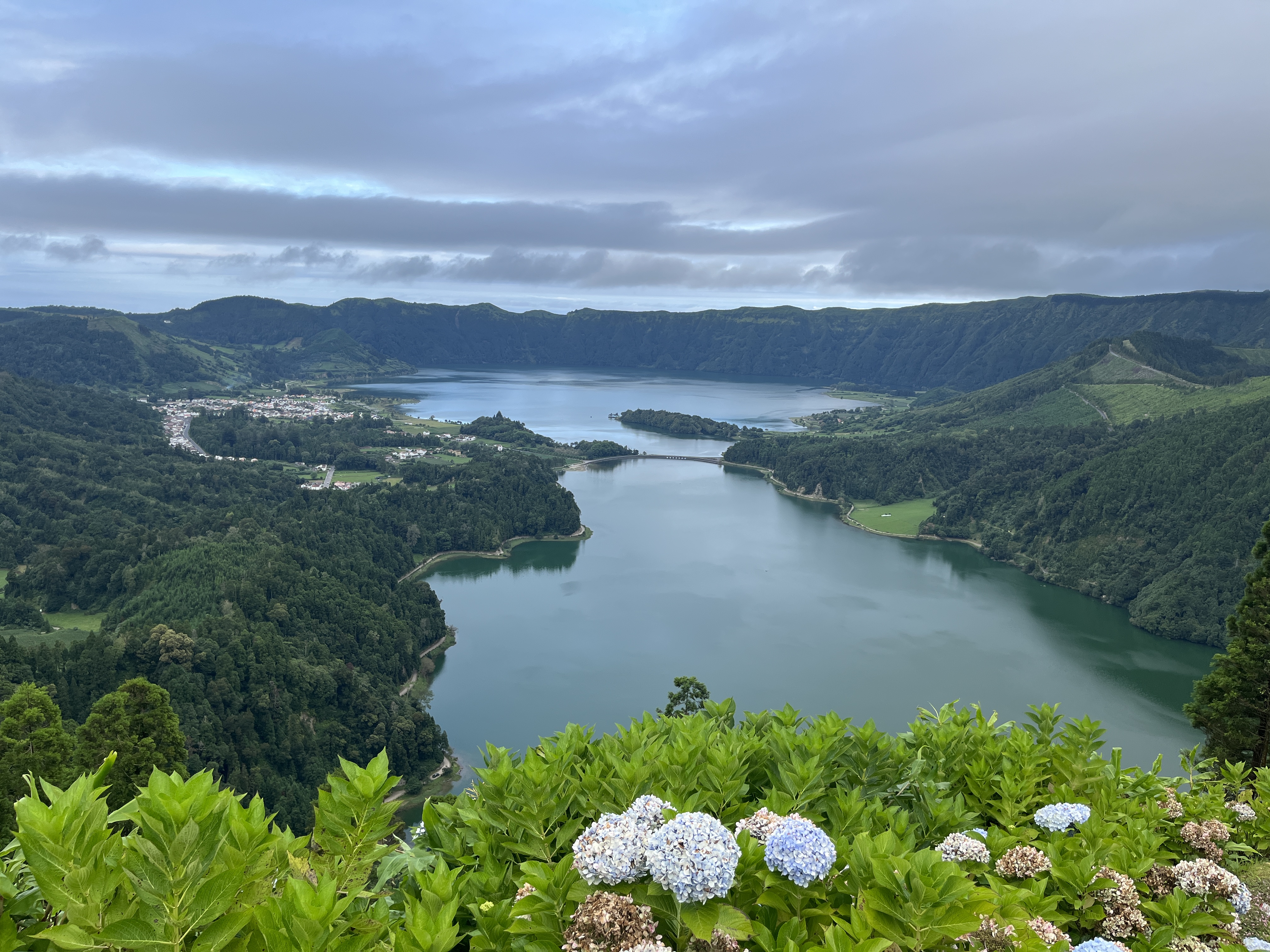
We’ll spend five days on magical São Miguel, one of the nine islands of the Azorean archipelago, “an otherworldly paradise for nature lovers and outdoor adventurers,” as described by Travel & Leisure. We’ll Immerse ourselves in the luxury of one of the island’s most elegant hotels, situated on an 18th century orchard estate, famous among islanders for blending tradition and nature. We’ll savor the cuisine of the island, which fuses farm-to-table and ocean-caught freshness with gourmet takes on traditional Portuguese recipes. And we’ll explore some of the natural wonders of the island, including the hot springs of Furnas, the beauty of the twin volcano lakes at Sete Cidades, and forest bathing in Pinhal da Paz (the pine grove of peace).
During this retreat, you’ll have ample time to write. After a delicious Azorean breakfast, I’ll lead a guided, intention-setting session before you set out to write on your own in the seclusion of the gardens or wherever you choose on the hotel grounds.
I’ll share my mindful approach to writing, what I call “Deep Attention,” a creative practice of looking at the world with intention and without distraction, which I first outlined in this essay. The retreat will incorporate this deep attention practice to help you tap into your creativity, gain new perspectives, and get beyond your daily, habitual obsessions and distractions.

Lunch will be served at the hotel or on guided field trips. After the afternoon field trip, you’ll have an opportunity for another writing session or free time to relax, use the spa, pool, or soak in the heated plunge pool in the pineapple greenhouse. After dinner, you’ll have an opportunity to share your work or reflect upon your experiences.
I’ve designed this retreat to show you some of the best my ancestral island has to offer, and I’ve hand-picked the hotel, restaurants, excursions, and experiences to ensure you will be inspired to write in a relaxed, mindful, and encouraging environment.
Early Bird Discount ends on June 15th, so sign up today!
Find out more: https://www.scottedwardanderson.com/azores-retreat
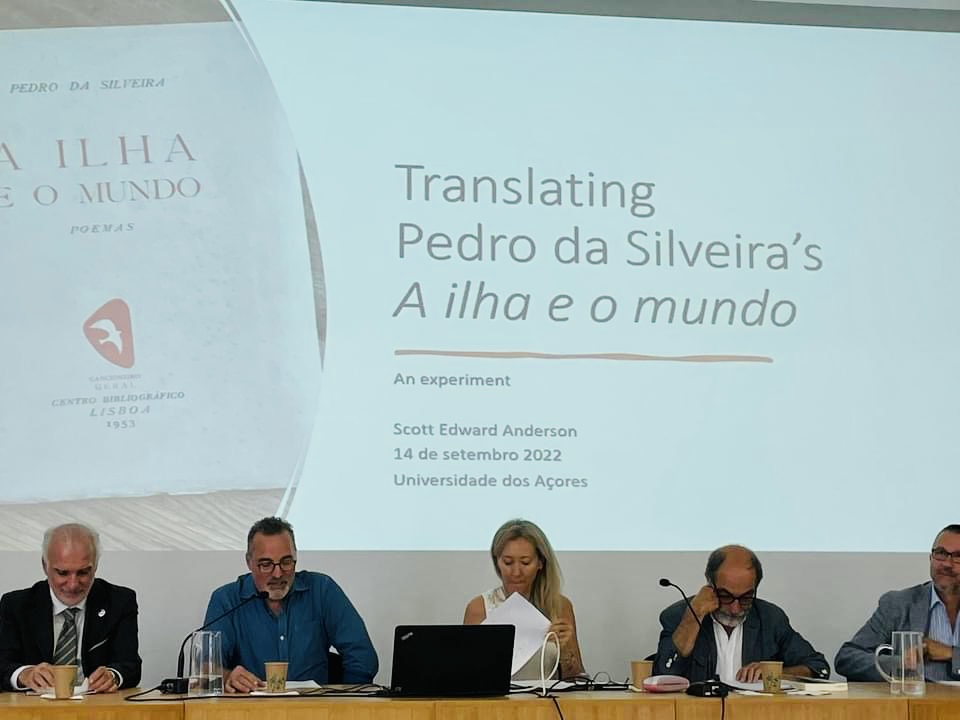
Last summer, I started a project to translate the Azorean poet Pedro da Silveira’s first book A ilha e o mundo (The Island and the World), which came out in 1952.
I had reviewed the late George Monteiro’s translation of Silveira’s last book, published in a bilingual edition by Tagus Press in the States and simultaneously by Letras Lavadas in the Azores in 2019 as Poems in Absentia & Poems from The Island and the World. In fact, the second half of that title was a misnomer; the book included only a few poems from Silveira’s first book–poems that had previously appeared in a Gávea-Brown anthology from the 1980s and sort of slapped on to the end of the book. (Silveira was born on Flores Island in 1922 and died in Lisbon in 2003.)
What struck me immediately about Silveira’s poetry—in Monteiro’s translation first and then in reading the facing Portuguese—was the depth of its feeling, the simplicity and directness of its language, and the brilliant tapestry woven by strands of memory, naming, and observations of nature. Indeed, all aspects that are found in my own poetry; hence, I felt a certain kinship with Silveira’s work straight away.
And yet, I was equally struck by the dearth of his poetry available in translation. How could such a seemingly important poet be so little represented in English translation? How much richer would the world of poetry–and the world of poetry-in-translation–be with Silveira’s body of work. And how much richer would be our lives in the Azorean diaspora with his sentiments, steadfast observations, and steady poetic hand.
I started with the second poem in the book, “Ilha”; this was likely the first poem I ever read by Silveira in translation, from that old Gávea-Brown anthology previously mentioned.
Here is the entire poem in its original Portuguese:
ILHA

Só isto:

                 O céu fechado, uma ganhoa

pairando. Mar. E um barco na distância:

olhos de fome a adivinhar-lhe, à proa,

Califórnias perdidas de abundância.
As I tend to do in my method of translation, I first read the poem straight through and then wrote an impression or literal reading as I understood it:
Just this:

                        The closed sky, a heron

Hovering. Sea. A boat in the distance:

Hungry eyes guessing, at the prow,

Californias lost of abundance.
A bit clunky and prosaic, and probably unworthy. I prefer to not read another’s translation (if there is one) while translating a poem lest I be influenced by it, so Monteiro’s sat on the shelf.
One thing troubled me, however. The bird. Where did that heron come from? Surely, I remembered it from Monteiro’s version. “Ganhoa,” at first, I thought was a misprint of “ganhou” – who won? – but that made absolutely no sense, so I went with heron. But what was a heron doing in this scene? Were herons even found in the Azores?
Reluctantly, I checked Monteiro’s translation. Sure enough, there it was, “heron.” It struck a dissonant chord with me now. A heron. Really? Again, I wondered whether herons were found in the Azores and turned to the Internet.
Yes, there were at least ten species of heron that have been noted on these islands, including great blues and little egrets, which according to the website whalewatchingazores.com have been sighted, but “not regularly”; the species is classified as an “uncommon vagrant” on the islands. And, most recently, a confirmed sighting of another species, the yellow-crowned night heron (Nyctanassa violacea) was described in a scientific paper by João Pedro Barreiros. Most likely, however, this one was blown east by a strong, errant wind from the west. Several herons were known to stop-over on their migratory path from Africa to northern climes and back.
Still, heron didn’t seem correct, to me, given the scene described. The use of Mar all alone. And the boat seemed to imply open waters rather than shoreline.
Herons are marsh-dwelling, shoreline species for the most part, so I was perplexed why they might be hovering “at Sea” or the “open ocean,” as I envisioned it. Were they blown off-course and out of their range? That would surely change the nature of this poem, which I assumed was about emigration or the emigrant returned or the desire to emigrate but also remain tied to the island. If it was not a heron, what was it then? What else might “hover” over the open ocean?
I typed “ganhoa” into Google. The almighty, all-seeing Google asked if I meant “ganhos” earnings; no, I did not. This was not a poem set in the halls of finance or a casino in Monaco. So, I clicked on “search instead for ganhoa” and up came a page from Priberam dicionário. I had my bird! The yellow-legged gull (Larus michahellis atlantis)…surely this bird would hover over the prow or bow of the boat, and even the stern, looking for a handout. A ganhoa recupera os seus ganhos. (The gull recovers its winnings.)
Here is my version of Pedro da Silveira’s “Island”:
Just this:

                    The closed sky, a yellow-legged gull

hovering. Open ocean. And a boat in the distance:

Hungry eyes, at the bow, divining,

lost Californias of plenty.
(Translated from the Portuguese by Scott Edward Anderson)
____
(This text was adapted from a paper delivered at the Colóquio celebrating the 100th anniversary of the birth of Pedro da Silveira, “Pedro da Silveira – faces de um poliedro cultural,” at the University of the Azores in Ponta Delgada, São Miguel, in September 2022.)
Speaking of the Azores: I am excited to host a Writing Retreat there from 13-18 October 2023! Join me for 5 days of writing and immersion in the nature, food, and culture of the Azores. We’ll explore the island, focus with deep attention, expand our horizons, and tap into the stories within. Details and registration at https://www.scottedwardanderson.com/azores-retreat
 Scott Edward Anderson
 Scott Edward Anderson's Poetry Blog