My Year in Writing 2024
December 9, 2024
This is the time of year—between my birthday and year’s end—when I take stock of my writing life over the past 12 months. A trend I’ve noticed this year is that I’ve become very Berkshire-focused as I approach the third anniversary of our move up here. I see that as a good thing; it means I’m digging into our community more and focusing on what’s closest to me.
I’ve also had the opportunity to explore more magazine writing—features, profiles, and interviews—through my work with Berkshire Magazine, which has allowed me to engage with and write about Michael Pollan, Mark C. Taylor, Camille A. Brown, Forrest Gander, and Ruth Reichl, among others. Thanks, Anastasia Stanmeyer!
And the Azores continues to be a focus—even though we didn’t return to the islands this year for the first time since 2021. We’ll have to change that in 2025! Overall, it’s been a productive year. Here are some of the highlights:
“Seeking My Roots Through a Painter’s Eyes” (essay), in Revista Islenha, Issue 73, in Madeira, Portugal. (January)
Led a writing workshop at Herman Melville’s Arrowhead titled, “Cultivating Deep Attention,” helping participants explore the art of profound concentration and how it can enhance their writing process and equip them with the tools and mindset needed to harness the power of deep attention in their writing journey. Workshop (February)
Launched “Berkshire Nature Talk Series” at West Stockbridge Historical Society with Leila Philip, author of Beaverland, kicking off the program. Featured three more talks throughout the year on birds, bears, and mushrooms. (February)

“A Philosopher’s Secret Garden: Mark C. Taylor and His Landscape of Ideas,” (lecture/presentation), delivered at “After the Human: Thinking for the Future,” UCSB Humanities & Social Change Center (March)
Featured poet at the first annual Poesia: A Celebration of Portuguese Poetry, Culture, & Fall River Poets, presented by Viva Fall River and Newport Poetry, at the Gates of the City, Fall River Heritage State Park, and the Fall River Visitors Center. (April)

“The British Invasion: The Royal Ballet Takes Over Jacob’s Pillow,” (article), Berkshire Magazine (May/June)
“Keep on Trocking: Les Ballets Trockadero de Monte Carlo Kicks Off Jacob’s Pillow 2024 Season,” (article), Berkshire Magazine (May/June)
Creative nonfiction mentor, Adroit Journal Summer Mentorship Program, mentored two students for the third year. (June-July)
“Cathy Park Hong: “On Minor Feelings, and writing poetry & prose,” (Q&A), Berkshire Magazine (July)
“Emily Wilson: On Translating Homer—and his lessons for today,” (Q&A), Berkshire Magazine (July)
“A Philosopher’s Secret Garden: Mark C. Taylor’s Landscape of Ideas,” (profile), Berkshire Magazine (July)
“Storytelling Through Dance: Camille A. Brown’s Vision & Voice,” (profile), Berkshire Magazine (July)
Hosted a Poetry booth at West Stockbridge Zucchini Festival where festival goers wrote “zucchrositc” poems – yes, acrostics using the word zucchini! (August)
“Getting Back to the Garden: Michael Pollan’s Long, Strange Trip,” (profile), Berkshire Magazine (August)
“Jennifer Egan: On The Candy House, storytelling, and genre,” (Q&A), Berkshire Magazine (September)
“Every Meal is a Story: A Peek into Ruth Reichl’s World of Food,” (profile), Berkshire Magazine (September)
“Lenox Rising: A Berkshire Town’s Resilience and Renewal,” (article), Berkshire Magazine (September)
Catalog essay for “NEXUS 2.0.1: Contemporary Landscape Paintings by Paul Paiement,” Ethan Cohen Gallery, NYC, October 10-November 23. (October)
“Prayer House,” (poem), Speaking for Everyone: An Anthology of “We” Poems (October)
“Six Poems by Pedro da Silveira from A ilha e o mundo,” (translations), Gávea-Brown: A Bilingual Journal of Portuguese-North American Letters and Studies, (October)
Featured Author of the Month, Casa da Saudade Branch Library, New Bedford Free Public Library, New Bedford, MA (October)

My poem, “Wanting,” reprinted in Poetry is Bread: The Anthology, edited by Tina Cane, published by Nirala Press, India (October)
“Massachusetts Voter Endorses Ballot Measure #4,” (Op-Ed), Lucid News (November)
“Letter to America: The psychedelic renaissance,” (essay), Terrain.org (November)
“The Power of Listening: Forrest Gander’s Poetry of Memory and Place,” (profile), Berkshire Magazine (November)
“A Massachusetts Voter Reflects on the Failure of Psychedelics Ballot Question 4,” (Op-Ed), Lucid News (December)
“First Impressions of the Açores,” (essay), Gávea-Brown: A Bilingual Journal of Portuguese-North American Letters and Studies (December)
A productive year, indeed—hoping to keep it alive in 2025!
—SEA
Discover the Power of Deep Attention: Seven Reasons to Join the Azores Writing Retreat with Scott Edward Anderson
July 7, 2023

Are you a writer seeking to delve into the depths of your creative well? Are you a would-be writer who has always wanted to write, but could never find the time or discipline? Do you long to cultivate a focused, immersive writing practice that transcends distractions and unlocks your true potential?
If so, we invite you to embark on a life-changing journey to the breathtaking Azores archipelago for a Deep Attention Writing Retreat with the esteemed author Scott Edward Anderson. From 13-18 October 2023, get ready to immerse yourself in an oasis of inspiration, surrounded by stunning natural beauty and the nurturing guidance of an expert wordsmith.
Here are seven reasons why attending this retreat could be the turning point in your writing journey:
1. Unleash Your Creative Potential: Scott Edward Anderson, an award-winning poet, memoirist, and essayist, is renowned for his ability to coax out the hidden depths of creativity within writers and would-be writers alike. Through his extensive experience and compassionate mentorship, he will help you tap into your unique voice and express your ideas with profound clarity and emotional resonance.
2. Deep Attention Practice: In an age of constant distractions, cultivating deep attention has become a superpower. This retreat is designed to help you reclaim your focus and immerse yourself in the present moment, where creativity flourishes. Through mindfulness exercises and specially curated nature-based interactive sessions, you will learn how to quiet the noise of the world and give undivided attention to your craft.
3. Inspiring Natural Surroundings: Nestled in the stunning Azores archipelago, this retreat on São Miguel Island offers an idyllic setting for creative exploration. Picture yourself surrounded by lush green landscapes, breathtaking ocean views, and the soothing sounds of nature. The serene ambiance of the Azores will inspire and invigorate your writing, providing the perfect backdrop for introspection and inspiration.
4. Intimate and Supportive Community: Connecting with fellow travelers who share your passion can be a transformative experience. The retreat fosters a warm and nurturing community, allowing you to engage in meaningful discussions, exchange ideas, and form lasting connections. The power of collective creativity and support will propel you forward on your writing journey long after the retreat ends.
5. Expert Guidance and Mentorship: Scott Edward Anderson’s wealth of knowledge and expertise will guide you through the intricacies of his Deep Attention writing practice. He will share invaluable insights into the craft and practice of writing and evoking deep emotions through language. His mentorship will help you grow as a writer and expand your creative boundaries, as it has for others like M. Chun, who says that Anderson “continuously expressed an encouraging and supportive approach toward my creative work, and I easily felt comfortable and confident sharing my ideas with him…[he] kindled my brainstorming process by recommending similar pieces and writers, and he also helped me pinpoint themes…from my initially unstructured ideas.”.
6. Reflection and Self-Discovery: Writing is not just about words on a page; it is a profound act of self-discovery. During the retreat, you will have ample time for introspection, allowing you to explore your inner landscape, uncover new perspectives, and deepen your understanding of yourself and your craft. This transformative journey will leave you with a newfound sense of purpose and direction in your writing.
7. Cultural Immersion: The Azores, with its rich cultural heritage and vibrant traditions, offers a unique opportunity for cultural immersion. From exploring local cuisine to engaging with the island’s history and culture, you’ll gain fresh insights that can enrich your writing. The vibrant tapestry of Azorean life will infuse your work with a sense of place and authenticity.
Spaces for this exclusive retreat are limited, so seize the opportunity to embark on a transformative journey of creative exploration. Escape the distractions of daily life, immerse yourself in the Azores’ natural beauty, and let Scott Edward Anderson’s guidance and mentorship unlock the full potential of your writing. Join us on this profound adventure and discover the transformative power of Deep Attention. Register today: Azores Deep Attention Writing Retreat
My short answer to this question is “No, absolutely not.” In fact, I’ve specifically designed the Azores Writing Retreat to meet you where you are as a participant, whether you consider yourself a writer or not. We all have stories we need to tell. Whether we consider ourselves writers is beside the point.
“We tell ourselves stories in order to live,” Joan Didion began her famous essay “The White Album.” I would further argue that we tell stories because it is an essential act of being human. Indeed, some scientists believe we may be hard-wired to tell stories.

As I wrote in my essay, “Telling Stories to Change the World,” which appeared in Terrain.org in 2006, “a story is a narrative account of a real or imagined event or events. Stories build worlds and define worldviews. Sharing experience through stories, we pass on accumulated wisdom, beliefs, and values. Through stories we explain how and why things are, and we define our role and purpose.”
In that essay, I also quote the National Storytelling Network, which says that “Stories are the building blocks of knowledge, the foundation of memory and learning.” They “connect us with our humanness and link past, present, and future.”
From our earliest time as a species, when we were hunter-gatherers, we told stories about the best hunting places or where plentiful berries could be found. Later, we told each other stories about planting crops and which crops grew best in what climate, soil, or aspect of the sun. We evolved as a species through stories, and we are grounded in stories. Storytelling may be a tradition as old as human communication itself.
Stories connect people to other people and to place, to the land and sea. That’s what I’m trying to do with the Azores Writing Retreat. We’ll spend five days getting connected to the land and sea of my ancestral island, São Miguel. We’ll connect with the nature, culture, food, and people of the island. And we’ll connect with each other as a cohort, listening to the stories we have within us that are yearning to be told.
At the end of the Azores Writing Retreat, whether you consider yourself a writer or not, my hope is you will come away with a deeper appreciation of the stories you have to write and a sense that your stories are important, whether you write them for yourself, your friends and family, or for possible publication. I hope you’ll join me on this remarkable journey.
For more information and to Register for the retreat: Azores Writing Retreat
Why a Writing Retreat in the Azores?
May 25, 2023
People ask me why a Writing Retreat in the Azores? My first answer to that question is: because I want to share my ancestral island and its natural and cultural gifts with you. My second answer is: what better place to practice deep attention to our writing than on a remote island in the middle of the Atlantic?
Writing without distraction is particularly difficult these days, that’s why I’ve designed the Azores Writing Retreat around what I’m calling Deep Attention. Everything we do will be guided by this framework, designed to develop a practice we can take with us long after the retreat is over.

Deep Attention is a practice I’m developing in response to our age of distraction. Paying attention in an age of distraction is hard. At any given moment, there is a myriad of distractions tempting us away from our writing.
If we’re paying attention, however, we can put our busy lives in perspective, create a context for what we’re doing on this planet. Living like this, life is not about going through the motions; rather, we actively participate in life, in all its facets.
Deep Attention sets us up for opening the writing brain, for preparing that muscle to do its best work. Working the writing-brain in this way makes it easier to pay attention, not only to our surroundings, but to our words and what the piece of writing is trying to say. It’s also a reciprocal, regenerative act: paying deep attention informs our writing and our writing helps us pay deeper attention.
For me, the practice of Deep Attention is part of the act of writing, as the practice of writing is part of the act of paying attention, a cyclical, symbiotic relationship. This type of attentiveness is akin to what Zen practitioners call deep listening.
As Zen practice implies, deep listening requires complete receptivity—an openness and attentiveness to what’s possible and to asking questions. If we have a question to answer through our writing, we need to ask it. Nevertheless, it sometimes seems like our minds are on autopilot and we are not truly paying attention, causing us to miss both questions and answers.
This deep listening and attentiveness are a form of tuning to the right frequency. Like the dial on an old car radio, if you turn a little too much to the right or left, you lose the signal. Through the act of paying attention, we fine-tune our ability to land on the right frequency.

Deep Attention requires a two-fold approach to paying attention: outward and inward. Outward: what’s going on around you and what you see, what you notice. Inward: what’s going on within you and your reactions to what you notice. Combined, this inward and outward focus develops our ability to see things others do not see and allows us to call attention to those things in our writing. Inward-focused attention also helps us turn observation into a piece of writing, aligning the frequencies and images to unlock the stories within us.
Deep Attention is, in part, a form of showing up, of being fully present, fully engaged. Distractions govern so much of our lives—from social media to work life—we so rarely allow time for deep attentiveness. If we make it a practice, however, we can begin to form insights and become more receptive to the poetry of our everyday lives and bring it into our writing.
Join me on the island of São Miguel for this five-day Deep Attention Retreat, October 13-18, 2023, where we’ll learn the practice Deep Attention, immerse ourselves in the incredible nature of the “Hawaii of Europe,” savor the delectable cuisine of the Azores, and get a lot of writing done.
Reserve your spot today: Azores Writing Retreat.
If you’ve ever dreamed of exploring the art of writing on an enchanted island, this is your opportunity! Join me for this unique writing retreat in the Azores, Portugal — the “Hawaii of Europe.”
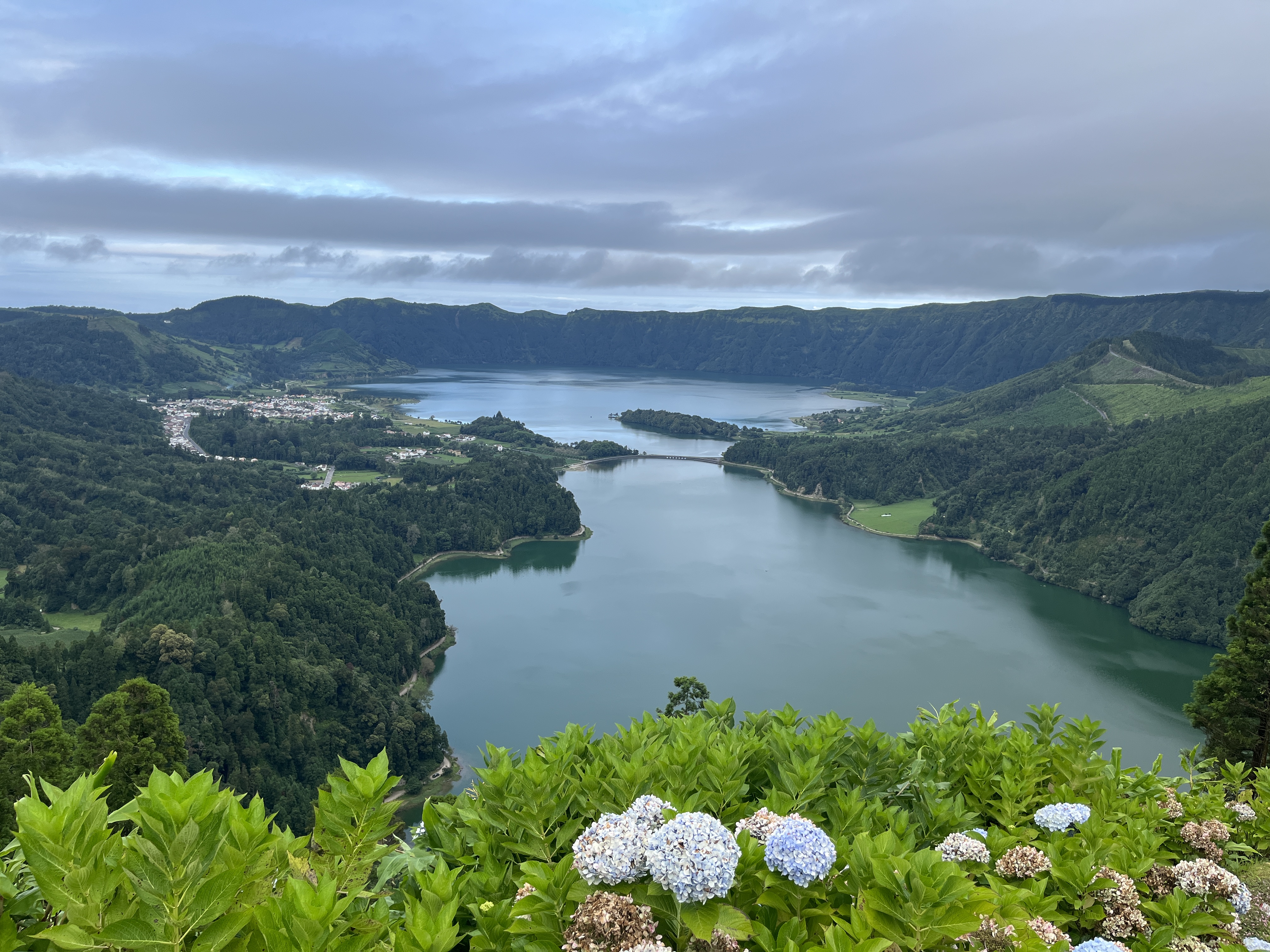
We’ll spend five days on magical São Miguel, one of the nine islands of the Azorean archipelago, “an otherworldly paradise for nature lovers and outdoor adventurers,” as described by Travel & Leisure. We’ll Immerse ourselves in the luxury of one of the island’s most elegant hotels, situated on an 18th century orchard estate, famous among islanders for blending tradition and nature. We’ll savor the cuisine of the island, which fuses farm-to-table and ocean-caught freshness with gourmet takes on traditional Portuguese recipes. And we’ll explore some of the natural wonders of the island, including the hot springs of Furnas, the beauty of the twin volcano lakes at Sete Cidades, and forest bathing in Pinhal da Paz (the pine grove of peace).
During this retreat, you’ll have ample time to write. After a delicious Azorean breakfast, I’ll lead a guided, intention-setting session before you set out to write on your own in the seclusion of the gardens or wherever you choose on the hotel grounds.
I’ll share my mindful approach to writing, what I call “Deep Attention,” a creative practice of looking at the world with intention and without distraction, which I first outlined in this essay. The retreat will incorporate this deep attention practice to help you tap into your creativity, gain new perspectives, and get beyond your daily, habitual obsessions and distractions.

Lunch will be served at the hotel or on guided field trips. After the afternoon field trip, you’ll have an opportunity for another writing session or free time to relax, use the spa, pool, or soak in the heated plunge pool in the pineapple greenhouse. After dinner, you’ll have an opportunity to share your work or reflect upon your experiences.
I’ve designed this retreat to show you some of the best my ancestral island has to offer, and I’ve hand-picked the hotel, restaurants, excursions, and experiences to ensure you will be inspired to write in a relaxed, mindful, and encouraging environment.
Early Bird Discount ends on June 15th, so sign up today!
Find out more: https://www.scottedwardanderson.com/azores-retreat
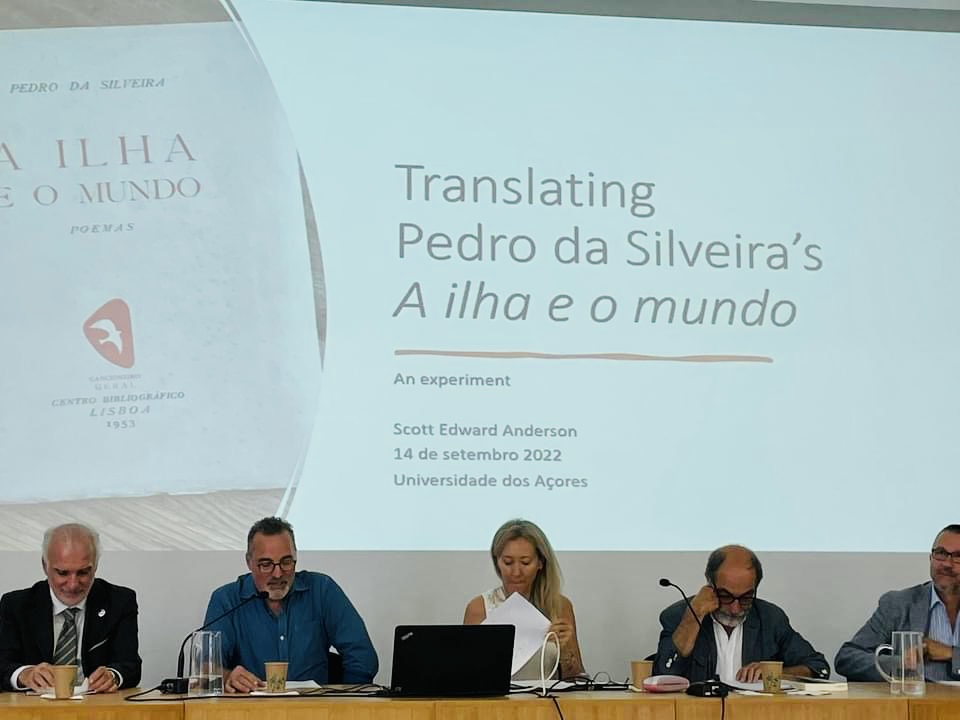
Last summer, I started a project to translate the Azorean poet Pedro da Silveira’s first book A ilha e o mundo (The Island and the World), which came out in 1952.
I had reviewed the late George Monteiro’s translation of Silveira’s last book, published in a bilingual edition by Tagus Press in the States and simultaneously by Letras Lavadas in the Azores in 2019 as Poems in Absentia & Poems from The Island and the World. In fact, the second half of that title was a misnomer; the book included only a few poems from Silveira’s first book–poems that had previously appeared in a Gávea-Brown anthology from the 1980s and sort of slapped on to the end of the book. (Silveira was born on Flores Island in 1922 and died in Lisbon in 2003.)
What struck me immediately about Silveira’s poetry—in Monteiro’s translation first and then in reading the facing Portuguese—was the depth of its feeling, the simplicity and directness of its language, and the brilliant tapestry woven by strands of memory, naming, and observations of nature. Indeed, all aspects that are found in my own poetry; hence, I felt a certain kinship with Silveira’s work straight away.
And yet, I was equally struck by the dearth of his poetry available in translation. How could such a seemingly important poet be so little represented in English translation? How much richer would the world of poetry–and the world of poetry-in-translation–be with Silveira’s body of work. And how much richer would be our lives in the Azorean diaspora with his sentiments, steadfast observations, and steady poetic hand.
I started with the second poem in the book, “Ilha”; this was likely the first poem I ever read by Silveira in translation, from that old Gávea-Brown anthology previously mentioned.
Here is the entire poem in its original Portuguese:
ILHA

Só isto:

                 O céu fechado, uma ganhoa

pairando. Mar. E um barco na distância:

olhos de fome a adivinhar-lhe, à proa,

Califórnias perdidas de abundância.
As I tend to do in my method of translation, I first read the poem straight through and then wrote an impression or literal reading as I understood it:
Just this:

                        The closed sky, a heron

Hovering. Sea. A boat in the distance:

Hungry eyes guessing, at the prow,

Californias lost of abundance.
A bit clunky and prosaic, and probably unworthy. I prefer to not read another’s translation (if there is one) while translating a poem lest I be influenced by it, so Monteiro’s sat on the shelf.
One thing troubled me, however. The bird. Where did that heron come from? Surely, I remembered it from Monteiro’s version. “Ganhoa,” at first, I thought was a misprint of “ganhou” – who won? – but that made absolutely no sense, so I went with heron. But what was a heron doing in this scene? Were herons even found in the Azores?
Reluctantly, I checked Monteiro’s translation. Sure enough, there it was, “heron.” It struck a dissonant chord with me now. A heron. Really? Again, I wondered whether herons were found in the Azores and turned to the Internet.
Yes, there were at least ten species of heron that have been noted on these islands, including great blues and little egrets, which according to the website whalewatchingazores.com have been sighted, but “not regularly”; the species is classified as an “uncommon vagrant” on the islands. And, most recently, a confirmed sighting of another species, the yellow-crowned night heron (Nyctanassa violacea) was described in a scientific paper by João Pedro Barreiros. Most likely, however, this one was blown east by a strong, errant wind from the west. Several herons were known to stop-over on their migratory path from Africa to northern climes and back.
Still, heron didn’t seem correct, to me, given the scene described. The use of Mar all alone. And the boat seemed to imply open waters rather than shoreline.
Herons are marsh-dwelling, shoreline species for the most part, so I was perplexed why they might be hovering “at Sea” or the “open ocean,” as I envisioned it. Were they blown off-course and out of their range? That would surely change the nature of this poem, which I assumed was about emigration or the emigrant returned or the desire to emigrate but also remain tied to the island. If it was not a heron, what was it then? What else might “hover” over the open ocean?
I typed “ganhoa” into Google. The almighty, all-seeing Google asked if I meant “ganhos” earnings; no, I did not. This was not a poem set in the halls of finance or a casino in Monaco. So, I clicked on “search instead for ganhoa” and up came a page from Priberam dicionário. I had my bird! The yellow-legged gull (Larus michahellis atlantis)…surely this bird would hover over the prow or bow of the boat, and even the stern, looking for a handout. A ganhoa recupera os seus ganhos. (The gull recovers its winnings.)
Here is my version of Pedro da Silveira’s “Island”:
Just this:

                    The closed sky, a yellow-legged gull

hovering. Open ocean. And a boat in the distance:

Hungry eyes, at the bow, divining,

lost Californias of plenty.
(Translated from the Portuguese by Scott Edward Anderson)
____
(This text was adapted from a paper delivered at the Colóquio celebrating the 100th anniversary of the birth of Pedro da Silveira, “Pedro da Silveira – faces de um poliedro cultural,” at the University of the Azores in Ponta Delgada, São Miguel, in September 2022.)
Speaking of the Azores: I am excited to host a Writing Retreat there from 13-18 October 2023! Join me for 5 days of writing and immersion in the nature, food, and culture of the Azores. We’ll explore the island, focus with deep attention, expand our horizons, and tap into the stories within. Details and registration at https://www.scottedwardanderson.com/azores-retreat
My Year in Writing: 2022
November 28, 2022
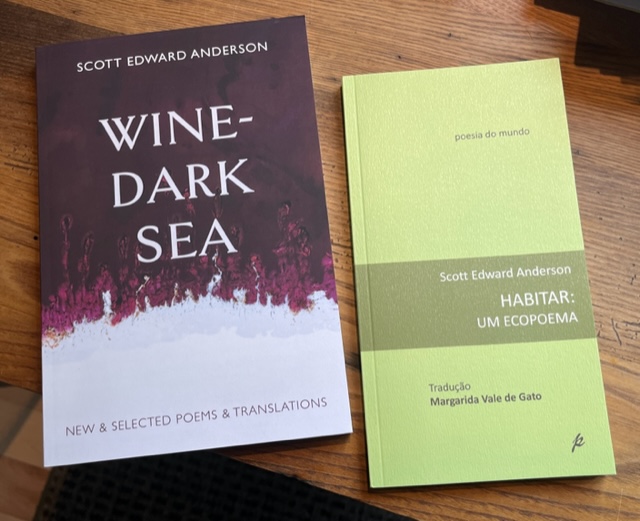
Now is the time, between my birthday and the end of the year, when I take stock of my year in writing. It’s been a pretty productive year, considering it also included a move from Brooklyn to the Berkshires:
Published Wine-Dark Sea: New & Selected Poems & Translations (Shanti Arts)
Book launch for Wine-Dark Sea online with Kathryn Miles (Feb)
Appearance on Portuguese American Radio Hour with Diniz Borges (March)
World Poetry Day/Cagarro Colloquium reading (March)
Book launch with Portuguese Beyond Borders Institute (March)
Book signing at Terrain.org booth at #AWP22 in Philadelphia (March)
Wine-Dark Sea gets “Taylored” by @taylorswift_as_books on Instagram! (March)

Lecture at University of the Azores: Mesa-redonda Poesia, Tradução e Memória (April)
Azores launch for Wine-dark Sea and Azorean Suite/Suite Açoriana at Letras Levadas in Ponta Delgada, São Miguel, Azores, with Leonor Sampaio Silva (April)
Açores Hoje television interview with Juliana Lopes on RTP Açores (April)
Terrain.org Reading Series with Joe Wilkins and Betsy Aoki (April)
“Phase Change” and “Under the Linden’s Spell” reprinted in TS Poetry’s Every Day Poems (online/email)
“Midnight Sun” and “Shapeshifting” reprinted in Earth Song: a nature poems experience (anthology), edited by Sara Barkat and published by TS Poetry Press
Named Ryan Observatory’s first Poet Laureate
Mentored 2 students in Creative Nonfiction for Adroit Journal Summer Mentorship Program (June/July) [UPDATE: one of the students I mentored got accepted into the University of Pennsylvania, early decision! So proud of her!]
Translated Pedro da Silveira’s A ilha e o mundo, his first book of poems (1952)
Excerpts from Corsair of the Islands, my translation of Vitorino Nemésio’s Corsário das Ilhas, published in Barzakh Magazine (online) (August)
Panelist/presenter at Colóquio: Pedro da Silveira – faces de um poliedo cultural, University of the Açores: On Translating Pedro da Silveira’s A Ilha (September)
Lançamento da obra Habitar: um ecopoema, Margarida Vale de Gato’s translation of Dwelling: an ecopoem, published by Poética Edições, with Nuno Júdice, Luís Filipe Sarmento, and Margarida Vale de Gato, at FLAD in Lisbon (September)
Guest lecturer in Creative Writing at University of the Azores (Leonor Sampaio Silva, professora)
Panelist/presenter at 36th Colóquio da Lusofonia, Centro Natália Correia, Fajã de Biaxo, São Miguel, Azores: reading from Azorean Suite/Suite Açoriana with Eduardo Bettencourt Pinto (October)
#YeahYouWrite Catskill Reading at Fahrenheit 451 House, Catskill, NY w/Stephanie Barber, Laurie Stone, and Sara Lippmann (October)
Guest Writer at UConn Stamford creative writing class (Mary Newell, professor) (October)
Poet & Astronomer in Conversation (with Derrick Pitts, Chief Astronomer of the Franklin Institute) at Ryan Observatory at Muddy Run, PA (November)

“Wine-Dark Sea” (poem) published in American Studies Over_Seas (November)
20th Anniversary of residency at Millay Arts and writing of Dwelling: an ecopoem (November) [UPDATE: Got asked to join the Board of Millay Arts in December.]
Selections from Habitar: um ecopoema published in Gávea-Brown (US) and Grotta (Azores)
Book reviews in Gávea-Brown and Pessoa Plural [Postponed until 2023.](December)
My essay, “Açorianidade and the Radiance of Sensibility,” accepted by Barzakh Magazine for publication in Winter 2023 issue. (December)
What a year! I am exceedingly grateful to everyone who has supported my writing over the past year. As Walter Lowenfels wrote, “One reader is a miracle; two, a mass movement.”
Like I said last year, I feel like I’ve been blessed by a mass miracle this year!
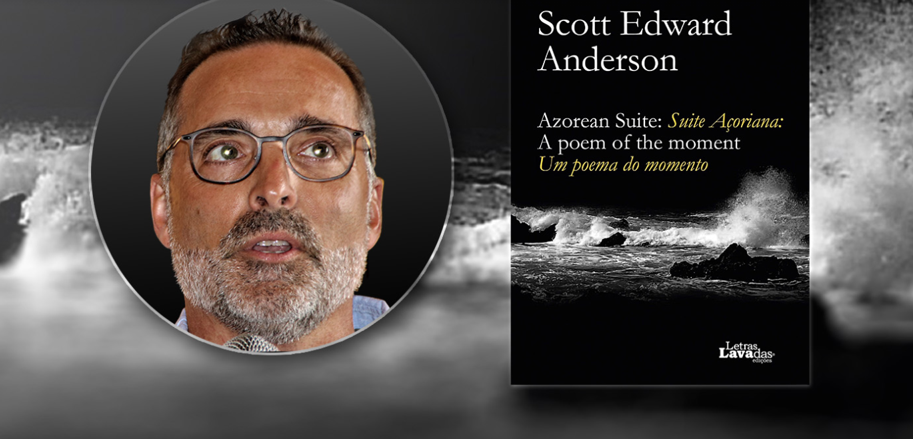
Please join me this Thursday, 3 June, at 7PM EDT, for a reading and talk I’m giving for the New Bedford Whaling Museum, which focuses on the connections between the Azores, New Bedford, and Rhode Island, whaling, and other Atlantic Crossings.
Inspired by my explorations into my family heritage, which in turn inspired my book-length poem Azorean Suite/Suite Açoriana, this reading and talk will explore the journeys of various waves of immigrants to America and their connection across the Atlantic to the Azores.
I’ll share passages from Azorean Suite, as well as from my work-in-progress, a research-driven memoir called “The Others in Me: A Journey to Discover Ancestry, Identity, and Lost Heritage.”
The ZOOM event is past, but you can watch the video here: Whaling Museum
Hope to “see” you there!
National Poetry Month 2021, Week Four: Adelaide Freitas’s “In the Bulge of Your Body”
April 30, 2021
Continuing to explore the poets and poetry of the Azores and its Diaspora, this week I’m featuring a poem by the late Adelaide Freitas, a wonderful Azorean poet, novelist, and essayist deserving of more attention.
Freitas was born 20 April 1949 in Achadinha, on the northeastern coast of São Miguel Island. She attended school in Ponta Delgada before moving with her family to the United States, where she attended New Bedford High School in Massachusetts. In 1972, she graduated with a BA in Portuguese from the Southeastern Massachusetts University (now UMass Dartmouth) and went on to earn a master’s degree in Comparative Literature from the City University of New York and a PhD in American Literature from the University of Azores. She lived in Ponta Delgada with her husband, Vamberto Freitas, and was a professor of American Literature and Culture at the University of the Azores.
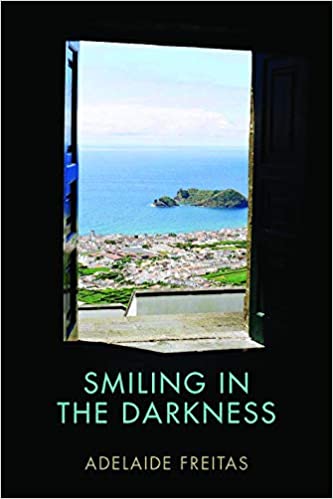
In 2018, Adelaide Freitas was honored by the Legislative Assembly of the Autonomous Region of the Azores with the Insígnia Autonómica de Reconhecimento (Commendation of Recognition), just a few weeks before she passed away after a long battle with Alzheimer’s.
“Adelaide Freitas had gone silent years ago through the devastation of illness,” wrote one of her translators, Emanuel Melo, on his blog. “Her husband, Vamberto Freitas, himself a man of letters and important literary critic in the Portuguese diaspora, with enduring love and faithfulness kept her by his side, even writing about her, but above all loving her with steadfastness. In one of his blog posts he wrote how in the middle of a sleepless night, with her resting in the next room, he would take her books from the shelf and read her words to himself when he could no longer her the voice of his beloved wife.”
Her novel, Smiling in the Darkness, is an intimate portrait of what life was like on the Azores during the latter half of the 20th Century, and follows a young woman who struggles with the absence of her emigrant parents—who left her behind when they went to America—and her desire to explore the world beyond her island home. It was recently published in a translation by Katherine Baker, Emanuel Melo, and others. You can order a copy (and you should) from Tagus Press here: Smiling in the Darkness.
Here is her poem, “No bojo do teu corpo” in its original Portuguese and my English translation:
“No bojo do teu corpo”
No bojo do teu copo
olho translúcido o teu corpo
Vibra a alegria da tua emoção
e em mim se dilui a sua gota
Ballet agita o copo
treme a boca da garrafa
A mão abafa o vidro morno
cala-se enterrada a ternura dos lábios
A folha verde voa etérea
pousa no líquido desfeito
Dela nasce uma flor
e o mundo nela se espelha
branca a luz se intersecta
refrecta o whisky beijado
Guardanapo assim molhado
refresca a tua fronte
Gentil ela se inclina
no Outro se confunde
No tchim-tchim da efusão
treme bojo do teu corpo
—
“In the bulge of your body”
In the bulge of your glass
I see your translucent body
Vibrating with the joy of your emotion
and your drop dissolves in me
Ballet stirs the glass
the mouth of the bottle is trembling
The hand stifles the tepid glass
the tenderness of the lips is buried, remains silent
The green leaf flies ethereal
lands in the dissolved liquid
From it a flower is born
and the world is mirrored in it
white light intersects
refracting the whisky kiss
Such a wet napkin
refreshing your brow
Gently she leans
into the Other, gets confused
In the Tchim-tchim![1] of effusion
the bulge of your body trembles
—Adelaide Freitas (translated by Scott Edward Anderson)
[1] Tchim-tchim! is an expression like Cheers! An onomatopoeic phrase that connotes the clinking of glasses. I decided not to translate it here, although I could have gone with “cling-cling!” or something similar.

Jardim Botânico José do Canto, Ponta Delgada, Azores. Photo by SEA
I first encountered Logan Duarte through Christopher Larkosh’s “Writing the Moment Lusodiasporic” event last June. A two-day event sponsored by the College of Arts and Sciences and the UMass Dartmouth Department of Portuguese, it brought together Luso-North American writers from throughout Canada and the U.S.
The event was originally supposed to be held in April at the Casa da Saudade Library in New Bedford, but due to the pandemic, it was moved to Zoom in June. The event featured a combination of presentations by writers and cultural agents like Irene Marques, Humberto da Silva, and Emanuel Melo, along with a generative writing workshop led by Carlo Matos.
(Larkosh, who tragically died this past December, served as Logan’s professor and adviser at UMass Dartmouth, and I’d like to dedicate this post to his memory.)
I next saw Logan when we both read for Diniz Borges’ Filaments of the Atlantic Heritage symposium in March 2021. I was impressed with Logan’s poetry, enthusiasm, and scholarship.
One of the poems Logan read during that session was “My Statue,” which he described to me as, “an act of homage towards a man who is the lifeblood of my açorianidade, and a testament to those who have gone before; those whose presence grows stronger in physical absence and gives us the confidence to smile in the rain.”
Logan is an Azorean Portuguese American writer currently based in Taunton, Massachusetts. His family came from São Miguel Island in the 1960s, which makes him first generation American; although he sometimes jokingly refers to himself as “0.5 generation,” having called Lisbon, Portugal, his home for part of his life.
His writing centers around cultural identity in the Luso-American diaspora and has been a runner-up for the Disquiet International Literary Program’s Luso-American Fellowship (2019) and featured in the Legacy section of the Tribuna Portuguesa (2020). He has a forthcoming set of poems in the upcoming issue of Gávea-Brown, a bilingual journal of Portuguese American letters and studies published by Brown University.
Logan is expected to graduate with a master’s in teaching from UMass Dartmouth in 2021, from which he also received his BA in Portuguese. He also studied at Universidade Católica Portuguesa and Universidade de Lisboa and has taught Portuguese at Milford and Taunton high schools and at Escola Oficial Portuguesa. He will be a graduate Teaching Fellow at UMass Dartmouth beginning his second masters in Portuguese Studies in the upcoming academic year.
Here is Logan Duarte’s “My Statue”
My Statue
Rain pelts the cobblestone calçada. A utopia turns to a warzone.
Tourists scatter…I walk
Knowing all too well the dangerous potential of a slick calçada.
Some of them slip. Now they know.
Walking, thinking, unperturbed by the hail of crossfire in which I am caught, I lift my head to see a statue.
I stop, my eyes examining its unique character.
It stands firm; the quintessence of gallantry; completely untouched by the bombardment letting loose on the city.
All else assumes a deep gray despondence, battered by the bombs that fall from the clouds. The streets are barren; a wasteland.
But the statue stands unscathed.
Only light shines on this singular obra-prima perfectly guarded in a safe corner of the universe.
A man stands chiseled out of the finest marble.
His eyes look directly at me…no one else.
Below him, a plaque:
“Ocean-crosser, storm-braver, fearless warrior”.
Who could it be?
A hero to the people? A national figure? The sacred one-eyed man?
No. This is no ordinary statue. This one is only mine.
I continue walking, still thinking. I still see a statue…
My statue…my avô.
The corners of my mouth raise nearly to my ears at the sight of my statue, and the rain clears. Tourists emerge from their hideaways; some still rubbing their bruises.
Their selfies one shade darker now,
But my statue remains unscathed.
It guides me through the warzone—a beacon amidst brume.
So that when others run, and sometimes slip,
I walk and think of my statue who in life sacrificed so much
So that I may not fear the rain.
And that I may turn my warzone into utopia.
—Logan Duarte
(This poem, used with permission of the author, originally appeared in Tribuna Portuguesa, in a slightly different version.)
 Scott Edward Anderson
 Scott Edward Anderson's Poetry Blog