30 Poems for National Poetry Month: Day 4
April 4, 2013
 Here is my Day 4 poem:
“Happiness is a choice,”
Says my friend Jack.
Whether you choose
To focus on the love
Expressed or the flaws
Hinted at; that’s your choice.
(Okay, you snore.
Is that enough?)
I choose to focus
On thriving, after so long
Languishing. Now
That I have found
The jewel in the crescent
Moon that makes disappear
The flaws in the bezel of my being.
–Scott Edward Anderson
30 Poems for National Poetry Month: Day 3
April 3, 2013
 Here’s my Day 3 poem for National Poetry Month, which I wrote during a bout with insomnia in the wee hours of the morning:
Love is never perfect
And neither are you and me.
You don’t walk on water;
I prefer to swim under.
And there is nothing
Over my eyes, neither
Gauzy nor hued.
I see your flaws
And raise them with mine.
And I love you,
Even in your imperfections,
Which I won’t enumerate here.
And even with all mine. (Ditto.)
That’s real love, baby.
Get used to it. It’s yours
If you want it–
–Scott Edward Anderson
30 Poems for National Poetry Month: Day One & Two
April 2, 2013
 The challenge is to write a poem every day for National Poetry Month.
I’ve never cared for these daily, quick-writ challenges, preferring to let a poem mull and steep rather than be cast onto the page too quickly like a gambler shooting dice out of a cup.
But, yesterday, sitting in Bryant Park eating my lunch, I was inspired to give it a go. And then again this morning on the subway heading from Brooklyn into Manhattan.
So, here are my first two entries:
1
April Fools the fool that fools
With the sun on the first day
Of baseball season.
They’ve laid new grass down
On the lawn at Bryant Park.
Sign reading: “Lawn Closed”–
Where just a month ago
There was a skating rink.
“The new sod is establishing
Its roots.”
2
Our blended family whorled
Back from Disney World,
Dispersed to their other
Homes, to come together
Later in this month of poetry.
Our fantasy become reality.
–Scott Edward Anderson

The Lounge at New York Central
I had a meeting yesterday with a European colleague at the Grand Hyatt in New York. We were introduced by a mutual acquaintance from outside the firm for which we both work.
As we met and ascended the stairs to the Lounge at New York Central, I was reminded of a poem I wrote in that bar many years ago, while working for an international publishing agency.
“Drink Meeting at the Grand Hyatt Sun Garden” wasn’t a very good poem, I think, but it well illustrated my discomfort at the time, as an artist in a business setting.
I used this poem in a talk called “Poetry & Business Life,” which was about the long tradition of poet-business people (Wallace Stevens, T.S. Eliot, James Dickey, Dana Gioia, etc.), and which I wrote about previously on this blog.
The name of the bar has changed, as has my comfort level with business life over the years. Here is my poem. “Drink Meeting at the Grand Hyatt Sun Garden”:
Jazz standards fill the atrium,
black and white and one uniform shade of gray
—is this a Woody Allen film?
I’m waiting for Soandso on business,
not my business,
but the people I work for, theirs—
Any moment Woody will walk in
with Mia Farrow or Somebody,
an entourage, paparazzi.
He’ll head straight for my table,
and shake my hand;
the press will want to know
who I am, and I’ll no longer
be “a minor poet, not very conspicuous.”
I fight the urge to bolt
out of the Sun Garden bar
and find some dark, unmonikered pub,
like those my father frequented.
I realize the discomfort he must have felt
when he’d visit the clean, well-lighted
establishments of Tokyo, or LA, or Miami
on business, not his
but the people he worked for, theirs—
This is not my world:
a foreign post for a poet
and accidental businessman.
I suspect they’d throw me out
if not for my Brooks Brothers suit
and American Express card, not mine
but the people I work for, theirs—
Soandso is late, or lost,
or has forgotten…no,
it turns out she’s been waiting
in the lobby, fifteen minutes, twenty,
only just now thought
to check the bar—“Silly me…”
No Woody, no Mia, no Diane Keaton.
(But wait, isn’t that Mr. Shawn by the piano?
And isn’t that Donald Trump on the divan?)
Just a meeting, information shared—
perhaps, one day, we could be friends—
business transacted,
not my business,
but what has become mine—
I light a cigarette after Soandso has gone.
“Are you finished with this one, sir?”
I order another drink
and finish my poem. This
is my business.
The world is my office.
–Scott Edward Anderson
##
Perseverance and my poem “An ‘Unkindness’ of Ravens”
June 9, 2012

Raven Mandala II by Nathalie Parenteau
I lived in Alaska sixteen years ago, when my oldest son Jasper was born.
During his first month he had trouble sleeping, as babies often do, and most nights found me walking with him in my arms trying to get him back to sleep.
While walking I would softly sing to him and recite poems and, occasionally, I would whisper a poem I was working on at the time.
One of these poems was “An ‘Unkindness’ of Ravens,” which was filled with direct observations of ravens — an almost constant presence in town and, along with polar bears, a kind of totem in my life since I first saw them as a boy in Maine.
The poem started forming one night when, after putting my son back in his crib, I couldn’t get back to sleep.
Looking out the window, I noticed ravens gathering in the tall trees behind the house. I was intrigued as their numbers grew and the poem began to unfold in my mind.
Many of the images in the poem came from ravens I observed out my office window in the old Alaska Railroad Depot building by Ship Creek below downtown Anchorage.
I always liked this poem, perhaps because of its association with the birth of my first child and what it said about the strangeness and newness of my life at the time: a new father and new to Alaska; both uncharted territories.
As with many things, my perseverance paid off and, fourteen years after it was written, the poem found a home in a journal called Abyss & Apex.
Here is my poem, “An ‘Unkindness’ of Ravens”:
To fall asleep at night, I count ravens
from my bedroom window.
They gather in the spruce trees
at the edge of the woods,
as snow gathers dusk on its surface.
By midnight, thirty or forty
have gathered there in the oily dark.
As a group, they are called “an unkindness,”
but they are polite
and helpful to each other,
share their successes and failures
pursue joy and embrace their strength
in numbers, which is more than we can say.
Plummeting downhill, they launch into air,
as if snowboarding; flipping and spinning
— hell-bent teenagers on a half-pipe.
In more sober moments, they tell each other
where to look for food, when danger is near,
and where the good garbage is. They discuss
variable wind speeds or compare moose meat
found in the woods with that of roadside kills.
They can be graceful on the wing — Naiads
of the air — or clumsy and indelicate,
half-eaten bagels dangling from black beaks.
Dusk comes later and later these evenings,
and morning arrives sooner, winter almost over.
Come Easter, the ravens will be gone.
Ravens prefer dead things remain dead.
–Scott Edward Anderson
“Winter Into Spring” – Ya know, “Baby birds and plants blooming…”
February 1, 2012

My son Walker pointing out crocuses in early March 2005.
I know it’s only February 1st, but it feels like Spring here on the eastern seaboard of the US.
Who knows what will happen when Punxsutawney Phil gets a look at the grass tomorrow morning? I doubt very much he will see his shadow.
It’s 64 degrees and sunny as I write this and earlier today I saw a robin bopping along by the train station.
My friend Leigh Scott challenged me to write a poem with the title or theme, “Winter Into Spring.”
As it happens, I already have a poem by that title, which I composed back in the late 90s upon my return to this coast from a few years in Alaska.
Here is my poem,
“Winter Into Spring”
Persephone brings life to the dead
With spring’s eternal hope,
Sharing the desires of young and old,
Partners in the revival of dreams.
Now dormant seeds awaken in the ground,
Hyacinth stirs with tender shoots,
And robin heralds the lengthening days;
Now winter’s coat floods river and marsh,
As we play at Eros with silk and lace.
–Scott Edward Anderson
“32 Facts About the Number Thirty-Two”
January 29, 2012

“32 Facts About the Number Thirty Two” as it appears on the back of 32 Poems magazine.
Twitter is a great place for poetry.
Not only is the short form of the messages (140 characters or less) conducive to the concision of the poetic craft, but the platform allows for the growth of connections and a network of poets in what is otherwise a lonely pursuit.
Twitter also allows for easier connections between writers and literary magazines.
Among the more active journals on Twitter is 32 Poems. Edited and published by poet Deborah Ager out of Hyattsville, MD, @32Poems is also is the host of the weekly “Poet Party” (#poetparty), which takes place Sunday nights (9-10 PM ET) on Twitter.
Some time ago, then associate editor Caroline Crew issued a challenge to fellow poet Twitter followers to use the number 32 in a poem.
At the prompting of Richard Fenwick, another poet I’ve gotten to know through the medium, I took up the challenge and wrote a poem called “32 Facts About the Number Thirty-Two.” The poem was published on the back of the Fall/Winter 2011 issue of 32 Poems (see photo at left).
Here is my poem, “32 Facts About the Number Thirty-Two”:
1.) 32 is not envious of 33 because it is surrounded by mystery on the back of a Rolling Rock beer bottle.
2.) 32 is the smallest number n with exactly 7 solutions to the equation [Phi] φ(x) = n.
3.) The Curtiss T-32 Condor II was a 1930s American biplane and bomber aircraft used by the U.S. Army Air Corps for executive transport.
4.) Year 32 (XXXII) was a leap year.
5.) Jesus is said to have been crucified in Year 32.
6.) The country code “32” is forBelgium. (You could call Hercule Poirot, if he weren’t fictional.)
7.) 32 is the new 23.
8.) 32 is the number of piano sonatas by Beethoven, completed and numbered.
9.) 32 degrees is the freezing point of water at sea level in Fahrenheit.
10.) There are 32 Kabalistic Paths of Wisdom. (Which is Madonna on?)
11.) 32 is the atomic number of the chemical element germanium (Ge), which is to say 32 is the number of protons found in the nucleus of its atom.
12.) 32 is the number of teeth in a full set of an adult human if the wisdom teeth have not been extracted.
13.) 32-bit is the size of a databus in bits.
14.) The Route 32 bus in Philadelphia will take you from Roxborough to CenterCity.
15.) 32 is the number of pages in the average comic book, excluding the cover wrap.
16.) Number 32 is for Shaquille O’Neal, Kevin McHale, Karl Malone, Magic Johnson, Dr. J, Sandy Koufax, Steve Carlton, Claude Lemieux, Marcus Allen, Jim Brown, and Franco Harris.
17.) There are 32 traditional counties in Ireland, which were formed between the late 1190s and 1607.
18.) “Thirty-two Short Films About Glenn Gould” is a film divided into thirty-two short films, thereby mimicking the thirty-two part structure of Bach’s “Goldberg Variations,” a recording of which Gould made famous or which made Gould famous.
19.) The thirty-two-bar form is popular especially among Tin Pan Alley songwriters and in rock & roll.
20.) “Deuce Coupe” is a slang term referring to the 1932 Ford coupe. “Little Deuce Coupe” was a pop song written in the 32-bar form by The Beach Boys.
21.) In the 32-bar form, each chorus is made up of four eight-bar sections.
22.) Some yogis believe there are 32 bars of energy running through our heads storing the electromagnetic component of all the thoughts, ideas, attitudes, decisions, and beliefs that we have ever had about anything.
23.) 32 is 40 % of 80.
24.) “Thirty-two Kilos” is a series of photographs by Ivonne Thein, in which she altered images of models to make them look anorexic, as if they weighed only 32 kilos (70 lbs.).
25.) According to the Urban Dictionary, “b-thirty-two” is one of the most dangerous and rapidly growing gangs in Bensonhurst,Brooklyn, and originally started on Bay 32nd St.
26.) I have had a 32-inch waist since 1982.
27.) By pregnancy week 32, an average baby weighs 3.75 pounds and is about 16.7 inches long.
28.) Nobody ever says “32-skidoo.”
29.) Psalm 32 begins “Blessed is he whose transgressions are forgiven, whose sins are covered.”
30.) Title 32 of the U.S. code outlines the role of the National Guard and allows members of the Guard to serve as law enforcement in their respective states.
31.) A beheaded body can make 32 steps, according to a legend involving King Ludwig of Bavaria in 1336.
32.) According to Microsoft Word, this poem is divided into 32 paragraphs, although I prefer to call them stanzas.
–Scott Edward Anderson
An Xmas Carol, Rewritten for a Secular Soul
December 17, 2011
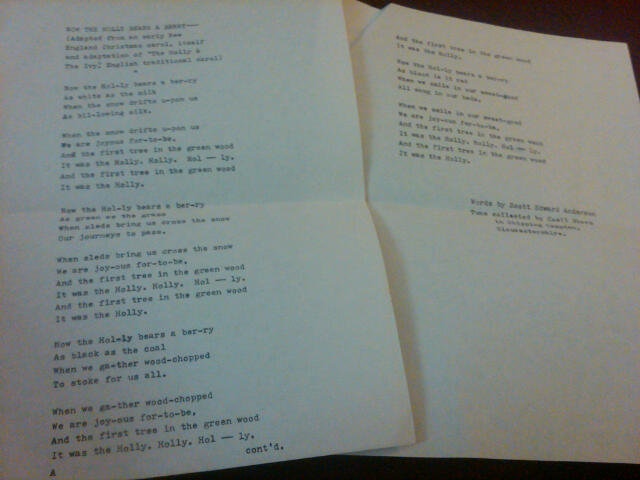
My typescript of "Now the Holly Bears a Berry..."
My 8-year-old daughter came across a couple of typewritten sheets of paper in a copy of The Penguin Book of Christmas Carols
“What’s this Papa?” she asked. “It looks like it was printed on a typewriter.”
It was “printed” on a typewriter, as the picture to the right attests; the tiny holes marking most of the periods are also a dead give-away. To this day, I have heavy fingers on a keyboard.
The poem was my attempt to rewrite the lyrics to an old carol known as “The Holly & The Ivy,” a traditional English carol whose best known words and tune were collected by Cecil Sharp, and begin,
“The holly and the ivy,
When they are both full grown,
Of all the trees that are in the wood,
The holly bears the crown…”
The crown is the crown of thorns, which if you have ever touched a holly leaf, you know its prickly scorn. The lyrics go on to draw analogues between the red berry of the holly and the blood of Christ, the “bitter gall” of the holly’s bark with the balm of Jesus as a redeemer.
It is a curious mix of Christian and Pagan imagery. Holly was associated with the winter solstice and known to be sacred to the druids.
My version was written more closely in the style of a traditional New England take on the “Sans Day Carol,” itself a Cornish carol from the 19th century that shares much with “The Holly & The Ivy.”
I’ve always loved the tune — there’s an excellent version of it on the Chieftans’s Christmas album, The Bells of Dublin
With that complicated provenance, here is my poem
(Adapted from an early New England Christmas carol, itself an adaptation of “The Holly & The Ivy,” an English traditional carol.)
Now the holly bears a ber-ry
As white as the milk
When the snow drifts u-pon us
As bil-lowing silk.
When the snow drifts u-pon us
We are joyous for-to-be,
And the first tree in the green wood
It was the Holly. Holly. Hol — ly.
And the first treee in the green wood
It was the Holly.
Now the Hol-ly bears a ber-ry
As green as the grass
When sleds bring us cross the snow
Our journeys to pass.
When sleds bring us cross the snow
We are joy-ous for-to-be,
And the first tree in the green wood
It was the Holly. Holly. Hol — ly.
And the first tree in the green wood
It was the Holly.
Now the Hol-ly bears a ber-ry
As black as the coal
When we ga-ther wood-chopped
To stoke for us all.
When we ga-ther wood-chopped
We are joy-ous for-to-be,
And the first tree int he green wood
It was the Holly. Holly. Hol — ly.
And the first tree in the green wood
It was the Holly.
Now the Hol-ly bears a ber-ry
As blood is it red
When we smile in our sweet-good
All snug in our beds.
When we smile in our sweet-good
We are joy-ous for-to-be,
And the first tree in the green wood
It was the Holly. Holly. Hol — ly.
And the first tree in the green wood
It was the Holly.
Words by Scott Edward Anderson
Juvenilia: “Snow Sleeping November”
November 19, 2011

Painting by Lisa Hess Hesselgrave, November 2002
JUVENILIA
1: compositions produced in the artist’s or author’s youth
2: artistic or literary compositions suited to or designed for the young
Origin of JUVENILIALatin, neuter plural of juvenilisFirst Known Use: 1622
As the Wikipedia entry for Juvenilia explains: “the term was first used in 1622 in George Wither‘s poetry collection Ivvenilia. Later, other notable poets, such as John Dryden and Alfred Lord Tennyson came to use the term for collections of their early poetry. Jane Austen‘s earlier literary works are also known by the name of Juvenilia. An exception to retrospective publication is Leigh Hunt’s collection Juvenilia, first published when he was still in his teens.”
One of my earliest extant poems, written when I was 15, came to my attention recently. The poem is called “Snow Sleeping November.” I was surprised by its language and resonance, although some of it seems over-written and bears too heavy an influence of Whitman, Frost, Hopkins, and perhaps Stephen Crane.
I can still see the cabin in New York’s Finger Lakes that provided its inspiration.
Here is my poem,
“Snow Sleeping November”
I realize the briskness of this November eve,
the quiet, complacency of stiff snow,
the darkness of full‑breasted snowclouds,
all of us retaining warmth
like soapstone.
My cup is full of hot water
the wood in the fire
gleams like cat’s eyes & gives-off a
sun‑like warmth‑‑radiant, welcoming.
Short days & long, frozen nights,
girding my boots
for the crisp winterchill,
wind driving drafts up my nose.
The sparkling, icy water
and trees stiff in the dead weight
of snow‑leaden branches.
Poets crawling at the clouds
pulling snow groundfast‑‑
Those November trees!
–Scott Edward Anderson
The painting is a sketch by my friend Lisa Hess Hesselgrave from my personal collection. You can see more work by Lisa at LisaHesselgrave.com
“Build What You Love”: The Search for the Perfect Poetry App
August 13, 2011

City Lights Books' Pocket Poets Series made poetry portable.
I started this post back in October, before becoming aware of quite a number of Poetry Apps for smartphones — that’s what I get for being stuck with a BlackBerry Storm, which sucks at storing apps and is so bad that no one in their right mind would write an app for it much less have one…er…ah…yeah.
Anyway, I’ll amend this post at the end with a few links to good lists of apps, which you can try if you are an iPhone or iPad user or perhaps even an HTC or Android user. At some point, I’ll join you. Here’s what I wrote in October:
My pal Andy Swan had a lively dialogue recently that I overheard on Twitter. He was talking about letting innovators innovate and not be beholden to some altruistic standard that dictates what they should work on.
(Microlending site Kiva.org is wrestling with this question, too, as they recently admitted their main competitor is, well, “Farmville,” the game where you can waste time tending a virtual farm instead of helping Kiva build real farms.)
Anyway, one of Andy’s points was about whether innovators should focus on solving societal ills or focus on solving problems that gnaw at them.
“What if Edison[‘s] not being able to read at night is not a legitimate problem while others starve,” Andy wrote.
He went on to say, “Innovators should build what they love. The market will distribute.”
I wondered what I would build if I were to just build what I love. And it got me thinking. I would love to build a new way of distributing poetry; one that makes it easy, portable and enjoyable for people.
What I’m thinking is something between and app and a book. As transformational as City Lights Books‘ Pocket Poets series, only with better design and more consistent, high quality poetry.
Of course — like my idea from over a decade ago for a poetry cable TV channel — there’s no money in it. Would that my interests were more like the virtual corruption you can participate in on “Mafia Wars,” but there it is.
I mentioned the idea to a dear friend of mine who said that perhaps I’m wrong; maybe there is a market for it. Not a huge market, perhaps, but certainly more than just a handful.
What features would you want in such an app, device, or “book”? Searchable index by poet, title, first line, assumed first line, theme, occasion, time-period, style?
It wouldn’t have to be a huge amount of storage on a device or would it? Could it be in the cloud and accessed via the cloud? Would you have to build in incentives for people to continue using it, contests, triva, etc.?
I’m just throwing this out there and will wrestle with it down the road. I may even pull together a Survey Monkey to gauge the interest need for features, and where the money is going to come from.
Well, it turned out there are quite a few apps out there already, so my idea was a little late in the game. Here are some links to some lists of apps you may want to explore:
Quick Access to Poetry in the Age of Technology (NY Times)
An essential poetry app as addictive as raspberries (Poetry Foundation)
Poetry Apps (Randall Weiss blog)
Poetry Apps (Emerging Writer blog)
Apps for Poets (App Advice b log)
A New Poetry App for the iPhone (Brian Spear)
I like what Spear, a poet and editor of The Rumpus, says in that last post about his ideal poetry app (back in May of 2010!):
The poetry app of my dreams is an aggregator, one that scans the web daily for new publications and then pulls them into a reader. It would need to push traffic to the online journals of origin and would have to include a way to limit the places you receive poetry from–maybe set it up so that the user gets a poem from a place and then decides whether or not to receive future updates from that journal. Swindle is a start toward that on the web, but I haven’t found anything like that for the iPhone yet.
Has that need been met? Do you have a poetry app you recommend? Do you want to build one with me? What would you build if you could build what you love?

 Scott Edward Anderson
 Scott Edward Anderson's Poetry Blog