30 Poems for National Poetry Month: Day 6
April 6, 2013
Here is my poem for Day 6 (or morning six, as it were…):

“Freedom’s just another word
For nothing left to lose,”
As it goes in that old
Kris Kristofferson song.
But we lose something
Every day, free or chained–
Cells, skin, hair, memories.
Time goes too, the sparrows
Mark it outside our window,
The mourning doves coo
And whisper, their throats
Parted by the morning mist.
We rise slowly on mornings
We’re alone together; infrequent
As those days may be.
Our bed loosing its grip
Ever so reluctantly.
“I ache to be in your hold,”
You wrote in a dream.
My poetess of sleep.
–Scott Edward Anderson
30 Poems for National Poetry Month: Day 5
April 5, 2013
 Here is my Day 5 poem for National Poetry Month:
Remember that Adrienne Rich poem
About falling in love at middle age?
The one where she talks about wanting
“To know even our limits.”
And where weeks stand in for years
Of not knowing one another.
Every day I’m convinced
That you are more beautiful
In your maturity, with your inner
Core more centered, than you
Could have been in your twenties.
(I am a better man now, too.)
And the time we do have can’t be
Wasted over what might have been,
Or how little of it there is.
We have what we have,
Which is a little like saying,
“It is what it is.”
Forget Manhattan
Or Berlin–
Let’s Take Brooklyn
And begin the beguine.
 I didn’t really know Jack Gilbert’s poetry much before my partner, Samantha’s mother (and my friend), Lee Langbaum, gave me his Collected Poems for the holidays, shortly after the poet’s death. (Gilbert died last November, after a long battle with Alzheimer’s.)
My life has been enriched reading Gilbert’s poetry — at times acerbic, quirky, and irascible — but I need to take him in small doses. There’s a risk in getting too close to fire.
Emily Dickinson famously wrote that “If I read a book [and] it makes my whole body so cold no fire ever can warm me I know that is poetry. If I feel physically as if the top of my head were taken off, I know that is poetry.”
Jack Gilbert’s poetry approaches that more often than not.
“He takes himself away to a place more inward than is safe to go,” the poet and novelist James Dickey said of Gilbert. “From that awful silence and tightening, he returns to us poems of savage compassion.”
“The hard part for me is to find the poem—a poem that matters,” Gilbert told The Paris Review. “To find what the poem knows that’s special. I may think of writing about the same thing that everyone does, but I really like to write a poem that hasn’t been written. And I don’t mean its shape. I want to experience or discover ways of feeling that are fresh. I love it when I have perceived something fresh about being human and being happy.”
Here is Jack Gilbert’s poem, “The Forgotten Dialect of the Heart”:
How astonishing it is that language can almost mean,
and frightening that it does not quite. Love, we say,
God, we say, Rome and Michiko, we write, and the words
Get it wrong. We say bread and it means according
to which nation. French has no word for home,
and we have no word for strict pleasure. A people
in northern India is dying out because their ancient
tongue has no words for endearment. I dream of lost
vocabularies that might express some of what
we no longer can. Maybe the Etruscan texts would
finally explain why the couples on their tombs
are smiling. And maybe not. When the thousands
of mysterious Sumerian tablets were translated,
they seemed to be business records. But what if they
are poems or psalms? My joy is the same as twelve
Ethiopian goats standing silent in the morning light.
O Lord, thou art slabs of salt and ingots of copper,
as grand as ripe barley lithe under the wind’s labor.
Her breasts are six white oxen loaded with bolts
of long-fibered Egyptian cotton. My love is a hundred
pitchers of honey. Shiploads of thuya are what
my body wants to say to your body. Giraffes are this
desire in the dark. Perhaps the spiral Minoan script
is not a language but a map. What we feel most has
no name but amber, archers, cinnamon, horses and birds.
-From THE GREAT FIRES: POEMS, 1982-1992 (Alfred A.Knopf, 1994)
Here is an audio recording of Gilbert reading this poem on April 12, 2005 at The New School in New York: http://www.poets.org/viewmedia.php/prmMID/19351
30 Poems for National Poetry Month: Day 4
April 4, 2013
 Here is my Day 4 poem:
“Happiness is a choice,”
Says my friend Jack.
Whether you choose
To focus on the love
Expressed or the flaws
Hinted at; that’s your choice.
(Okay, you snore.
Is that enough?)
I choose to focus
On thriving, after so long
Languishing. Now
That I have found
The jewel in the crescent
Moon that makes disappear
The flaws in the bezel of my being.
–Scott Edward Anderson
30 Poems for National Poetry Month: Day 3
April 3, 2013
 Here’s my Day 3 poem for National Poetry Month, which I wrote during a bout with insomnia in the wee hours of the morning:
Love is never perfect
And neither are you and me.
You don’t walk on water;
I prefer to swim under.
And there is nothing
Over my eyes, neither
Gauzy nor hued.
I see your flaws
And raise them with mine.
And I love you,
Even in your imperfections,
Which I won’t enumerate here.
And even with all mine. (Ditto.)
That’s real love, baby.
Get used to it. It’s yours
If you want it–
–Scott Edward Anderson
30 Poems for National Poetry Month: Day One & Two
April 2, 2013
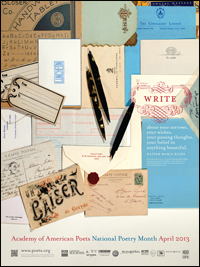 The challenge is to write a poem every day for National Poetry Month.
I’ve never cared for these daily, quick-writ challenges, preferring to let a poem mull and steep rather than be cast onto the page too quickly like a gambler shooting dice out of a cup.
But, yesterday, sitting in Bryant Park eating my lunch, I was inspired to give it a go. And then again this morning on the subway heading from Brooklyn into Manhattan.
So, here are my first two entries:
1
April Fools the fool that fools
With the sun on the first day
Of baseball season.
They’ve laid new grass down
On the lawn at Bryant Park.
Sign reading: “Lawn Closed”–
Where just a month ago
There was a skating rink.
“The new sod is establishing
Its roots.”
2
Our blended family whorled
Back from Disney World,
Dispersed to their other
Homes, to come together
Later in this month of poetry.
Our fantasy become reality.
–Scott Edward Anderson

Alison Hawthorne Deming and raccoon cub.
I love when poetry shows up in unexpected places.
The Poetry Society of America and the MTA recently revived their “Poetry in Motion” program on the New York City subways.
The Clint Eastwood Super Bowl commercial for Chrysler, written by poet Matthew Dickman, is another example.
“The Language of Conservation,” a Poets House project that provides residencies for poets in zoos around the country, is still another.
So I was thrilled when American Scientist magazine published my friend Alison Hawthorne Deming‘s poem “Mosquitoes” in a recent issue.
Alison lives in the Tucson desert and draws inspiration from the natural world there, her native New England, as well as Grand Manan Island, Canada, where she has a family home, the Everglades, Alaska — really, wherever she is.
Her work has long been concerned with the relationship between art and science — her first book was titled Science & Other Poems — and the science of looking at the world. So her appearance in a scientific magazine is not really a surprise, but the fact that the magazine publishes poetry at all is to be celebrated.
Alison’s books include the poetry collection Rope (Penguin, 2009) and the essay collection The Edges of the Civilized World (Picador USA, 1998). She is coeditor of The Colors of Nature: Essays on Culture, Identity, and the Natural World (Milkweed Editions, revised edition 2011).
Formerly director of the University of Arizona Poetry Center, Alison teaches creative writing at the University of Arizona and also serves as chair of the board of directors for Orion magazine. She recently completed a new nonfiction book titled Zoologies: On Animals and the Human Spirit.
Whether writing about individual species (The Monarchs), entire ecosystems, or the human despoilment of nature, Alison trains a scientist’s eye on her subjects. Yet, she’s not afraid to add a little wry humor into the mix.
“Mosquitoes” offers an enlightened victim’s view of this annoying insect, prompting us to appreciate its singleness of purpose and a reciprocity with which most of us would rather not comply.
Here is Alison Hawthorne Deming’s “Mosquitoes”:
First came the scouts who felt our sweat in the air
and understood our need to make a sacrifice.
We were so large and burdened with all we had carried,
our blood too rich for our own good. They understood
that we could give what they needed and never miss it.
Then came the throng encircling our heads like acoustic haloes
droning with the me-me-me of appetite. We understood
their pleasure to find such hairless beasts so easy to open and drink.
We understood their female ardor to breed and how little
they had to go on considering the protein required to make
their million-fold eggs. Vibrant, available, and hot,
we gave our flesh in selfless service to their future.
— Alison Hawthorne Deming
National Poetry Month Poem-a-Week 2012: Randall Maggs’s “Different Ways of Telling Time”
April 21, 2012

Bobby Orr flies through the air after scoring the Stanley Cup winning goal in 1970. Photo by Ray Lussier
The Stanley Cup Playoffs have been on my mind this week as my home town Boston Bruins attempt to defend their championship from last year — our first since my childhood.
I started playing hockey the same year I started writing poetry. And hockey legend Bobby Orr had something to do with both pursuits.
Poetry and hockey may seem unlikely bedfellows, but not to me. I was the player in the back of the bus with a stack of library books: the Beats, Transcendalists, Whitman’s Leaves of Grass, and a slim volume of Stephen (“Red Badge of Courage”) Crane’s poetry I’d love to find today.
To me, hockey is a kind of poetry; perhaps because my earliest memory of the sport is tied to a flying Bobby Orr in black and gold. The game is comprised of all life’s elements: brutality, grace, and fragility; the speed, tenacity, and acumen it takes to succeed in the world. All life’s triumphs and heartbreaks played out on a hard, frozen surface.
Bobby Orr and the Bruins won the Stanley Cup 1970 in a Mother’s Day overtime game captured in my memory by twin images: Orr flying through the air over the collapsing St. Louis goalie Glenn Hall — triumphant, jubilant, having just scored the winning goal; and the trajectory of my father’s beer can that I sent flying in my enthusiasm of the moment.
To this day, I don’t wear socks in my skates because that’s how #4 rolled, and Inever rest a beer can on the arm of a chair.
Orr’s first year in the league — 1966-67 — was the last year of the National Hockey League’s “Original Six”: Boston, New York, Montreal, Detroit, Chicago, and the improbably, poetically named Toronto Maple Leafs. That was also the last time Toronto won the Stanley Cup. The Leaf’s goalie that season, Terry Sawchuk, was one of the best of the golden era of goaltending.
It’s called the golden era because the game was rapidly changing, becoming a “shooters game.” Goaltenders had to develop new techniques and new approaches in response to the goal-scoring, stick-handling legends of the age, guys with names like Howe and Hull and Rocket Richard.
And unlike the heavily armored and padded goalies of today, Sawchuk and Hall and Jacques Plante and Gump Worsley didn’t wear masks; their faces were exposed to screaming pucks and sharpened blades and wooden spears brandished by bruisers careening down the ice at breakneck speeds.

Terry Sawchuk as a Boston Bruin, 1956. Associate Press Photo,
Canadian poet Randall Maggs wrote a book-length poetic tribute to the game and the complicated man who was Terry Sawchuk, Night Work: The Sawchuk Poems, is some of the best hockey writing I’ve read and it contains some pretty good poetry too.
Here are a few sections from Randall Maggs’ poem “Different Ways of Telling Time,” from Night Work:
(i) last minute of play
Four-faced, the clock sees everywhere.
Dead centre over the ice, it hangs from chains.
The players glance up, exchange a word, a sideward
look – less than a minute to go. They know time’s rough
and tumble. Space and time, that’s where they live,
arcs and angles, a quick move to open ice.
Their flashy physics.
Spectacles shift and glitter behind the glass.
Maybe someone they know but they never look
at the crowd. They’re at the bench to hear the plan –
“Boys, you get a bounce here, things can happen fast.”
Left out on the ice – they might as well be
on the moon – both goalies eye the clock,
one’s for zero, the other likes infinity,
but things can change.
Get going clock.
Slow down slow down.
No one in the building likes time’s pace.
(ii) you could drift out here forever
Jesus, here we go.
Seventh game, and seconds left to overtime.
Talk’s over at the glass, the captains
waved away. The referee holds four fingers up
and folds his arms, four seconds he wants put back
on the clock. Son of a bitch, an old defender
sags against the boards. Still, imagine the power,
to kick time’s arse like that.
(iv) ice time
The guys arrive as if at random intervals,
lay out their gear, lucky shirt, same skate first,
same old jokes about my liniment, Jesus,
Ukey, lose that shit why don’t you?
Roll their eyes and tiptoe by.
Check the clock and tape my own stick,
thank you, heel to toe, no wrinkles, tape the ankles.
Time to go out and get loose, guys in twos and threes
at home on ice, tucking pucks lazily under the crossbar.
Same old talk, someone you got to slow down,
a glance where he’s talking it up
with his own guys.
Here’s the house where I live, I can’t say no.
Howe and Lindsay’s eyes on me. Pronovost, tough
as a bag of batteries, slaps my pads. I see myself as I pass
in the glass, pick up that look from the other side, a nice pair
of knees that edge apart as I go by. I get a whiff of ice
and something in me starts alive. I take
a few shots, catch and flick, feeling
quick, clank behind me,
lucky too.
Then back inside and bedlam now. Adams
flapping but I don’t hear. Holy Mary, don’t let me
fall on my face tonight. I try to loosen a pad, my shaking
hand so bad Jesus Jesus. Tommy Ivan shoves in beside me,
knowing he needs to settle me down. New cufflinks on.
Knocks my stick for luck I’m nodding but Mother of Christ
I’m dying inside, can’t keep still now everybody wants to go,
the clatter, the chatter, rockers, talkers. “Gotta have this one.
Gotta have it guys.” This was where we’d bellow out
some raunchy song when we were young, scare
the bejesus out of everyone. “Nice neighbourhood like this,”
they’d say. “Who let the bloody DPs in?” Tommy drums
a rhythm on my leg – I watch his moving hand
distracted by the veins and lines that make the hand
a miracle, an acrobat, a thief. Gotta have it, guys.
I brace for the roar at the end of the tunnel.
“Give me a hand here, Tommy, tuck that in, that – look,
that bloody strap.” Then bang the door and Jesus here we go,
someone shouts those words I love and dread, I hear
them all my life – “Let the goalie go first.”
##P.S. During the Bruins 2012 Stanley Cup Playoffs, I’m participating in Beardathon, a fundraiser for kids charities, by growing my beard. You can vote for my beard, contribute towards my fundraising goal, and watch my progress at: http://www.beardathon.com/bruins/seabear/profile.aspx

Frederick Seidel at home in New York, 2009. Photo by Antonin Kratochovil/Vii
Poet Michael Hofmann, in his entertaining review of Frederick Seidel’s Poems 1959-2009
Hofmann draws comparisons with V.S. Naipaul and quotes from a new biography of that author saying the two are purveyors of “picong, a Trinidadian term, ‘from the French piquant, meaning sharp or cutting, where the boundary between good and bad taste is deliberately blurred, and the listener is sent reeling.’”
The New York Times called Seidel the “Laureate of the Louche,” which is to say simultaneously rakish and appealing. He is a poet with a penchant for the most expensive hotels, bespoke suits, handmade shoes, and Italian racing bikes – of the motor kind, not pedaling – and a strange, nearly fatal attraction to all that is dark and violent and decadent.
One is never quite sure if Seidel is putting it on – does he really do the things he says in his poems or is it all a persona? Is he playing with the reader the way he plays with form, with lines, with puns, with rhyme? That is to say, masterfully.
“Convinced life is meaningless, / I lack the courage of my conviction,” Seidel wrote in an early poem, “After the Party,” but then opens two poems – “Racer” and “Fog” — with the same line: “I spend most of my time not dying./ That’s what living is for.
Seidel’s poetry burns with a fury matched only by the leatherclad poet hitting 120 MPH on his custom-built Ducati. He takes a perverse pleasure in imagining his own fiery death, which hasn’t come; the poet turned 76 this year.
Take these lines from “A Gallop to Farewell,” quoted by Hoffmann:
The most underrated pleasure in the world is the takeoff
Of the Concorde and putting off the crash
Of the world’s most beautiful old supersonic plane,
with no survivors,
In an explosion of champagne.
Readers and critics either love or hate Seidel. There is no middle ground. But he couldn’t care less. He’s never taught or sought tenure or prizes or even a “career” in poetry, which is kind of an oxymoron anyway. He studied with Robert Lowell, but shook off his teacher’s influence pretty early on and hasn’t been associated with any poetry “movement.”
And while Seidel’s first book came out in 1963, he blossomed late, with 17 years between his first and second collection and 10 books published over the past two decades, culminating in his 500-page, 50 years worth of poems, which is the best of poetry I’ve read in a long time. What I mean by that is Seidel’s POEMS does what William Styron said a good book should: it leaves you slightly exhausted at the end because you lived several lives while reading it.
Here is Frederick Seidel’s “Fog”:
I spend most of my time not dying.
That’s what living is for.
I climb on a motorcycle.
I climb on a cloud and rain.
I climb on a woman I love.
I repeat my themes.
Here I am in Bologna again.
Here I go again.
Here I go again, getting happier and happier.
I climb on a log
Torpedoing toward the falls
Basically, it sticks out of me.
At the factory,
The racer being built for me
Is not ready, but is getting deadly.
I am here to see it being born.
It is snowing in Milan, the TV says.
They close one airport, then both.
The Lord is my shepherd and the Director of Superbike Racing.
He buzzes me through three layers of security
To the innermost secret sanctum of the racing department
Where I will breathe my last.
Trains are delayed.
The Florence sky is falling snow.
Tonight in Bologna is fog.
This afternoon, there it was,
With all the mechanics who are making it around it.
It stood on a sort of altar.
I stood in a sort of fog.
Taking digital photographs of my death.
–Frederick Seidel

Robert Browning
Next month marks the bicentennial of Robert Browning, who was born on May 7, 1812, in Camberwell, England. My Samantha recently sent me his poem “Now” and it spoke to me, although it was not familiar to me.
Browning is a bit of an enigma: simultaneously overshadowed by his more famous wife, the poet Elizabeth Barrett Browning, and lionized as one of the great creators of the dramatic monologue.
Victorian readers found his work somewhat difficult, in part because of his sometimes arcane language and obscure references. He was home-schooled and self-taught – subsequently, many of his allusions were lost on his more conventionally educated audience.
Ultimately, Browning, as Wordsworth said of all great poets, had to “create the taste by which [he was] to be enjoyed.”
One of Browning’s enduring themes was “ideal love,” which for the poet meant the consummation and culmination of an intuitive course of action wherein a pair of lovers pierce the barrier separating them to become one in an all-consuming spiritual union — the “moment eternal” between two human beings.
To Browning, the passion and intensity of romantic love was often at odds with conventional social morality. Ideal love in Browning’s conception required giving up everything, what others have called “the world well-lost for love.”
Here is Robert Browning’s short lyric poem, “Now”:
Out of your whole life give but a moment!
All of your life that has gone before,
All to come after it, — so you ignore,
So you make perfect the present, condense,
In a rapture of rage, for perfection’s endowment,
Thought and feeling and soul and sense,
Merged in a moment which gives me at last
You around me for once, you beneath me, above me —
Me, sure that, despite of time future, time past,
This tick of life-time’s one moment you love me!
How long such suspension may linger? Ah, Sweet,
The moment eternal — just that and no more —
When ecstasy’s utmost we clutch at the core,
While cheeks burn, arms open, eyes shut, and lips meet!
–Robert Browning, 1812-1889
 Scott Edward Anderson
