“Years are not a life…” and My Poem “Hope Against Hope”
July 22, 2012

The Charter for Rhode-Island and Providence Plantations.
My maternal grandmother, Marjorie Burgess Perry, was a funny woman.
I remember one story she told about her friend Ruthie, who got her hand caught in a meat grinder. I think the lesson there was about paying attention to what you’re doing in the moment.
Another time, she was sitting in her kitchen in East Providence, and had some advice to impart.
“I know I shouldn’t smoke,” she said, lighting a cigarette. “But my doctor said I need to stop drinking. And at my age, I can’t have sex anymore.”
She took a deep drag, exhaled, and quipped, “You have to have one vice.”
After she died, inevitably, at the hands of that one vice of hers, I found a few of her journals and a draft of a letter she wrote to me.
I’m not sure any of us knew the side of her that she poured into her writings. She was passionate, profound, and philosophical.
One of the phrases in her journals that struck me was “Years are not a life.”
A short time later I was working on a long poetic sequence called “Providence,” which attempts to tell the story of the European settling of Rhode-Island and Providence Plantations, King Philip’s War, the arrival of Portuguese in southern New England, and a bit of my family’s history there, which extends to 1637 in Sandwich, Massachusetts.
I used the phrase in one of the poems from the sequence, which was later published in Terrain.
Here is my poem, “Hope Against Hope”:
My mind is a slate gray sky
about to open up over the capitol. In the distance,
electricity grounds itself to Rhode Island’s terminal moraine,
and Narragansett Bay is alive with activity.
The city is like a tree, grafted to increase yield:
the scion of this hybrid is Freedom and the stock, Hope.
Did Roger Williams have this in mind, on the day
he was expelled from Massachusetts Bay Colony
and exiled to “Rogue’s Island?”
My mind is bent to the future
like a fly buzzing against a table lamp,
guided by some unknown power to the light.
Spruce-trees freckle Rhode Island’s low hills,
like “Indians” on horseback overlooking a settlement
in some old western. Years are not a life,
trees come down with heavy snow or summer storms,
others are cut to fuel fires in cast-iron stoves,
or are cleared for houses on subdivided acres.
Providence is an article of faith
as much as of divinity. Maybe a life is determined
in the balance of past, present, and future.
Providence, in the immutable language of trees:
Tulip-trees heavy-laden with their “magnolia” blossoms;
post oaks, twisted and stunted, like worried warriors;
ash, hickory, hope; willow, red spruce, blood;
poplar, pine, providence; sandy loam, eelgrass, freedom;
arrow-arum, water weed, Wampanoag; hope against hope.
My Version of Psalm 23, “Shepherd”
July 14, 2012

“David Playing the Harp,” by Jan de Bray, 1670
My partner Samantha and her family are in Jerusalem today, visiting the Tower of David among other significant sites in that city. They’ve been on tour in Israel all week, in advance of her nephew’s bar mitzvah on Monday.
David, the “warrior-poet,” slayer of Goliath, biblical King of Israel, uniter of the Jewish people, and writer of the Psalms.
He was a remarkable poet, and the Psalms are filled with all the complexities of who he was as a man: a fierce warrior, passionate lover, covenanted with God.
Psalms, which is important to Jewish, Christian, and Islamic traditions, is my favorite book of the Bible, along with that other great poetic work, the Song of Songs, written by David’s son, Solomon.
Psalm 23 is perhaps one of the most famous pieces of literature the world over. In this psalm, David portrays God as his shepherd. He uses the shepherd as a metaphor for the godly way his people should cope with fear and anxiety in their lives.
Here is my version of Psalm 23, which I’ve called, “Shepherd,” and which appeared in the journal A New Song nearly 20 years ago.
Shepherd
After Psalm 23
You prepare a table for us
in front of our enemies,
picking the sheepfold clean
with your own hands–
raw with the sting of nettle,
stained the color of sheep laurel.
Your back is stiff from bending,
filling your crooked arm
with lupine and false hellebore,
to keep us from having
one-eyed lambs.
From the bluestem foothills
comes the hush of rustling.
You look to the north,
sighting down landscape,
scenting the wind.
Your breath fills air,
pungent as pipe smoke.
Goodness and mercy, friend,
come forth from you as naturally
as clouds darkening this valley.
We would follow you anywhere,
dear shepherd, putting fears aside,
although you often seem foolhardy
in this green land, this restful pool.
—Scott Edward Anderson
Misidentifying Moths and My Poem “Summer Love”
June 23, 2012

Cecropia moth (Hyalophora cecropia)
My old friend and former decompositionalist compatriot, Penny Perkins, posted a gorgeous picture of a moth on Facebook today, which she misidentified as an “Endangered Emperor Moth.”
I recognized her mistake right away. The moth was, in fact, a Luna moth (Actias luna) and not Saturnia pavonia.
I noted this on her post in the comments section and also the fact that neither moth is endangered. She thanked me and then asked if, perchance, I had any poems about moths. I did or do.
(At least, I thought it was about moths. I’m never sure anymore what I was writing about when I wrote a poem!)
Here is my poem “Summer Love”:
The female cecropia moth,
Hyalophora cecropia, emerges
As in a stop-action film: swollen
Abdomen shrinking while wings
Rise, fill, and form. Pheromones
Kick in, attracting a male from miles away.
They couple quickly—how easy love can be.
Linked like this, at terminus,
They are most vulnerable to predators.
They will stay this way, available
To each other, for hours—
Then vanish as memory fades.
–Scott Edward Anderson

Eastern Redbud Tree (Cercis canadensis) blossoms - photo © Valerie Reneé
on Flickr - noncommercial use permitted with attribution / no derivative works
The Eastern redbud (Cercis canadensis) is one of my favorite trees. Native to eastern North America from southern Ontario to northern Florida, the redbud is an early harbinger of spring.
Also known as the “Judas tree,” it is among the first to bloom. In my experience, it flowers before the cherries and magnolias in the mid-Atlantic.
The redbud is easily recognizable from its showy, magenta to fuchsia-pink flowers appearing in clusters from March to May. Rather than bursting out of the ends of branches, however, the redbud’s flowers seem to “break out” on bare stems before the leaves and sometimes on the trunk itself.
The flowers are pollinated by long-tongued bees such as blueberry bees, carpenter bees and mining or miner bees.
Calvin, my pitbull, is no stranger to my readers and friends. I’ve written about him before and he had quite a few followers on my Twitter account (@greenskeptic) where I often post pictures of him.

Calvin in the Wissahickon
My poem, “Redbud & Pitbull,” originated from a scene I witnessed sitting on the porch of my former house two years ago. The redbud I had planted there a few years back had still produced no flowers.
I was curious about this fact and about the frenetic activity of the mining bees, which should have been pollinating the redbud, because both seemed to be indicative of my life at the time. I was simultaneously unsettled and not yet ready to flower.
What a difference a few years makes: the redbud flowered for the first time this year — and what glorious flowers have bloomed in my life!
Here is my poem, “Redbud & Pitbull”:
The mining bees are emerging.
Males zipping around
tiny holes in the ground
where females are burrowing
beneath the redbud.
The males have a curious display;
more manic than romantic,
expecting a mate to think crazy
is sexy or superior.
I guess we all
fall prey to a little crazy
love now and again,
do something foolish,
cross a line or two.
But the bees flying too close
to the ground are just frantic,
can’t imagine they’d make
suitable mates.
They course and dive and zip
(yes, that’s the best word for it, zip),
while females wait below the redbud.
My pitbull Calvin watches
the mining bees swirling
above and into the ground
beneath the redbud. He thinks,
Who or what are these (things)
buzzing and drilling in the dirt?
Truth is, the mining bees
–neither food nor friend—
pay him little interest.
Now Calvin grows bored,
slopes over to the sidewalk
flopping down in the sun.
The redbud’s waxy leaves
glisten in the same sun,
green edging into red.
Calvin is mottled, piebald,
brindle and white with a big brown
eye patch that makes people smile.
He’s a lover, not a fighter.
He cares little why the redbud’s shock
of fuchsia flowers, like scales or
a rash running up the limbs hasn’t shown.
He has no word for flowers
and little time for bees.
–Scott Edward Anderson
P.S. This poem, along with “Calvin’s Story,” appeared in Dogs Singing: A Tribute Anthology, published by Salmon Press. If you love dogs and poetry, you must have this book – it makes a great Mother’s Day gift too!

Alison Hawthorne Deming and raccoon cub.
I love when poetry shows up in unexpected places.
The Poetry Society of America and the MTA recently revived their “Poetry in Motion” program on the New York City subways.
The Clint Eastwood Super Bowl commercial for Chrysler, written by poet Matthew Dickman, is another example.
“The Language of Conservation,” a Poets House project that provides residencies for poets in zoos around the country, is still another.
So I was thrilled when American Scientist magazine published my friend Alison Hawthorne Deming‘s poem “Mosquitoes” in a recent issue.
Alison lives in the Tucson desert and draws inspiration from the natural world there, her native New England, as well as Grand Manan Island, Canada, where she has a family home, the Everglades, Alaska — really, wherever she is.
Her work has long been concerned with the relationship between art and science — her first book was titled Science & Other Poems — and the science of looking at the world. So her appearance in a scientific magazine is not really a surprise, but the fact that the magazine publishes poetry at all is to be celebrated.
Alison’s books include the poetry collection Rope (Penguin, 2009) and the essay collection The Edges of the Civilized World (Picador USA, 1998). She is coeditor of The Colors of Nature: Essays on Culture, Identity, and the Natural World (Milkweed Editions, revised edition 2011).
Formerly director of the University of Arizona Poetry Center, Alison teaches creative writing at the University of Arizona and also serves as chair of the board of directors for Orion magazine. She recently completed a new nonfiction book titled Zoologies: On Animals and the Human Spirit.
Whether writing about individual species (The Monarchs), entire ecosystems, or the human despoilment of nature, Alison trains a scientist’s eye on her subjects. Yet, she’s not afraid to add a little wry humor into the mix.
“Mosquitoes” offers an enlightened victim’s view of this annoying insect, prompting us to appreciate its singleness of purpose and a reciprocity with which most of us would rather not comply.
Here is Alison Hawthorne Deming’s “Mosquitoes”:
First came the scouts who felt our sweat in the air
and understood our need to make a sacrifice.
We were so large and burdened with all we had carried,
our blood too rich for our own good. They understood
that we could give what they needed and never miss it.
Then came the throng encircling our heads like acoustic haloes
droning with the me-me-me of appetite. We understood
their pleasure to find such hairless beasts so easy to open and drink.
We understood their female ardor to breed and how little
they had to go on considering the protein required to make
their million-fold eggs. Vibrant, available, and hot,
we gave our flesh in selfless service to their future.
— Alison Hawthorne Deming
National Poetry Month Poem-a-Week 2012: Randall Maggs’s “Different Ways of Telling Time”
April 21, 2012

Bobby Orr flies through the air after scoring the Stanley Cup winning goal in 1970. Photo by Ray Lussier
The Stanley Cup Playoffs have been on my mind this week as my home town Boston Bruins attempt to defend their championship from last year — our first since my childhood.
I started playing hockey the same year I started writing poetry. And hockey legend Bobby Orr had something to do with both pursuits.
Poetry and hockey may seem unlikely bedfellows, but not to me. I was the player in the back of the bus with a stack of library books: the Beats, Transcendalists, Whitman’s Leaves of Grass, and a slim volume of Stephen (“Red Badge of Courage”) Crane’s poetry I’d love to find today.
To me, hockey is a kind of poetry; perhaps because my earliest memory of the sport is tied to a flying Bobby Orr in black and gold. The game is comprised of all life’s elements: brutality, grace, and fragility; the speed, tenacity, and acumen it takes to succeed in the world. All life’s triumphs and heartbreaks played out on a hard, frozen surface.
Bobby Orr and the Bruins won the Stanley Cup 1970 in a Mother’s Day overtime game captured in my memory by twin images: Orr flying through the air over the collapsing St. Louis goalie Glenn Hall — triumphant, jubilant, having just scored the winning goal; and the trajectory of my father’s beer can that I sent flying in my enthusiasm of the moment.
To this day, I don’t wear socks in my skates because that’s how #4 rolled, and Inever rest a beer can on the arm of a chair.
Orr’s first year in the league — 1966-67 — was the last year of the National Hockey League’s “Original Six”: Boston, New York, Montreal, Detroit, Chicago, and the improbably, poetically named Toronto Maple Leafs. That was also the last time Toronto won the Stanley Cup. The Leaf’s goalie that season, Terry Sawchuk, was one of the best of the golden era of goaltending.
It’s called the golden era because the game was rapidly changing, becoming a “shooters game.” Goaltenders had to develop new techniques and new approaches in response to the goal-scoring, stick-handling legends of the age, guys with names like Howe and Hull and Rocket Richard.
And unlike the heavily armored and padded goalies of today, Sawchuk and Hall and Jacques Plante and Gump Worsley didn’t wear masks; their faces were exposed to screaming pucks and sharpened blades and wooden spears brandished by bruisers careening down the ice at breakneck speeds.

Terry Sawchuk as a Boston Bruin, 1956. Associate Press Photo,
Canadian poet Randall Maggs wrote a book-length poetic tribute to the game and the complicated man who was Terry Sawchuk, Night Work: The Sawchuk Poems, is some of the best hockey writing I’ve read and it contains some pretty good poetry too.
Here are a few sections from Randall Maggs’ poem “Different Ways of Telling Time,” from Night Work:
(i) last minute of play
Four-faced, the clock sees everywhere.
Dead centre over the ice, it hangs from chains.
The players glance up, exchange a word, a sideward
look – less than a minute to go. They know time’s rough
and tumble. Space and time, that’s where they live,
arcs and angles, a quick move to open ice.
Their flashy physics.
Spectacles shift and glitter behind the glass.
Maybe someone they know but they never look
at the crowd. They’re at the bench to hear the plan –
“Boys, you get a bounce here, things can happen fast.”
Left out on the ice – they might as well be
on the moon – both goalies eye the clock,
one’s for zero, the other likes infinity,
but things can change.
Get going clock.
Slow down slow down.
No one in the building likes time’s pace.
(ii) you could drift out here forever
Jesus, here we go.
Seventh game, and seconds left to overtime.
Talk’s over at the glass, the captains
waved away. The referee holds four fingers up
and folds his arms, four seconds he wants put back
on the clock. Son of a bitch, an old defender
sags against the boards. Still, imagine the power,
to kick time’s arse like that.
(iv) ice time
The guys arrive as if at random intervals,
lay out their gear, lucky shirt, same skate first,
same old jokes about my liniment, Jesus,
Ukey, lose that shit why don’t you?
Roll their eyes and tiptoe by.
Check the clock and tape my own stick,
thank you, heel to toe, no wrinkles, tape the ankles.
Time to go out and get loose, guys in twos and threes
at home on ice, tucking pucks lazily under the crossbar.
Same old talk, someone you got to slow down,
a glance where he’s talking it up
with his own guys.
Here’s the house where I live, I can’t say no.
Howe and Lindsay’s eyes on me. Pronovost, tough
as a bag of batteries, slaps my pads. I see myself as I pass
in the glass, pick up that look from the other side, a nice pair
of knees that edge apart as I go by. I get a whiff of ice
and something in me starts alive. I take
a few shots, catch and flick, feeling
quick, clank behind me,
lucky too.
Then back inside and bedlam now. Adams
flapping but I don’t hear. Holy Mary, don’t let me
fall on my face tonight. I try to loosen a pad, my shaking
hand so bad Jesus Jesus. Tommy Ivan shoves in beside me,
knowing he needs to settle me down. New cufflinks on.
Knocks my stick for luck I’m nodding but Mother of Christ
I’m dying inside, can’t keep still now everybody wants to go,
the clatter, the chatter, rockers, talkers. “Gotta have this one.
Gotta have it guys.” This was where we’d bellow out
some raunchy song when we were young, scare
the bejesus out of everyone. “Nice neighbourhood like this,”
they’d say. “Who let the bloody DPs in?” Tommy drums
a rhythm on my leg – I watch his moving hand
distracted by the veins and lines that make the hand
a miracle, an acrobat, a thief. Gotta have it, guys.
I brace for the roar at the end of the tunnel.
“Give me a hand here, Tommy, tuck that in, that – look,
that bloody strap.” Then bang the door and Jesus here we go,
someone shouts those words I love and dread, I hear
them all my life – “Let the goalie go first.”
##P.S. During the Bruins 2012 Stanley Cup Playoffs, I’m participating in Beardathon, a fundraiser for kids charities, by growing my beard. You can vote for my beard, contribute towards my fundraising goal, and watch my progress at: http://www.beardathon.com/bruins/seabear/profile.aspx

Frederick Seidel at home in New York, 2009. Photo by Antonin Kratochovil/Vii
Poet Michael Hofmann, in his entertaining review of Frederick Seidel’s Poems 1959-2009
Hofmann draws comparisons with V.S. Naipaul and quotes from a new biography of that author saying the two are purveyors of “picong, a Trinidadian term, ‘from the French piquant, meaning sharp or cutting, where the boundary between good and bad taste is deliberately blurred, and the listener is sent reeling.’”
The New York Times called Seidel the “Laureate of the Louche,” which is to say simultaneously rakish and appealing. He is a poet with a penchant for the most expensive hotels, bespoke suits, handmade shoes, and Italian racing bikes – of the motor kind, not pedaling – and a strange, nearly fatal attraction to all that is dark and violent and decadent.
One is never quite sure if Seidel is putting it on – does he really do the things he says in his poems or is it all a persona? Is he playing with the reader the way he plays with form, with lines, with puns, with rhyme? That is to say, masterfully.
“Convinced life is meaningless, / I lack the courage of my conviction,” Seidel wrote in an early poem, “After the Party,” but then opens two poems – “Racer” and “Fog” — with the same line: “I spend most of my time not dying./ That’s what living is for.
Seidel’s poetry burns with a fury matched only by the leatherclad poet hitting 120 MPH on his custom-built Ducati. He takes a perverse pleasure in imagining his own fiery death, which hasn’t come; the poet turned 76 this year.
Take these lines from “A Gallop to Farewell,” quoted by Hoffmann:
The most underrated pleasure in the world is the takeoff
Of the Concorde and putting off the crash
Of the world’s most beautiful old supersonic plane,
with no survivors,
In an explosion of champagne.
Readers and critics either love or hate Seidel. There is no middle ground. But he couldn’t care less. He’s never taught or sought tenure or prizes or even a “career” in poetry, which is kind of an oxymoron anyway. He studied with Robert Lowell, but shook off his teacher’s influence pretty early on and hasn’t been associated with any poetry “movement.”
And while Seidel’s first book came out in 1963, he blossomed late, with 17 years between his first and second collection and 10 books published over the past two decades, culminating in his 500-page, 50 years worth of poems, which is the best of poetry I’ve read in a long time. What I mean by that is Seidel’s POEMS does what William Styron said a good book should: it leaves you slightly exhausted at the end because you lived several lives while reading it.
Here is Frederick Seidel’s “Fog”:
I spend most of my time not dying.
That’s what living is for.
I climb on a motorcycle.
I climb on a cloud and rain.
I climb on a woman I love.
I repeat my themes.
Here I am in Bologna again.
Here I go again.
Here I go again, getting happier and happier.
I climb on a log
Torpedoing toward the falls
Basically, it sticks out of me.
At the factory,
The racer being built for me
Is not ready, but is getting deadly.
I am here to see it being born.
It is snowing in Milan, the TV says.
They close one airport, then both.
The Lord is my shepherd and the Director of Superbike Racing.
He buzzes me through three layers of security
To the innermost secret sanctum of the racing department
Where I will breathe my last.
Trains are delayed.
The Florence sky is falling snow.
Tonight in Bologna is fog.
This afternoon, there it was,
With all the mechanics who are making it around it.
It stood on a sort of altar.
I stood in a sort of fog.
Taking digital photographs of my death.
–Frederick Seidel

Robert Browning
Next month marks the bicentennial of Robert Browning, who was born on May 7, 1812, in Camberwell, England. My Samantha recently sent me his poem “Now” and it spoke to me, although it was not familiar to me.
Browning is a bit of an enigma: simultaneously overshadowed by his more famous wife, the poet Elizabeth Barrett Browning, and lionized as one of the great creators of the dramatic monologue.
Victorian readers found his work somewhat difficult, in part because of his sometimes arcane language and obscure references. He was home-schooled and self-taught – subsequently, many of his allusions were lost on his more conventionally educated audience.
Ultimately, Browning, as Wordsworth said of all great poets, had to “create the taste by which [he was] to be enjoyed.”
One of Browning’s enduring themes was “ideal love,” which for the poet meant the consummation and culmination of an intuitive course of action wherein a pair of lovers pierce the barrier separating them to become one in an all-consuming spiritual union — the “moment eternal” between two human beings.
To Browning, the passion and intensity of romantic love was often at odds with conventional social morality. Ideal love in Browning’s conception required giving up everything, what others have called “the world well-lost for love.”
Here is Robert Browning’s short lyric poem, “Now”:
Out of your whole life give but a moment!
All of your life that has gone before,
All to come after it, — so you ignore,
So you make perfect the present, condense,
In a rapture of rage, for perfection’s endowment,
Thought and feeling and soul and sense,
Merged in a moment which gives me at last
You around me for once, you beneath me, above me —
Me, sure that, despite of time future, time past,
This tick of life-time’s one moment you love me!
How long such suspension may linger? Ah, Sweet,
The moment eternal — just that and no more —
When ecstasy’s utmost we clutch at the core,
While cheeks burn, arms open, eyes shut, and lips meet!
–Robert Browning, 1812-1889
Elegy & Exile: Elizabeth Bishop’s Poem “Crusoe in England”
February 8, 2012
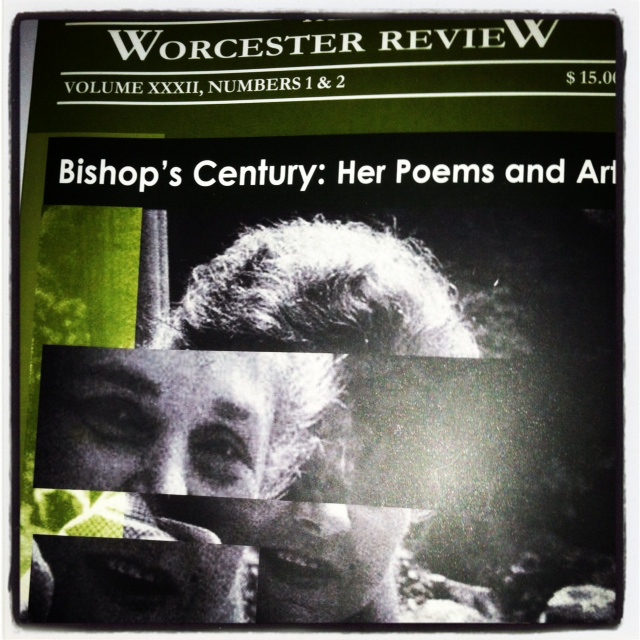
Cover of The Worcester Review, Vol 32, No. 1 &2
All year long I’ve been celebrating the 100th anniversary of the birth of the poet Elizabeth Bishop (1911-1979).
You can read some of what I’ve written about Ms. Bishop and her poetry on this blog.
Today, the 101st anniversary of the poet’s birth, to mark the completion of the centennial celebrations, I want to share my essay “Elegy & Exile: Elizabeth Bishop’s Poem ‘Crusoe in England’.”
Here is my essay as it appeared in The Worcester Review‘s special edition “Bishop’s Century: Her Poems and Art”:
A new volcano has erupted,
the papers say, and last week I was reading
where some ship saw an island being born
…
They named it. But my poor island’s still
un-rediscovered, un-renamable.— Elizabeth Bishop
So begins Elizabeth Bishop’s poem, “Crusoe in England” one of two fine elegies found in her last collection, Geography III, and her longest sustained narrative poem.
The island is “un-renamable,” which implies it was named by someone once. In fact, the speaker in the poem named it “The Island of Despair,” for its volcanic centerpiece, “Mont d’Espoir or Mount Despair.” He had time to play with names; twenty-eight years, by at least one account.
The speaker is, of course, the protagonist of Daniel Defoe’s 1719 novel, Robinson Crusoe – and he isn’t.
Defoe’s Robinson was Christian, civilized, and strongly empirical in his thinking; Bishop’s Crusoe is skeptical and unsure of his knowledge and memory.
Both are displaced figures, but Defoe’s Robinson feels that displacement most acutely on the island upon which he is shipwrecked. Bishop’s Crusoe feels more displaced after his return to “another island,/ that doesn’t seem like one…” His home country of England.
Crusoe was lonely on the island; its clouds, volcanoes, and water-spouts were no consolation – “beautiful, yes, but not much company.” He experiences a “dislocation of physical scale,” as Bishop biographer Lorrie Goldensohn observed.
He’s a giant compared to the volcanoes, which appear in miniature from such distance; the goats and turtles, too. It is, Goldensohn writes, “an analogue of the nausea of connection and disconnection.”
Then “Friday” arrives, but even their relationship, in the Bishop poem, is tinged with loneliness. They both long for love they cannot consummate, “I wanted to propagate my kind,/ and so did he, I think, poor boy.”
Defoe’s Robinson is much less isolated. His island is visited by native cannibals who take their victims to the island to be eaten (Friday is their prisoner; until Crusoe saves him and names him), as well as Spaniards, and English mutineers. This last group helps Robinson return to England with Friday. There are other adventures in the novel, including a voyage to Lisbon and a crossing of the Pyrenees on foot.
None of this is for Bishop. Her goal was not to re-write the novel, but to re-imagine the story. Her Crusoe possesses, as C.K. Doreski has noted, “a weary tonality of such authenticity her character seems not an extension of Defoe’s fictional exile, but a real Crusoe, endowed with a twentieth-century emotional frankness.”
Bishop’s Crusoe finds even deeper loneliness back “home,” with its “uninteresting lumber.” Once there, he longs for the intensity of life on his island, its violence and self –determination, and its objects full of meaning.

The author at Elizabeth Bishop’s grave, July 4, 2011
“Disconcertingly,” as Goldensohn describes it, “Crusoe discovers that the misery from which he so willingly fled was the chief stock of his life.”
Defoe’s Robinson returns to England to find nothing there for him. Robinson’s family thought him dead after his 28-year absence, and there is no inheritance for him, no fortune to claim, no home.
Crusoe, in Bishop’s devising, also finds nothing for him at home, despite the longing he felt for it while a castaway. His loss is a spiritual and cultural loss.
While on the island, he tries to hold onto his home culture. He makes “tea” and a kind of fizzy fermented drink from berries he discovers, even a homemade flute with “the weirdest scale on earth.”
Alas, he doesn’t remember enough of his culture’s great literature to make him feel at home,
The books
I’d read were full of blanks;
the poems – well, I tried
reciting to my iris beds,
“They flash upon that inward eye,
which is the bliss…” The bliss of what?
One of the first things that I did
When I got back was look it up.
The bliss is, of course, “solitude,” which is the word completing this line from Wordsworth’s “Daffodils” (” I wandered lonely as a cloud…”). We forgive Bishop this anachronism; Wordsworth’s poem was written over one hundred years after Defoe’s novel. By referencing this line she creates a sense of displacement or dislocation in us, her readers.
For Bishop’s Crusoe, solitude approaches bliss by way of banality, especially when he reflects on what was lost – including Friday, who was introduced with the banal phrase, “Friday was nice and we were friends.”
The potency of their relationship is merely hinted at; perhaps reflecting Bishop’s own sense of decorum in matters personal. (“Accounts of that have everything all wrong,” Bishop writes.)
Some critics have suggested that Friday in this poem is a stand-in for Lota de Soares Macedo, Bishop’s Brazilian lover; while others, James Merrill among them, wondered why Bishop couldn’t give us “a bit more about Friday?”
For almost as soon as Friday arrives they are taken off the island. By the end of the poem, we learn that Friday died of measles while in England, presumably a disease to which he had no immunity.
Bishop began writing “Crusoe in England” in the early 1960s – although notebook entries from 1934 hint that the poem may have its origins in her time at Vassar – and picked it up again after Lota’s death in 1967. (Goldensohn postulates based upon her reading of drafts of the poem that Bishop brought Friday into the poem at that time.)
She worked on it again after a visit to Charles Darwin’s home in Kent. She relied on Darwin’s notes from the Galapagos for her depiction of the island, along with Herman Melville’s “Encantadas,” and perhaps Randall Jarrell’s “The Island,” as has been suggested, as well as on her own experience of tropical and sub-tropical locales.
By the time she visited Galapagos in 1971, however, the poem had been delivered to The New Yorker. She must have been fairly pleased that her description was almost spot-on. (My own experience of the Galapagos has the spitting and hissing she writes about coming from the iguanas rather than the turtles, but no matter.)
Bishop’s friend and fellow poet, Robert Lowell, thought “Crusoe” to be “maybe your very best poem,” and I’m inclined to agree. (Although the poem preceding it in 1979’s Geography III, “The Waiting Room,” gives it a run for my money.)
“An analogue to your life,”Lowell wrote in a letter to Bishop, “or an ‘Ode to Dejection.’ Nothing you’ve written has such a mix of humor and desperation.”
It’s true this poem has a kind of desperation to it that comes from desolation and longing, for “home,” in particular, be it the island or England. Bishop’s humor is evident, too, in such lines as
What’s wrong about self-pity, anyway?
With my legs dangling down familiarly
over a crater’s edge, I told myself
“pity should begin at home.” So the more
pity I felt, the more I felt at home.
“By making [Crusoe’s] life center around the idea of home,” writes biographer Brett Millier, Bishop “brings him in line with her own habitually secular and domestic points of view.”
Crusoe was also an unwitting solitary, who reluctantly gave in to his plight. As such, he appealed to Bishop, especially in his self-reliance. He made things from what’s at hand, just as she made poems from what surrounded her. She, too, had surrendered to her “exile” in Brazil.
There’s an ungentle madness to Crusoe the solitary, which also contrasts somewhat with Defoe’s Robinson. The latter reads the Bible and becomes increasingly more religious. Bishop’s Crusoe is more pagan, painting goats with berry juice, dreaming of “slitting a baby’s throat, mistaking it/ for a baby goat,” and has visions of endlessly repeating islands where he is fated to catalog their flora and fauna.
I’m tempted to see this last reference as almost a nightmare reflection of the poet’s own self-exile and imprisonment by her style: her oft-cited gift for description, which she saw as limiting.
Regardless of whether Bishop saw herself in her Crusoe, her own removal to New England from Brazil – to Harvard’s uninteresting lumber – must have caused equal disconnection, a “dislocating dizziness,” to borrow Goldensohn’s phrase.
“When you write my epitaph, you must say I was the loneliest person who ever lived,” Bishop wrote to Robert Lowell in 1948. In “Crusoe in England,” she captures the loneliness, displacement, and loss of an individual set adrift in emotional isolation, which leads to a kind of post-traumatic stress syndrome.
For Crusoe, his island life seemed interminable and insufferable, only to turn romantic and desirable when the experience ended.
It seems likely Bishop was thinking of her life in Brazil with Lota, which had become increasingly strained towards the end, until the latter’s suicide, and the poet’s life thereafter. That makes this poem, along with “One Art,” from the same collection, an elegy with a depth beyond its surface.
Here is a link to the complete text of “Crusoe in England,” which includes an audio recording of Bishop reading the poem: http://www.poetryfoundation.org/poem/177903
–Scott Edward Anderson
“Winter Into Spring” – Ya know, “Baby birds and plants blooming…”
February 1, 2012

My son Walker pointing out crocuses in early March 2005.
I know it’s only February 1st, but it feels like Spring here on the eastern seaboard of the US.
Who knows what will happen when Punxsutawney Phil gets a look at the grass tomorrow morning? I doubt very much he will see his shadow.
It’s 64 degrees and sunny as I write this and earlier today I saw a robin bopping along by the train station.
My friend Leigh Scott challenged me to write a poem with the title or theme, “Winter Into Spring.”
As it happens, I already have a poem by that title, which I composed back in the late 90s upon my return to this coast from a few years in Alaska.
Here is my poem,
“Winter Into Spring”
Persephone brings life to the dead
With spring’s eternal hope,
Sharing the desires of young and old,
Partners in the revival of dreams.
Now dormant seeds awaken in the ground,
Hyacinth stirs with tender shoots,
And robin heralds the lengthening days;
Now winter’s coat floods river and marsh,
As we play at Eros with silk and lace.
–Scott Edward Anderson
 Scott Edward Anderson
 Scott Edward Anderson's Poetry Blog