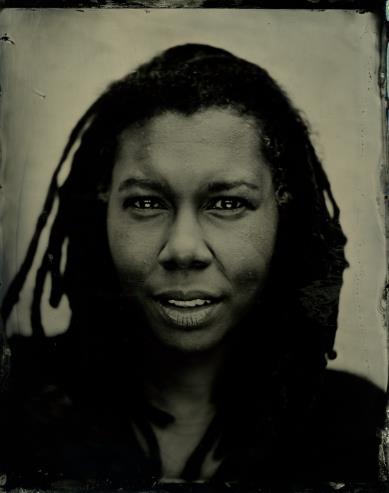
Sheree Mack c) 2012 Alastair Cook
Every month it seems there is another flashpoint of tensions between police and black communities in cities around the United States.
From Ferguson to Baltimore, our country seems ready to tear at the seams from a volatile combination of racial prejudice, police militarism, and the systemic poverty and disenfranchisement black people feel in America today.
It is impossible to ignore this critical issue of our day – we ignore it at our peril – even in a forum such as this.
In that light, I asked poet Sheree Mack if I could feature one of her poems for this final week of National Poetry Month. I was thinking we’d choose one from her remarkable new book, Laventille, which I’ve just started reading.
But Sheree asked if I’d rather have a new poem, one where she is trying “to get my head around the issue of race in America now with #BlackLivesMatter and how things haven’t changed much since lynching was another arm of the ‘law’.”
When she sent me, “Called Witness,” I jumped at the chance to share it, with its unflinching mixture of found texts (from a source cited below) and its paraphrase of Billie Holiday’s “Strange Fruit” in line 8.
Sheree Mack was born in 1971 in Bradford, England, to a Trinidadian father and a “Geordie” mother of Ghanaian and Bajan ancestry. She worked as a teacher for several years before studying for a PhD on black British women poets.
Sheree now dedicates her life to “fostering creativity in everyone’s life” working with communities of women and young writers, and currently lives in Tynemouth. She is the author of two collections, Family Album (Flambard Press, 2011) and Laventille (Smokestack Books, 2015).
I met Sheree Mack through the group “52,” which I participated in last year. Members of “52” wrote poems each week to prompts supplied by the group’s founder, Jo Bell, and commented upon each other’s work in a closed group on Facebook. (See my blog post on the subject here.)
Sheree’s poetry rose to the surface in my mind for its clarity, craft, and complexity of vision. Mack’s poems “lament, rage and mourn,” as the publisher says about her latest book. “But they also offer a song of healing, a celebration of survival, a glimmer of the flames that burn in the hearts of a people still living in slavery’s dark shadow. “
Her perceptive comments on a number of poems (mine and others) flagged her as one of those people you want to spend time with, even if the only opportunity is through the auspices of a virtual poetry workshop.
It was only later that I realized she was also the subject of my friend Alastair Cook’s stunning collodion portrait of a striking woman with captivating eyes, that I’d seen as part of his McArthur’s Store exhibition. There is something haunting about this portrait, as is the case of much of Alastair’s work in the medium.
The image is timeless or time-bound or both simultaneously. It could just as easily be a photograph of someone from Trinidad and Tobago at the time of the 1970 student uprisings in Laventille (the subject of her book) or an image from an even earlier era.
In short, the photo is a bit like Sheree Mack’s poetry: a bit timeless, a bit time-bound, but always unflinching and intriguing.
Here is Sheree Mack’s poem, “Called Witness”:
The exhibition opened in a small New York gallery.
The crowds came, self-righteous and proud.
Assembled and displayed were sixty photographs,
collected from family albums, attic trunks, flea markets.
Small, black-and-white postcards,
not more than a few inches long and wide,
depicting African-American men in Jim Crow
South; black bodies swinging from poplar trees.
Long lines stood for hours on the wintry
sidewalk, waiting for their view.
Once inside, bodies overwhelmed the intimate space.
Images laid flat on display tables or assembled
in tight groupings tacked to light-coloured walls.
Tattered, faded and worn, neither retouched nor restored.
Nor framed, matted, or captioned. Instead offered
as artefacts, not fine art objects. None for sale.
Visitor huddled close, hunched over tables,
faces pushed up against the walls, they felt
the warmth and proximity of others, jostling
and angling their bodies for a better look.
Through generations, onlookers enticed to the scene
by the spectacle of mutilated, dangling bodies.
c) 2015 Sheree Mack
Used by permission of the author.
_________________
Text cited: Lynching Photographs by Dora Apel and Shawn Michelle Smith,
University of California Press, Berkeley and Los Angeles, California, 2007

Table Mountain, Cape Town, South Africa. Photo by the author.
As some of you know, my new role in my day job at EY involves helping globalize prepaid smart metering programs for municipal utilities in emerging markets.
It’s a project that started in South Africa, and I think it’s pretty cool to be exporting an innovation from the African continent rather than imposing it from outside.
Traveling to South Africa, I’ve begun to explore the literature and art of the country over the last 20 years since the end of apartheid.
Thinking about poets whose work I could share, I thought about the work of Isobel Dixon. I know Isobel chiefly through social media — I believe it was Jo Bell or the Scottish Poetry Library who first introduced me to her work.
Dixon lives in London, but was born in Umtata, South Africa, and grew up in the semi-desert region known as the Karoo. She studied in the South African winelands country of Stellenbosch (where I was with my wife Samantha in January) and in Edinburgh.
In 2000, Dixon won the Sanlam Literary Award for her then unpublished collection of poetry Weather Eye, which was subsequently published by Carapace Poets (2001). She is also the author two collections, The Tempest Prognosticator and A Fold in the Map, both published by Salt in the UK. You can read more of her work at isobeldixon.com
I love the rhythms and musicality of Isobel Dixon’s poem, “She Comes Swimming,” and the mix of history and mythology that unfolds as we read. Of the poem Dixon wrote in an email to me,
“This is a poem very close to my heart, about my beloved country, South Africa. I wrote it in my first years abroad, feeling very keenly what it means to live far from the motherland, to yearn for it – and yet to fear that time away will change you, or change others’ perceptions of you, so that you might be perceived as an outsider, in spite of all you feel and are.”

Winelands, South Africa. Photo by the author.
Dixon “won a scholarship to do postgraduate study in my father’s native Scotland, the realisation of a dream, but at a time when I’d rather have stayed in South Africa – the momentous year of the first democratic elections.”
Another aspect of the poem that I particularly admire is what Dixon explains as “This sense of rueful distance, of vivid longing, and an awareness of the complex histories and hybrid mythologies of my faraway homeland, all fed into a poem about my imagined journey southwards, swimming back in time and language too.”
Dixon also told me that the poem has a central place in her Salt collection, A Fold in the Map, a collection that looks at the traveler’s state of “in-betweenness,” caught between lives and countries.
“The poem flowed onto the page in something of a hypnotic state,” Dixon wrote. “One of those poems you look at the day after and think, ‘Where did that come from, and how?’ Wherever it summoned itself from, I’m glad it did.” We are too.
Here is Isobel Dixon’s poem, SHE COMES SWIMMING
She comes swimming to you, following
da Gama’s wake. The twisting Nile
won’t take her halfway far enough.
No, don’t imagine sirens – mermaid
beauty is too delicate and quick.
Nor does she have that radiance,
Botticelli’s Venus glow. No golden
goddess, she’s a southern
selkie-sister, dusky otter-girl
who breasts the cold Benguela, rides
the rough Atlantic swell, its chilly
tides, for leagues and leagues.
Her pelt is salty, soaked. Worn out,
she floats, a dark Ophelia, thinking
what it feels like just to sink
caressed by seaweed, nibbled by
a school of jewel-plated fish.
But with her chin tipped skyward
she can’t miss the Southern Cross
which now looks newly down on her,
a buttress for the roof of her familiar
hemisphere. She’s nearly there.
With wrinkled fingertips, she strokes
her rosary of ivory, bone and horn
and some black seed or stone
she can’t recall the name of,
only knows its rubbed-down feel.
And then she thanks her stars,
the ones she’s always known,
and flips herself, to find her rhythm
and her course again. On, southwards,
yes, much further south than this.
This time she’ll pay attention
to the names – not just the English,
Portuguese and Dutch, the splicings
and accretions of the years. She’ll search
for first names in that Urworld, find
her heart-land’s mother tongue.
Perhaps there’s no such language,
only touch – but that’s at least a dialect
still spoken there. She knows when she
arrives she’ll have to learn again,
so much forgotten, lost. And when
they put her to the test she fears
she’ll be found wanting, out of step.
But now what she must do is swim,
stay focused on each stroke,
until she feels the landshelf
far beneath her rise, a gentle slope
up to the rock, the Cape,
the Fairest Cape. Her Mother City
and its mountain, waiting, wrapped
in veils of cloud and smoke.
Then she must concentrate, dodge
nets and wrack, a plastic bag afloat –
a flaccid, shrunk albino ray –
until she’s close enough to touch
down on the seabed, stumble
to the beach – the glistening sand
as great a treasure as her Milky Way –
fall on her knees and plant a kiss
and her old string of beads,
her own explorer’s cross
into the cruel, fruitful earth at last.
She’s at your feet. Her heart
is beating fast. Her limbs are weak.
Make her look up. Tell her she’s home.
Don’t send her on her way again.
© 2001, Isobel Dixon
Used by permission of the author.

View of Mt. Zion from the Moses Montefiore Windmill. Photograph by the author.
Last month, Samantha and I went to Israel. It was my first time in the country and my first visit to the Holy Land.
I was struck by the conundrum that is Israel. On the one hand, there is the history of the land and the history on the land.
Three of the world’s major religions were built from the earth there and sprouted and diverged as any people do, resulting in conflict and misunderstanding.
On the other hand, there is evidence of these religious factions co-existing much like that bumper sticker popular a few years ago featuring the message “Co-Exist” and a pantheon of religious symbols, as if to ask, can’t we all just “get along”?
In Old Jaffa, south of Tel Aviv, for instance, ancient mosques and churches and synagogues sit cheek by jowl along the sea approach. And the market in Jerusalem is filled with Muslim and Jewish merchants distinguished perhaps only by their working hours and some specific merchandise.
Concurrent with this trip, Samantha asked me to write a poem to serve as the peace prayer at her daughter, Erica’s Bat Mitzvah, which happens to be this weekend. I was honored that not only Samantha, but my stepdaughter, too, wanted me to participate in her special day.
I’d been thinking about the subject on my first days in Israel, much of which was spent on my own as Samantha was in a conference.
But it wasn’t until our last day, in Jerusalem, when a tour guide we’d hired read a poem of Yehuda Amichai’s called “An Arab Shepherd is Searching for His Goat on Mt. Zion,” as we stood on a hill under the Moses Montefiore windmill overlooking Mt. Zion, that a poem started to come to me.
(Amichai is significant, too, because I gave Erica’s brother Max a book of Amichai’s poetry for his Bar Mitzvah a few years ago.)
Here is my poem “Peace On Mt. Zion,” which I dedicate to Erica and will read at her ceremony:
PEACE ON MT. ZION
(for Erica, on her Bat Mitzvah)
Peace is such an abstract word,
made concrete by the story
of an Arab shepherd and a Jewish father
told by a guide overlooking
Sultan’s Pool, outside the old city
of Jerusalem, from Amichai’s poem
about searching for a goat
and a child on Mt. Zion.
Their “temporary failure”
strikes me first, a lasting impression
lingering over the ramparts of the old city
–cradle and shelter of all origins.
So much begins searching
for a goat and a child on a mountain—
new religions, sacrifices, whole
cloths to cover the void,
until the child is found and the goat,
hiding together among the bushes.
The father and the shepherd
cry together and laugh,
and for a moment, all is quiet,
except for their voices,
which you can still hear
echoing over centuries of stone.
–Scott Edward Anderson

David Simpson reading at NYU CEnter for Creative Writing in December 2014, while his brother Dan records.
I’ve known David Simpson for a dozen years, probably more. We were introduced by another writer in Philadelphia and became fast friends, sharing poems with each other, giving readings together on stages and coffee houses.
Dave was funny, direct, and touching in ways that few other poets were in those days. I mean without being solipsistic or confessional or glib or “clever.”
His work reminded me more of Gerald Stern, David Ignatow, or Frank O’Hara than that of any of his contemporaries. I admired a certain casual freedom he offered in his work.
When Dave, who along with his twin brother, poet Dan Simpson, is blind, contracted ALS recently, it seemed unfair. Here was this most gentle soul, funny and sometimes acerbic, always caring for others, stricken by a crippling and debilitating disease.
Dave and I both agonized over our collections of poetry – for years — and the length of time it took us to compile and find a publisher. Both outsiders in the “poetry biz” world, we had time to refine our collections, sharing poems and encouraging each other – even competing with and inspiring each other.
With the publication of his book, The Way Love Comes to Me, just a few months after my Fallow Field, I was ready to celebrate with Dave. It had been a few years since we’d seen each other, as life changes, moves, and other circumstances would have it. So when Dave read at NYU this past winter, I leapt at the chance to go see him, congratulate him, and hear him read again.
I wasn’t disappointed. Even though I could see he was suffering and the disease was clearly getting the upper hand in the battle, Dave remained the same hopeful, witty, entertaining, thoughtful person I’ve always known.
Yet, as his brother Dan wrote in a recent blog post, “ALS, like other terminal illnesses, forces you to redefine what you mean when you use words like ‘good’ and ‘hope.’ Dave says he can see losses every week. He no longer hopes to perform his one-man show. His idea of a good day has more to do with breathing well, with the help of his by-pap machine, and reading something stimulating than with treks into the city and hosting dinners for friends and family.”
At readings, his poem “Spring Fever,” was always a crowd-pleaser. It’s Dave’s “big hit.” He had to read it or his fans would clamor for it. He probably grew sick of reading it, not wanting to be a one-hit wonder.
When he read it at NYU in December, I immediately wanted to share it with my readers during National Poetry Month this year. Why? Because it has all those qualities I love in Dave and his poetry: humor, pathos, and a beautiful way of rendering tenderness in human interactions.
Here is David Simpson’s poem, “Spring Fever”:
A basketball bounces by the pharmacy as I go in.
Thin music from speakers overhead
mixes with the almost-B-flat hum of neon lights. A cashier,
seeing I am blind, locks her register,
grabs a basket, and leads me by the hand down narrow aisles
as we discuss best buys
on Colgate toothpaste with fluoride,
unscented stick deodorants, and three-roll packs
of two-ply toilet paper. In my ears,
my blood begins to prod: Condoms…condoms
and I say to her: “I need
batteries–four double A’s”
Condomscondomscondoms
“and then, let’s check out the condom display.”
She stands on tiptoes to take down
the box of twelve Latex nonoxynol 9’s,
dips low to read me others that advertise
ribs and dimples, or flavors of mint
and mandarin. “Don’t get the mandarin,” she advises,
her hair brushing my hand as she stands up.
The brand name Excita makes us laugh a little
and I get to talking about Ramses and all his offspring
and what kind of confidence would a name like that
instill in someone looking for birth control?
To nearby customers, it might seem as if
we’re lovers, or very married. I wonder if she…
if we… I choose a pack of Lifestyles; she
puts them in the basket, and for just
a moment before we move
toward the checkout line, they are ours.
c) David Simpson
Used by permission of the author.
PS You can order Dave’s book — and I encourage you to do so — on Amazon.

Jo Bell; photograph ©Alastair Cook
Quite possibly the best thing about the Internet for a poet is the ease with which one can learn about other poets and their work from far-flung corners of the world.
Over the past few years I’ve come in contact with the poems of some remarkable poets whose work I may not ever have discovered through the traditional means of poetry publication and exchange.
And their work grows increasingly important to me as I get to know it better and, in some cases, get to know the poet through Facebook and other social media.
One of my absolute favorites is Jo Bell, to whose work I was first introduced by Alastair Cook. Alastair, who has made a couple of filmpoems featuring my poetry, has done a few with Jo as well.
Jo holds the unique position of UK Canal Poet Laureate, and lives on a narrow boat, “Tinker,” making her way around England. She’s a self-described “poetry freelancer,” sharing her wares like the tinkers of old their tin works. Only it’s poetry she’s repairing. Her performances are brilliant and enjoyable (see her reading as part of Poets & Players at the Rylands Library).
Her signature verse is “The Shipwright’s Love Song,” and it’s a tour de force: replete with her timeless language, the double entendre of the ship/woman, her deft use of enjambment, such as “rudderless/ and yawing,” and slant rhymes “swell –/the smell,” the exclamation, a kind of gasp of recognition that begins the second stanza, “Oh, her skin was salt!” – and that ending, which you have to hear her read to truly appreciate the rhythm. Simply remarkable.
Much of Jo’s poetry does what poetry should do, makes you see things differently, to notice worlds new to you, and worlds you only thought you knew. Jo’s poems have what all well-written poems have in common, as I’ve written elsewhere: “They sing. They make you dance. And they give you a new way of looking at the world.”
Here is Jo Bell’s poem, “The Shipwright’s Love Song,”
Oh, but the lines of her!
The curve and glinting swell –
the smell, as sweet as pitch pine,
thick and hot as tar.
Oh, I was launched and splashing in the slipway,
happy to be rudderless
and yawing, mast head
touching to the foam.
Oh, but her skin was salt,
was starred with gasping salt beneath my tongue,
and slowly
she came round to me –
bucking and slipping at my touch,
making way in fits and starts
to reach me and be calm.
Later, long before she rocked me into sleep
I saw the seas, saw all of them in one blue ache:
unlandmarked, vast; horizonless.
c) 2003 Jo Bell. Used by permission of the author.
Here is Jo reading the poem: Shipwright on Soundcloud
And here is a videopoem version by Marc Neys (aka Swoon): Shipwright by Swoon
If you enjoy this poem, do yourself (and her) a favor and order Jo’s book, NAVIGATION, which is available through Moormaid Press in the UK: NAVIGATION
The Telegraph has a nice profile of Jo this weekend: Jo Bell in the Telegraph
And, finally, you can follow Jo’s blog, here: Bell Jar Blog
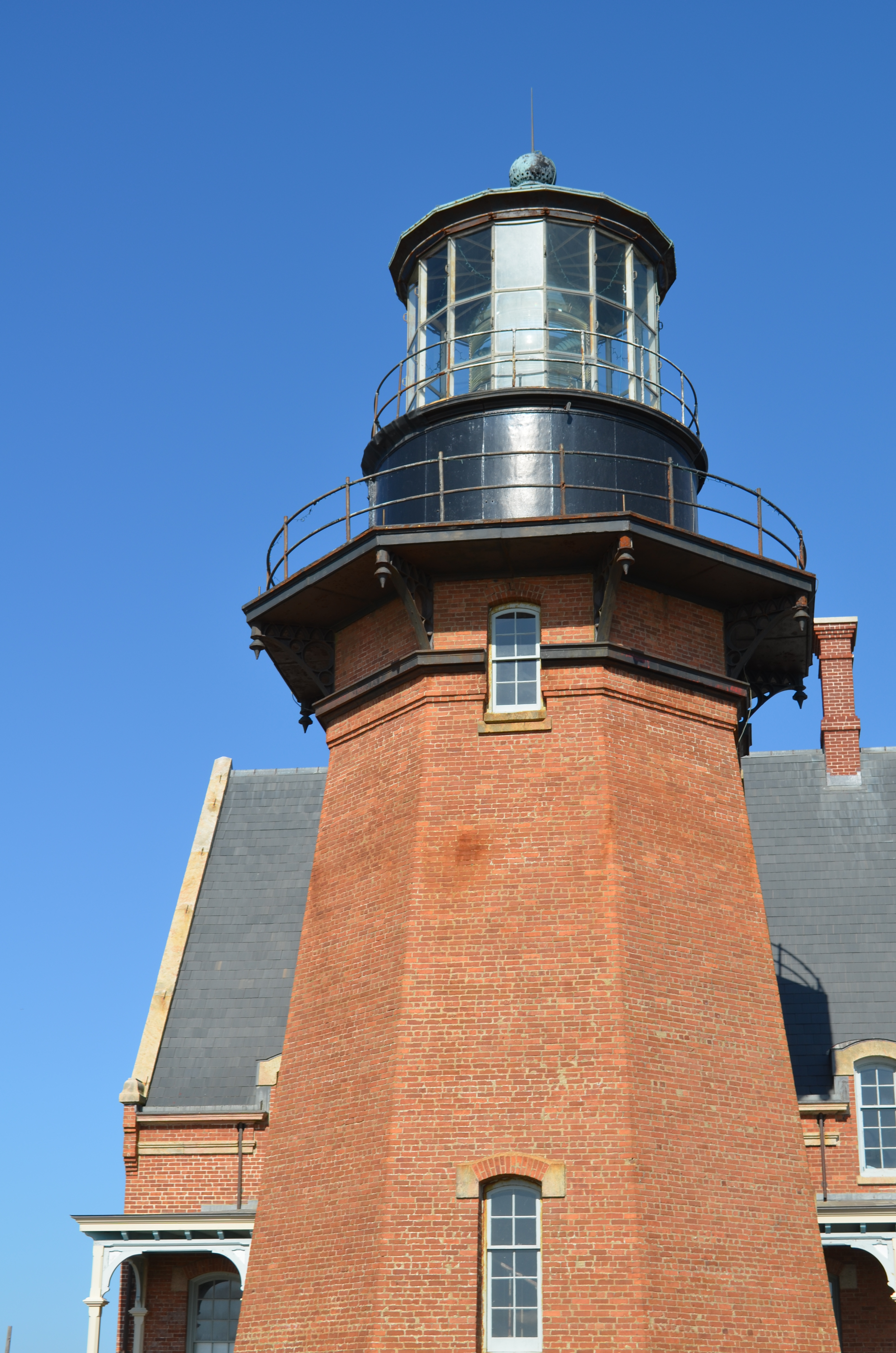
Block Island Southeast Lighthouse, 1875. Photo by SEA.
When you read this, I’ll be on yet another island with Samantha, this time Isla de Vieques, an island-municipality of Puerto Rico in the northeastern Caribbean, part of a group of islands some call the Spanish Virgin Islands.
Much of the island was formerly a bombing range of the US Navy (most of that area is now a National Wildlife Refuge), so much of Vieques was long closed to tourism.
Islands always make me think of lighthouses, of which there are two on Vieques, the ruins of Puerto Ferro and the restored Punta Mulas lighthouse.
Thinking about visiting those lighthouses reminded me of Alfred Corn’s poem, “Lighthouse,” which closes his latest collection, Tables.
I first became aware of Alfred’s poetry when I worked on the editorial staff at Viking Press in the late 1980s. Viking published his collection The West Door and his essay collection, The Metamorphoses of Metaphor. I also worked on his anthology, Incarnation: Contemporary Writers on the New Testament, which featured writers such as Annie Dillard, Robert Hass, Anthony Hecht, and John Hersey.
According to the biographical entry on the Poetry Foundation’s website, “Early in his career, Corn says, he aimed to write poetry that sounded like conversation and to find ‘verbal equivalents for visual realities.’ These conversational patterns have evolved into an attention to rhythm and an eye for detail. He often employs strict formal and metrical devices in his personal and social histories.”
As poet Thomas Disch has written about Corn’s poetry, “It is not the regnant mode among poetry academics at the moment, but since at least the time of Byron and Wordsworth it has been the kind of poetry that most commends itself to readers of poetry.”
I commend to you, dear readers of poetry, Alfred Corn’s poem, “Lighthouse”:
Pilot at the helm of a hidden
headland it steers free
from convergence with the freighter
when fog and storm clouds gather
Sparking communiqué no full stop ends
its broadcast performed in a three-sixty sweep
the cycle burning up five solar seconds
Midnight eye that blinks away
invisibility a high beam
revealing as it scans whatever seas
or ships return terra firma’s landmark gaze
c) 2010 Alfred Corn, used by permission of the author.
 This is a very special April for me, and a very special first poem for this 2014 edition of National Poetry Month. Tomorrow, Saturday, April 5th, I am getting married to my best friend, soul mate, partner, and fiancee, Samantha.
Ours has been a long road with many obstacles, detours, and diversions to finally arrive at where we are going to be on this certain April day.
I wrote a poem for the occasion. Actually, I wrote it for the poetry group to which I belong called 52, which is challenging me to write a poem each week during the year. We decided to print the poem on the back of the program for the wedding (see photo).
Poet Jo Bell (whose work I will feature later in the month) started group 52 and supplies most of the prompts for this virtual poetry workshop that numbers over 500 members worldwide. (You can find the prompts here: 52.) One week, the prompt was to write about Journeys. It was the perfect prompt to get me thinking about how we got here.
Here is my poem “Our Journey”:
How did we get here?
We say it all began with a yes,
But, really, it all began
With an across-the-room
Magnetism, with a searing
Feeling every time I tried to look away.
As if, there was something I had to see,
That only you could show me
And that I didn’t know you had.
What was it? You’ve shown it
To me almost every day since.
A fabric rent and become whole again,
A mystery with a resolution
That surprises us, every time.
A face as if seen through glass,
Scratched or etched
To a fine filigreed, subtle design.
No, no, that’s not it.
It’s more like glass that’s been glazed
With a pale, soapy film,
Which, once it is rubbed off,
Is clearer than the glass itself.
The two of us on separate, nearly parallel paths,
Not knowing we were looking for each other.
So many times, our paths nearly crossed,
But didn’t. Near misses we can only attribute to –
To what? Some kind of cruel,
But beautiful joke played by the Fates?
Nevertheless, here we are,
Together at last or again or finally.
On a journey together that results in a walk
Together down another path
On this certain April day.
–Scott Edward Anderson
5 Questions for Poets
April 2, 2014

I Saw the Figure 5 in Gold, 1928, Charles Demuth (American, 1883–1935)
Jonathan Hobratsch, writing in the Huffington Post, celebrates National Poetry Month by posing 5 questions by readers of poetry to some of the “top poets” writing today. Alfred Corn posted the questions to his friends on Facebook.
Here are my answers:
1. Do the Internet and social media contribute to the well-being of poetry?
On the plus side, my work has reached audiences beyond the reach of traditional publishing venues, and I’ve met and been exposed to poets from around the world whose work I could not have otherwise found. My community of poets has grown and challenged my work in new and fascinating ways.
2. What do most poorly-written poems have in common?
Language or structure that doesn’t serve the poem. Over-writing or lazy writing. Sentimentality. Lack of music. Basically, when it’s clear the poet hasn’t listened to the poem.
3. What do most well-written poems have in common?
They sing. They make you dance. And they give you a new way of looking at the world.
4. How important is accessibility of meaning? Should one have to work hard to “solve” the poem?
Poetry should be neither a Rubik’s cube nor a road sign.
5. What book are you reading right now?
All Standing: The Remarkable Story of the Jeanie Johnston, the Legendary Irish Famine Ship by Kathryn Miles; The Old Ways: A Journey on Foot by Robert McFarlane; Orr: My Story by Bobby Orr; and Navigation by Jo Bell.
Here’s a link to the original article: 5 Questions for Poets

Diana and Actaeon by Titian
I hope you have enjoyed National Poetry Month for 2013 as much as I have. As always, I end with a “bonus poem,” one of my own that I am delighted to share with you.
If you haven’t had enough poetry, you can always check out and even subscribe to this blog below.
I’ve written about ekphrastic poetry before, the art of writing poetry about or inspired by other works of art.
Last September, Samantha and I were in London and went to the National Gallery’s “Metamorphosis: Titian 2012” show.
The multi-arts show brought together a group of specially commissioned works responding to three of Titian’s paintings – “Diana and Actaeon,” “The Death of Actaeon,” and the recently acquired “Diana and Callisto” – all of which depict stories from Ovid’s epic poem “Metamorphoses.”
The three paintings at the heart of the exhibition had not been seen together since the 18th century.
The National Gallery also commissioned poets to write poems inspired by the artworks (you can watch the poets read their poems here, and there was even a Twitter poetry contest.

The Death of Actaeon by Titian
I was inspired to write my own poems in response to the show, one of which explores the relatedness of two paintings, “Diana and Actaeon” and “The Death of Actaeon.”
Here is my poem, “Titian’s Metamorphosis”:
They are twin paintings, really,
Titian’s “Diana and Actaeon” and
The one depicting his death.
Look at the positioning: in
The former, Actaeon, poised
To the left, arm raised parting
The curtain, feet apart, all
Broad shouldered and startled.
Diana, right reclining, as an Odalisque,
Right arm raised and feet, one
Caressed by a handmaid, the
Other dangling to the floor.
Seer and seen, searing gaze
And startled, glance agape.
In the latter, the roles are
Reversed: Diana to the left,
Huntress, bow flexed and ready
To shoot, sharp as her earlier withering
Arrow-glare; Actaeon, already begun
His metamorphosis, stag’s head,
Toppling and startled still,
But this time not by beauty,
By the horror of his own dogs
Ripping at his unrecognizable
Flesh. Look how his upreaching arm
Mimics Diana’s in its twin,
Handmaidens become hounds,
The cadence of his weakness
Coming down with the heaviness
Of his antler rack, head-heavy
All forgotten heedlessness,
Of beauty turned bestial.
“If looks could kill…”
–Scott Edward Anderson
##
30 Poems for National Poetry Month: Day 30
April 30, 2013
This has been an experiment. Although I try to write every day, I have never posted my daily scribblings for the world to see.
This year, in addition to my weekly emails and post for National Poetry Month, I took up the challenge of writing a poem each day to see what I could do.
When you are your own harshest critic, it’s hard to post what you know isn’t ready. Unvarnished, at times raw emotionally and in terms of craft, the poems are here to speak for themselves.
I must thank you, my readers, for your indulgence and your loyalty. Some of you have offered comments and feedback for which I am grateful; others have simply “liked” an individual poem or post, which is also encouragement.
Through it all, I must thank my partner Samantha, for both inspiring me and being patient with my almost poetry diary, which put our life and love on public display.
I’m looking forward to printing out these poems so I can look at them on the page — as a group and individually — and see what comes of them. Let the real work begin!
Here is my poem for Day 30:
And so it ends, this Month of Poetry,
Not with a band, but with a whisper.
Although I wanted to kill that mockingbird
This morning, with his incessant trilling,
Which would have caused excitement,
And made our morning a tad more thrilling.
My love held close to me in the kitchen,
As we were making breakfast,
Her curves beautifully accentuated
In her tight-fitting nightgown.
The kettle whistled, as did I,
When she looked at me so longingly,
And curved her body up to mine.
Ah, if only we had the time
This morning, but the month has come
To an end. Tomorrow we begin again,
Perhaps with fewer daily posts,
But no less poetry in our lives.
–Scott Edward Anderson

 Scott Edward Anderson
 Scott Edward Anderson's Poetry Blog