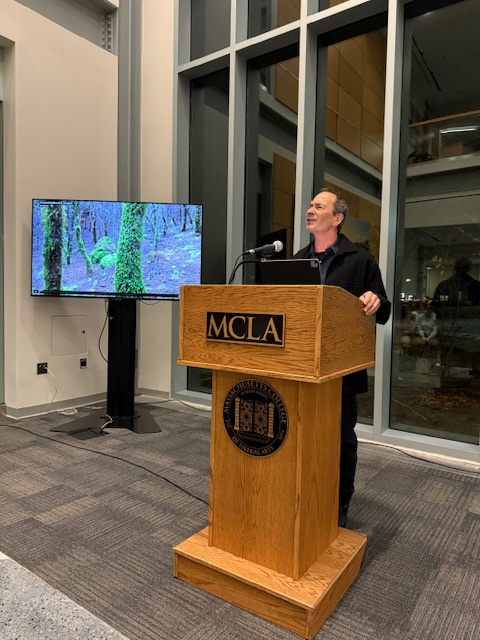
I wrote a profile of poet Forrest Gander for Berkshire Magazine back in the Fall of 2024, when he was visiting poet at MCLA in North Adams, MA. I’ve been personally and deeply engaged with Forrest’s poetry and nonfiction since his first book, Rush to the Lake, came out from Alice James Books in 1988. And I thoroughly enjoyed spending some concentrated time with his body of work, along with his latest book, Mojave Ghost: A Novel Poem, which New Directions published that year, in preparation for the article.
“The basic gesture of my writing is a listening,” poet Forrest Gander has written. “The great capacity of language is to bring us into proximity with one another.”
In Mojave Ghost, Gander is listening hard: to the desert, to the dead, and to the layered silences between. More sentence-based and more nakedly elegiac than anything he has published before, the book traces a movement from Arkansas into California, and along the San Andrea Fault, following geological and personal fault lines simultaneously.
Gander was born in 1956 in Barstow, in the Mojave Desert itself. His mother talked about the desert often, and he didn’t return until after she was gone. Her stories about Rainbow Basin, the fossils she collected there, and the landscape she loved, run through the book like an underground current. So does grief for his partner of 35 years, the poet C.D. Wright, who died suddenly in 2016. In Mojave Ghost, the pronouns slip and the addressee shifts; it may be his late mother, his late partner, or Ashwini Bhat, the sculptor he married in 2020. “Science tells us that although we may feel ourselves as a unified, authentic self, we’re actually a collaboration of conflicting voices,” Gander told me in an interview. “That’s something I’ve come to intuitively feel.”
What holds it all together is the landscape and what landscape does to time. While hiking along the San Andreas, Gander realized that looking at the terrain around him, he was also seeing past and present at once. “Those two conflations of past and present — of the personal and the geological — form the currents in Mojave Ghost.”
Memory has long been active in his work. In the new book, he asks:
Is it odd that what we remember
is confined so often to particular moments
like still images ripped from a film?
“My memory of my late mother’s face can be more real for me, more exact, more present even than the face of someone I’m talking with now,” he says. “In our minds, whatever had once been possible can be so again.”
Asked what he hopes readers take away from his poetry, Gander offers something close to a credo: “Thought-feeling. Feeling-thought. Western culture divides feeling from thought, but there are single words in Chinese and Japanese for heart/mind.” He agrees with Ezra Pound that “only emotion endures.”
“No one cares about how much money some investor made in 600 BCE, but we do care about even the small fragments of Sappho’s poems,” Gander says. “That’s about as much of a miracle as the world offers us.”
The following section from Mojave Ghost is shared with the author’s permission:
Because the tree line opens contours of meanings
other than the ones for which we’re prepared,
we treat it with suspicion.
When he smiled and shook his head no, his face
connoted the presumption that you and I live in a different world.
He took us in like the scent of a dead animal.
But how to sustain attentiveness? How to keep
the mind from dropping its needle
into the worn grooves of association?
My art, you said in passing, is nothing much
more than the discipline of an embodied life.
Articulating nuance. The delicate
palette. You paint details
with a tiny brush you made yourself
of hair plucked from your forearm.
They distrust me, you said, because
they can tell I prefer my work to their own.
Which is when I tucked a red anemone
under your pillow to bring you good dreams. What
else did you say?
Fair enough. It is a marriage of equals and without degree.
Your trace on me
like rope marks on the well’s mouth.
Here, have a thought.
As for our misfit status: as Brecht observed,
the palace of canonical culture is built on—
Not to interpret. To feel life course through you.
—Forrest Gander, from Mojave Ghost
Here’s a link to my Berkshire Magazine profile: Forrest Gander

To close National Poetry Month for 2025, I’d like to share a poem I wrote in the tradition of occasional poetry—a form composed to mark a specific moment or honor a particular request. I was honored when my wife Samantha and her co-author Rimi Chakraborty invited me to contribute a poem to their powerful book, Beyond Resilience to Rootsilience. Our friendship with Rimi and her husband João Ferreira began in the Azores several years ago, and since then, I’ve watched with admiration as she and Samantha have brought this work to life and have helped many women leaders deal with burnout, get more grounded, and improve their physical and mental health.
Beyond Resilience to Rootsilience offers a vital reimagining of what it means to lead and live well, especially for women navigating the demands of leadership and life. It speaks to that moment when our bodies tell us we’ve gone too far and how they ask us to listen—and to root. Samantha and Rimi coined the word “rootsilience” (rhyming with resilience) because creating lasting change requires a shift not just in mindset but in language itself. The idea is to be like a tree that is rooted in the ground while it sways in the wind and weather rather than “snapping back” in the face of stress.
Inspired by this vision, my poem draws on the metaphor of trees and the quiet strength found in their networks of connection, adaptation, and mutual support—lessons nature teaches us, if we are willing to listen. Here is my poem, “On Roots and Resilience”:
“On Roots and Resilience”
Trees are not silent sentinels in the forest,
we just can’t hear their communication,
and don’t understand their language.
If we could learn to listen, we might absorb
strength from their interdependence,
their interconnected web in the soil,
tangled up in mycorrhiza,
water and minerals coursing from fungus to roots,
sugars from leaves to fungi,
roots below mirroring branches above,
always ready in their capacity to change,
to adapt, to learn from experience,
to share wisdom and strength
in a mutualistic relationship.
Be like the tree in the forest,
neither silent nor alone,
and not only resilient,
but swaying with the stresses,
and standing in the calm,
connecting your whole self
and your relationship with others,
to your own interdependent web.
Let your interconnected roots
provide your true strength,
from canopy to leaf, branch to trunk, root to rhizome.
— Scott Edward Anderson
You can learn more about Samantha and Rimi’s book here: rootsilience

by François-Xavier Fabre (1800)
Life in America today feels chaotic—unmoored, even. Not long ago, we were enjoying the strongest post-pandemic economy in the world and, for all our flaws, still held a place of trust and respect among nations. Now, it feels as though we’re in retreat from the very values that have defined us for nearly 250 years. Our economy is shaky, our moral compass seems scrambled, and our global standing has taken a nosedive. Former allies are pushed aside, while historic adversaries are reframed as potential friends. How the heck did we get here?
For some time now, I’ve felt we’re living through the final convulsions of an outdated, constricted worldview—a last gasp, if you will. The future, by contrast, looks vibrant in its diversity, and stronger for it. But the old mindset is panicking. It scapegoats the “other” for its own decline, retreats into fear, and recoils from empathy, love, and peace. It would rather enforce authorityrrany—a toxic blend of authoritarianism and tyranny—than allow for genuine autonomy. In clinging to control, it seeks to impose a narrow minority’s will on a richly diverse majority.
Still, the tide is too strong against it. I believe the day will come when we look back on this era and see it clearly for what it was: a necessary darkness before the dawn. As poet Seamus Heaney (1939–2013) wrote, “the longed-for tidal wave of justice” will break, and when it does, it will wash away the debris of this fearful, closed-off way of thinking.
That famous line comes from Heaney’s The Cure at Troy, his poetic reimagining of a play by the ancient Greek dramatist Sophocles. The work wrestles with questions of morality, deceit, political compromise, suffering, and the hope of healing. Heaney’s brilliance lies in how he connects these ancient themes to the struggles of our modern lives. Lately, I’ve been thinking often of the stanza containing that “tidal wave” line—and the even more quoted line about hope and history rhyming. I decided to revisit the full passage, and what I found feels especially fitting in these troubled times:
From The Cure at Troy
Human beings suffer,
They torture one another,
They get hurt and get hard.
No poem or play or song
Can fully right a wrong
Inflicted and endured
…
History says, don’t hope
On this side of the grave.
But then, once in a lifetime
The longed-for tidal wave
Of justice can rise up,
And hope and history rhyme.
So hope for a great sea-change
On the far side of revenge.
Believe that further shore
Is reachable from here.
Believe in miracles
And cures and healing wells.
Call miracle self-healing:
The utter, self-revealing
Double-take of feeling.
If there’s fire on the mountain
Or lightning and storm
And a god speaks from the sky
That means someone is hearing
The outcry and the birth-cry
Of new life at its term.
It means once in a lifetime
That justice can rise up
And hope and history rhyme.
—Seamus Heaney

A bonus poem this week, in honor of the 250th anniversary of the beginning of the American Revolution—this nation’s bold revolt against monarchy and taxation without representation. (It’s a message that seems particularly timely with what’s happening in our country today.)
On the night of April 18, 1775, British troops marched out of Boston, aiming to arrest Sons of Liberty leaders Samuel Adams and John Hancock in Lexington and to seize colonial ammunition stockpiles in Concord. In response, Paul Revere and William Dawes rode through the countryside to alert the colonists, including Adams and Hancock, of the British plans. Their warning helped spark the armed resistance that would become the Revolutionary War.
To mark this historic occasion, you can watch this speech by historian Heather Cox Richardson, delivered last night at Boston’s Old North Church—the very place where lanterns were famously hung as a signal of the British advance.
Although Henry Wadsworth Longfellow’s poem Paul Revere’s Ride takes creative liberties—emphasizing one man’s role in what was a broader collective effort—it played a powerful part in shaping American memory. Written nearly a century later, as the country teetered on the brink of Civil War, the poem first appeared in the January 1861 issue of The Atlantic Monthly, published the very day South Carolina seceded from the Union.
You can explore more about the real story of Paul Revere’s ride here, read an account in his own words here, and learn more about Longfellow’s poem here.
Below is the poem as it originally appeared in The Atlantic Monthly in January 1861:
Listen, my children, and you shall hear
Of the midnight ride of Paul Revere,
On the eighteenth of April, in Seventy-Five:
Hardly a man is now alive
Who remembers that famous day and year.
He said to his friend, — “If the British march
By land or sea from the town to-night,
Hang a lantern aloft in the belfry-arch
Of the North-Church-tower, as a signal-light, —
One if by land, and two if by sea;
And I on the opposite shore will be,
Ready to ride and spread the alarm
Through every Middlesex village and farm,
For the country-folk to be up and to arm.”
Then he said good-night, and with muffled oar
Silently rowed to the Charlestown shore,
Just as the moon rose over the bay,
Where swinging wide at her moorings lay
The Somersett, British man-of-war:
A phantom ship, with each mast and spar
Across the moon, like a prison-bar,
And a huge, black hulk, that was magnified
By its own reflection in the tide.
Meanwhile, his friend, through alley and street
Wanders and watches with eager ears,
Till in the silence around him he hears
The muster of men at the barrack-door,
The sound of arms, and the tramp of feet,
And the measured tread of the grenadiers
Marching down to their boats on the shore.
Then he climbed to the tower of the church,
Up the wooden stairs, with stealthy tread,
To the belfry-chamber overhead,
And startled the pigeons from their perch
On the sombre rafters, that round him made
Masses and moving shapes of shade, —
Up the light ladder, slender and tall,
To the highest window in the wall,
Where he paused to listen and look down
A moment on the roofs of the town,
And the moonlight flowing over all.
Beneath, in the churchyard, lay the dead
In their night-encampment on the hill,
Wrapped in silence so deep and still,
That he could hear, like a sentinel’s tread,
The watchful night-wind, as it went
Creeping along from tent to tent,
And seeming to whisper, “All is well!”
A moment only he feels the spell
Of the place and the hour, the secret dread
Of the lonely belfry and the dead;
For suddenly all his thoughts are bent
On a shadowy something far away,
Where the river widens to meet the bay, —
A line of black, that bends and floats
On the rising tide, like a bridge of boats.
Meanwhile, impatient to mount and ride,
Booted and spurred, with a heavy stride,
On the opposite shore walked Paul Revere
Now he patted his horse’s side,
Now gazed on the landscape far and near,
Then impetuous stamped the earth,
And turned and tightened his saddle-girth;
But mostly he watched with eager search
The belfry-tower of the old North Church,
As it rose above the graves on the hill,
Lonely, and spectral, and sombre, and still.
And lo! as he looks, on the belfry’s height,
A glimmer, and then a gleam of light!
He springs to the saddle, the bridle he turns,
But lingers and gazes, till full on his sight
A second lamp in the belfry burns!
A hurry of hoofs in a village-street,
A shape in the moonlight, a bulk in the dark,
And beneath from the pebbles, in passing, a spark
Struck out by a steed that flies fearless and fleet:
That was all! And yet, through the gloom and the light,
The fate of a nation was riding that night;
And the spark struck out by that steed, in his flight,
Kindled the land into flame with its heat.
It was twelve by the village-clock,
When he crossed the bridge into Medford town.
He heard the crowing of the cock,
And the barking of the farmer’s dog,
And felt the damp of the river-fog,
That rises when the sun goes down.
It was one by the village-clock,
When he rode into Lexington.
He saw the gilded weathercock
Swim in the moonlight as he passed,
And the meeting-house windows, blank and bare,
Gaze at him with a spectral glare,
As if they already stood aghast
At the bloody work they would look upon.
It was two by the village-clock,
When be came to the bridge in Concord town.
He heard the bleating of the flock,
And the twitter of birds among the trees,
And felt the breath of the morning-breeze
Blowing over the meadows brown.
And one was safe and asleep in his bed
Who at the bridge would be first to fall,
Who that day would be lying dead,
Pierced by a British musket-ball.
You know the rest. In the books you have read
How the British regulars fired and fled, —
How the farmers gave them ball for ball,
From behind each fence and farmyard-wall,
Chasing the red-coats down the lane,
Then crossing the fields to emerge again
Under the trees at the turn of the road,
And only pausing to fire and load.
So through the night rode Paul Revere;
And so through the night went his cry of alarm
To every Middlesex village and farm, —
A cry of defiance, and not of fear, —
A voice in the darkness, a knock at the door,
And a word that shall echo forevermore!
For, borne on the night-wind of the Past,
Through all our history, to the last,
In the hour of darkness and peril and need,
The people will waken and listen to hear
The hurrying hoof-beat of that steed,
And the midnight-message of Paul Revere.
–Henry Wadsworth Longfellow, The Atlantic Monthly, January 1861

A few weeks from now—on May 8th, to be exact—poet Gary Snyder will complete his 95th trip around the Sun. That we have had Snyder on our planet for nearly a century—and may yet celebrate his hundredth with him—is a remarkable gift. Those of us lucky enough to have studied with him, in whatever capacity, have been doubly blessed, both by his instruction and by his example.
I’ve been thinking about Snyder a lot lately, partly because I’ve reached the same age he was when I studied with him and because what he taught me continues to resonate. (I’ve written about that experience elsewhere, here and here.)
But Snyder’s upcoming birthday isn’t the only reason he’s been on my mind. It’s because we need his example now more than ever. We need his fierce compassion. We need his brand of resistance, rooted in a holistic, ecological worldview that calls for a fundamental shift in how we live, think, and act.
Snyder challenges us to confront environmental degradation and social injustice as intertwined crises, urging resistance to industrial capitalism, the culture of consumption, and the exploitation of both nature and people. This resistance, in his view, is not just political or economic, it’s also spiritual and intellectual. A path toward a more just, more sustainable way of being.
There are countless expressions of this ethic in his poetry—“For All,” from his Pulitzer Prize-winning Turtle Island (1974)), comes to mind. But today, I’m thinking about his “Smokey the Bear Sutra.” Snyder wrote it in 1969 for the Sierra Club Wilderness Conference and released it to the public domain so it could be freely shared.
In the poem, he reimagines Smokey the Bear, the iconic U.S. Forest Service symbol, not as a mascot, but as a reincarnation of the Vairocana Buddha, here to save not only the forests, but all living beings.
“My Smokey is essentially a dharmapala, a dharma protector, and I modeled him after the Japanese figure of Fudo,” Snyder later said. “In Sanskrit he has the name Achala, which means ‘immovable, unshakable,’ which is also what fudo means. He’s got a fierce visage and is usually pictured surrounded by flames, further evidence that the Forest Service’s Smokey is his North American incarnation.”

10.75″ x 10.75″. 7/14/05. Watercolor.
Snyder confided, “the sutra’s basic message is that our sacred responsibility is to protect all of life…to protect life down to the smallest little creature, protect our community, maintain our own practice, and honor impermanence, all at the same time.”
We need a little more of that sense of responsibility these days, especially considering the chaos swirling around us.
Here is Gary Snyder’s “Smokey the Bear Sutra”:
Once in the Jurassic about 150 million years ago, the Great Sun Buddha in this corner of the Infinite Void gave a discourse to all the assembled elements and energies: to the standing beings, the walking beings, the flying beings, and the sitting beings—even the grasses, to the number of 13 billion, each one born from a seed, assembled there: a Discourse concerning Enlightenment on the planet Earth.
“In some future time, there will be a continent called America. It will have great centers of power called such as Pyramid Lake, Walden Pond, Mt. Rainier, Big Sur, Everglades and so forth; and powerful nerves and channels such as Columbia River, Mississippi River, and Grand Canyon. The human race in that era will get into troubles all over its head and practically wreck everything in spite of its own strong intelligent Buddha-nature.”
“The twisting strata of the great mountains and the pulsings of volcanoes are my love burning deep in the Earth. My obstinate compassion is schist and basalt and granite, to be mountains, to bring down the rain. In that future American Era I shall enter a new form, to cure the world of loveless knowledge that seeks with blind hunger and mindless rage, eating food that will not fill it.”
And he showed himself in his true form of
SMOKEY THE BEAR
A handsome smokey-colored brown bear standing on his hind legs, showing that he is aroused and watchful.
Bearing in his right paw the Shovel that digs to the truth beneath appearances, cuts the roots of useless attachments, and flings damp sand on the fires of greed and war;
His left paw in the mudra of Comradely Display—indicating that all creatures have the full right to live to their limits and that deer, rabbits, chipmunks, snakes, dandelions, and lizards all grow in the realm of the Dharma;
Wearing the blue work overalls symbolic of slaves and laborers, the countless men oppressed by a civilization that claims to save but often destroys;
Wearing the broad-brimmed hat of the west, symbolic of the forces that guard the wilderness, which is the Natural State of the Dharma and the true path of man on Earth:
all true paths lead through mountains—
With a halo of smoke and flame behind, the forest fires of the kali-yuga, fires caused by the stupidity of those who think things can be gained and lost whereas in truth all is contained vast and free in the Blue Sky and Green Earth of One Mind;
Round-bellied to show his kind nature and that the great Earth has food enough for everyone who loves her and trusts her;
Trampling underfoot wasteful freeways and needless suburbs, smashing the worms of capitalism and totalitarianism;
Indicating the task: his followers, becoming free of cars, houses, canned foods, universities, and shoes, master the Three Mysteries of their own Body, Speech and Mind, and fearlessly chop down the rotten trees and prune out the sick limbs of this country America and then burn the leftover trash.
Wrathful but Calm. Austere but Comic. Smokey the Bear will Illuminate those who would help him; but for those who would hinder or slander him . . .
HE WILL PUT THEM OUT.
Thus his great Mantra:
Namah samanta vajranam chanda maharoshana Sphataya hum traka ham mam
“I DEDICATE MYSELF TO THE UNIVERSAL DIAMOND
BE THIS RAGING FURY DESTROYED.”
And he will protect those who love the woods and rivers, Gods and animals, hobos and madmen, prisoners and sick people, musicians, playful women, and hopeful children;
And if anyone is threatened by advertising, air pollution, television, or the police, they should chant SMOKEY THE BEAR’S WAR SPELL:
DROWN THEIR BUTTS
CRUSH THEIR BUTTS
DROWN THEIR BUTTS
CRUSH THEIR BUTTS
And SMOKEY THE BEAR will surely appear to put the enemy out with his vajra-shovel.
Now those who recite this Sutra and then try to put it in practice will accumulate merit as countless as the sands of Arizona and Nevada.
Will help save the planet Earth from total oil slick.
Will enter the age of harmony of man and nature.
Will win the tender love and caresses of men, women, and beasts.
Will always have ripened blackberries to eat and a sunny spot under a pine tree to sit at.
AND IN THE END WILL WIN HIGHEST PERFECT ENLIGHTENMENT
. . . thus we have heard . . .
–Gary Snyder
(A note at the end of the poem states that it “may be reproduced free forever.”)

Photo by Lisa Catherman
For the past few years, I’ve had the honor of serving as the first Poet Laureate of the Ryan Observatory at Muddy Run in Pennsylvania. While I may be the first poet laureate appointed to an observatory, I certainly hope I won’t be the last.
This role began in 2022, after one of my annual National Poetry Month emails caught the attention of Al Ryan, the Observatory’s founder and director. Al and I go way back—25 years, in fact—to when he was legal counsel at PECO Energy and I worked for The Nature Conservancy in Pennsylvania.
We first met on the Susquehanna River near the Conowingo Dam, where PECO had sought the Conservancy’s help mapping sensitive habitats during its FERC license renewal. That collaboration led to a friendship, and my recommending Al for the PA chapter’s board of trustees. Over the years, we kept in touch—mostly through my poetry emails—until Al extended this unique invitation.
Saturday, April 12th, marks my final visit to the Observatory as Poet Laureate, and I look back on these past three years with pride. Why bring poetry to a science-based observatory? Al believed that the Observatory’s STEM mission (Science, Technology, Engineering, Mathematics) should embrace the Arts as well—transforming STEM into STEAM.
Alongside the Observatory’s Arts Committee, we framed our mission this way: “Poetry and astronomy stem from the same sense of curiosity and imagination. They both begin with observation and attention, move toward reflection and memory, and ultimately seek meaning in what is seen.”
We explored how other institutions have brought science and poetry together—such as Poets House’s collaborations with zoos and science centers—and began weaving poetry into the Observatory’s monthly open houses.
One of my favorite events was a live conversation with Derek Pitts, Chief Astronomer at the Franklin Institute (you can watch it here). A local teacher in the audience was so inspired, she had her students write poetry about the stars. We invited her back to share their work and speak about the project. At another event, we had the audience contribute lines on 3×5 cards, which I then assembled into a collaborative poem. And every solstice, I shared seasonal poems with our guests.

We also created poetry signage around the grounds, beginning with my original poem “River of Stars,” followed by a poem about Pluto from the Observatory’s youngest volunteer, Gabe Catherman, and finally Ada Limón’s “In Praise of Mystery: A Poem for Europa.” Her poem, written for NASA’s Europa Clipper mission, now travels aboard the spacecraft—engraved on its body along with names submitted through NASA’s “Message in a Bottle” campaign. Together, they’ll journey 1.8 billion miles to the Jupiter system.
I’m deeply grateful to Al Ryan and the Arts Committee for inviting me into the Observatory’s orbit. It’s been an unforgettable journey, and I hope whoever steps into this role next will continue to explore the cosmic crossroads of science and poetry—boldly going where few poets have gone before.
Here is “In Praise of Mystery” by Ada Limón:
“In Praise of Mystery: A Poem for Europa”
Arching under the night sky inky
with black expansiveness, we point
to the planets we know, we
pin quick wishes on stars. From earth,
we read the sky as if it is an unerring book
of the universe, expert and evident.
Still, there are mysteries below our sky:
the whale song, the songbird singing
its call in the bough of a wind-shaken tree.
We are creatures of constant awe,
curious at beauty, at leaf and blossom,
at grief and pleasure, sun and shadow.
And it is not darkness that unites us,
not the cold distance of space, but
the offering of water, each drop of rain,
each rivulet, each pulse, each vein.
O second moon, we, too, are made
of water, of vast and beckoning seas.
We, too, are made of wonders, of great
and ordinary loves, of small invisible worlds,
of a need to call out through the dark.
–Ada Limón
“In Praise of Mystery: A Poem for Europa.” Copyright Ada Limón, 2023. All rights reserved. The reproduction of this poem may in no way be used for financial gain.
National Poetry Month 2025, Week One: e.e. cummings’ “Paris;this April sunset completely utters”
April 7, 2025

April in Paris. It sounds almost cliché. And yet…we just returned from a wonderful week there celebrating our anniversary over food and wine and art and miles upon miles of walking. All with the most glorious weather imaginable and all the signs of Spring having sprung.
Samantha and I have been to Paris together before, and we’ve been there in other incarnations prior to our knowing each other, but this trip felt different. It was as if we were seeing Paris anew or for the first time, even when we went to places we’d been before.
And, unlike in the famous song composed by Vernon Duke and lyricist E.Y. Harburg, there was no rain. There’s rain in this poem by e.e. cummings, which also features some of his characteristic challenges to conventional punctuation.
Here is cumming’s “Paris;this April sunset completely utters”:
Paris;this April sunset completely utters
utters serenely silently a cathedral
before whose upward lean magnificent face
the streets turn young with rain,
spiral acres of bloated rose
coiled within cobalt miles of sky
yield to and heed
the mauve
of twilight(who slenderly descends,
daintily carrying in her eyes the dangerous first stars)
people move love hurry in a gently
arriving gloom and
see!(the new moon
fills abruptly with sudden silver
these torn pockets of lame and begging colour)while
there and here the lithe indolent prostitute
Night,argues
with certain houses
— e.e. cummings

I’ve been writing these National Poetry Month emails/posts for the past 27 years and each year I think it’s going to be my last. Will anyone miss them if I stop? Does anyone really read them? But then I get such great messages in response to a post, and it keeps me going. Sometimes, I hear from someone I haven’t heard from in a long time, and it makes all the difference.
Today, I got a phone call from an old friend, Andrew Coulter, in Wyoming—we go back to our early days with The Nature Conservancy over 30 years ago. He called me after having read my Week Four post and explained he was going to send me an email to tell me how much he enjoyed getting the poems every year. But then he thought, “I’ll just pick up the phone and call him.”
We talked for about half an hour, got caught up on each other’s lives, and had a few laughs over some of our shared stories and history. I know we both hung up with smiles on our faces. It’s a good reminder to reach out to people we care about—we’re all so busy that it’s easy to lose touch, to let the years pass by without connecting with old friends.
Andrew’s call also reminded me that I usually post a Bonus Week poem, typically one of my own, at the end of every Poetry Month. “You can have a Bonus Poem in May,” Andrew said. So, why not? Here goes. (Thanks, Andrew.)
My poem “Doubting Finches” started, like many of my poems, from a simple observation made in 2009. A pair of house finches had set up a nest in the porch light of my old house in Philadelphia. I had the image of the nesting house finch couple and the intricacy of what I observed in the nest, but it didn’t amount to much more. I worked on the poem for quite a while before it came together—a few years, actually —and it finally went beyond the original inspiration.
The poem languished until I found there was more to the story. This was around two years later, at the tail end of a marriage, and I was about to embark on a new life where that house would no longer be mine. It was a time of turmoil, uncertainty, grief, and yet, also, a certain joy and anticipation. I wasn’t running away from something this time; I was running towards something.
The finished poem appeared in the UK online journal, Zoomorphic, in 2017, thanks to the wonderful Welsh poet, Susan Richardson. It also appears in my book, Wine-Dark Sea: New & Selected Poems & Translations, published by Shanti Arts in 2022.
Here is my poem, “Doubting Finches”:
The house finch nest in my porch light
has a curious architecture,
made entirely of found things:
dried seed heads from last year’s columbine,
dusky strands of my daughter’s hair,
small sticks, rose thorns, bits of string,
a gold thread from a cigarette pack wrapper.
Inside, wool-lined, cotton and fleece,
it holds three eggs, blue with tawny flecks.
The female finch sits on the nest
for an unusually long time; so long,
I fear she is mistaken or my messing
with the nest has disrupted gestation.
She picked her mate for the redness
of his head and chest, proxy for feeding prowess.
(I guess.)
In a few weeks all will be gone:
cherry blossoms drifting on air,
dogwoods blooming, oaks leafing out,
and the female finch finding another mate,
to start a second family this season.
Who was it that said, “Doubt is a privilege
of the faithful”? At least, I think someone
said it or should have. Then it was me,
me finding another mate, another home,
another reason. And I saw they swept out
the finch nest from that old porch light
as soon as I was gone.
–Scott Edward Anderson

I’d almost forgotten to write my post for Week Four of National Poetry Month when I realized it was the last night of April and poetry month would soon be over for another year. I had no idea what poem or poet to feature although, having recently returned from Fall River, MA, where I had been part of the first Poesia Festival there, I thought it might be one of the Portuguese poets featured at the event: Camões, Silveira, Amaral, Pessoa, or Medeiros. (I’d already featured Sophia de Mello Breyner Andresen the previous week.)
“It can wait until tomorrow,” I told myself, turning on Game 5 of the Boston Bruins Stanley Cup playoff game against the Toronto Maple Leafs, which my team lost in overtime.
This morning, I woke to the news that Paul Auster had died at 77 years old after a long battle with lung cancer. I have a long, tenuous, and tangential relationship with Paul Auster dating back to the late 1980s, when I was part of a writing group called the “Decompositionalists” and worked in publishing. I texted one of the other members of that writing group who had been a big fan of the author of City of Glass. “I still treasure The New York Trilogy,” she texted back. “Something of a shock to learn of his passing, though every time I saw him he was smoking.”
When I was a young editor at Viking Penguin, Auster, in all his swarthy, 38-year-old handsomeness used to come into the office to meet with his editor. All the young women—or, rather, ALL the women would swoon, and many of the men, too! “He is smoking hot,” a colleague at the time explained to me when I asked what the attraction was. “There’s nothing like a smoking hot intellectual to make an editorial department swoon.”
While Auster was best known as a highly acclaimed novelist and writer of prose fiction, memoirs, and essays, he started as a poet and translator, living in Paris after graduating from Columbia in 1969. It wasn’t lost on me that Auster, who had partaken in the student protests at Columbia University in 1968, died the day the NYPD sent in its surge troops to evict students from Hamilton Hall, a building they were occupying as part of a pro-Palestinian protest.
The earlier protest, which police also cracked down upon on April 30th fifty-six years ago, ended in violence that resulted in more than 700 arrests and 148 reports of injuries as “officers trampled protesters, hit them with night sticks, punched and kicked them down stairs,” according to The New York Times.
While Auster’s poetry has been overshadowed by his prose, he published several volumes of poetry over his career, including Unearth (1974), Wall Writing (1976), and Facing the Music (1980). Two volumes of selected poems, Disappearances (1988) and Ground Work (1990) along with a volume of Collected Poems (2007), were also published.
His poetry tends to have an experimental, avant-garde style influenced by French writers and surrealists, wherein, as in much of his fiction, he explores themes of chance, games, language play, intertextuality, and the role of the author. While respected, his poetry has received less mainstream attention and acclaim compared to his novels like 4321 (2017), The New York Trilogy (1987), The Book of Illusions (2002), and The Brooklyn Follies (2005).
Auster rather famously wrote with a fountain pen. “If I could write directly on a computer or typewriter, I would do it. But keyboards have always intimidated me,” he said in an interview with The Paris Review. “A pen is a much more primitive instrument. You feel that the words are coming out of your body, and then you dig the words into the page. Writing has always had that tactile quality for me. It’s a physical experience.”
Auster explores the relationship between the body and language in his poem, “White Nights,” with a characteristic hint of surrealism. RIP Paul Auster (1947-2024). Here is Paul Auster’s poem:
WHITE NIGHTS
No one here,
and the body says: whatever is said
is not to be said. But no one
is a body as well, and what the body says
is heard by no one
but you.
Snowfall and night. The repetition
of a murder
among the trees. The pen
moves across the earth: it no longer knows
what will happen, and the hand that holds it
has disappeared.
Nevertheless, it writes.
It writes: in the beginning,
among the trees, a body came walking
from the night. It writes:
the body’s whiteness
is the color of earth. It is earth,
and the earth writes: everything
is the color of silence.
I am no longer here. I have never said
what you say
I have said. And yet, the body is a place
where nothing dies. And each night,
from the silence of the trees, you know
that my voice
comes walking toward you.
–Paul Auster, from Disappearances: Selected Poems, Overlook Press, 1988
National Poetry Month 2024, Week Three: Sophia de Mello Breyner Andresen’s “Descobrimento”
April 22, 2024

This Thursday marks the 50th anniversary of the Carnation Revolution, whereby the people of Portugal overthrew the dictatorship under which they had lived for forty-eight years. I have previously shared my translation of Sophia de Mello Breyner Andresen’s poem of the revolution, “25 de Abril” (“25th of April”). Sophia was born in Porto in 1919, she died in 2004 at the age of 84 and is now buried in the National Pantheon in Lisbon, an honor recognizing her as one of Portugal’s greatest poets.
Her work often explored themes of nature, particularly the power and mystery of the sea. Indeed, she can be considered a poet of the sea. One poem that encapsulates her maritime inspiration is “Descobrimento” (“Discovery”). In “Discovery,” Andresen paints a vivid, almost surreal portrait of the ocean through metaphor and visceral imagery. She writes of “An ocean of green muscles/ An idol with as many arms as an octopus/ Incorruptible chaos that erupts/ And orderly turmoil…” [my translation]. This strange yet mesmerizing depiction captures the paradoxical nature of the sea — its turbulent, ungovernable force coexisting with an inherent rhythm and pattern.
The sea represented many things for Andresen beyond its literal presence. As a dedicated Hellenist, she found inspiration in ancient Greek mythology and often blurred the lines between the Atlantic Ocean of her Portuguese homeland and the Mediterranean. The sea became a symbol of renewal, eternity, and the mysteries of life and death.
Her reverence for the ocean likely stemmed from her childhood spent along the coast in Porto, watching the ebb and flow of the tides. The poem evokes her early, formative experiences at Praia de Granja, a beach south of Porto that shaped her poetic vision.
In “Discovery,” Andresen seems to be urging the reader to explore the depths of the ocean and surrender to its “incorruptible chaos.” The sea is both menacing with its crashing waves and comforting in its ceaseless cadence. By wading into those waters, perhaps we can access greater truths about ourselves and the world around us.
With her luminous language and profound naturalism, Sophia de Mello Breyner Andresen invites the reader to discover the ocean anew through her transcendent poetry. “Discovery” reminds us that the seas contain not just thrilling adventures and discoveries, but insights into the very essence of our existence.
Here is my translation of Sophia de Mello Breyner Andresen’s “Descobrimento”:
Discovery
An ocean of green muscles
An idol with as many arms as an octopus
Incorruptible chaos that erupts
And orderly turmoil
Dancer twisted up
Around the outstretched ships
We cross rows of horses
Who shake their manes at the trade winds
The sea suddenly became too young and too old
To show the beaches
And a people
Of newly created men still clay-colored
Still naked, still dazzled
—
Here is the poem in its original Portuguese:
Descobrimento
Um oceano de músculos verdes
Um ídolo de muitos braços como um polvo
Caos incorruptível que irrompe
E tumulto ordenado
Bailarino contorcido
Em redor dos navios esticados
Atravessamos fileiras de cavalos
Que sacudiam as crinas nos alísios
O mar tornou-se de repente muito novo e muito antigo
Para mostrar as praias
E um povo
De homens recém-criados ainda cor de barro
Ainda nus ainda deslumbrados
–Sophia de Mello Breyner Andresen
From Obra Poética III, published by Caminho, Lisboa
To hear Sophia read her poems in 1985: https://www.loc.gov/item/93842563/
My translations of Sophia de Mello Breyner Andresen, along with several other Portuguese poets, appear in my book Wine-Dark Sea: New & Selected Poems & Translations (Shanti Arts, 2022), available through this link or wherever you buy books.
 Scott Edward Anderson
 Scott Edward Anderson's Poetry Blog