Still More 5 Questions for Poets
May 15, 2014
 Jonathan Hobratsch, writing in the Huffington Post, celebrated National Poetry Month by posing “5 Questions for Poets” by readers of poetry.
I’m going to continue to answer these questions (this is Part 3 for me, but out of sequence with the original; you can find my answers to other sets of questions, here and here). Here’s a link to Jonathan’s original Part 2 post and the other poets’ answers: 5 Questions for Poets.
And here are my answers:
1. What qualities or subject matter do you feel is missing in contemporary poetry?
In my humble opinion, there are four things lacking in contemporary (American) poetry: 1.) a sense of the history of poetry before Bukowski and the Beats; 2.) a belief that there are ANY universal truths; 3.) faith in the power of love; and 4.) thinking, deep and critical. Individual poets fill this void, to be sure, but generally speaking, the poetry that gets attention these days seems lacking in many ways.
2. What is your writing and editing process like? How long does it generally take you to finish a poem?
If asked that a year or two ago I would have said, I work late at night, usually while walking, and work on poems a lot in my head before I get anything on paper. When I do get a poem on paper it is long-hand first, then I type it up. Then I revise, revise, revise, until the poem goes where it wants to go.
Lately, however, I’ve completely changed my way of working. In part, because of two experiences: last year I wrote a poem-a -day for National Poetry Month and posted it on my blog: raw, unedited, and “unfinished.” (I’ve since gone over them a bit, but the originals are still up for all to see.)
Then, this year, I joined a poetry group started by Jo Bell in the UK. The group is called “52” and meets virtually, in a closed group on Facebook. It’s called 52 because the challenge is to write a poem a week in response to a prompt posted each Thursday. It’s been remarkably fruitful. Will anything survive the experiment? I already have 2-3 poems I feel are worth continuing to work on, and a few others that served their purpose as occasional verse.
The result is I’m writing quickly, much more quickly than my previous, more methodical efforts, and usually on my iPhone. Is it a better way of working? Only time will tell.
3. What Poets Do You Read?
I read any and all poetry I can get my hands on. I try to buy a handful of poetry books each year – I need to contribute to the poetry economy and, if I’m going to ask others to buy my books, I should support other poets. Most recently, I’ve bought and read collections by Jo Bell, Kathleen Jamie, John Glenday, Ada Limon, Ethan Paquin, Don Paterson, Jo Shapcott, and Robert Wrigley. And I’ve been reading a lot of Tamil poetry, in translation of course, both modern and classical.
I’ve also read Alfred Corn’s last collection, Tables, and thoroughly enjoyed reconnecting with his work this year. I went back to Seamus Heaney’s poetry when he died last summer; such remarkable language and imagery. Jack Gilbert’s Collected Poems, which my mother-in-law gave me for the holidays last year, is still on my bedside table and I dip into it as often as possible. Frederick Seidel captured my attention two years ago. It took me an entire year to get through his Selected Poems, 1959-2009, but it was worth it. He’s a trip.
And, of course, Elizabeth Bishop remains a constant for me. I turn most often to her work.
4. What is an up-and-coming poet?
An up-and-coming poet, I guess by that you mean an emerging poet? It’s funny, when I won the Nebraska Review and Aldrich Emerging Poets awards back in the late 90s, I thought, “Okay, so I’m emerging, now what?” It took 15 more years for my book, FALLOW FIELD, to come out. Am I still emerging? Have I emerged? Am I up-and-coming? I’m glad to be up at all, frankly; as they say, the alternative is much worse.
5. Who is the best living poet?
Up until he died at the end of last summer, I would have said Seamus Heaney.
If by “best” you mean “greatest living,” I’d have to say Derek Walcott, at least in terms of the scope and breadth of his work. There is a real sense of history in his poetry. It is rich and full of traditions and truths that are both global and place-based. His thinking is deep and critical, and his poetry is full of faith in love. Take his “Love After Love”:
The time will come
when, with elation
you will greet yourself arriving
at your own door, in your own mirror
and each will smile at the other’s welcome,
and say, sit here. Eat.
You will love again the stranger who was your self.
Give wine. Give bread. Give back your heart
to itself, to the stranger who has loved you
all your life, whom you ignored
for another, who knows you by heart.
Take down the love letters from the bookshelf,
the photographs, the desperate notes,
peel your own image from the mirror.
Sit. Feast on your life.
–Derek Walcott
5 More Questions for Poets
May 6, 2014
 Jonathan Hobratsch, writing in the Huffington Post, celebrated National Poetry Month by posing “5 Questions for Poets” by readers of poetry.
I’m going to continue to answer these questions (this is Part 2 for me, but out of sequence with the original; you can find my answers to Part 1, here). Here’s a link to Jonathan’s original post and the poets’ answers: 5 Questions for Poets, Part 3.
And here are my answers:
- How many of your poems do you throw away?
I believe, as Paul Valery wrote, “A poem is never finished, only abandoned.” I never throw them away. Sometimes I find lines that are useful elsewhere or I work on them and find a way to let them get where they need to go over a period of years.
Of course, there are many, many that will never find their way and will never see the light of day. I want only those poems that I have “finished” or “abandoned” to represent my work in the world. I’ll be lucky if even one or two survive beyond my lifetime.
- Do you still get poems rejected in poetry journals?
All the time. The ones that hurt the most are the seemingly annual rejections from The New Yorker, POETRY, Ploughshares, The Gettysburg Review, all places where I really want to publish someday, but others as well. I try to move on quickly and send them out again. If a poem gets rejected more than a few times, I’ll pull it out of circulation and take another look at it. I’ve been fortunate to be published in some very fine places, in print and online.
- How many poems do you have memorized?
Only one, I think. “One Art” by Elizabeth Bishop. Oh, and parts of others. I was never good at memorization. I have too much poetry working in my head and my filing system is only big enough for what I’m working on. Although, I did recite Whitman’s “O Captain, My Captain,” when I was nine.
- Are creative writing programs good or bad for literature? Why?
Good and bad. At its best, a creative writing program will encourage writers to hone their craft and voice, to improve their work through revision and paying attention to what a poem needs. At worst, it is a breeding ground for poetry careerism and cronyism and mimicry of the worst sort.
Of course, when I asked Robert Hass whether I should get an MFA, he, in turn, asked me, “Do you want to teach?” I cheekily answered, “No, I don’t think you can teach writing poetry.” He told me to go out and get a real job, to experience life and have something to write about other than academic life, and that has made all the difference to me.
- Do you think the Best of American Poetry, or Best Poems of 20__ and the Pushcart annual are useful indices of the best work now being published?
Obviously not, they’ve never included any of mine – not even some of my better efforts, like “Naming” and “Fallow Field.” The latter was nominated for a Pushcart, but as the title poem of my collection published last fall, not in the year it was published in Blueline.
In all seriousness, these lists or time-sensitive anthologies represent the opinion, taste or whims of an individual or a series of individuals; the editor of the anthology, etc, and those who chose the poems for publication in the first place. Nothing more; nothing less.

Jo Bell; photograph ©Alastair Cook
Quite possibly the best thing about the Internet for a poet is the ease with which one can learn about other poets and their work from far-flung corners of the world.
Over the past few years I’ve come in contact with the poems of some remarkable poets whose work I may not ever have discovered through the traditional means of poetry publication and exchange.
And their work grows increasingly important to me as I get to know it better and, in some cases, get to know the poet through Facebook and other social media.
One of my absolute favorites is Jo Bell, to whose work I was first introduced by Alastair Cook. Alastair, who has made a couple of filmpoems featuring my poetry, has done a few with Jo as well.
Jo holds the unique position of UK Canal Poet Laureate, and lives on a narrow boat, “Tinker,” making her way around England. She’s a self-described “poetry freelancer,” sharing her wares like the tinkers of old their tin works. Only it’s poetry she’s repairing. Her performances are brilliant and enjoyable (see her reading as part of Poets & Players at the Rylands Library).
Her signature verse is “The Shipwright’s Love Song,” and it’s a tour de force: replete with her timeless language, the double entendre of the ship/woman, her deft use of enjambment, such as “rudderless/ and yawing,” and slant rhymes “swell –/the smell,” the exclamation, a kind of gasp of recognition that begins the second stanza, “Oh, her skin was salt!” – and that ending, which you have to hear her read to truly appreciate the rhythm. Simply remarkable.
Much of Jo’s poetry does what poetry should do, makes you see things differently, to notice worlds new to you, and worlds you only thought you knew. Jo’s poems have what all well-written poems have in common, as I’ve written elsewhere: “They sing. They make you dance. And they give you a new way of looking at the world.”
Here is Jo Bell’s poem, “The Shipwright’s Love Song,”
Oh, but the lines of her!
The curve and glinting swell –
the smell, as sweet as pitch pine,
thick and hot as tar.
Oh, I was launched and splashing in the slipway,
happy to be rudderless
and yawing, mast head
touching to the foam.
Oh, but her skin was salt,
was starred with gasping salt beneath my tongue,
and slowly
she came round to me –
bucking and slipping at my touch,
making way in fits and starts
to reach me and be calm.
Later, long before she rocked me into sleep
I saw the seas, saw all of them in one blue ache:
unlandmarked, vast; horizonless.
c) 2003 Jo Bell. Used by permission of the author.
Here is Jo reading the poem: Shipwright on Soundcloud
And here is a videopoem version by Marc Neys (aka Swoon): Shipwright by Swoon
If you enjoy this poem, do yourself (and her) a favor and order Jo’s book, NAVIGATION, which is available through Moormaid Press in the UK: NAVIGATION
The Telegraph has a nice profile of Jo this weekend: Jo Bell in the Telegraph
And, finally, you can follow Jo’s blog, here: Bell Jar Blog
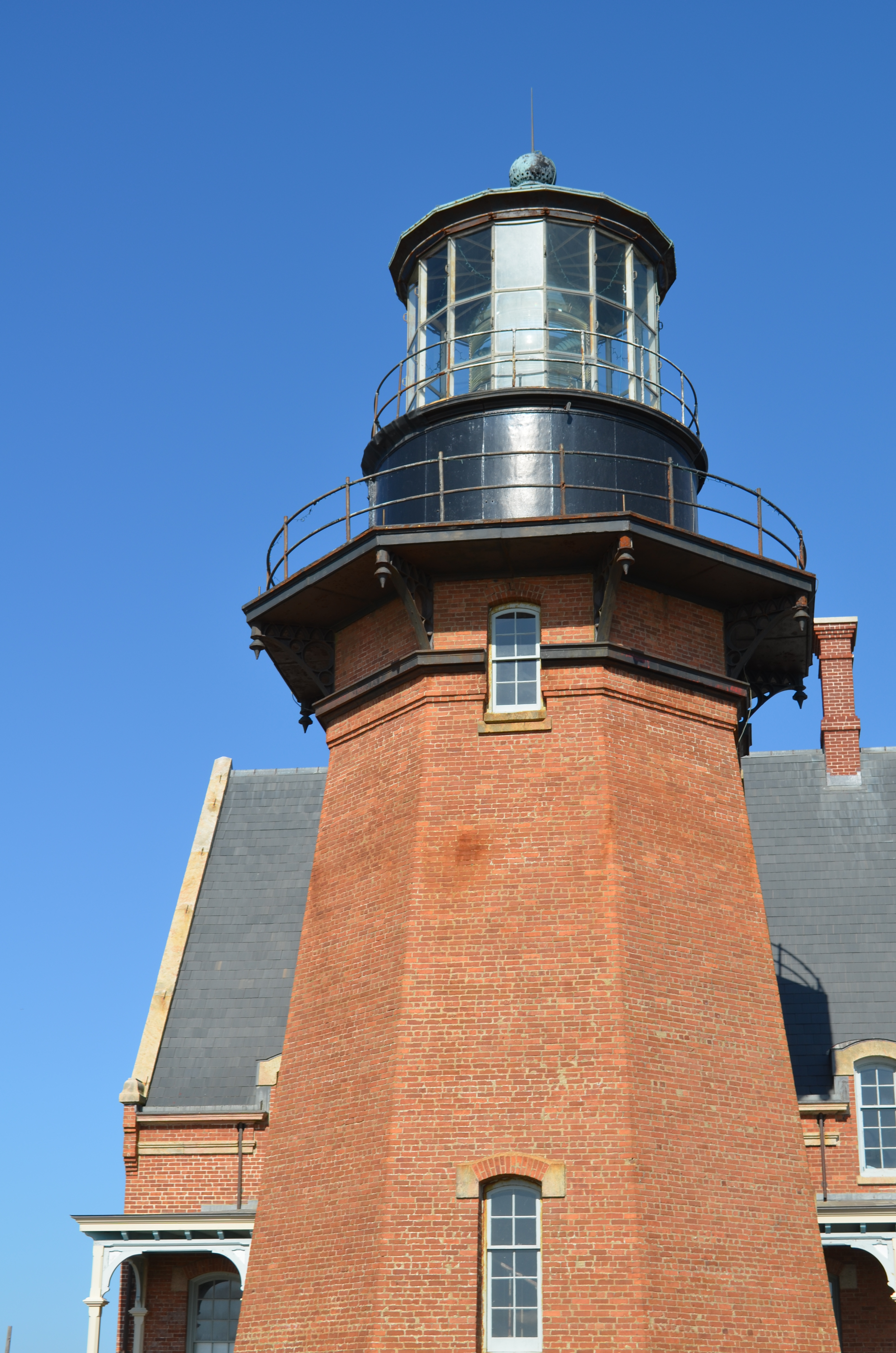
Block Island Southeast Lighthouse, 1875. Photo by SEA.
When you read this, I’ll be on yet another island with Samantha, this time Isla de Vieques, an island-municipality of Puerto Rico in the northeastern Caribbean, part of a group of islands some call the Spanish Virgin Islands.
Much of the island was formerly a bombing range of the US Navy (most of that area is now a National Wildlife Refuge), so much of Vieques was long closed to tourism.
Islands always make me think of lighthouses, of which there are two on Vieques, the ruins of Puerto Ferro and the restored Punta Mulas lighthouse.
Thinking about visiting those lighthouses reminded me of Alfred Corn’s poem, “Lighthouse,” which closes his latest collection, Tables.
I first became aware of Alfred’s poetry when I worked on the editorial staff at Viking Press in the late 1980s. Viking published his collection The West Door and his essay collection, The Metamorphoses of Metaphor. I also worked on his anthology, Incarnation: Contemporary Writers on the New Testament, which featured writers such as Annie Dillard, Robert Hass, Anthony Hecht, and John Hersey.
According to the biographical entry on the Poetry Foundation’s website, “Early in his career, Corn says, he aimed to write poetry that sounded like conversation and to find ‘verbal equivalents for visual realities.’ These conversational patterns have evolved into an attention to rhythm and an eye for detail. He often employs strict formal and metrical devices in his personal and social histories.”
As poet Thomas Disch has written about Corn’s poetry, “It is not the regnant mode among poetry academics at the moment, but since at least the time of Byron and Wordsworth it has been the kind of poetry that most commends itself to readers of poetry.”
I commend to you, dear readers of poetry, Alfred Corn’s poem, “Lighthouse”:
Pilot at the helm of a hidden
headland it steers free
from convergence with the freighter
when fog and storm clouds gather
Sparking communiqué no full stop ends
its broadcast performed in a three-sixty sweep
the cycle burning up five solar seconds
Midnight eye that blinks away
invisibility a high beam
revealing as it scans whatever seas
or ships return terra firma’s landmark gaze
c) 2010 Alfred Corn, used by permission of the author.

Erica reading the poem at the wedding of Samantha and Scott, April 5th, 2014. Photo by David Feldt.
When Samantha and I married last Saturday evening, we weren’t just bringing together our hearts, bodies, minds, and souls; we were bringing together our two families.
Each of us has three children from our previous marriages — my two boys and a girl; her two girls and a boy.
Comparisons to “The Brady Bunch,” the eponymous 1970s TV series, with which we grew up, are ever-present. “Except we don’t have Alice,” we usually reply.
We wanted our children to be incorporated into the ceremony. And they were: my oldest son, Jasper, was best man; Samantha’s oldest son performed “In My Life” by The Beatles on guitar for the processional.
Walker, my younger boy, was ring-bearer, while his twin sister, Elizabeth, and Samantha’s youngest, Sasha, were “bridesmaids bearing flowers,” decidedly not “flower girls.” Samantha’s older daughter, Erica, was asked to give a reading during the community blessings segment of the ceremony.
I was tasked with finding an appropriate poem for Erica to read.
“Perhaps something about a blended family,” Samantha suggested. Scanning the Internet, I came up empty. How could there be no poems about blended families? (Or, at least, poems worthy of the name in this poet’s opinion.)
The poems I found were either over-written, overly sentimental or just plain bad. This seemed a shame in an age when blended families are almost commonplace.
So I wrote one. Luckily, the poetry group to which I belong, “52,” came along with a weekly prompt for a poem on praise.
Erica did an amazing job reading it at the wedding and we were all very proud of her — and not a few of us were moved to tears. This was not so much a validation of the poem’s value, but because she delivered it with so much feeling. I post it here in the hope that other couples on the path of blending their families may be searching for a way to honor such a beautiful and complex union.
Here is my poem in praise of the “Blended Family”:
When families are blended
it’s not like a smoothie,
where all the ingredients
combine to make a new flavor.
In the multiflavored family,
each flavor remains unique,
each name remains its own.
There is joy in blending families,
but sometimes tears, too.
You don’t deny the one for
the other, you are more
together, yet equal apart.
You are “and” rather than “or.”
There is more of you–
So praise our blended family,
let it bring abundance into all our lives.
Let there be strength in our numbers,
as there are now more shoulders
to lean on, more hands to lend,
more hearts to be kept in,
more love to share in its union and bond.
And let each of us
make the best that is all of us
shine more brightly, now, together.
–Scott Edward Anderson
 This is a very special April for me, and a very special first poem for this 2014 edition of National Poetry Month. Tomorrow, Saturday, April 5th, I am getting married to my best friend, soul mate, partner, and fiancee, Samantha.
Ours has been a long road with many obstacles, detours, and diversions to finally arrive at where we are going to be on this certain April day.
I wrote a poem for the occasion. Actually, I wrote it for the poetry group to which I belong called 52, which is challenging me to write a poem each week during the year. We decided to print the poem on the back of the program for the wedding (see photo).
Poet Jo Bell (whose work I will feature later in the month) started group 52 and supplies most of the prompts for this virtual poetry workshop that numbers over 500 members worldwide. (You can find the prompts here: 52.) One week, the prompt was to write about Journeys. It was the perfect prompt to get me thinking about how we got here.
Here is my poem “Our Journey”:
How did we get here?
We say it all began with a yes,
But, really, it all began
With an across-the-room
Magnetism, with a searing
Feeling every time I tried to look away.
As if, there was something I had to see,
That only you could show me
And that I didn’t know you had.
What was it? You’ve shown it
To me almost every day since.
A fabric rent and become whole again,
A mystery with a resolution
That surprises us, every time.
A face as if seen through glass,
Scratched or etched
To a fine filigreed, subtle design.
No, no, that’s not it.
It’s more like glass that’s been glazed
With a pale, soapy film,
Which, once it is rubbed off,
Is clearer than the glass itself.
The two of us on separate, nearly parallel paths,
Not knowing we were looking for each other.
So many times, our paths nearly crossed,
But didn’t. Near misses we can only attribute to –
To what? Some kind of cruel,
But beautiful joke played by the Fates?
Nevertheless, here we are,
Together at last or again or finally.
On a journey together that results in a walk
Together down another path
On this certain April day.
–Scott Edward Anderson
Poems of Displacement, Love, and Other Modern Tamil Concerns
March 23, 2014
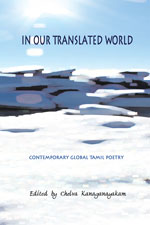 IN OUR TRANSLATED WORLD: Contemporary Global Tamil Poetry, edited by Chelva Kanaganayakam (TSAR Publications, Toronto, Canada)
My first encounter with Tamil poetry came in the form of a short poem by Auvaiyar, written two millennium ago:
Bless you, earth:
field,
forest,
valley,
or hill,you are only as good
as the good young men
in each place.
This poem appeared in a book of classical Tamil poetry called Poems of Love and War from the Eight Anthologies and the Ten Long Poems of Classical Tamil, selected and translated by A.K. Ramanujan, which featured poems from around 100 BC to AD 250, and late classical poems from the 5th and 6th centuries.
The poems were divided into two distinct sections, “Akam” (pronounced “aham”) which were love poems, and “Puram,” which were about heroes and battles. Akam means heart or household, and the poems are distinguished by the landscape each poem evokes and, in turn, the particular experience of love each landscape connotes. The Tamil called this “Tinai” in their poetics.
The subtropical climate of Tamil Nadu in southern India ranges from seaside to mountains, agricultural fields to forests, and desert. Each landscape is associated with a certain mood and the poems typically feature a flower, tree or plant of the corresponding biome. For example, as Ramanujan points out in his translator’s note, “Kurinci, a mountain flower; neytal, blue lily; mullai, jasmine; maratam, queen’s flower; palai, a desert tree.”
The poems are distinguished by straight-forward emotions and plain language (at least in translation), with a simplicity rivaling Chinese and Japanese poetry.
Take Kapilar’s poem of longing, “What She Said to her friend” (p. 13):
You ask me to forget him,
How can I?
His mountain,
wearing its dark raincloud
white-crested
as a bean flower
the east wind opens,
his mountain,
that blue sapphire,
is never out of sight.
We know from the Tinai that each landscape corresponds to a phase or experience of love: union/mountains; separation/desert; patience waiting/forest; anxious waiting/seaside; and infidelity and resentment/lowland farms. In the poem above, the speaker is clearly longing for the union or reunion with her lover on his mountain, which she keeps in her memory.
Tamils have a strong attachment to their language, which is central to their identity. Many refer to it as Tamil̲an̲n̲ai, “the Tamil mother.” It is one of the oldest surviving classical languages in the world, and written Tamil is a beautiful Brahmic script. Thankfully, this anthology is bilingual, which allows the reader to see the poems (if not read them) in their original form.
Poets such as Mahakavi Bharathiyar and Bharathidasan — the latter a kind of Tamil Fernando Pessoa who wrote many of his poems in various pseudonyms — brought Tamil poetry into the modern era. Their work gave Tamil poets freedom from the constraints of traditional Tamil poetics and expanded the subject matter available to Tamil poets.
In Our Translated World: Contemporary Global Tamil Poetry is a recent anthology of contemporary global Tamil poetry, published by the Tamil Literary Garden of Canada and TSAR Publications in Toronto. The work of the Tamil poets in this anthology clearly bears the mark of its modern predecessors, but also the influence of modern and contemporary poetry from Europe and Asia.
Not surprising, given the book is a selection of recent poems from Tamils around the world. Indeed, the anthology, edited by Chelva Kanaganayakam, features around 80 poems from Tamil Nadu, Sri Lanka, Malaysia, Singapore, and the Tamil diaspora in England, Canada, and elsewhere.
As Chelva writes in the introduction, “for Tamils, particularly in the last three decades, the experiences have been one of displacement, trauma, nostalgia, and despair.” This is especially true of Sri Lankan Tamils, as many tried to escape ethnic conflicts on that island nation.
For some Sri Lankans, such conflict breeds a conflicting nature. For example, Chandra Bose Sudhakar, who defends his choosing a life of books,
Life began with some books:
that the words in books
produce no rice became
the problem of our lives.
For Sudhakar, “books swallow the howls/ of my tormented heart” and offer the Sri Lankan poet, who was killed by armed men in his house in 2007, a kind of acknowledgment he couldn’t find elsewhere.
Some poems in the collection have echoes, intentional or not, of classical Akam poems, such as this one by Majeed, which sounds to me like a desert or separation poem:
You live on
in the empty spaces
that cannot be filled
with anything else.
Or consider the seaside imagery of another poem by Auzhiyaal, which could be in the voice of an anxious lover trying to find solace in the littoral environment:
At the end of each day
our minute secrets
rise again
a pregnant silver fish
a sea weed
a pink sea rock.
The freedom afforded by contemporary poetics may bely an ignorance of Tamil classical themes and symbolism, as some of the poets freely mix landscapes, emotions, and place, such as in this poem by Rashmy,
Parting is always bitter;
everywhere, eventually brackish;
trembling flesh,
nerves starved with lust,
the soul’s love
draining, filled to the brim.
From our paddy fields
gold-hued grains
we will harvest
the day after yesterday.
Others call out the connection, such as Anar does in her poem “Marutham,” with its rich depiction of the farm fields and rice paddies indicative of the agricultural landscape and a hint of possible infidelity in the lines,
The fragrant smell of
ripe paddy in the fields,
offers a giddy sense of joy.
As much as the poets in this collection have deep memories of their Tamil past and poetry, the poems in this collection are, as the editor writes in his introduction, “a form of transformation, a gesture about the future. Whether the poems are ostensibly realistic or self-consciously fantastic, the poems move beyond ethnographic detail to offer an imaginative sense of the Tamil experience.”
And for poetry readers, the Tamil experience is a rich and rewarding one in the hands of the poets, translators, and editor of In Our Translated World.
##
Images That Stick and My Poem “Becoming”
December 27, 2013

Jasper and sunflower.
Who’s to say how images come to stick in our mind and how they make their way into our poetry?
There’s an image of my oldest son, Jasper, that stuck with me over the years and I recently ran across a photograph that captured the image and inspired lines in my poem, “Becoming.”
“The way a sunflower towers over a child,
each year growing shorter–
…
–no, the child growing taller.”
In the photograph my son is in the summer of his second year. We we were living in Anchorage, Alaska, where the sunflowers grow tall in the nearly full-day sun.
He’s measuring himself up against a sunflower — and bending the sunflower down to touch his head.
There are other images of Jasper in his youth that appear in that poem and things that we saw out on hikes together.
Here is my poem, “Becoming”:
Say that childhood memory
has more relevance than yesterday–
a moose calf curled up against the side of a house
merely saying it may make it so.
The way a sunflower towers over a child,
each year growing shorter–
a hermit crab crawling out of a coconut
–no, the child growing taller.
a sharp-shinned hawk swooping over a stubble field
imagining the earth, “the earth is all before me,”
blossoming as it stretches to the sun–
a brilliant red eft – baby salamander — held aloft in a small, pink hand
Is home the mother’s embrace?
a white cabbage butterfly flitting atop purple flox
The child sees his world or hers
stroking the furry back of a bumblebee
head full of seed, until it droops,
spent, ready to sow the seeds.
Say that our presence in the world
a millipede curling up at the child’s slightest touch
is making the book of our becoming.
–Scott Edward Anderson
Poetry at Work: My Foreword to the Book by Glynn Young
December 16, 2013
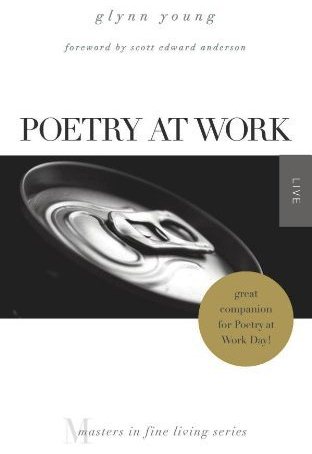
Readers of this blog know I’ve written on the subject of poetry and business life on a number of occasions. (You can find examples here and here.)
So it will come as no surprise when you learn I’ve written a Foreword to a new book called Poetry at Work: (Masters in Fine Living Series)
You should definitely buy the book — for yourself and for your colleagues, which you can do by clicking on this link: Poetry at Work: (Masters in Fine Living Series)
On the one-year anniversary of 9/11, we held a vigil or memorial service in the office where I worked. We thought it best to set aside time to reflect, remember, and reconnect with each other.
Gathering in the conference room, we shared our thoughts, memories, and connections, our stories, prayers, and poems.
I read W.H. Auden’s poem “September 1, 1939,” and we followed it with a moment of silence. Others shared poems, told of where they were when they heard the news, someone sang a hymn, I believe; most of us cried.
It was the most powerful staff meeting I’d ever attended.
Later that day, I circulated Auden’s poem by email to my colleagues at work and to a larger poetry email list I maintain for National Poetry Month.
The poem, Auden’s reaction to the Nazi invasion of Poland, seemed an appropriate response to the shock we all still felt about the attack on the World Trade towers, and the massive loss of life such as we hadn’t experienced on our soils since the Civil War.
Auden, writing not far from lower Manhattan, begins the poem,
I sit in one of the dives
On Fifty-second Street
Uncertain and afraid
As the clever hopes expire
Of a low dishonest decade:
Waves of anger and fear
Circulate over the bright
And darkened lands of the earth,
Obsessing our private lives;
The unmentionable odour of death
Offends the September night.
This poem was widely circulated in the aftermath of 9/11, as if the poem struck a collective chord both emotional and visceral. Great poetry is timeless.
Back in the mid-to-late 90s, I delivered a series of talks about poetry and business life to groups of corporate leaders, Rotary clubs, and small business associations. I read poems — not my own — about how it felt to fire someone, what it was like for a woman in corporate America, and why it’s so hard to let go when you retire.
I loved the reactions of the businessmen in the room, especially the older men who had experienced a lot of the feelings described.
Invariably, most nodded along with something that hit home; many looked skyward and blinked back tears. Poetry moved them to tears.
Poetry at work is no longer an anomaly. David Whyte, Clare Morgan, James Autry, and others helped make it acceptable. So, too, did many individual leaders and managers who were open to letting poetry into their companies, offices, and discourse.
In Poetry at Work, Glynn Young argues for the poetry of work — at work, in work, and in the workplace. He finds it in the big things, such as the crisis to which he helped respond as a speechwriter for a chemical company, and in the small, everyday interactions we all experience at the office.
Long ago I received a bit of advice from an older poet who told me to go out and get a real job and write about real life. It was sage counsel and I am the better for it. I have no regrets about being a working poet rather than an academic.
I have spent my entire working life as a poet. Indeed, I was a poet even before I had my first job.
The closest I ever came to having a traditional “poetry job” was when I worked on the editorial staff at Viking Press — that and one lecture on the process of revision given at the University of Alaska, Anchorage.
I have always tried to bring my poetry to my work life and to let my work life influence my poetry. The work that lent itself best to my poetry was the 15 years I spent with The Nature Conservancy, in part because much of my poetry is focused on the natural world and our species’ relationship with it.
The Conservancy offered me opportunities for first-hand field observations, unparalleled access to the scientific knowledge of some of the world’s foremost biologists, and travel to many of the Earth’s last great and most spectacular places.
My time with the Conservancy provided a beautiful symbiosis between my work and my poetry. I have not since been able to reclaim that symbiosis, yet my work life still informs my poetry in other ways.
I may not find direct, poetic inspiration from my day job now, but it affects the way I work on my poetry. Rather than writing late at night after being out in the field, I now find odd, furtive moments: walking to or from the office between meetings, on my subway commute, and while waiting for elevators.
Occasionally, I’ll be struck by some phrase or sentence heard on a conference call and I’ll worry it until finding its marrow or proving it useless. Part of it might resurface while I’m driving between cities or on an airplane or it may be lost forever.
I had a meeting a little over a year ago with a European colleague at the Grand Hyatt in New York. We were introduced by a mutual acquaintance from outside the firm for which we both work.
As we met and ascended the stairs to the Lounge at New York Central, I was reminded of a poem I wrote in that bar many years ago, while working for an international publishing agency.
“Drink Meeting at the Grand Hyatt Sun Garden” wasn’t a very good poem, I think, but it well illustrated my discomfort at the time, as an artist in a business setting.
The name of the bar has changed, as has my comfort level with business life over the years. Here is “Drink Meeting at the Grand Hyatt Sun Garden”:
Jazz standards fill the atrium,
black and white and one uniform shade of gray
—is this a Woody Allen film?
I’m waiting for Soandso on business,
not my business,
but the people I work for, theirs—
Any moment Woody will walk in
with Mia Farrow or Somebody,
an entourage, paparazzi.
He’ll head straight for my table,
and shake my hand;
the press will want to know
who I am, and I’ll no longer
be “a minor poet, not very conspicuous.”
I fight the urge to bolt
out of the Sun Garden bar
and find some dark, unmonikered pub,
like those my father frequented.
I realize the discomfort he must have felt
when he’d visit the clean, well-lighted
establishments of Tokyo, or LA, or Miami
on business, not his
but the people he worked for, theirs—
This is not my world:
a foreign post for a poet
and accidental businessman.
I suspect they’d throw me out
if not for my Brooks Brothers suit
and American Express card, not mine
but the people I work for, theirs—
Soandso is late, or lost,
or has forgotten…no,
it turns out she’s been waiting
in the lobby, fifteen minutes, twenty,
only just now thought
to check the bar—“Silly me…”
No Woody, no Mia, no Diane Keaton.
(But wait, isn’t that Mr. Shawn by the piano?
And isn’t that Donald Trump on the divan?)
Just a meeting, information shared—
perhaps, one day, we could be friends—
business transacted,
not my business,
but what has become mine—
I light a cigarette after Soandso has gone.
“Are you finished with this one, sir?”
I order another drink
and finish my poem. This
is my business.
The world is my office.
##
I try to bring poetry to my work life as much as possible, whether I’m giving a speech or presentation, leading trainings or writing copy for an annual report or business plan.
It’s not always easy to bring poetry to work, but as my friend the management consultant Cam Danielson says, poetry adds a dimension to me that others don’t have — a way of paying attention to and perceiving the world that perhaps challenges or even changes the worldview of others.
In the end, we don’t give ourselves enough time for poetry — at work or at home. If we did, our business life might be less stressful and more satisfying. We might find our work more rewarding. We might, as Young suggests in his book, find the poetry at work.
–Scott Edward Anderson
Seamus Heaney Remembered
November 12, 2013

Program for Heaney Tribute at Cooper Union.
A stellar lineup of poets, musicians, publishers, and poetry organizations gathered last night to pay tribute to Seamus Heaney.
Heaney, the 1995 Nobel laureate in literature, died after a fall on Friday, August 30, 2013, in Dublin. He had suffered a stroke in 2006.
The event, organized by the Poetry Society of America, the Academy of American Poets, Poets House, the Unterberg Poetry Center at the 92nd Street Y, the Irish Arts Center PoetryFest, and Farrar, Straus and Giroux, Heaney’s US publisher, took place at the Great Hall of Cooper Union in New York City, an appropriate venue for such a stentorian public poetic figure.
Among the readers were Heaney’s fellow Irish poets Eamon Greenan, Eavan Boland, Greg Delanty, and Paul Muldoon, along with Tracy K. Smith, Kevin Young, Jane Hirshfield, and Yusef Komunyakaa. You can read the full list here: Heaney Tribute.
One poem that was missing last night was one that I thought of shortly after hearing the news of Heaney’s death.
We were heading out to Martha’s Vineyard for a week with Samantha’s family to celebrate the 70th year of her mother, Lee Langbaum. The New York Times the morning we left had Heaney’s picture on the front page and ran his obituary, but I couldn’t get to it until much later in the day, aboard the ferry.

New York Times announcing Heaney’s death.
It was sad news indeed, for those of us who loved his poetry and for the world that lost a remarkable voice. Heaney was a wonderful poet and a warmhearted man, as most of the people gathered at Cooper Union last night — whether on stage or off — would attest.
I only met him twice, and only very briefly after readings, but he was gracious and generous both times. The last time I saw him was at a reading three years ago or so at Villanova University.
The poem that came to mind on Martha’s Vineyard, came to me as we were talking with the oyster shucker outside of Home Port Restaurant in Menemsha. Of course it was “Oysters,” a poem that was missing last night.
Here is Seamus Heaney’s “Oysters”:
Our shells clacked on the plates.
My tongue was a filling estuary,
My palate hung with starlight:
As I tasted the salty Pleiades
Orion dipped his foot into the water.
Alive and violated,
They lay on their bed of ice:
Bivalves: the split bulb
And philandering sigh of ocean —
Millions of them ripped and shucked and scattered.
We had driven to that coast
Through flowers and limestone
And there we were, toasting friendship,
Laying down a perfect memory
In the cool of thatch and crockery.
Over the Alps, packed deep in hay and snow,
The Romans hauled their oysters south of Rome:
I saw damp panniers disgorge
The frond-lipped, brine-stung
Glut of privilege
And was angry that my trust could not repose
In the clear light, like poetry or freedom
Leaning in from sea. I ate the day
Deliberately, that its tang
Might quicken me all into verb, pure verb.
—Seamus Heaney, 1939-2013
Here is Heaney reading his poem at the Griffin Poetry Prize Awards ceremony in 2012: http://www.dailymotion.com/video/xslwsp_seamus-heaney-oysters_creation
 Scott Edward Anderson
 Scott Edward Anderson's Poetry Blog