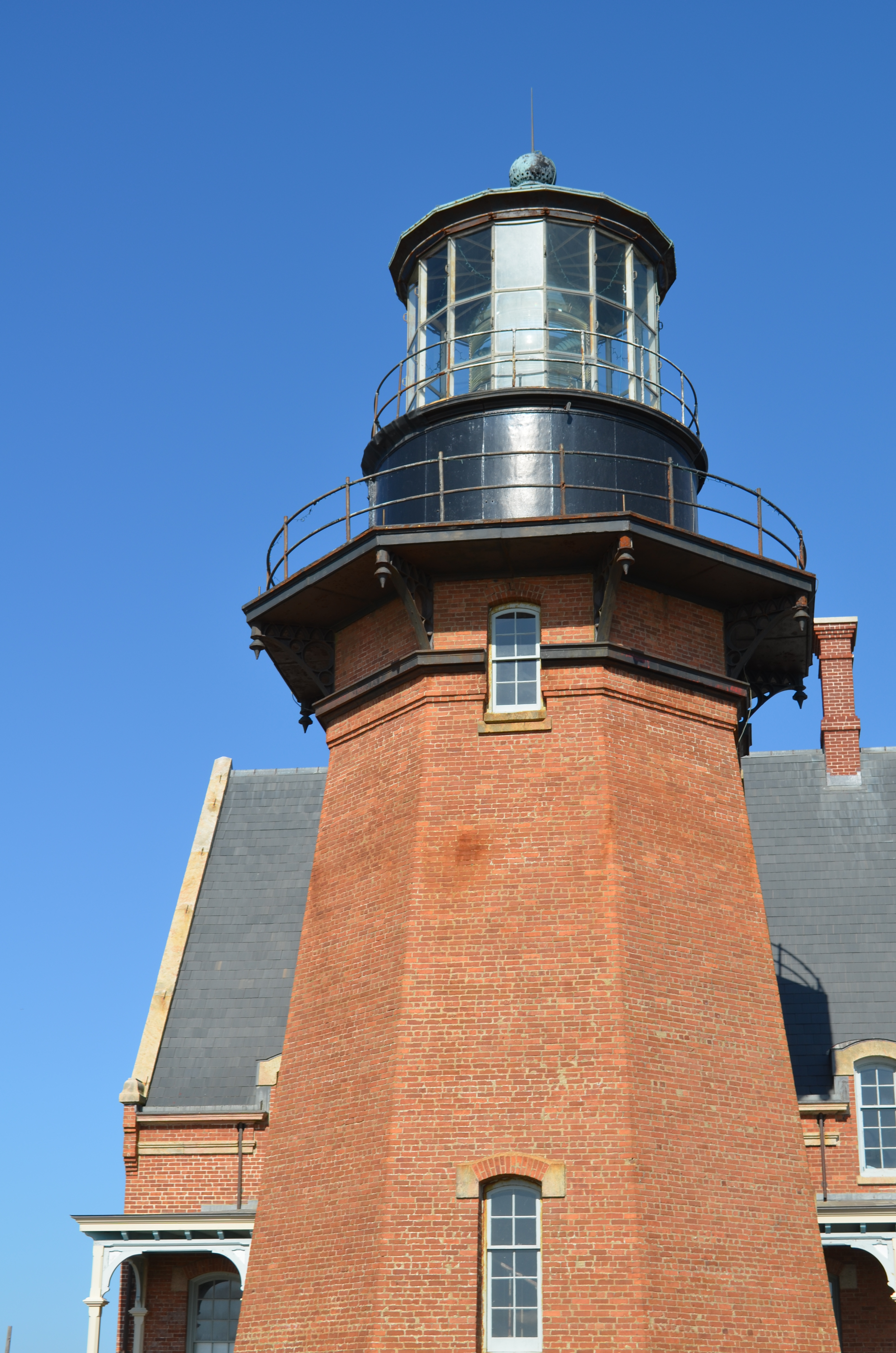
Block Island Southeast Lighthouse, 1875. Photo by SEA.
When you read this, I’ll be on yet another island with Samantha, this time Isla de Vieques, an island-municipality of Puerto Rico in the northeastern Caribbean, part of a group of islands some call the Spanish Virgin Islands.
Much of the island was formerly a bombing range of the US Navy (most of that area is now a National Wildlife Refuge), so much of Vieques was long closed to tourism.
Islands always make me think of lighthouses, of which there are two on Vieques, the ruins of Puerto Ferro and the restored Punta Mulas lighthouse.
Thinking about visiting those lighthouses reminded me of Alfred Corn’s poem, “Lighthouse,” which closes his latest collection, Tables.
I first became aware of Alfred’s poetry when I worked on the editorial staff at Viking Press in the late 1980s. Viking published his collection The West Door and his essay collection, The Metamorphoses of Metaphor. I also worked on his anthology, Incarnation: Contemporary Writers on the New Testament, which featured writers such as Annie Dillard, Robert Hass, Anthony Hecht, and John Hersey.
According to the biographical entry on the Poetry Foundation’s website, “Early in his career, Corn says, he aimed to write poetry that sounded like conversation and to find ‘verbal equivalents for visual realities.’ These conversational patterns have evolved into an attention to rhythm and an eye for detail. He often employs strict formal and metrical devices in his personal and social histories.”
As poet Thomas Disch has written about Corn’s poetry, “It is not the regnant mode among poetry academics at the moment, but since at least the time of Byron and Wordsworth it has been the kind of poetry that most commends itself to readers of poetry.”
I commend to you, dear readers of poetry, Alfred Corn’s poem, “Lighthouse”:
Pilot at the helm of a hidden
headland it steers free
from convergence with the freighter
when fog and storm clouds gather
Sparking communiqué no full stop ends
its broadcast performed in a three-sixty sweep
the cycle burning up five solar seconds
Midnight eye that blinks away
invisibility a high beam
revealing as it scans whatever seas
or ships return terra firma’s landmark gaze
c) 2010 Alfred Corn, used by permission of the author.
 This is a very special April for me, and a very special first poem for this 2014 edition of National Poetry Month. Tomorrow, Saturday, April 5th, I am getting married to my best friend, soul mate, partner, and fiancee, Samantha.
Ours has been a long road with many obstacles, detours, and diversions to finally arrive at where we are going to be on this certain April day.
I wrote a poem for the occasion. Actually, I wrote it for the poetry group to which I belong called 52, which is challenging me to write a poem each week during the year. We decided to print the poem on the back of the program for the wedding (see photo).
Poet Jo Bell (whose work I will feature later in the month) started group 52 and supplies most of the prompts for this virtual poetry workshop that numbers over 500 members worldwide. (You can find the prompts here: 52.) One week, the prompt was to write about Journeys. It was the perfect prompt to get me thinking about how we got here.
Here is my poem “Our Journey”:
How did we get here?
We say it all began with a yes,
But, really, it all began
With an across-the-room
Magnetism, with a searing
Feeling every time I tried to look away.
As if, there was something I had to see,
That only you could show me
And that I didn’t know you had.
What was it? You’ve shown it
To me almost every day since.
A fabric rent and become whole again,
A mystery with a resolution
That surprises us, every time.
A face as if seen through glass,
Scratched or etched
To a fine filigreed, subtle design.
No, no, that’s not it.
It’s more like glass that’s been glazed
With a pale, soapy film,
Which, once it is rubbed off,
Is clearer than the glass itself.
The two of us on separate, nearly parallel paths,
Not knowing we were looking for each other.
So many times, our paths nearly crossed,
But didn’t. Near misses we can only attribute to –
To what? Some kind of cruel,
But beautiful joke played by the Fates?
Nevertheless, here we are,
Together at last or again or finally.
On a journey together that results in a walk
Together down another path
On this certain April day.
–Scott Edward Anderson
Poetry at Work: My Foreword to the Book by Glynn Young
December 16, 2013
Readers of this blog know I’ve written on the subject of poetry and business life on a number of occasions. (You can find examples here and here.)
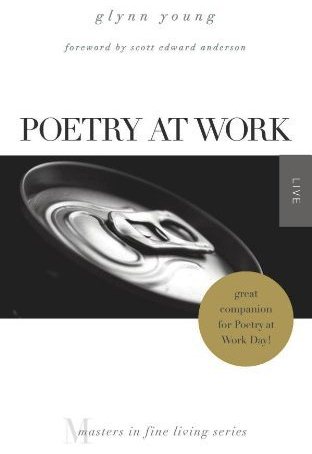
So it will come as no surprise when you learn I’ve written a Foreword to a new book called Poetry at Work: (Masters in Fine Living Series)
You should definitely buy the book — for yourself and for your colleagues, which you can do by clicking on this link: Poetry at Work: (Masters in Fine Living Series)
On the one-year anniversary of 9/11, we held a vigil or memorial service in the office where I worked. We thought it best to set aside time to reflect, remember, and reconnect with each other.
Gathering in the conference room, we shared our thoughts, memories, and connections, our stories, prayers, and poems.
I read W.H. Auden’s poem “September 1, 1939,” and we followed it with a moment of silence. Others shared poems, told of where they were when they heard the news, someone sang a hymn, I believe; most of us cried.
It was the most powerful staff meeting I’d ever attended.
Later that day, I circulated Auden’s poem by email to my colleagues at work and to a larger poetry email list I maintain for National Poetry Month.
The poem, Auden’s reaction to the Nazi invasion of Poland, seemed an appropriate response to the shock we all still felt about the attack on the World Trade towers, and the massive loss of life such as we hadn’t experienced on our soils since the Civil War.
Auden, writing not far from lower Manhattan, begins the poem,
I sit in one of the dives
On Fifty-second Street
Uncertain and afraid
As the clever hopes expire
Of a low dishonest decade:
Waves of anger and fear
Circulate over the bright
And darkened lands of the earth,
Obsessing our private lives;
The unmentionable odour of death
Offends the September night.
This poem was widely circulated in the aftermath of 9/11, as if the poem struck a collective chord both emotional and visceral. Great poetry is timeless.
Back in the mid-to-late 90s, I delivered a series of talks about poetry and business life to groups of corporate leaders, Rotary clubs, and small business associations. I read poems — not my own — about how it felt to fire someone, what it was like for a woman in corporate America, and why it’s so hard to let go when you retire.
I loved the reactions of the businessmen in the room, especially the older men who had experienced a lot of the feelings described.
Invariably, most nodded along with something that hit home; many looked skyward and blinked back tears. Poetry moved them to tears.
Poetry at work is no longer an anomaly. David Whyte, Clare Morgan, James Autry, and others helped make it acceptable. So, too, did many individual leaders and managers who were open to letting poetry into their companies, offices, and discourse.
In Poetry at Work, Glynn Young argues for the poetry of work — at work, in work, and in the workplace. He finds it in the big things, such as the crisis to which he helped respond as a speechwriter for a chemical company, and in the small, everyday interactions we all experience at the office.
Long ago I received a bit of advice from an older poet who told me to go out and get a real job and write about real life. It was sage counsel and I am the better for it. I have no regrets about being a working poet rather than an academic.
I have spent my entire working life as a poet. Indeed, I was a poet even before I had my first job.
The closest I ever came to having a traditional “poetry job” was when I worked on the editorial staff at Viking Press — that and one lecture on the process of revision given at the University of Alaska, Anchorage.
I have always tried to bring my poetry to my work life and to let my work life influence my poetry. The work that lent itself best to my poetry was the 15 years I spent with The Nature Conservancy, in part because much of my poetry is focused on the natural world and our species’ relationship with it.
The Conservancy offered me opportunities for first-hand field observations, unparalleled access to the scientific knowledge of some of the world’s foremost biologists, and travel to many of the Earth’s last great and most spectacular places.
My time with the Conservancy provided a beautiful symbiosis between my work and my poetry. I have not since been able to reclaim that symbiosis, yet my work life still informs my poetry in other ways.
I may not find direct, poetic inspiration from my day job now, but it affects the way I work on my poetry. Rather than writing late at night after being out in the field, I now find odd, furtive moments: walking to or from the office between meetings, on my subway commute, and while waiting for elevators.
Occasionally, I’ll be struck by some phrase or sentence heard on a conference call and I’ll worry it until finding its marrow or proving it useless. Part of it might resurface while I’m driving between cities or on an airplane or it may be lost forever.
I had a meeting a little over a year ago with a European colleague at the Grand Hyatt in New York. We were introduced by a mutual acquaintance from outside the firm for which we both work.
As we met and ascended the stairs to the Lounge at New York Central, I was reminded of a poem I wrote in that bar many years ago, while working for an international publishing agency.
“Drink Meeting at the Grand Hyatt Sun Garden” wasn’t a very good poem, I think, but it well illustrated my discomfort at the time, as an artist in a business setting.
The name of the bar has changed, as has my comfort level with business life over the years. Here is “Drink Meeting at the Grand Hyatt Sun Garden”:
Jazz standards fill the atrium,
black and white and one uniform shade of gray
—is this a Woody Allen film?
I’m waiting for Soandso on business,
not my business,
but the people I work for, theirs—
Any moment Woody will walk in
with Mia Farrow or Somebody,
an entourage, paparazzi.
He’ll head straight for my table,
and shake my hand;
the press will want to know
who I am, and I’ll no longer
be “a minor poet, not very conspicuous.”
I fight the urge to bolt
out of the Sun Garden bar
and find some dark, unmonikered pub,
like those my father frequented.
I realize the discomfort he must have felt
when he’d visit the clean, well-lighted
establishments of Tokyo, or LA, or Miami
on business, not his
but the people he worked for, theirs—
This is not my world:
a foreign post for a poet
and accidental businessman.
I suspect they’d throw me out
if not for my Brooks Brothers suit
and American Express card, not mine
but the people I work for, theirs—
Soandso is late, or lost,
or has forgotten…no,
it turns out she’s been waiting
in the lobby, fifteen minutes, twenty,
only just now thought
to check the bar—“Silly me…”
No Woody, no Mia, no Diane Keaton.
(But wait, isn’t that Mr. Shawn by the piano?
And isn’t that Donald Trump on the divan?)
Just a meeting, information shared—
perhaps, one day, we could be friends—
business transacted,
not my business,
but what has become mine—
I light a cigarette after Soandso has gone.
“Are you finished with this one, sir?”
I order another drink
and finish my poem. This
is my business.
The world is my office.
##
I try to bring poetry to my work life as much as possible, whether I’m giving a speech or presentation, leading trainings or writing copy for an annual report or business plan.
It’s not always easy to bring poetry to work, but as my friend the management consultant Cam Danielson says, poetry adds a dimension to me that others don’t have — a way of paying attention to and perceiving the world that perhaps challenges or even changes the worldview of others.
In the end, we don’t give ourselves enough time for poetry — at work or at home. If we did, our business life might be less stressful and more satisfying. We might find our work more rewarding. We might, as Young suggests in his book, find the poetry at work.
–Scott Edward Anderson
Much Ado About Nada: Harper’s “Poetry Slam”
June 22, 2013

Harper’s Magazine, July 2013
Okay, so I read the Mark Edmundson article, “Poetry Slam, or the Decline of American Verse.”
The essay was supposed to have all us poets rending our garments and pounding our chests in anger. At least, that’s according to Ron Charles of the Washington Post, whose summation you can read here.
To read the full article, you have to buy the July 2013 issue of Harper’s, because you can’t access it without a subscription. Which begs the question, who subscribes to Harper’s anymore, really?
What I found there was nothing earth shattering. Edmunson, a professor of English at the University of Virginia, makes some fairly common complaints about the baby boomer generation of contemporary poets, a generation of which I am on the cusp. (In the interest of full disclosure, I studied with one of the poets he criticizes and had a poem selected for recognition by another.)
Edmundson offers criticisms of some usual suspects (John Ashbery, Jorie Graham, Robert Hass), a decidedly weak argument against Seamus Heaney, and one of the first, valid pot-shots I’ve seen aimed at Paul Muldoon and his tenure as tastemaker of poetry at The New Yorker.
He also pokes fun at Anne Carson, who is overdue, but for her part has been poking fun at us readers for years, so what’s the point?
Ultimately, Edmundson seems to be arguing for much the same kind of politically aware and socially engaged poet that Ginsberg, Whitman, and Eliot (!) represented. And the sort of heightened language deployed by Robert Lowell in his best days. Edmundson longs for the liberal left, activist branch of poetry — although he admits that Fr. Eliot doesn’t really fit that mold.
In addition, he calls for a poetry that exploits the same veins of popular culture — references to TV shows, the Internet, and current events — that a younger generation has been mining for the past decade.
Reading his essay, I wonder whether Edmundson has read any poet born after, say, the late 1950s? He clearly has not spent any time with poets as pop-culture savvy as Matthew Zapruder, Dorothea Lasky, and Matthew Rohrer.
I doubt Edmundson has read the “unapologetically queer poet activist, ” CA Conrad, who can best be described as the love-child of a ménage à trois between Walt Whitman, Allen Ginsberg, and Anne Waldman wrapped up in glitter, nail polish, and parapsychology. (And I write that with affection for CA and his writing.)
Neither, I suspect, has Edmundson read Natasha Trethewey, who writes about race, identity, and family in much of her work.
If Edmundson really wants to read poets writing about nothing, he should check out what I call the “Seinfeld Generation” of poets: the Dickman twins (one of whom wrote that annoying Clint Eastwood Chrysler Super Bowl commercial, “Halftime in America”) or the over-lauded Timothy Donnelly, whose linguistic pyrotechnics are certainly as “perpetually hedging” as anything Ashbery has written.
Hard for Edmundson to make the argument he’s making while his reading is seemingly so “generationally challenged.”
While I agree with some of what Edmundson says — that much contemporary poetry seems lacking in ambition — his is the same kind of argument critics made of John Lennon’s last solo recordings.
They found Lennon’s mature work — he was 39 — to be more domesticated, self-absorbed, and solipsistic than his earlier, more political solo work, much of which strikes one as facile now. (Does anyone really prefer “Some Time in New York City” to John’s songs on “Double Fantasy”?)
I’ve seen some over the top reactions in defense of “contemporary” poetry resulting from this latest jeremiad about the sorry state of the art, but I suspect they didn’t read past Harper’s pay wall. At least, after reading the complete essay in the magazine, I don’t see how Edmundson’s prose could get any poet’s panties in a twist.
My friend Dan Nester had perhaps the most sober, cogent reaction I’ve read. He wrote entertainingly on the subject as part of his blog’s “Notes” series.
In the end, I applaud Edmundson for caring enough to persuade the editors of this once-relevant magazine to publish his essay about everyone’s favorite, once-relevant art form.
But, really, this essay is much ado about nothing.
Winslow Homer, Masterworks, and My Poem “Bermudiana”
May 21, 2013
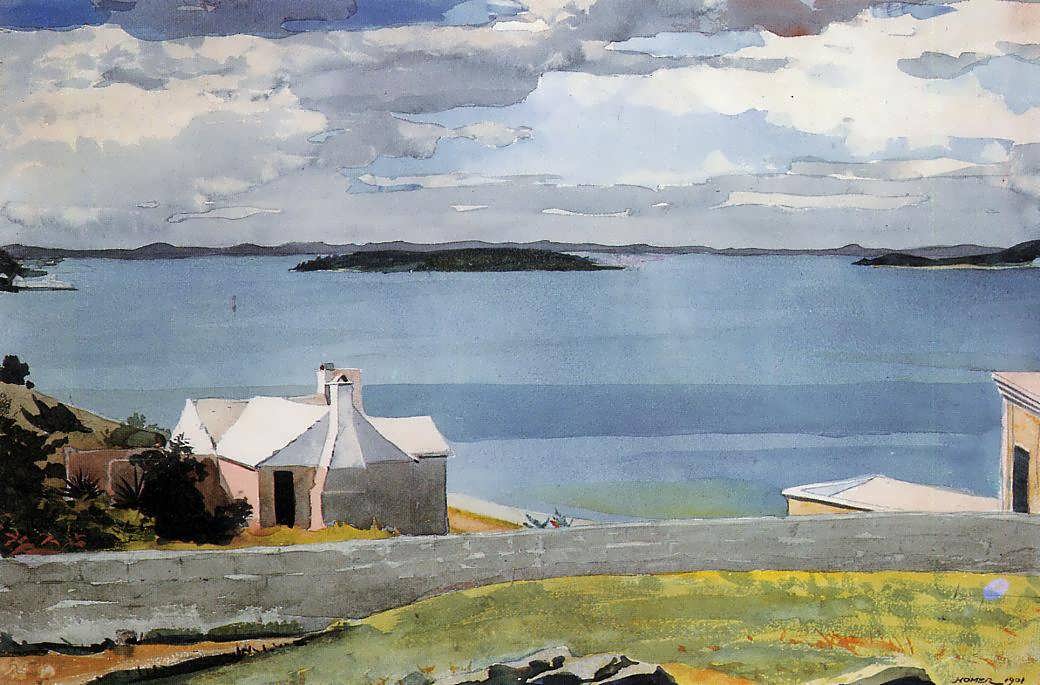
Inland Water by Winslow Homer
We’ve just returned from a remarkable trip to Bermuda, where Samantha and I got engaged, and, frankly, we fell in love with the place.
The colors, the scents, the sounds, and the magical experiences we had — a bit like Alice in her Wonderland, actually, just took us deeper and deeper.
One such experience was meeting Tom Butterfield and Elise Outerbridge of the Masterworks Museum of Bermuda Art, which has as part of its mission the repatriation of works created by world renowned artists in Bermuda.
When we were there, Tom was hanging a show of Brooklyn artist Ogden Pleissner’s watercolors painted at St. George’s on the far eastern part of the country.
He took us down into the archives to see Georgia O’Keefe’s charcoal of a banyan tree, and Winslow Homer’s “Inland Water,” which was painted not far from where we were staying in Warwick Parish.
Samantha challenged me to write poetry inspired by Bermuda — not easy to do after a month of writing a poem-a-day during the month of April. But when we got home, my notes proved to have some gems.
Here is the first that has emerged,
“Bermudiana”
Light refracts off turquoise waters,
But “turquoise waters” sounds so trite
And cliché, until you see it’s true.
Not since Indonesia have I seen such a color.
Then there’s the colorful pastel houses
Of yellow and sea green,
Sage, russet, the occasional purple,
The coral pink ferry stops –
All with whitewashed limestone roofs,
Stepped and sculpted to channel and capture
Rain; the islands’ only source of fresh water.
These islands are awash with color–
Flowers from the tiny, purple-blue Bermudiana
To the brilliant red hubris of Chinese hibiscus,
Shrimp plant, with its shriveled crustacean-hued
Flowers stacked along the stalk,
And morning glories, a soft purple
Bruise against green skin–
Light is texture here, which is perhaps
Precisely why painters, especially
Watercolourists, have been so inspired
By this land- and seascape.
The island across the way from us
Was captured by Winslow Homer,
In the painting we saw at Masterworks.
The perfume of the air, frangipani
(Or was it something else?),
Which scents the towels during our stay.
We find ourselves exploring
All over Bermuda, drinking it in,
With our Dark ‘n’ Stormies.
We will leave a part of ourselves
Here, as we take back memories
Of being transported to the beginning
Of our beautiful engagement.
What a place for a proposal;
What a place to conjure
using all our senses,
and all of our sensibilities.
 Ada Limón’s poetic world is one where dislocation leads to an opening up rather than a shutting down, an unfolding rather than sequestration, and where doors are open, not closed. She isn’t afraid to confront her emotions or to let the reader in to observe her reactions to those emotions.
Yet, Limón’s is not a confessional poetry or, at least, not in the derogatory sense of that word. Limón tells stories and she’s proud of that fact.
“It’s ingrained in human nature to crave stories,” Limón explained in an interview. “We want them read to us as children, to be told around the fire, we want to see ourselves, our lives in these stories, and to have a sense of both escapism and transformation. People don’t know that poetry can do that, because they have the preconceived notion that poems take a tremendous amount of work to even comprehend, let alone be moved by.”
Her poems are not meant solely for the page, but to be read aloud. Her language is fluid, whether describing dreams or reality or the blurring between the two.
As Jeffrey Cyphers Wright wrote in The Brooklyn Rail, “She personalizes her homilies, stamping them with the authenticity of invention and self-discovery.”
Born March 28, 1976, Ada Limón is originally from Sonoma, California, and now divides her time between there and Lexington, Kentucky. Her first collection of poetry, lucky wreck, won the 2005 Autumn House Poetry Prize. She is also the author of This Big Fake World, winner of the 2005 Pearl Poetry Prize, and Sharks in the Rivers (Milkweed Editions, 2010).
Here is Ada Limón’s poem, “Sharks in the Rivers”:
We’ll say unbelievable things
to each other in the early morning—
our blue coming up from our roots,
our water rising in our extraordinary limbs.
All night I dreamt of bonfires and burn piles
and ghosts of men, and spirits
behind those birds of flame.
I cannot tell anymore when a door opens or closes,
I can only hear the frame saying, Walk through.
It is a short walkway—
into another bedroom.
Consider the handle. Consider the key.
I say to a friend, how scared I am of sharks.
How I thought I saw them in the creek
across from my street.
I once watched for them, holding a bundle
of rattlesnake grass in my hand,
shaking like a weak-leaf girl.
She sends me an article from a recent National Geographic that says,
Sharks bite fewer people each year than
New Yorkers do, according to Health Department records.
Then she sends me on my way. Into the City of Sharks.
Through another doorway, I walk to the East River saying,
Sharks are people too.
Sharks are people too.
Sharks are people too.
I write all the things I need on the bottom
of my tennis shoes. I say, Let’s walk together.
The sun behind me is like a fire.
Tiny flames in the river’s ripples.
I say something to God, but he’s not a living thing,
so I say it to the river, I say,
I want to walk through this doorway
But without all those ghosts on the edge,
I want them to stay here.
I want them to go on without me.
I want them to burn in the water.
–Ada Limón
#
30 Poems for National Poetry Month: Day 25
April 25, 2013
Here is what passes for my Day 25 poem:
Not feeling very poetic today,
The tank approaching empty.
I’ll jot some lines here anyway,
In hopes to replenish the plenty.
–Scott Edward Anderson

Misidentifying Moths and My Poem “Summer Love”
June 23, 2012

Cecropia moth (Hyalophora cecropia)
My old friend and former decompositionalist compatriot, Penny Perkins, posted a gorgeous picture of a moth on Facebook today, which she misidentified as an “Endangered Emperor Moth.”
I recognized her mistake right away. The moth was, in fact, a Luna moth (Actias luna) and not Saturnia pavonia.
I noted this on her post in the comments section and also the fact that neither moth is endangered. She thanked me and then asked if, perchance, I had any poems about moths. I did or do.
(At least, I thought it was about moths. I’m never sure anymore what I was writing about when I wrote a poem!)
Here is my poem “Summer Love”:
The female cecropia moth,
Hyalophora cecropia, emerges
As in a stop-action film: swollen
Abdomen shrinking while wings
Rise, fill, and form. Pheromones
Kick in, attracting a male from miles away.
They couple quickly—how easy love can be.
Linked like this, at terminus,
They are most vulnerable to predators.
They will stay this way, available
To each other, for hours—
Then vanish as memory fades.
–Scott Edward Anderson
Perseverance and my poem “An ‘Unkindness’ of Ravens”
June 9, 2012

Raven Mandala II by Nathalie Parenteau
I lived in Alaska sixteen years ago, when my oldest son Jasper was born.
During his first month he had trouble sleeping, as babies often do, and most nights found me walking with him in my arms trying to get him back to sleep.
While walking I would softly sing to him and recite poems and, occasionally, I would whisper a poem I was working on at the time.
One of these poems was “An ‘Unkindness’ of Ravens,” which was filled with direct observations of ravens — an almost constant presence in town and, along with polar bears, a kind of totem in my life since I first saw them as a boy in Maine.
The poem started forming one night when, after putting my son back in his crib, I couldn’t get back to sleep.
Looking out the window, I noticed ravens gathering in the tall trees behind the house. I was intrigued as their numbers grew and the poem began to unfold in my mind.
Many of the images in the poem came from ravens I observed out my office window in the old Alaska Railroad Depot building by Ship Creek below downtown Anchorage.
I always liked this poem, perhaps because of its association with the birth of my first child and what it said about the strangeness and newness of my life at the time: a new father and new to Alaska; both uncharted territories.
As with many things, my perseverance paid off and, fourteen years after it was written, the poem found a home in a journal called Abyss & Apex.
Here is my poem, “An ‘Unkindness’ of Ravens”:
To fall asleep at night, I count ravens
from my bedroom window.
They gather in the spruce trees
at the edge of the woods,
as snow gathers dusk on its surface.
By midnight, thirty or forty
have gathered there in the oily dark.
As a group, they are called “an unkindness,”
but they are polite
and helpful to each other,
share their successes and failures
pursue joy and embrace their strength
in numbers, which is more than we can say.
Plummeting downhill, they launch into air,
as if snowboarding; flipping and spinning
— hell-bent teenagers on a half-pipe.
In more sober moments, they tell each other
where to look for food, when danger is near,
and where the good garbage is. They discuss
variable wind speeds or compare moose meat
found in the woods with that of roadside kills.
They can be graceful on the wing — Naiads
of the air — or clumsy and indelicate,
half-eaten bagels dangling from black beaks.
Dusk comes later and later these evenings,
and morning arrives sooner, winter almost over.
Come Easter, the ravens will be gone.
Ravens prefer dead things remain dead.
–Scott Edward Anderson

Calvin as we found him, October 2009
My pitbull Calvin was adopted a year and a half ago from the PSPCA.
When we asked about his story, we heard a horrible tale of abuse and abandonment followed by rescue and recovery and, ultimately, his second chance.
I composed a poem out of Calvin’s story for Jessie Lendennie’s wonderful book, Dogs Singing: A Tribute Anthology,
Here is my poem,
“Calvin’s Story”
“Make it stop, make it stop,”
was all I kept thinking;
my eyes closed, some
bully biting my body, limbs,
tearing flesh and hair—
Boys pinned me to the pavement,
each one holding a leg, holding
me down on my back.
Another boy – so there were 5?
–pressing the bully into me
head lashing at anything
it could grab with canines.
I’m surprised I didn’t black out—
Then, I remember a scuffle.
I was almost unconscious,
drifting in an out—
Two men freed my limbs,
but still I couldn’t move.
One chased the boys
while the other lifted me,
cradled me, into a van.
I’ll never forget the smell
–camphor, maybe, almost
lavender, medicinal.
The gentle one dabbed my
wounds with a wet cloth,
stroked me slowly, dabbed
–there was a lot of blood;
were there sirens? I don’t
remember sirens. (Should
there have been sirens?)
The next thing I remember
is being on a cold, metal
table – a nurse or doctor
looking me over – another
shaking her head. The first
mumbles something (all I hear
is “Dog,” that word they have
for us), then I’m sure she said,
“This one’s a keeper, let’s give
him a second chance…”
I wake in a crate, damp towel
beneath me, head swirling.
I must be in the “pound,”
there are others barking.
(I wish they would be quiet;
my head hurts.) Then
the pretty nurse or doctor
comes in, mumbles to me;
I look up, try to smile
(this seems to please her),
and I slip in and out of sleep.
Months later,
I’m sitting on a street corner,
leashed, with some of the nice pound
people. A lot of people pass by,
they pat my head, mumble
in that way they do, until one
couple lingers (a child or two
are with them, I can’t recall).
They mumble to the pound people;
one of them (Alpha, I’ll call him)
walks me; he has a firm hand,
but is gentle, in control.
Oh how I wish for a forever
family…but I don’t
want to get my hopes up.
Then, the day is over,
back to the pound – sigh –
guess it wasn’t meant to be.
Next night, however, there
is Alpha, and he’s brought
some others. (Oh, let me be
on best behavior so they will
take me home.) They seem
to like when I snuggle, listen,
take commands, lick the cute
young ones – they are salty sweet!
Days go by after that night,
the pound people tell me
to get ready. Maybe, just maybe,
this is a good sign. Oh, I get so
excited my butt wiggles faster and
faster. Finally, the day comes;
Alpha arrives with the others,
and I think, This is it. I’m going home
with my forever family…to a home;
home at last for my second chance.
–Scott Edward Anderson
 Scott Edward Anderson
 Scott Edward Anderson's Poetry Blog