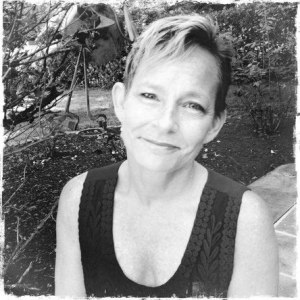
A.V. Christie
(Photo: Darcie Goldberg)
Poet A.V. Christie died this month. Poets die all the time – celebrities, too, and friends, family members. Death is inevitable. We are all dying as we go on living.
Over the past two years there have been countless poets passing, some well-known, such as Seamus Heaney, Galway Kinnell, and Philip Levine; some not as known as they should be: Belle Waring, Wendy Batin, and David Simpson.
Somehow, though, Ann Christie’s death hit home more than the others. Perhaps because she was my age; perhaps because I was in Philadelphia when I heard the news, across the river from where she lived. Perhaps, too, because we’d read together over the years in different venues in the Philadelphia area.
But also because we had just corresponded a few months back via Facebook, as she continued to battle Stage 4 cancer. When I asked if there was anything I could do to help her with her struggle, she asked me to send a recent poem. (I did and will share it you next week.)
Ann was generous like that and cared deeply about poetry and people. She experienced a great deal of pain in her life – her brother committed suicide when he was 32, which she wrote about so eloquently and forcefully in her first book, Nine Skies (University of Illinois Press, 1997).
I’ve been re-reading Ann’s work the past week or so, and eagerly awaiting the publication next month of her last chapbook, And I Began to Entertain Doubts, coming out from Folded Word Press. Her other books include, The Housing (The Ashland Poetry Press, 2004) and The Wonders (Seven Kitchens Press, 2014).
In thinking about a poem of hers to share, it suddenly dawned on me – actually, as I struggled to fold a fitted sheet in our laundry room the other night — that a poem that shows off the facets of Ann’s poetry jewels is her poem on that subject, “Folding the Fitted Sheet,” which of course is about more than that, but it made me smile thinking of and reading it again, which is what her poems do best: rouse us out of our everyday reality.
Her poems make us feel something new, look at things a different way – from heartache to routines – they challenge our perspective on the world. This, in the end, is what great poetry is supposed to do.
Here is A.V. Christie’s poem, “Folding the Fitted Sheet”:
There is a way to do this.
The sheet stiff from the line
and king-size overwhelming as an hour can be.
Arms outstretched.
She apes a stance that looks like welcoming.
This obstinate sea!
The day has been so far fear and syllables rippling.
So commence to fit each messy gather
one to the next—.
Pulled to, like a widespread inner panic managed
repeatedly.
One corner puckers, then droops— a sun
that, disaffected, simply drops from out of the sky.
In this method the right side and the wrong
confound. She says aloud the words Counterpane—
Horizon— thinks out the demands of tomorrow’s
presentation, velocity, the power-point resources
circulating and the cool weight
of what gets infolded.
We watch her,
the one moving deeply along a nerve—
toward some far city or god.
-A.V. Christie (1963-2016)
Source: Cave Wall (2009)
You can learn more about A.V. Christie’s poetry here: http://www.avchristie.com/
A Memorial reading will take place at Moonstone @ Brandywine Workshop in Philadelphia on 26 May.
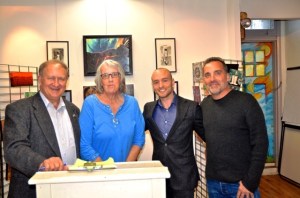
Peter Krok, Eileen Moeller, Cameron Conaway, and Scott Edward Anderson at MRAC, November 2015. Photo: Ron Howard
Late last year I read at the Manayunk-Roxborough Arts Center in Philadelphia. The event was billed as “Poets with a Cause” and featured two other poets neither of whom were familiar to me, Cameron Conaway and Eileen Moeller.
There were some common themes in our work – nature, travel, and spirituality — and, after the reading Eileen and I exchanged books, as poets often do.
As with my book, Fallow Field, which compiled work written over a 25-year period, the poems in Eileen’s book, Firefly, Brightly Burning were written over many years.
“When I first put the manuscript together, it seemed like a patchwork of unlike things, perhaps because it contains a number of serial pieces,” Moeller said in an interview. “Many of the poems come from a fictional, narrative impulse, though certainly not all.”
One series, the “Anna God” poems, Moeller relates in the interview, “were instigated by a photo in the newspaper of a college girl asleep on a couch in a triangle of sunlight. Her name was, yes, you guessed it, Anna God.”
Moeller’s Anna God poems at first seem surreal: a smitten skunk follows Anna around; she gets a “B” for a fifth-grade diorama of a clay man “throwing paper girls/ across the sky like tiny airplanes”; Death comes to visit and asks for a better contract; “she thinks of each leg hair as a redwood tree” and she can’t find a razor big enough to do the job.
“My aim in the poems is to catch the reader in an erotics of sound, story, and feeling,” says Moeller in an artist’s statement about her work overall. “The web that stretches between the poles of lyric and narrative. I look for surprises, wait for them to leap up out of the quotidian, like fish breaking the surface of the poem at its ruptures of juxtaposition and metaphor. We read the world through the lens of the body, and I try to ride its hungers, triumphs, joys, follies, wounds, even its decay. So, the soul evolves in its salt brine of words.”
Here is Eileen Moeller’s poem “Anna God Remembers,” which I find particularly haunting:
Ann God Remembers
the time she followed in
her father’s footsteps,
tiptoeing through the night
behind him as he left for the barn.
She was only two years old but she remembers
how the front door locked behind her
and he went off to do the milking,
not even seeing her standing there
in her little coat and rubber boots.
She remembers singing to herself
as she curled up on the front porch
to get out of the wind.
But her mother never heard her over the wailing.
The rest she only knows from stories:
how she froze like a porcelain doll there,
on a night that dipped to eight below.
(Her mother always cried at the part
where she found Anna blue as skim milk,
and drove her to the hospital,
dead and stiff on the back seat.
Anna would cry too, over how
the Doctors swore and wept and pleaded,
thawing her out, coaxing her heart into beating again).
It’s fuzzy, but Anna remembers
being startled awake by warm hands
kneading her arms and legs,
and the voices saying: Come on, open your eyes.
Once in awhile she dreams she is her father again:
dozing in the straw against the kindly beasts,
warm as a newborn calf.
–Eileen Moeller
from Firefly, Brightly Burning (Grayson Books, 2015)
Used by permission of the author.
You can read more about Eileen and her work at http://eileenmoeller.blogspot.com/
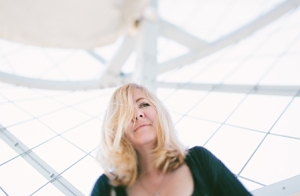
Erin Belieu
(photo by Gesi Schilling)
Erin Belieu is one of the poets of my generation whose work I turn to most.
Ever since her first collection, Infanta, came out in 1995, Belieu consistently impresses me with her witty, philosophical, and deceptively conversational poems that are actually the result of rigorous revision.
“I’m very much a sculptor with my poems,” Belieu said in an interview. “It’s getting it on the page where the ditch digging begins.” That may be one aspect of her work that attracts me – although it flows on the page as naturally as a phone conversation, I know it’s the result of much effort.
Another aspect is her clarity of language – she has an “aversion to artifice” and “can’t abide pretension,” as two critics have said of her work. Her humor and pathos and contrariness keep bringing me back to the poems, where I also find moments of real vulnerability.
“You’d hope we’re something/ more than a sack of impulse, of soul defined/ by random gristle,” she writes in “The Body is a Big Sagacity.” Nietzsche’s phrase, from the “Despisers of the Body” section of Thus Spoke Zarathustra, reads “The body is a big sagacity, a plurality with one sense, a war and a peace, a flock and a shepherd.”
Yet, while Nietzsche espouses a vision where there is no difference between the physical and psychological ability of the body, where a human being’s purpose is to surpass itself, Belieu’s “little man, with itty hands” requires a giant, superhuman truck to surpass the abilities or limitations of his own body.
In a poet of lesser gifts, Belieu’s wry observations may seem mean-spirited; and then she counts herself among the challenged, claiming her own body “once was whole, symmetrical, was/ actually beautiful for three consecutive years,” to reveal where her sympathies lie.
Belieu once said she was “under no illusion that the world can’t sleep without the next Erin Belieu poem.” There are many among us who beg to disagree. Here is Erin Belieu’s poem, “The Body is a Big Sagacity”:
The Body Is a Big Sagacity
is another thing Nietzsche said
that hits me as pretty specious,
while sitting in my car in the Costco
parking lot, listening to the Ballet
mécanique of metal buggies shrieking,
as each super, singular, and self-contained
wisdom of this Monday morning rumbles
its jumbo packs of toilet paper and Diet Coke
up the sidewalk. So count me a Despiser
of the Body, though I didn’t generate this
woe any more than the little man parked
next to me, now attempting the descent from
his giant truck, behemoth whose Hemi roars
like a melting reactor and stands
as the ego’s corrective to the base methods
by which the body lets the spirit down.
Buzz-clipped, tidy as an otter, he’s high and
tight in his riding heels. Pearl snaps on
the little man’s shirt throw tiny lasers
when he passes. But who isn’t more war
than peace? And how ridiculous to suffer
this: to be a little man, with itty hands
and bitty feet, to know yourself lethal, but
Krazy Glued for life to the most laughable
engine. Recycled, rewired, product of
genes and whatever our mamas thought
to smoke: the spirit gets no vote, Fred.
My body once was whole, symmetrical, was
actually beautiful for three consecutive years,
expensive as a rented palace, and yet I blew
that measly era watching my clock hands move,
as if I were the trigger rigged to homemade
dynamite. But if you would look inside me,
into all the lonely seeming folks here loading
their heavy bags, you’d hope we’re something
more than a sack of impulse, of soul defined
by random gristle. Which is why the little man
pauses on the sidewalk, why he stops to look at
me looking at him: this pocket-size person,
whose gaze unkinks a low, hairy voltage from
my coccyx. And thus speaks Zarathustra,
You Great Star,
what would Your happiness be
had You not those for whom
You shine?
Ask the little man, neither ghost nor plant,
his bootheels ringing down the concrete.
–Erin Belieu
from Slant Six (Copper Canyon Press)
Copyright © 2015 by Erin Belieu
All rights reserved. Used by permission of the author.
On Becoming the Subject: When Someone Writes About Your Work
January 10, 2016
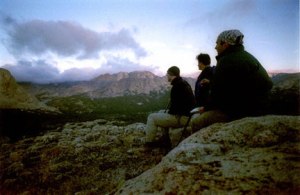
The poet (in bandanna) and pals, Wind River Range, Wyoming, Summer 2001. Photo by Joshua Sheldon.
“I never read my reviews,” the novelist Pat Conroy once said. “Not even the good ones. Barbra Streisand once told me, if just one person in the audience doesn’t applaud, it bothers her. I’m the same way. I’d be devastated to read that someone didn’t like my work.”
Back in 2001, a young woman named Veronika Linhartova Morley, then a student at De Anza College in Cupertino, California, contacted me by email. She wanted to write about my poetry for a class assignment on contemporary American poets.
She told me she’d read a poem of mine called “Carpentry” in the Boston Review and had found a number of other poems on line. I was flattered. Only, I never wrote a poem with that title and I’ve not yet published in the Boston Review. I looked up the poem, which was written by a Scott Anderson (see the link above) and thought, I could have written it, but I didn’t.
I hated to disappoint Ms. Morley, but broke the news to her by reply email. She was embarrassed; however, it turned out that all the other poems she’d found were indeed mine, and she still wanted to write about my work. We had a nice correspondence and she wrote a delightful little essay about my poetry and the influence of Elizabeth Bishop and Donald Hall on my work.
Her essay begins with a lengthy quote from a lecture I gave at the University of Alaska some years before:
“The contemporary poet of my choice, Scott Edward Anderson, once wrote in his essay ‘Making Poems Better: The Process of Revision’: ‘…writing poems is a lot like cooking. We bring everything we know about cooking and about what foods go well together to preparing a meal, just as we bring all we’ve learned or read or practiced to writing a poem. Sometimes, it’s just luck that we get the right combination of ingredients, but much of the time a fine meal is made from good ingredients being put together by a well-practiced chef.'”
She went on to make some good observations about my work and points about what I learned from both Bishop and Hall. She also identified a spiritual note in my work and my conflicting feelings about “the way we treat our world.”
In all, it’s a pretty accurate picture of my work, its process and two of my biggest influences. And the last line of her essay would make any poet proud. She writes that through her assignment and correspondence with me, she “not only learned about the process of writing poetry, but also learned to appreciate poetry even more.”
I don’t know how the essay was graded. I still have a copy. Veronika came to this country from Czechoslovakia in the late 1990s, as she told me, to get the kind of education unavailable in her own country. Some time ago, she gave me permission to reprint the essay, which you can read in full here.
My Poem “Deserted Sheep”
January 7, 2016

Sheep in the Scottish Borderlands, August 2014. Photo by SEA
Twice in my life I wanted to raise sheep. I’m not sure why. Perhaps it is an interest stemming from deep within my Scottish and Portuguese heritage.
The first time, I was as a teenager outside of Rochester, New York. I considered enrolling in the organic agriculture program at Goddard College in Vermont, where I’d learn animal husbandry and then get a piece of land where I could raise a flock. I heard that Canada had a generous homesteader program and wrote to various provincial governments. (I still have a couple of their responses.)
The second time was in 1992, I had just moved to Garrison, New York, into a converted ice house on the old Vanderbilt-Webb estate. I bought Raising Sheep the Modern Way by Paula Simmons and a few other books and looked into buying a few starter sheep from a neighbor. (I still can’t part with my copy of Simmons’s book.)
While my poem, “Deserted Sheep,” which was part of a group of three poems that won the Nebraska Review Award in 1997, was certainly influenced by my experiences in New York’s countryside, thinking about raising sheep, it was a very different landscape that provided the inspiration.
I was walking the hills outside of Giessen, in what was then West Germany, in the spring of 1987, when I stumbled upon the sheepfold described in the poem. The sheep were alone, except for each other, grazing within a small, orange plastic enclosure.
Like many of the poems I wrote at the time, the early drafts were heavily influenced by my attempts to learn the German language through reading its poetry — no easy task. This course of study had a deleterious effect on my writing at the time, as I’ve described elsewhere, and it took me a long time to get my native tongue back to its proper place; not to mention my syntax, grammar, and word order!
By the time I arrived at the version that appeared in the Nebraska Review and, later, in my book Fallow Field, the result was very different, after many stumbles and headlong bumps like those lambs in the poem.
Perhaps one day I will retire to the Azores and raise sheep. Now that my wife, Samantha, has taken up knitting we could use the extra wool and lamb kofta is a favorite dish of ours. Here is my poem,
Deserted Sheep
Lambs, jostled, forgive
the wolf, break
its taste in lamb
into a toddler’s gallop,
bumping headlong
into thick-piled ewes–
lanolin slicking their noses, as
they stumble on the fescue
dotting the valley,
a pointillist’s landscape.
No shepherd, no sheep dog,
no gate to enter; a small,
orange plastic snow fence,
neatly staked at four corners
with steel posts,
gives form to the sheepcote.
The last ounce of sun
a violet tremor the wolf
forgives, lingering
along the western ridge,
the shepherd’s fear
returning to the valley.
A ram, brown and flocculent,
secures a silent corner
of the fold — eyes intent
upon a slow-moving shadow.
–Scott Edward Anderson

David Simpson reading at NYU CEnter for Creative Writing in December 2014, while his brother Dan records.
I’ve known David Simpson for a dozen years, probably more. We were introduced by another writer in Philadelphia and became fast friends, sharing poems with each other, giving readings together on stages and coffee houses.
Dave was funny, direct, and touching in ways that few other poets were in those days. I mean without being solipsistic or confessional or glib or “clever.”
His work reminded me more of Gerald Stern, David Ignatow, or Frank O’Hara than that of any of his contemporaries. I admired a certain casual freedom he offered in his work.
When Dave, who along with his twin brother, poet Dan Simpson, is blind, contracted ALS recently, it seemed unfair. Here was this most gentle soul, funny and sometimes acerbic, always caring for others, stricken by a crippling and debilitating disease.
Dave and I both agonized over our collections of poetry – for years — and the length of time it took us to compile and find a publisher. Both outsiders in the “poetry biz” world, we had time to refine our collections, sharing poems and encouraging each other – even competing with and inspiring each other.
With the publication of his book, The Way Love Comes to Me, just a few months after my Fallow Field, I was ready to celebrate with Dave. It had been a few years since we’d seen each other, as life changes, moves, and other circumstances would have it. So when Dave read at NYU this past winter, I leapt at the chance to go see him, congratulate him, and hear him read again.
I wasn’t disappointed. Even though I could see he was suffering and the disease was clearly getting the upper hand in the battle, Dave remained the same hopeful, witty, entertaining, thoughtful person I’ve always known.
Yet, as his brother Dan wrote in a recent blog post, “ALS, like other terminal illnesses, forces you to redefine what you mean when you use words like ‘good’ and ‘hope.’ Dave says he can see losses every week. He no longer hopes to perform his one-man show. His idea of a good day has more to do with breathing well, with the help of his by-pap machine, and reading something stimulating than with treks into the city and hosting dinners for friends and family.”
At readings, his poem “Spring Fever,” was always a crowd-pleaser. It’s Dave’s “big hit.” He had to read it or his fans would clamor for it. He probably grew sick of reading it, not wanting to be a one-hit wonder.
When he read it at NYU in December, I immediately wanted to share it with my readers during National Poetry Month this year. Why? Because it has all those qualities I love in Dave and his poetry: humor, pathos, and a beautiful way of rendering tenderness in human interactions.
Here is David Simpson’s poem, “Spring Fever”:
A basketball bounces by the pharmacy as I go in.
Thin music from speakers overhead
mixes with the almost-B-flat hum of neon lights. A cashier,
seeing I am blind, locks her register,
grabs a basket, and leads me by the hand down narrow aisles
as we discuss best buys
on Colgate toothpaste with fluoride,
unscented stick deodorants, and three-roll packs
of two-ply toilet paper. In my ears,
my blood begins to prod: Condoms…condoms
and I say to her: “I need
batteries–four double A’s”
Condomscondomscondoms
“and then, let’s check out the condom display.”
She stands on tiptoes to take down
the box of twelve Latex nonoxynol 9’s,
dips low to read me others that advertise
ribs and dimples, or flavors of mint
and mandarin. “Don’t get the mandarin,” she advises,
her hair brushing my hand as she stands up.
The brand name Excita makes us laugh a little
and I get to talking about Ramses and all his offspring
and what kind of confidence would a name like that
instill in someone looking for birth control?
To nearby customers, it might seem as if
we’re lovers, or very married. I wonder if she…
if we… I choose a pack of Lifestyles; she
puts them in the basket, and for just
a moment before we move
toward the checkout line, they are ours.
c) David Simpson
Used by permission of the author.
PS You can order Dave’s book — and I encourage you to do so — on Amazon.
Final 5 Questions for Poets
June 13, 2014
 Jonathan Hobratsch, writing in the Huffington Post, celebrated National Poetry Month by posing “5 Questions for Poets” by readers of poetry.
I’ve tried to answer each of his questions (this is the 5th and final). You can find my answers to other sets of questions, here, here, here, and here. Here’s a link to Jonathan’s original Part 5 post and the other poets’ answers: 5 Questions for Poets.
And here are my answers:
1. How hard should you work at a poem?
As hard as it takes to get the poem where it wants to go and get the author out of the way.
2. According to The Atlantic, over 50 percent of people think computers will be able to write great works of literature in 50 years. Do you hold with the majority prognostication?
Great works of literature? I doubt it. But then, when artificial intelligence takes over, great will be defined by a different standard.
3. What would poets like for undergrads to know about poetry?
Poems are pleasure, as Donald Hall wrote in “The Unsayable Said: an essay
4. What interests outside of literature work well with writing poetry?
Many and various interests outside literature work well with poetry, sports, romance, hiking, travel, even work. I found my work with The Nature Conservancy exposed me to so many of nature’s wonders and details that it proved a storehouse of inspiration for my poetry. But even now, when I work for a Big Four firm’s cleantech practice, I’m in one of my most productive periods. It’s all about paying attention.
5. If you were poet during a different era, when/where would you want to exist?
In a workshop long ago Gary Snyder accused me of having a 17th or 18th century sensibility as a poet. So, maybe that’s where I’d find a home. But I’m very happy where I am right here and now.
Yet More 5 Questions for Poets
June 4, 2014
 Jonathan Hobratsch, writing in the Huffington Post, celebrated National Poetry Month by posing “5 Questions for Poets” by readers of poetry.
I’m going to continue to answer these questions (this is Part 3 for me, but out of sequence with the original; you can find my answers to other sets of questions, here, here, and here). Here’s a link to Jonathan’s original Part 4 post and the other poets’ answers: 5 Questions for Poets.
And here are my answers:
1. April 23 was Shakespeare’s 450th anniversary. If you went back in time and could ask him one question, what would that question be?
How the hell did you do it?
2. What bothers you most in your literature community?
That I don’t get to spend more time in it – whether it’s my virtual community “52” or the one where I live in Brooklyn. There are some wonderful poets – wonderful people! – in those communities and I really wish I had more time to hang out with them. In the larger poetry community: careerism, cronysism, and churlishness.
3. Which poets, alive or dead, are overrated/underrated?
I’m sure I’ll offend with this comment but I find Charles Bukowski completely overrated and over-read. And his influence is dreadfully felt. Among contemporaries, I also can’t see what all the fuss is about Dorothea Lasky, there doesn’t seem to be much there there. (I can see the email daggers massing in my in-box or, for that one.)
There are way too many underrated contemporary poets to mention them all, but among the dead Lorine Niedecker, Kenneth Patchen, and Walter Pavlich have always seemed unfairly neglected in my book.
4. Are prizes like Pulitzer, NBA, NBCC are good for poetry. Is there discrimination against women poets, non-white poets, gay poets?
Prizes are for poets, not poetry. It seems like a popularity contest more than anything. I’m sure there is discrimination; you find that wherever there are human beings, cliques, factions, and dominant cultural hierarchies. Others have VIDA stats and ratios to prove it.
5. Is poetry useful?
Poetry is neither as useful as a tool nor as useless as a whim. Of course, I couldn’t live without it.
Wasps, Spiders, and My Poem “Opportunity”
May 22, 2014
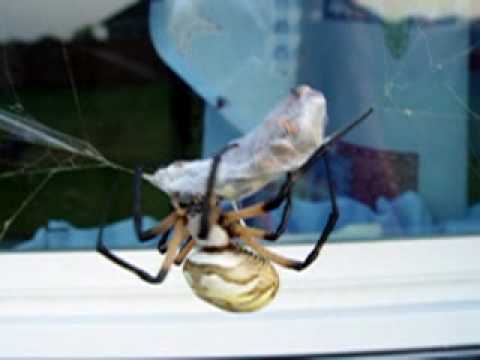 This week’s prompt at 52, the poetry group I joined this year to challenge me to write a poem each week during the year, is about insects.
As Jo Bell writes in her introduction to the prompt, “Insects buzz and flutter and sting the air around us.
“They have us outnumbered, and they will outlast us. Insects thrive in every evolutionary niche – from the bluebottle, living on excrement and unpopular in the kitchen, to the Wandering Violin Mantis (yes, really – watch this to see it and its curious friends).”
As readers of my poetry know, observations in nature are a major subject of mine, especially birds. Whether the moths and butterflies featured in my poem, “The Postlude, or How I Became a Poet,” or the mining bees that open, “Redbud & Pitbull,” or the cecropia moth that is or isn’t the subject of my poem, “Summer Love,” insects are also not strangers to my poetry lens.
“Opportunity,” which appears in my book FALLOW FIELD, was originally published in the journal Blueline. It was prompted by a scene I witnessed in The Nature Conservancy’s Adirondacks office in Keene, New York, in the 1990s.
The poem centers around an interaction between an insect (wasp) and an arachnid (spider). Spiders are among the most remarkable predators on the planet. The spider featured in the poem was a web-hunting spider, a form of hunting that requires delicacy, building skills, and not a small amount of patience. (For more on how such spiders catch their prey, check out this illustrated description.)
Here is my poem, “Opportunity”:
A wasp wrestles all day
with the false freedom
of a window pane.
Scaling the glass, then slipping
down, buzzing the cracked paint
of the old window frame.
As if thrumming wings faster
will pull it closer to the blossom,
just beyond its reach.
So determined in its struggle
to get in, to wrest pollen from
the exotic flower on the other side.
A spider sets its dinner table
in the corner of the pane—
–Scott Edward Anderson
Still More 5 Questions for Poets
May 15, 2014
 Jonathan Hobratsch, writing in the Huffington Post, celebrated National Poetry Month by posing “5 Questions for Poets” by readers of poetry.
I’m going to continue to answer these questions (this is Part 3 for me, but out of sequence with the original; you can find my answers to other sets of questions, here and here). Here’s a link to Jonathan’s original Part 2 post and the other poets’ answers: 5 Questions for Poets.
And here are my answers:
1. What qualities or subject matter do you feel is missing in contemporary poetry?
In my humble opinion, there are four things lacking in contemporary (American) poetry: 1.) a sense of the history of poetry before Bukowski and the Beats; 2.) a belief that there are ANY universal truths; 3.) faith in the power of love; and 4.) thinking, deep and critical. Individual poets fill this void, to be sure, but generally speaking, the poetry that gets attention these days seems lacking in many ways.
2. What is your writing and editing process like? How long does it generally take you to finish a poem?
If asked that a year or two ago I would have said, I work late at night, usually while walking, and work on poems a lot in my head before I get anything on paper. When I do get a poem on paper it is long-hand first, then I type it up. Then I revise, revise, revise, until the poem goes where it wants to go.
Lately, however, I’ve completely changed my way of working. In part, because of two experiences: last year I wrote a poem-a -day for National Poetry Month and posted it on my blog: raw, unedited, and “unfinished.” (I’ve since gone over them a bit, but the originals are still up for all to see.)
Then, this year, I joined a poetry group started by Jo Bell in the UK. The group is called “52” and meets virtually, in a closed group on Facebook. It’s called 52 because the challenge is to write a poem a week in response to a prompt posted each Thursday. It’s been remarkably fruitful. Will anything survive the experiment? I already have 2-3 poems I feel are worth continuing to work on, and a few others that served their purpose as occasional verse.
The result is I’m writing quickly, much more quickly than my previous, more methodical efforts, and usually on my iPhone. Is it a better way of working? Only time will tell.
3. What Poets Do You Read?
I read any and all poetry I can get my hands on. I try to buy a handful of poetry books each year – I need to contribute to the poetry economy and, if I’m going to ask others to buy my books, I should support other poets. Most recently, I’ve bought and read collections by Jo Bell, Kathleen Jamie, John Glenday, Ada Limon, Ethan Paquin, Don Paterson, Jo Shapcott, and Robert Wrigley. And I’ve been reading a lot of Tamil poetry, in translation of course, both modern and classical.
I’ve also read Alfred Corn’s last collection, Tables, and thoroughly enjoyed reconnecting with his work this year. I went back to Seamus Heaney’s poetry when he died last summer; such remarkable language and imagery. Jack Gilbert’s Collected Poems, which my mother-in-law gave me for the holidays last year, is still on my bedside table and I dip into it as often as possible. Frederick Seidel captured my attention two years ago. It took me an entire year to get through his Selected Poems, 1959-2009, but it was worth it. He’s a trip.
And, of course, Elizabeth Bishop remains a constant for me. I turn most often to her work.
4. What is an up-and-coming poet?
An up-and-coming poet, I guess by that you mean an emerging poet? It’s funny, when I won the Nebraska Review and Aldrich Emerging Poets awards back in the late 90s, I thought, “Okay, so I’m emerging, now what?” It took 15 more years for my book, FALLOW FIELD, to come out. Am I still emerging? Have I emerged? Am I up-and-coming? I’m glad to be up at all, frankly; as they say, the alternative is much worse.
5. Who is the best living poet?
Up until he died at the end of last summer, I would have said Seamus Heaney.
If by “best” you mean “greatest living,” I’d have to say Derek Walcott, at least in terms of the scope and breadth of his work. There is a real sense of history in his poetry. It is rich and full of traditions and truths that are both global and place-based. His thinking is deep and critical, and his poetry is full of faith in love. Take his “Love After Love”:
The time will come
when, with elation
you will greet yourself arriving
at your own door, in your own mirror
and each will smile at the other’s welcome,
and say, sit here. Eat.
You will love again the stranger who was your self.
Give wine. Give bread. Give back your heart
to itself, to the stranger who has loved you
all your life, whom you ignored
for another, who knows you by heart.
Take down the love letters from the bookshelf,
the photographs, the desperate notes,
peel your own image from the mirror.
Sit. Feast on your life.
–Derek Walcott
 Scott Edward Anderson
 Scott Edward Anderson's Poetry Blog