
Rebecca Schumejda, her Dad, and a friend.
Her poems are about loss and longing, gardening and dishwashing, motherhood and marriage — and not a few of them are about the seedy side of life. (Rebecca once co-owned a pool hall.)
Rebecca Schumejda is the author of Falling Forward, a full-length collection of poems (2009); and several chapbooks, including The Map of Our Garden (2009); Dream Big Work Harder (2006); The Tear Duct of the Storm (2001); and the postcard poem “Logic.” She received her MA in Poetics and Creative Writing from San Francisco State University and her BA in English and Creative Writing from SUNY New Paltz.
You can read more about Rebecca’s poetry at http://www.rebeccaschumejda.com/
Schumejda’s poem “In This Picture” was written after she found a photograph of her father some time after he died and her own daughter was born. The photo of Rebecca and her father was taken at the end of a fishing trip. I like the simplicity of this poem and the short lines, which calls to mind the shortness of breath one gets when faced with loss.
It also made me think of a dear friend whose father passed away ten years ago today; so this is for her, and for Rebecca who wrote the poem, and for everyone who has lost a parent or loved one.
Here is Rebecca Schumejda’s poem
“In This Picture”
Never will you
bait the hook
for the child
floundering
inside me.
In this picture
we sandwich
a blue fish.
In this picture
we both wear
stubborn noses.
In this picture
you smell like
saltwater.
In this picture
is all I have
left of you.
I am seven
and in love
with you, forever.
In this picture
your heart
was not weak.
In this picture
no tombstones,
just fishhooks.
Someday, curious,
your grandchild
will ask
who you were
and I will say
in this picture
you were Neptune,
god of the sea.
–Rebecca Schumejda
Poem in Your Pocket Day: “One Art” by Elizabeth Bishop
April 14, 2011
 Today is “Poem-in-Your Pocket” Day and the poem in my pocket is Elizabeth Bishop‘s villanelle “One Art.”
This is perhaps the most famous of Bishop’s poems, touching as it does on the loss of love. It is also a poem about writing poetry, as has been asserted by a number of critics, and about giving up control for the sake of art. There is a kind of mastery in losing control that I think both frightened and emboldened Bishop.
In the end, the poet (and the speaker) is not in control and the poem ends (almost) in disaster, with a stroke of poetic mastery in that last line.
Here is Elizabeth Bishop’s “One Art”:
The art of losing isn’t hard to master;
so many things seem filled with the intent
to be lost that their loss is no disaster.
Lose something every day. Accept the fluster
of lost door keys, the hour badly spent.
The art of losing isn’t hard to master.
Then practice losing farther, losing faster:
places, and names, and where it was you meant
to travel. None of these will bring disaster.
I lost my mother’s watch. And look! my last, or
next-to-last, of three loved houses went.
The art of losing isn’t hard to master.
I lost two cities, lovely ones. And, vaster,
some realms I owned, two rivers, a continent.
I miss them, but it wasn’t a disaster.
–Even losing you (the joking voice, a gesture
I love) I shan’t have lied. It’s evident
the art of losing’s not too hard to master
though it may look like (Write it!) like disaster.
–Elizabeth Bishop

A Cento from The Pisan Cantos of Ezra Pound
April 12, 2011

Pound in Pisa
I am really enjoying John R. Keene’s run at the helm of the Poetry Foundation’s Twitter moniker @harriet_poetry. He regularly talks about forms of poetry and offers examples — famous and not so famous — and asks poets to submit their own versions.
Last Friday night, John was talking about centos, which the Academy of American Poets describes as “From the Latin word for “patchwork,” the cento is a poetic form made up of lines from poems by other poets. Though poets often borrow lines from other writers and mix them in with their own, a true cento is composed entirely of lines from other sources. Early examples can be found in the work of Homer and Virgil.”
I composed a cento using several lines from several sections of Ezra Pound’s “Pisan Cantos.” Pound wrote this section of his long, incomplete poem, which totals 120 sections, while incarcerated in Italy during World War II.
Here is my cento,
A Cento dei Cantos di Ezra Pound[1]
What thou lovest well remains,
the rest is dross
a man on whom the sun has gone down
and the wind came as hamadryas[2] under the sun-beat.
What thou lov’st well shall not be reft from thee
nor is it for nothing that the chrysalids mate in the air
color di luce,
green splendor and as the sun through pale fingers.
What thou lovest well is thy true heritage—
I don’t know how humanity stands it
with a painted paradise at the end of it
without a painted paradise at the end of it
the dwarf morning-glory twines round the grass blade
whose world, or mine or theirs
or is it of none?
Nothing matters but the quality
of the affection—
in the end—that has carved the trace in the mind;
dove sta memoria?
Pull down thy vanity, I say pull down.
The mountain and shut garden of pear trees in flower
here rested.
What thou lovest well remains—
–Scott Edward Anderson
[1] Composed of lines from “The Pisan Cantos” by Ezra Pound; specifically Cantos LXXIV, LXXVI, LXXXI.
[2] May refer to Hamadryas (mythology), the daughter of Oreios and mother of the Hamadryads in Greek mythology, or to Hamadryas argentea (also called Silvery Buttercup), a species of plant in the Ranunculaceae family.

Jo Shapcott. (Image by Getty Images via @daylife)
Another poet from across the Pond for this week. British poet Jo Shapcott was diagnosed with breast cancer in 2004. She once described how the treatment left her feeling “reborn as someone slightly different.” Last year, she published a collection that emerged from this experience, Of Mutability.
“The body has always been a subject for me,” she told The Guardian in an interview. “It is the stage for the high drama of our lives, from birth to death and everything in between. When you observe your own body under physical change like that, there’s a new kind of urgency. I had a lumpectomy, my lymph glands out, chemo and radiotherapy. You go through several different stages, so you don’t know how ill you are for a while, and the verdict keeps getting worse and worse, until you can actually take action, start treatment.”
The concept of mutability has a long tradition in English poetry extending back as far as Chaucer. Mutability points to the transience of things and of the inevitable changes of life.
Wordsworth spoke of “the unimaginable touch of Time” in his poem, “Mutability.” Shelley ended his poem of the same title,
It is the same!–For, be it joy or sorrow,
The path of its departure still is free:
Man’s yesterday may ne’er be like his morrow;
Nought may endure but Mutability.
Shapcott is no stranger to life’s mutability. Her parents both died unexpectedly when she was 18. She found solace in the poetry of Elizabeth Bishop, who had also suffered early loss and dramatic change throughout her life. Shapcott went to Oxford to pursue a PhD on Bishop’s poetry, but left for Harvard to study with poet Seamus Heaney when she received a scholarship. It turned out to be a fortuitous mentorship.
Her books include Electroplating the Baby (1988), Phrase Book (1992), My Life Asleep (1998), and Her Book: Poems 1988-1998 (2000).
Shapcott writes with a “‘rangy, long-legged’ brio,” as one critic described her tone. Her language is equally intellectual and sensual, enigmatic and direct, which makes for poetry of breadth and range. Consequently very few poems feel alike in the way you can tell the work of certain poets, a Gary Snyder poem or a Billy Collins poem, for example. (The one exception in Shapcott’s work is her “Mad Cow” persona poems.)
Like Bishop, Shapcott is rarely overtly personal, even when writing about her illness from which she is now, thankfully, fully recovered and working on a new book.
Here is Jo Shapcott’s poem, “Of Mutability”:
Too many of the best cells in my body
are itching, feeling jagged, turning raw
in this spring chill. It’s two thousand and four
and I don’t know a soul who doesn’t feel small
among the numbers. Razor small.
Look down these days to see your feet
mistrust the pavement and your blood tests
turn the doctor’s expression grave.
Look up to catch eclipses, gold leaf, comets,
angels, chandeliers, out of the corner of your eye,
join them if you like, learn astrophysics, or
learn folksong, human sacrifice, mortality,
flying, fishing, sex without touching much.
Don’t trouble, though, to head anywhere but the sky.
–Jo Shapcott
On Sestinas and “Second Skin”
April 5, 2011

Image via Wikipedia
The poet John R. Keene was tweeting about sestinas on Saturday under the Poetry Foundation’s @harriet_poetry moniker and I sent him one that I tried back in 1994. It started from an actual scene I witnessed at the time in my garden in Garrison, NY.
According to The Academy of American Poets, “The sestina follows a strict pattern of the repetition of the initial six end-words of the first stanza through the remaining five six-line stanzas, culminating in a three-line envoi. The lines may be of any length, though in its initial incarnation, the sestina followed a syllabic restriction.”
The Academy description lists some tour de force sestinas, including Ezra Pound’s “Sestina: Altaforte” and John Ashbery’s “Farm Implements and Rutabagas in a Landscape,” along with “Sestina” and “A Miracle for Breakfast” by Elizabeth Bishop, and “Paysage Moralise” by W.H. Auden.
Here is my sestina, which pales in comparison like the flaking sloughed-off skin of the snake it describes:
Second Skin
In the yard by the barn was a snake
resting on a leaf-pile in the garden,
nearby his old shod skin
limp and lifeless under a noon-day sun.
Abandoned on the blades of grass,
like an untangled filament of memory.
The sight of him fired my memory,
which cast a shadow on the snake
(who now slithered away in the grass).
He lent a curious aspect to the garden–
aspect being its relation to the sun
–not unlike his relation to the skin.
He seemed to remember the skin.
(Do snakes have that much memory?)
Or was it a trick of the sun
that he mistook for a female snake?
When he made his way out of the garden,
I crept along quietly in the grass.
As I followed him there in the grass,
he stretched ever closer to the skin;
his path leading out of the garden,
as if tracing the line of a memory.
How strange, I thought, this snake,
disregarding the late summer sun.
Later, over-heated in afternoon sun,
I lay down to rest on the grass.
I watched again as the snake
tried to resuscitate his discarded skin,
perhaps to revive its dead memory
and lure it back home to the garden.
Cutting the lawn by the garden,
I must have been dizzy with sun,
or dozing in the haze of a memory.
Translucent flakes feathered the grass:
it was then I remembered the skin;
it was then I remembered the snake.
I sat by the garden dropping fresh-cut grass
onto my arm and its sun-baked skin,
clippings of memory snaking through my mind.
–Scott Edward Anderson
Each April, for the past 14 years, I’ve sent out a poem-a-week via email during National Poetry Month. Now I’m happy to continue this tradition here on my poetry blog. If you’d like to receive these poems by email, please write to me at greenskeptic [AT] gmail [DOT] com and I will add you to the list.
Don Paterson is a contemporary Scottish poet whose work I discovered only last year through my friends at the Scottish Poetry Library. Upon finding Paterson’s work, I was hooked and devoured it, feeding a hunger I didn’t know I had. His poetry is unlike any other and I am so grateful to have found it.
Born in Dundee in 1963, Paterson left school at sixteen to pursue a career in music and moved to London in 1984, where he also began writing poetry. Paterson is an autodidact, which means, as A.E. Stallings has written, “he learned the old-fashioned way, by deep, long reading in the tradition.”
His first collection, Nil Nil, was published in 1993, which won the Forward Prize for the Best First Collection. Next were God’s Gift to Women and Landing Light, which both received the T. S. Eliot Prize. In the US, Graywolf Press introduced readers to Paterson’s work with The White Lie: New & Selected Poems. Rain was published by Faber in the UK (2009) and FSG in the US last year and garnered him another Forward Prize.
Paterson’s poetry has a musicality that is clearly informed by his musical pursuits, as rhythms and lyricism build in a layered, patterned fashion. His use of interlocking rhyme is breathtakingly masterful, and his language moves from high to low, erudite to colloquial, contemporary to mannered, playful to painful, and from Scots to English.
One of the most powerful poems in Rain is “The Lie,” in which the speaker of the poem must “nurture” a suppressed and bound self-deception for fear it will escape and reveal itself.
The anonymous blogger, “An American in the Cotswolds,” has an interesting take on this poem, which stuck with her after hearing Paterson read it in London. She “interpreted ‘The Lie’ as being about his own divorce. The boy to whom he tends so faithfully and yet from whom he has remained detached for ‘thirteen years or more’ is any one of the number of small lies in our relationships, lies that somehow culminate in that one big lie, that everything is just fine.”
“The Lie”
by Don Paterson
As was my custom, I’d risen a full hour
before the house had woken to make sure
that everything was in order with The Lie,
his drip changed and his shackles all secure.
I was by then so practiced in this chore
I’d counted maybe thirteen years or more
since last I’d felt the urge to meet his eye.
Such, I liked to think, was our rapport.
I was at full stretch to test some ligature
when I must have caught a ragged thread, and tore
his gag away; though as he made no cry,
I kept on with my checking as before.
Why do you call me The Lie? he said. I swore:
it was a child’s voice. I looked up from the floor.
The dark had turned his eyes to milk and sky
and his arms and legs were all one scarlet sore.
He was a boy of maybe three or four.
His straps and chains were all the things he wore.
Knowing I could make him no reply
I took the gag before he could say more
and put it back as tight as it would tie
and locked the door and locked the door and locked the door.
–Don Paterson
Here’s a recording of Don Paterson Reading “The Lie.”
On Twitter’s “Birthday,” World Poetry Day & #poetweet
March 19, 2011

Image via CrunchBase
Monday is the 5th anniversary of the first Tweet, sent by @jack, founder of the 140-character communication service.
It’s also World Poetry Day, a coincidence that did not go unnoticed by the New York Times this weekend (read, if the Old Gray Lady‘s new paywall hasn’t gone up, the story here.
The Times even commissioned new Twitter poems by four well-known bards for the occasion. (You can tell they aren’t really users of the service.)
Twitter has been a great outlet for poets almost since the beginning. As the Times points out, the constraints of the service are perfect for haiku or a loose approximation of the form. The poet and editor @poeticmindset even has a poetry challenge called the #haikuthrowdown.
Here is a list of some of the poets on Twitter, compiled by Collin Kelly, and a Twitter list of poets, presses, libraries, and poetry lovers that I curate.
Some of us sprinkle poetry into our every day Twitterstream, whether linking to poems we love, poems we’re reading, or poems we are working on. The journal 32 Poems hosts a #poetparty on Sunday evenings at 9PM ET, which brings together poets from around the world.
I was an early adopter of Twitter, thanks to Fred Wilson, who got me hooked several years ago, and have often shared poetry or poetic observations among my regular tweets @greenskeptic.
Here’s a sampling from a few summers ago, which I pulled together into a poem sequence:
TwitterVerse, or 12 Micropoems Composed on Twitter
1. Cloudy morning in the mountains. A murder of crows cleaning up last night’s messes. (10:22 AM August 21, 2008 from TwitterBerry)
2. Tent caterpillars attacking the sourwood trees. Crape myrtle taken off like dismembered figureheads. (07:28 PM August 21, 2008 from TwitterBerry)
3. Darkness falls, misty fog in the mountains. Night of oppossum and opacity. (09:37 PM August 21, 2008 from TwitterBerry)
4. A bat hits the plate glass window, sonar ignoring proximity. Breathlessness of all that is fragile. (11:47 PM August 21, 2008 from TwitterBerry)
5. Pair of late-nesting goldfinch at the feeder: she’s telling him to watch his cholesterol; he’s rolling his eyes. (10:18 AM August 22, 2008 from TwitterBerry)
6. Periwinkle clouds and forest green mountains sandwich a raspberry jam-colored sky. (09:22 PM August 22, 2008 from TwitterBerry)
7. The female house finch must be jealous of her more resplendent husband; especially when she’s mistaken, in passing, for passer domesticus. (10:56 AM August 23, 2008 from TwitterBerry)
8. The edges of darkness are drier than kiln dried wood. Even moths are logy, drought sucking moisture from papery wings. Where is the rain? (01:15 AM August 24, 2008 from TwitterBerry)
9. Morning: a rose red dawn, hush of newsprint, and whispers between the chair and its ottoman. (11:07 AM August 24, 2008 from TwitterBerry)
10. The blue jay glances around before he screeches; as if to make sure no one will throw a bad tomato, sneaker, or tin can. Comedian or poet? (03:01 PM August 24, 2008 from TwitterBerry)
11. House of whispers, try playing a different game tonight. All your old plays are recorded and discarded. Creaks diminish with every footfall. (01:47 AM August 25, 2008 from TwitterBerry)
12. Rain at last, but not enough to soak the grass or slake the thirst of trees or titmice. Fay does not show herself, cloud-veiled. (10:17 AM August 25, 2008 from mobile web )
–Scott Edward Anderson
(Twitter: greenskeptic)
On “Bread” and Baking
March 18, 2011

Sourdough Loaves
I love baking bread and pizza. I make my own dough and everything is done by hand — from the starter to the kneading and shaping.
Back in the late 1980s, I contemplated going to apprentice with the famous French boulanger, Lionel Poilâne. I still fantasize about opening a bakery/pizzeria.
My good friend Mark Herrera, who lives in San Francisco, also loves to bake bread. We often swapped recipes and shared stories of our bread baking. Once he shared with me a starter that had been in his family for years.
I loved the idea of sharing starter over a long distance and this idea became the starting point for a poem called, “Bread,” which was published in the journal Earth’s Daughters in 1999. Here is my poem,
“Bread”
“Christ may have risen all at once, the gospel according to Betty Crocker seems to say, but flour and yeast and people made of dust require successive chances to reach their stature” —Garret Keizer
He takes the bread from the oven, pausing
midway between the bread board and cooling rack,
absorbing the gluteny scent through crusty skin
–the color of a child’s arm
after a long hike on a summer’s day.
She says, “I have a marvelous sourdough starter,
passed on to me from a cousin who ran a bakery–
I can bring it to you.”
One pinch of starter travels two-thousand miles,
five hours through adventure, through altitude,
the acrid odor filling the cabin of the plane.
“It makes a bread that Jesus would be proud to call body.”
“Just a pinch?” she asks. “How can you deny me?”
She says that not to let her test it is tantamount to lack of love.
He gives in, just to see her face grow sanguine and lustful.
He once baked thirteen loaves for a homeless shelter;
then, nervous over numerology, he baked a fourteenth.
He couldn’t remember which one had been the offending loaf,
so he started all over again. This time he scored each one
with a distinguishing mark using the blade of a sharp knife.
In the bread bowl, he mixes flour, water, salt.
Kneads, lets it ferment. Kneads again, pulling and folding,
folding and pulling, lets it come into fullness.
Then lifts it into the oven, from where it will emerge
so finely crusted, so evenly textured, so giving of itself.
Bread that cries, when placed in her mouth,
“Eat me and you will never die.”
–Scott Edward Anderson, Earth’s Daughters, Issue 54, 1999
On Bison, Bluestem, and “Osage Moon”
March 5, 2011
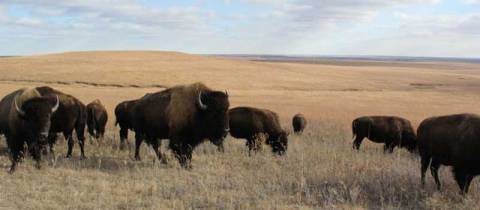
If you’ve never seen a bison up close then you can’t know how big they are: massive wedge-shaped heads, calling to mind an anvil or the head of a maul, and bodies that look like what you’d get if you crossed a cow with a moose.
So imagine hiking through the tall grass prairie and rounding a bend to find a whole head of these prehistoric-looking beasts, staring and snorting at you on the open plain. Awestruck is the word that comes to mind. And that was me in the mid-90s at the Tallgrass Prairie Preserve in Pawhuska, Oklahoma.
I was there with Annick Smith, helping edit her book, Big Bluestem: A Journey into the Tallgrass, which she wrote for The Nature Conservancy and Council Oak Books.
We spent a lot time out on the prairie, when we weren’t working on drafts of the text at the big farm table in the ranch house. We walked in the bluestem, sometimes with experts, sometimes alone, and always struck by the power and beauty of the landscape and the ecosystem.
One night, after we’d stopped wrestling over sentences, put the manuscript to bed, and all was quiet on the plain, I stepped outside onto the porch to take in the night sky. The sky was huge — Montana has nothing on Oklahoma skies — and the stars were so bright and plentiful, they formed an opaque glistening broken only by a chalk white moon.
Here is my poem, “Osage Moon,” which appeared in The Cortland Review in 2002:
Osage Moon
The moon |
–Scott Edward Anderson, The Cortland Review
Solitude & Sincerity: RIP John Haines, 1924–2011
March 4, 2011

John Haines Photo © Dorothy Alexander
In the spring of 1997, I was living in Anchorage, Alaska, and was invited by the University of Alaska Anchorage to put together a program for their annual Writing Rendezvous conference.
I thought about the fact that I was in Alaska and we were coming to the close of a century and that poetry seemed to be at a crossroads.
And then I thought about John Haines. Any panel on poetry in Alaska must feature John Haines, I thought. Haines was a kind of unofficial permanent poet laureate of Alaska.
Since moving there to homestead in 1947, Haines had crafted and composed poetry of great solitude and sincerity out of his Alaska experience.
Haines was pleased to join the panel, although he said something about being too old to be of interest to the audience. Then I told him the panel would be rounded out by a young spoken word poet and an Alaska Native woman poet. He got a spark and became more interested in the prospect.
I don’t remember much about the panel — and I confess I don’t have my notes at hand. It was called “Poetry at the Edge of the Millennium” or somesuch. I do remember the panelists were engaged with each other and engaging to the audience.
And I recall that Haines stirred up a bit of controversy on the panel talking about spoken word versus conventionally printed poetry. That was pretty typical for the poet.
“He was a cantankerous, insufferable, unbendable old bastard but he was a damn good writer,” longtime friend John Koolstra told the Fairbanks Daily News Miner. “He is Alaska’s best writer. He was a standout.”
So when I heard that John Haines died last night in Fairbanks at the age of 86, I thought about his poetry.
From his isolated cabin above the Tanana River in Alaska’s Interior, he learned “to make things for myself, to build shelters, to weave nets, to make sleds and harnesses, and to train animals for work. I learned to hunt, to watch, and to listen.”
And there he crafted poems out of a spiritual wilderness where his solitary imagination confronted existence without the comforting illusions of society (to paraphrase poet Dana Gioia).
Here is John Haines’ poem “Fairbanks Under the Solstice”
Slowly, without sun, the day sinks
toward the close of December.
It is minus sixty degrees.
Over the sleeping houses a dense
fog rises—smoke from banked fires,
and the snowy breath of an abyss
through which the cold town
is perceptibly falling.
As if Death were a voice made visible,
with the power of illumination…
Now, in the white shadow
of those streets, ghostly newsboys
make their rounds, delivering
to the homes of those
who have died of the frost
word of the resurrection of Silence.
–John Haines
 Scott Edward Anderson
