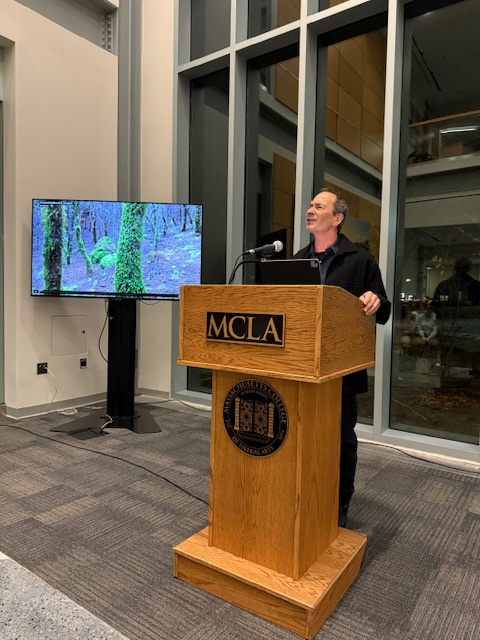
I wrote a profile of poet Forrest Gander for Berkshire Magazine back in the Fall of 2024, when he was visiting poet at MCLA in North Adams, MA. I’ve been personally and deeply engaged with Forrest’s poetry and nonfiction since his first book, Rush to the Lake, came out from Alice James Books in 1988. And I thoroughly enjoyed spending some concentrated time with his body of work, along with his latest book, Mojave Ghost: A Novel Poem, which New Directions published that year, in preparation for the article.
“The basic gesture of my writing is a listening,” poet Forrest Gander has written. “The great capacity of language is to bring us into proximity with one another.”
In Mojave Ghost, Gander is listening hard: to the desert, to the dead, and to the layered silences between. More sentence-based and more nakedly elegiac than anything he has published before, the book traces a movement from Arkansas into California, and along the San Andrea Fault, following geological and personal fault lines simultaneously.
Gander was born in 1956 in Barstow, in the Mojave Desert itself. His mother talked about the desert often, and he didn’t return until after she was gone. Her stories about Rainbow Basin, the fossils she collected there, and the landscape she loved, run through the book like an underground current. So does grief for his partner of 35 years, the poet C.D. Wright, who died suddenly in 2016. In Mojave Ghost, the pronouns slip and the addressee shifts; it may be his late mother, his late partner, or Ashwini Bhat, the sculptor he married in 2020. “Science tells us that although we may feel ourselves as a unified, authentic self, we’re actually a collaboration of conflicting voices,” Gander told me in an interview. “That’s something I’ve come to intuitively feel.”
What holds it all together is the landscape and what landscape does to time. While hiking along the San Andreas, Gander realized that looking at the terrain around him, he was also seeing past and present at once. “Those two conflations of past and present — of the personal and the geological — form the currents in Mojave Ghost.”
Memory has long been active in his work. In the new book, he asks:
Is it odd that what we remember
is confined so often to particular moments
like still images ripped from a film?
“My memory of my late mother’s face can be more real for me, more exact, more present even than the face of someone I’m talking with now,” he says. “In our minds, whatever had once been possible can be so again.”
Asked what he hopes readers take away from his poetry, Gander offers something close to a credo: “Thought-feeling. Feeling-thought. Western culture divides feeling from thought, but there are single words in Chinese and Japanese for heart/mind.” He agrees with Ezra Pound that “only emotion endures.”
“No one cares about how much money some investor made in 600 BCE, but we do care about even the small fragments of Sappho’s poems,” Gander says. “That’s about as much of a miracle as the world offers us.”
The following section from Mojave Ghost is shared with the author’s permission:
Because the tree line opens contours of meanings
other than the ones for which we’re prepared,
we treat it with suspicion.
When he smiled and shook his head no, his face
connoted the presumption that you and I live in a different world.
He took us in like the scent of a dead animal.
But how to sustain attentiveness? How to keep
the mind from dropping its needle
into the worn grooves of association?
My art, you said in passing, is nothing much
more than the discipline of an embodied life.
Articulating nuance. The delicate
palette. You paint details
with a tiny brush you made yourself
of hair plucked from your forearm.
They distrust me, you said, because
they can tell I prefer my work to their own.
Which is when I tucked a red anemone
under your pillow to bring you good dreams. What
else did you say?
Fair enough. It is a marriage of equals and without degree.
Your trace on me
like rope marks on the well’s mouth.
Here, have a thought.
As for our misfit status: as Brecht observed,
the palace of canonical culture is built on—
Not to interpret. To feel life course through you.
—Forrest Gander, from Mojave Ghost
Here’s a link to my Berkshire Magazine profile: Forrest Gander
 Scott Edward Anderson
 Scott Edward Anderson's Poetry Blog