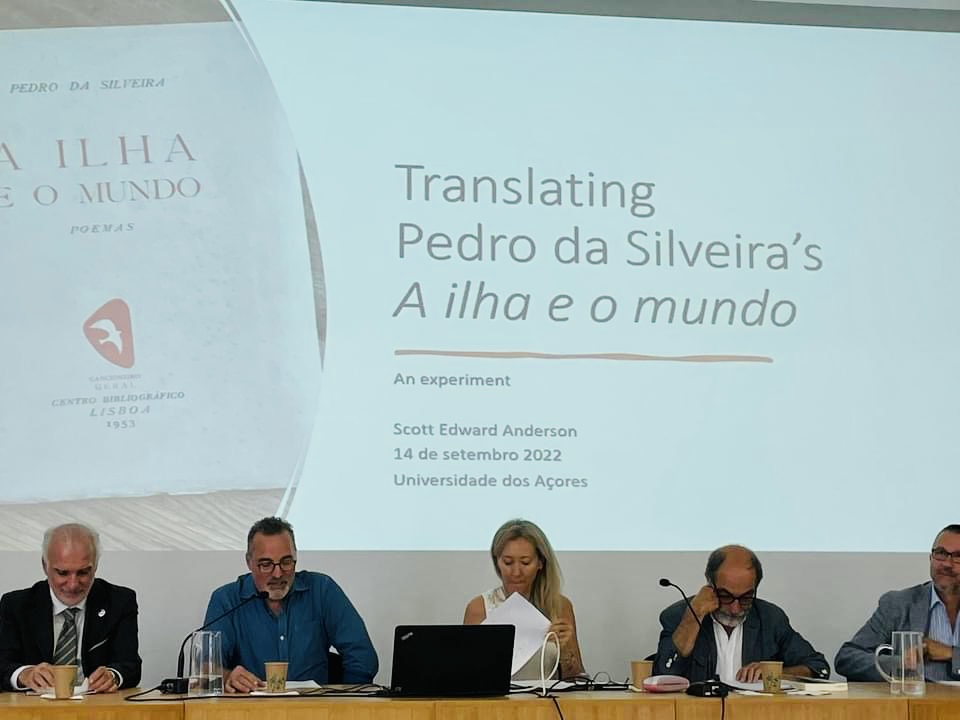
Last summer, I started a project to translate the Azorean poet Pedro da Silveira’s first book A ilha e o mundo (The Island and the World), which came out in 1952.
I had reviewed the late George Monteiro’s translation of Silveira’s last book, published in a bilingual edition by Tagus Press in the States and simultaneously by Letras Lavadas in the Azores in 2019 as Poems in Absentia & Poems from The Island and the World. In fact, the second half of that title was a misnomer; the book included only a few poems from Silveira’s first book–poems that had previously appeared in a Gávea-Brown anthology from the 1980s and sort of slapped on to the end of the book. (Silveira was born on Flores Island in 1922 and died in Lisbon in 2003.)
What struck me immediately about Silveira’s poetry—in Monteiro’s translation first and then in reading the facing Portuguese—was the depth of its feeling, the simplicity and directness of its language, and the brilliant tapestry woven by strands of memory, naming, and observations of nature. Indeed, all aspects that are found in my own poetry; hence, I felt a certain kinship with Silveira’s work straight away.
And yet, I was equally struck by the dearth of his poetry available in translation. How could such a seemingly important poet be so little represented in English translation? How much richer would the world of poetry–and the world of poetry-in-translation–be with Silveira’s body of work. And how much richer would be our lives in the Azorean diaspora with his sentiments, steadfast observations, and steady poetic hand.
I started with the second poem in the book, “Ilha”; this was likely the first poem I ever read by Silveira in translation, from that old Gávea-Brown anthology previously mentioned.
Here is the entire poem in its original Portuguese:
ILHA

Só isto:

                 O céu fechado, uma ganhoa

pairando. Mar. E um barco na distância:

olhos de fome a adivinhar-lhe, à proa,

Califórnias perdidas de abundância.
As I tend to do in my method of translation, I first read the poem straight through and then wrote an impression or literal reading as I understood it:
Just this:

                        The closed sky, a heron

Hovering. Sea. A boat in the distance:

Hungry eyes guessing, at the prow,

Californias lost of abundance.
A bit clunky and prosaic, and probably unworthy. I prefer to not read another’s translation (if there is one) while translating a poem lest I be influenced by it, so Monteiro’s sat on the shelf.
One thing troubled me, however. The bird. Where did that heron come from? Surely, I remembered it from Monteiro’s version. “Ganhoa,” at first, I thought was a misprint of “ganhou” – who won? – but that made absolutely no sense, so I went with heron. But what was a heron doing in this scene? Were herons even found in the Azores?
Reluctantly, I checked Monteiro’s translation. Sure enough, there it was, “heron.” It struck a dissonant chord with me now. A heron. Really? Again, I wondered whether herons were found in the Azores and turned to the Internet.
Yes, there were at least ten species of heron that have been noted on these islands, including great blues and little egrets, which according to the website whalewatchingazores.com have been sighted, but “not regularly”; the species is classified as an “uncommon vagrant” on the islands. And, most recently, a confirmed sighting of another species, the yellow-crowned night heron (Nyctanassa violacea) was described in a scientific paper by João Pedro Barreiros. Most likely, however, this one was blown east by a strong, errant wind from the west. Several herons were known to stop-over on their migratory path from Africa to northern climes and back.
Still, heron didn’t seem correct, to me, given the scene described. The use of Mar all alone. And the boat seemed to imply open waters rather than shoreline.
Herons are marsh-dwelling, shoreline species for the most part, so I was perplexed why they might be hovering “at Sea” or the “open ocean,” as I envisioned it. Were they blown off-course and out of their range? That would surely change the nature of this poem, which I assumed was about emigration or the emigrant returned or the desire to emigrate but also remain tied to the island. If it was not a heron, what was it then? What else might “hover” over the open ocean?
I typed “ganhoa” into Google. The almighty, all-seeing Google asked if I meant “ganhos” earnings; no, I did not. This was not a poem set in the halls of finance or a casino in Monaco. So, I clicked on “search instead for ganhoa” and up came a page from Priberam dicionário. I had my bird! The yellow-legged gull (Larus michahellis atlantis)…surely this bird would hover over the prow or bow of the boat, and even the stern, looking for a handout. A ganhoa recupera os seus ganhos. (The gull recovers its winnings.)
Here is my version of Pedro da Silveira’s “Island”:
Just this:

                    The closed sky, a yellow-legged gull

hovering. Open ocean. And a boat in the distance:

Hungry eyes, at the bow, divining,

lost Californias of plenty.
(Translated from the Portuguese by Scott Edward Anderson)
____
(This text was adapted from a paper delivered at the Colóquio celebrating the 100th anniversary of the birth of Pedro da Silveira, “Pedro da Silveira – faces de um poliedro cultural,” at the University of the Azores in Ponta Delgada, São Miguel, in September 2022.)
Speaking of the Azores: I am excited to host a Writing Retreat there from 13-18 October 2023! Join me for 5 days of writing and immersion in the nature, food, and culture of the Azores. We’ll explore the island, focus with deep attention, expand our horizons, and tap into the stories within. Details and registration at https://www.scottedwardanderson.com/azores-retreat
National Poetry Month 2023, Week Four: Hannah Linden’s “My daughter says the ghosts were busy last night”
April 24, 2023

I first read Hannah Linden’s poetry in 2014, when we were both part of Jo Bell’s “52” group of writers–a number of us committing to write a poem each week for the entire year. We shared our work-in-progress in response to the prompts Jo supplied us with each week in a private Facebook group. Hannah’s writing stood out from the group and I was delighted when she announced last year that her first pamphlet, The Beautiful Open Sky, was coming out in the Fall. (A pamphlet is what the Brits call a small selection of poems; what we in the States might call a chapbook.)
Hannah is from a working class background, as she puts it, born in a “cotton mill town slum” in northern England. Poetry “didn’t seem like something one of us could write or think of as ‘ours,’” she said in an interview. Later, she “started writing poems on paper bags,” while working the register at a supermarket. Her co-workers “told people to come to their till instead because ‘can’t you see the poet is writing!’”
Some early encouragement from a teacher led her to enter some poems into a prize competition, which she won. She went to university–the first in her family to do so–but “felt in awe of all writers, out of my depth and that I was kidding myself to think I could be ‘one of them’.” She gave up writing poetry until she was in her early thirties, having moved from the North to Devon, where she took some poetry classes, but got discouraged by a teacher there, and didn’t read or write poetry for fourteen years while raising her children. A random meeting with Mike Sims of the Poetry Society led to her sharing poems with him and he encouraged her to write more. Then she joined Simon Williams’ Poem-a-Day forum and “52.”
In the interview, Hannah explained that in these poems she “was interested in the way ‘mother’ is both a role and a relationship.” The Beautiful Open Sky opens with a series of poems exploring the damage inflicted by a narcissistic mother. The voice in the poems shifts from the mother “saying what she thinks her children may be feeling and then she lets them start to speak for themselves whilst navigating the role of a single parent.” Finally, “as her children mature, the mother starts to relate to them more as independent people and, in the last poem, the adult daughter herself is speaking in the poem’s title as the mother comes to terms with letting go.”
As Hannah says in the interview, “the ‘beautiful open sky’ is a way of trying to see the world when a series of situations are weighing you down, oppressing or terrifying you.”
My daughter says the ghosts were busy last night
I’m getting old. I don’t hear the creaks
even on the nights she wakes me, unable
to settle into the cooling house. It could be
owls, I say. They call across the valley, hunt
and flirt with each other. Maybe, she says,
I hear more than one species these days.
Insects in the loft, perhaps. But I know she’s
thinking of the people who lived here before—
those we never met or the one we try to forget.
And of the loneliness of the nights
when she should be somewhere else.
It’s too safe for her here now, and today
she’s going out into the world again.
Soon I’ll be the one listening
to the roof expanding, contracting.
–Hannah Linden, from The Beautiful Open Sky
________________________
In case you missed it: I am excited to host a Writing Retreat there from 13-18 October 2023! Join me for 5 days of writing and immersion in the nature, food, and culture of the Azores. We’ll explore the island, focus with deep attention, expand our horizons, and tap into the stories within. Details and registration at https://www.scottedwardanderson.com/azores-retreat
My friend and colleague Leonor Sampaio da Silva published her first collection of poems last summer, Quase um Carimbo (Companhia das Ilhas, 2022).

Born on the island of São Miguel, Azores, Leonor holds a master’s degree in Anglo-Portuguese Studies from the Universidade Novo de Lisboa and a PhD in Anglo-American Studies from the University of the Azores, where she has taught since 1991.
Having published a number of academic papers and contributions to various books, anthologies, and literary magazines, Leonor made her literary debut with a book of short stories, Mau Tempo e Má Sorte – contos pouco exemplares, which received the Daniel de Sá Humanities Prize in 2014. She is also the author of ABN da Pessoa com Universo ao Fundo (2017) and, with Carlos Carvalho, Pouca Terra – Fotografia e Literatura (2019).
“My idea for [this] book was to talk about the experience of isolation caused by the pandemic,” Leonor explained to me. “In which we lost contact with others and forced ourselves to face situations such as the vulnerability of life, how to make sense of each day, how to live with routine.”
Some of the poems read like diary entries, the poetic voice spoken by characters representing, as Leonor notes, “the others that exist within and outside of oneself.”
“Carimbo,” it may be useful to note, means “stamp,” the kind used to mark or authenticate official or private papers. Another meaning of the word, however, is “timestamp” (although usually written as “carimbo de data/hora.”) and, in this collection, each poem is marked by a timestamp: morning, afternoon, or night, as well as an action–I wake up, I sit down, I get up–as if to indicate stage direction.
It’s as if the characters in the poems are actors in their own play, marking their time, the pandemic imbuing even the most mundane tasks with the aspects of a theatrical production.
The book title translates as “Almost a Stamp,” which leads the reader to a question: if it is “almost,” what is it? An approximation? What is reality? The questions are heightened by the ending of the book where the theatrical stage suddenly becomes cinematic, play becomes film, language shifts in tone, the curtain falls, a wind picks up, a torrential rain pours down, and fallen leaves return to their trees. The speaker remains lonely. The book ends with one last action: “Adormeço” (I fall asleep).
“Poetry,” Leonor argues, “is a way of putting us in touch with each other and exploring new languages.” She carries this thread throughout the collection, whether using “the more intimate language of the diary/newspaper” or “the more social language of the theater,” demonstrating that “everything happens as if on a stage” and shielding us from loneliness and death.
Quase um Carimbo is an impressive debut poetry collection and I hope to translate more of it in the future.
Here are two poems by Leonor Sampaio da Silva in the original Portuguese and my translations into English:
manhã
acordo
uma personagem pragueja baixinho
pela noite mal dormida
o que farei se um Comboio transformar
a geografia deste lugar?
pensar no improvável tem sido
passatempo habitual
quase uma Obsessão
preocupa-me em demasia
a falta de uma Estação
—
morning
I wake up
a character curses softly
over the sleepless night
what will I do if a train transforms
the geography of this place?
thinking about the improbable has been
a regular hobby
almost an obsession
it worries me too much
the lack of a station
________
manhã
acordo
deve estar um dia quente a avaliar pela
temperatura do quarto
o corpo, o que é um corpo?
uma madeixa cortada
vivendo por um fio
enquanto aguarda reunir-se
à cabeça que dela se esqueceu
uma madeixa que se deixa
varrer
alisar
torcer em caracol
alourar ao sol
o sol, o que é o sol?
um corpo
—
morning
I wake up
it must be a hot day judging by
the temperature of the room
a body, what is a body?
a severed lock
living by a thread
while waiting to be reunited
with the head that has forgotten it
a lock that lets itself
sweep
smooth
twists into a curl
glistening in the sun
the sun, what is the sun?
a body
–Leonor Sampaio da Silva, from Quase um Carimbo
(translated from the Portuguese by Scott Edward Anderson)
___
Speaking of the island of São Miguel: I am excited to host a Writing Retreat there from 13-18 October 2023! Join me for 5 days of writing and immersion in the nature, food, and culture of the Azores. We’ll explore the island, focus with deep attention, expand our horizons, and tap into the stories within. Details and registration at https://www.scottedwardanderson.com/azores-retreat
My dog Calvin died this year. He was fifteen and losing his ability to move. The last time I saw him, he was responsive, yet it was clear he was increasingly uncomfortable in his body. He always lit up when he saw me; sadly, I think he was always thinking, “At last you’ve come home.” I was not.

In fact, I lost Calvin in my divorce over 10 years ago and, after a few years of occasional visits in Brooklyn, I stopped getting to spend regular time with him. I know we both missed each other. (I’ve had a number of dogs in my life; we got Beverley in 2015 and, when she does something I wish she wouldn’t, I remind her that she’s neither my first dog nor my last.)
I wrote two poems about Calvin, both of which appear in the anthology, Dogs Singing. One, in the voice of Calvin, recounts his origin story, based upon what we were told by the PASPCA. The other is not so much about Calvin as about my growing restlessness in the home of my previous marriage. Calvin serves as a character, if not a symbol, along with mining bees and a redbud tree.
Because Calvin was put down earlier this year, Emily Berry’s poem, “Dream of a Dog,” which appeared originally in Granta last February and in her most recent collection, Unexhausted Time, struck a particular chord in me when I read it. Berry’s poem appears about a quarter of the way through the book and, after a series of untitled poems, it is the first poem with a title in the book and closes the book’s first, unnumbered section. (As readers, poets always look for things like this in a collection; there is usually a significance to such placements, signaling an intention on the part of the poet, as if to say, “pay attention to this one.”)
It’s also one of the few poems in the collection where, in the words of critic Steven Lovatt, writing in The Friday Poem, “the tone is for once gentle, undemonstrative and open to outside impressions.” Berry’s work has always struck me as characterized by a so-called “flat style,” which Noreen Masud, in an article in the journal Textual Practice, explains “involves postures of poetic melodrama which state themselves ‘flatly’, without apology.”
Berry’s “Dream of a Dog,” while it does use a flat style, also consists of one long sentence, or rather a fragment of a sentence, for it ends not with a full-stop period, but an ellipsis. The ellipsis hints there is more to come or, perhaps, that the reader could circle back to the beginning of the poem for it ends where it begins, with the words, “My life” as if the poem could be an endlessly cycling dream.
It also causes me to question, is it the “dream of a dog,” as in, the speaker is dreaming of a dog (line 19 begins, “if I had a dog”) or is it a dream a dog is having, complete with its sighs. (My dog Beverley barks in her dreams, along with sighs, and chases things; I wish I knew what.)
Emily Berry is the author of three poetry books published by Faber in the UK: Unexhausted Time (2022), Stranger, Baby (2017) and Dear Boy (2013). You can read more about her and her work at: https://www.emilyberry.co.uk/
Here is her poem, “Dream of a Dog”:
Dream of a Dog
My life, and all our lives, I said sleepily,
so soft now, like the neck of a sleeping dog,
I lay my hand on it, as you have lain your hand
on mine (on my life), this tenderly, as the dog
noses deeper into sleep, as she sighs the way
a dreaming dog does, I wish my life was in
your dream, dog, I think it is, and she turns
onto her back so her stomach rises pale and
softly furred, and your words are travelling
through me, or, no, they travel over me, the
way a breeze makes fabric touch us, the fabric
of half-drawn curtains billowing from an open
window, as I pass and glance out on such
a day, the dog whimpering softly in sleep;
perhaps it’s that you say I should have faith,
or that you have faith, in increments, while
my shoes are nosing through leaves and the
dog is alert or disappears (but she comes back),
if I had a dog she would be a kind of faith,
I would lift her onto my shoulder, the points
of her ears very elfin and her face, serious,
tilted to regard you, she would listen and run
and then, from a distance, up a slight incline,
when I call her, look back, then run on,
and I do believe in increments, as when
the dog brings me, in her dream, pinecones,
when she wriggles in my arms, her ribcage
strung like an archer’s bow, when her paws
bend at the wrist in supplication, I do not see
the slow wheels in my blood turning, but
I ride them, I do not see what I know
and everything beneath that, which I may
come to know, or may not, the slow slow
discernment of the deep layer, air bubbles
rising from the dead zone, the dog in her
dream talismanic on a hilltop, the soft tips
of her ears in sleep, a slight sigh, all my life.
–Emily Berry, from Unexhausted Time

I stumbled across Martha Sprackland’s debut collection, Citadel, in Desperate Literature, a wonderful little bookshop off the Plaza Santo Domingo in Madrid last month. The poet, originally from Liverpool, now divides her time between London and Madrid, and she thanks the bookstore in the acknowledgments of her book. The collection intrigued me because of its size–a bit taller and thinner than the old City Lights paperbooks–and the paper wrapped around it proclaiming it as a staff favorite.
Inside, I found a captivating mix of poems that seemed to alternate between, as the back cover indicates, a “composite ‘I’–part Reformation-era monarch, part twenty-first century poet.” The monarch is Juana of Castile, “sixteenth-century Queen of Spain and daughter of the instigators of the Inquisition,” the so-called “Joanna the Mad.” The book was published in 2020 and shortlisted for the John Pollard International Poetry Prize in 2021, the Forward Prize for Best First Collection in 2020, and the 2020 Costa Poetry Award.
Cocido madrileño is a traditional stew from Madrid with meat and vegetables in a chickpea (garbanzo bean) base. I picked this poem to share because it is indicative of Sprackland’s gift for moving between the present and the past in this collection. I look forward to reading more of her work in the future.
Here is the poem in its entirety:
Cocido Madrileño
It was an unexplainable hunger, like a gravel pit,
and it wouldn’t go away. Sickness like a fingernail moon
around its darkness. Juana went to the bodega
and bought six tins of cocido ridged
like braziers, Litoral stamped in red along
the white coastline, the meats reclining
in an adoring harem of chickpeas.
Juana’s faith was on the wane but pork would prove it.
Morcilla, chorizo, tocino de ibérico, panceta,
soft white lard and blood and bone and smoke
tipped over the lip and into the pit, like a body
she desperately wanted to be rid of.
This, she believed, would sate her, save her.
–Martha Sprackland, from CITADEL
Learn more about the poet: Martha Sprackland
Click here to purchase Citadel directly from the publisher, Liverpool University Press.
 Scott Edward Anderson
 Scott Edward Anderson's Poetry Blog