On Bison, Bluestem, and “Osage Moon”
March 5, 2011
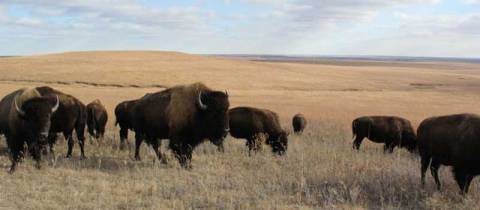
If you’ve never seen a bison up close then you can’t know how big they are: massive wedge-shaped heads, calling to mind an anvil or the head of a maul, and bodies that look like what you’d get if you crossed a cow with a moose.
So imagine hiking through the tall grass prairie and rounding a bend to find a whole head of these prehistoric-looking beasts, staring and snorting at you on the open plain. Awestruck is the word that comes to mind. And that was me in the mid-90s at the Tallgrass Prairie Preserve in Pawhuska, Oklahoma.
I was there with Annick Smith, helping edit her book, Big Bluestem: A Journey into the Tallgrass, which she wrote for The Nature Conservancy and Council Oak Books.
We spent a lot time out on the prairie, when we weren’t working on drafts of the text at the big farm table in the ranch house. We walked in the bluestem, sometimes with experts, sometimes alone, and always struck by the power and beauty of the landscape and the ecosystem.
One night, after we’d stopped wrestling over sentences, put the manuscript to bed, and all was quiet on the plain, I stepped outside onto the porch to take in the night sky. The sky was huge — Montana has nothing on Oklahoma skies — and the stars were so bright and plentiful, they formed an opaque glistening broken only by a chalk white moon.
Here is my poem, “Osage Moon,” which appeared in The Cortland Review in 2002:
Osage Moon
The moon |
–Scott Edward Anderson, The Cortland Review

When the Spirit Moves You, Go With It
November 18, 2010

Gladys Taylor (on right), with her companion Ga Morrill, in Brookfield, Vermont
Back in November 2002 I was a poet-in-residence at the Millay Colony in upstate New York. I went up there with the kernels of a big, ambitious new project in mind — my poetic sequence called “Dwelling.”
One day, November 17th to be exact, I took a break from writing and went for a hike in the woods. In the middle of the woods I had a kind of vision of my childhood.
I was in the woods with Gladys Taylor, who we called Aunt Gladys and who looked after me those days. Really, I was her protegé. (I have two slim books of stories she wrote about my exploits as a toddler.)
Suddenly, as rarely happens, I had one of those bolts of inspiration and was compelled to run back to my studio. I sat down at the desk, grabbed my notebook, and wrote furiously. Some 250 lines later, I put down my pencil and went to the communal dining hall. When I got back after dinner and read what I had written, I thought some of it was pretty good.
The best of it was the story of Gladys’s “education” of me — I always say that everything I learned, I learned from Gladys Taylor.
Wanting to acknowledge Gladys in a dedication, I looked up her birth date on the Social Security Death Index (she died in 1986). It turned out, I was writing the poem on what would have been her 100th birthday! (This past Wednesday would have been her 108th.)
As a dear friend of mine said to me once, “Coincidence is God’s way of remaining mysterious.”
Here is my poem, which was a runner-up for the Robert Frost Foundation Poetry Award a few years ago:
The Postlude
“What dwelling shall receive me?…The earth is all before me.”
–Wordsworth, “The Prelude”
I am a child, crawling around in the leaves
With Gladys Taylor while she names the trees,
parts the grasses, digs into the earth with a gardener’s trowel.
She picks out worms and slugs, millipedes
And springtails, which we see with a “Berlese funnel.”
Busy decomposers working their busy tasks,
Turning waste into energy, leaf litter into soil again.
Gladys names things for me: “That oak,
That maple there, that sassafras, smell its roots.”
“Root beer!” I exclaim,
Her laughter peeling away into the hills. Later,
With Comstock’s Handbook of Nature Study
On the table next to the unending jigsaw puzzle,
Gladys opens to “The Oaks,” reading or reciting:
“The symbol of strength since man first gazed
Upon its noble proportions…” Then she sings Virgil,
Full in the midst of his own strength he stands
Stretching his brawny arms and leafy hands,
His shade protects the plains, his head the hills commands.
Leaves and acorns spread across the table,
Each divided to its source, as if cataloguing specimens:
The white and chestnut oaks, red and scarlet,
Every oak in the neighborhood, sketching the leaves,
Tracing and coloring them. Then questions, such questions:
“Where did we see this one growing?” “How tall?”
“Are the branches crooked or straight?”
“Round leaves or pointy?”
And then a game of matching
Acorn to leaf; a most difficult lesson — as difficult
As those jigsaw puzzles for a boy lacking patience
Or attention. Outdoors again, to learn attention,
Naming the birds that came to eat at the feeder:
Chickadee, sparrow, nuthatch, tufted titmouse,
The ubiquitous jay.
“The mockingbird, hear
How he makes fun of all the other birds.” Now
Thrasher, now robin, the sweet sweet sweet,
Very merry cheer of the song sparrow,
Or the flicker’s whicka whicka wick-a-wick.
Then a jay’s piercing caw, a cat’s meow,
This was all the mocker’s doing! And wide-eyed,
I stare, as Gladys seems to call birds to her side.
“The robin tells us when it’s going to rain,
Not just when spring is come,” she says. “Look
How he sings as he waits for worms to surface.”
That summer, rowing around the pond
By Brookfield’s floating bridge, I saw a beaver
Slap the water with its tail, and then swim around the boat,
As if in warning. Under water a moment later he went,
Only to appear twenty yards away, scrambling up the bank,
Back to his busy work. “Busy as a beaver,” Gladys laughs.
Then a serious tone, “You know that beavers gathered
The mud with which the earth was made?”
(I later learned this was Indian legend; to her
There was little difference among the ways of knowing.)
All around the pond the beavers made of the creek,
The sharp points of their handiwork: birches broken
For succulent shoots, twigs, leaves and bark bared.
“When they hear running water, they’ve just got
To get back to work!” Beavers moving across
The water, noses up, branches in their teeth,
Building or repairing dams or adding to their lodges,
Lodges that look like huts Indians might have used.
I watched for them — beavers and Indians — when
Out on the water, and once I remember a beaver
Jumping clear out of the water over the bow of the rowboat!
Later, wading in the mud shallows by the pond’s pebbly edge,
I came out of the water to find leeches covering my feet,
Filling the spaces between my toes. Screaming, fascinated,
I learned that they sucked blood, little bloodsuckers,
A kind of worm, which were once used to reduce fever.
That was me to Gladys Taylor’s teaching,
Wanting to soak up everything she had to give me.
We picked pea pods out of the garden, shelled
On the spot, our thumbs a sort prying-spoon,
And ate blackberries by the bushel or bellyful,
Probably blueberries, too, I don’t know. And
Seeing the milkweed grown fat with its milk,
I popped it open, squirting the white viscous
Juice at my brother. Gladys always found
A caterpillar on the milkweed leaves, tiger stripes
Of black, white, and yellow. “Monarchs,” she said,
“The most beautiful butterfly you’ll ever see.”
I looked incredulously at the caterpillar, believing,
Because she was Gladys, but not believing her,
That this wiggly, worm-like thing could be a butterfly.
Later, she found a chrysalis and took the leaf
And twig from which it hung. She placed it atop
A jar on the picnic table, and each day we waited
— waited for what? I didn’t know. Until one day,
It was empty, a hollow, blue-green emerald shell,
And I almost cried. “Look, out in the meadow,”
She instructed. Hundreds, it seemed like
Thousands, of monarch butterflies flitting about,
From flower to flower!
The wooly-bear
Was easier to study. We put it in a jar with a twig
And fresh grass every day; it curled and slept and ate
Until one day it climbed, climbed to the top
Of the twig and spun a cocoon from its own hairs.
There it stayed for weeks, until at last I thought it dead.
But then, emerging from its silky capsule, a hideous sight:
Gray, tawny, dull–a tiger moth! Nothing like the cute
And fuzzy reddish-brown and black teddy bear we’d found.
“This is magic,” said Gladys. “Nature’s magic.”
And I believed her, believe her still, that there is some magic
In nature speaking within us when we are in it, of it, let it in–
Science may explain this all away, physics or biology,
But nothing will shake my faith in this:
That the force of nature, the inner fire, anima mundi,
Gaia, or whatever you may call it, is alive within each
Being and everything with which we share this earth.
My Mother Earth was Gladys Taylor, and she
Taught me these things, and about poetry and art,
In the few, brief years we had together. Gladys
Taught me how to look at the world — to pay attention.
Thus began my education from Nature’s bosom:
A woman, childless herself (I believe) who,
In her dungarees and work-shirt, took a child
Under her wing and gave him gold,
Gave him his desire for dwelling on this earth.
(For Gladys Taylor, 17 November 1902-18 March 1986)
–Scott Edward Anderson
Ground Zero: Trying to Write About 9/11
September 11, 2010
In the wake of tragedy on September 11, 2001 — in the face of it, in some ways — there were reports of poems appearing all over New York. On lampposts, bus stops, phone booths, taped over advertisements; poems to lost loved ones, the missing, the dead, to the world.
Poetry seemed to be a healing force for some, a way of calling out in remembrance for others. Poems then started to appear in print, as poets from Deborah Garrison to Wisława Szymborska tried to come to grips with what had happened that day.
I tried to write a poem to express what I felt about that day. I wasn’t there, I was 100 miles away in Philadelphia, but some people I love were there and their lives were forever changed by the tragedy. All of us were.
I started writing the poem that November and worked on it for a while before giving up. It wasn’t easy to write about. I took it out again six years later and found it wanting. I was reminded of the poem today — nine years after the tragedy — and decided to share it here.
Here is my poem, “Ground Zero”:
Neighbors worked in these buildings;
buildings no longer there, no longer here.
Their emptiness fills the space once occupied.
How tall is emptiness?
How empty is remembrance?
Memory flares, burns out.
Neighbors are strangers become familiars,
and neighborhoods are the places we meet
the stranger’s glance, acknowledge or turn away.
Only now, who can turn away?
Who can pretend innocence?
Decoy repelling and attracting.
The boy in Belfast on his way to school
who runs past the empty spaces
between houses, fearing snipers;
the girl who fears an ill-timed car bomb;
the mother awaiting children from the playground;
the father fearing policeman protecting and serving.
Neighbors may be those we’d least like
to live with, but they make our community.
The empty space left by buildings gone.
Our hearts wanting for lack of something,
connection, community, solace–
Who can fill the space gone empty, gone?
(for Barbara Einzig & Chloe Indigo Hannah Guss)
–Scott Edward Anderson
My Longshot Submission: “Imaginary Comeback”
September 10, 2010
Over 48 hours, from noon on August 27, 2010, through noon on August 29, 2010, “hundreds of writers, editors, artists, photographers, programmers, videographers, and other creatives from all around the world came together via the Internet — and in offices in Los Angeles, Portland, and San Francisco — to make a magazine from start to finish.” It was called Longshot.
The theme was “comeback.” My submission wasn’t published in the magazine, but will appear on their blog linked to this blog post. It’s a cool idea. Here is my longshot, a poem I wrote in a flash on Saturday, August 28th, called
“Imaginary Comeback”
He was big, really big.
In his mind, he was the only star
There ever was — the one true star.
A star of the stage, screen, and sport,
Legions of fans cheering his every move.
They bought all his records,
Sold out his shows, cheered every score.
No one could get enough of him,
Kept demanding more.
He fell in with the wrong crowd,
An adoring mass of one,
That took him down the wrong path.
He fell into bad habits: sex,
Drugs, deviant behavior – all by himself.
Only, when he fell, nobody knew
It was all in his mind. He disappeared
Further into obscurity; none missed him.
He stopped hearing the cheering
In the back of his mind,
The soundtrack no longer played,
Accolades and self-congratulation
Were no longer forthcoming.
But now, poised for a comeback,
He sits on the couch and stares,
Paralyzed with fear and self-loathing.
What if you were a star
Of your own mind
And you made a comeback
To which nobody came—
Would the fame taste as sweet?
Or bitter, bitter as bile piling up
In the pit of his stomach
Churning with anxiety.
Heck, even John Lennon used to
Throw up before The Beatles’ gigs,
He tells himself. Then he heaves,
Leaving his lunch on the living room
Floor: the only thing making
A comeback today
Is the sandwich he ate an hour ago.
–Scott Edward Anderson
Revise, revise, but when is too much?
June 25, 2009
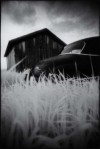
Fallow Field by Joshua Sheldon
In fact, we were both inspired by the same image we saw, one summer driving south out of the Adirondack Mountains. A field, a car, a barn.
I wrote the poem in a quick burst of notes crawling around in the field as Joshua searched for the best angle to capture the scene on film. (See the result at left.)
Joshua’s photograph hangs on my wall and has adorned at least one book (not yet mine). My poem was published in Blueline, a journal published at SUNY Potsdam.
Some time over the years, after its publication, I revised the poem, excising what I thought were superfluous lines that made too fine a point in trying to draw a parallel between the subject’s experience — a woman who ended her marriage abruptly — and the landscape we found. The lines removed are underlined below:
Fallow Field
The old car is there,
where she left it,
out by the old shed,
breeding rust–obscured
from the roadway by the rye grass
that grows up all around.
Long triangular tentacles
blowing and bending
in the hot breeze, as
sunlight filters in
through gathering clouds.
By now the grass has worked
up into the engine block.
The car--an old
Chevrolet or Buick?–
no matter, it’s what
is planted now,
in this fallow field,
awaiting bulldozers.
They call this grass
“poverty grain,” and there’s
no small comfort in the fact
that it’s as tolerant
of poor soils
as she was of the poor soils
of her marriage.
On the day she left,
she packed her whole life
into an old grip: clothing,
framed photographs
of the children, her parents,
the salt cellar she’d bought
on her honeymoon in Rome.
While packing, she’d given
pause that her whole life
had become so
portable, where once there’d
been permanence. And now,
she blows and bends
like this rye grass
on a midsummer afternoon,
so far from home,
so far from the old shed
of her former self.
Joshua’s objections are outlined in the following email:
SEA: Ok, I’ve read and re-read the two versions of Fallow Field and again I want to express my support for the earlier version. There are three changes I’m aware of, two lines in the body and the ending. I don’t feel the two lines alter the poem much but the ending! The ending Scott! It flowed before, it let you down easy, it tied it all up like the well written present that it was.
I agree with Joshua that the old ending tied it all up neatly — just a little too neatly for my taste. I think the newer ending, with its abruptness, speaks more to the experience of the woman in the poem, and is more true to life.
Things don’t always end neatly. In fact, I suggest that most things don’t. Life is full of messy, sudden changes, especially in relationships.
Below is how the revised version of the poem reads today. What do you think?
Fallow Field
The old car is there,
where she left it,
out by the old shed,
breeding rust–obscured
from the roadway by the rye grass
that grows up all around.
Long triangular tentacles
blowing and bending
in the hot breeze, as
sunlight filters in
through gathering clouds.
By now the grass has worked
up into the engine block.
The car
is planted now,
in this fallow field,
awaiting bulldozers.
They call this grass
“poverty grain,” and there’s
no small comfort in the fact
that it’s as tolerant
of poor soils
as she was of her marriage.
On the day she left,
she packed her whole life
into an old grip: clothing,
framed photographs
of the children, her parents,
the salt cellar she’d bought
on her honeymoon in Rome.
While packing, she’d given
pause that her whole life
had become so
portable, where once there’d
been permanence. And now,
she blows and bends–
rye grass on a midsummer afternoon.
##
 Scott Edward Anderson
 Scott Edward Anderson's Poetry Blog