My Year in Writing 2025
November 29, 2025
This is the time of year—between my birthday and year’s end—when I take stock of my writing life over the past 12 months. A trend that’s continued this year: I’ve continue to be very Berkshire-focused as we approach the fourth anniversary of our move up here. As I told one of my students at Berkshire Community College this semester, where I’ve been teaching Principles of Marketing, filling in for a professor on her sabbatical, “This is my time to give back and go hyperlocal…”
I’ve also continued to write for Berkshire Magazine—eighteen in total and sometimes as many as 4-5 articles per issue (!), causing me to joke with my editor, Anastasia Stanmeyer, “Do you have any other writers?” In addition to having the cover story in one issue this year, Anastasia generously wrote about me in her editor’s note in the Fall issue accompanied by this photo.

I’m still shopping around my book of essays, The Others in Me: On the Azores & Ancestry, Poetry & Identity, and am building a new series of essays about life on our little beaver pond in the Berkshires, which I’m calling “To Learn Attention: Encounters in the Anthropocene Backyard,” several of which were published earlier this year.
While we didn’t get to the Azores for the second year in a row—something I hope to remedy in 2026—we had a wonderfully inspiring trip to Paris in late March-early April. Overall, it’s been a productive year. Here are some of the highlights:
“A Modern Log Cabin: Industrial Chic Meets Rustic Warmth,” in Berkshire Magazine, Spring 2025
“Betting Big on the Outdoors: Paul Jahinge Leads the State’s Outdoor Recreation Vision” (profile), in Berkshire Magazine, Spring 2025
“Matt Rubiner: An Unconventional Path to Cheese Mastery” (Q&A) in Culture: The word on cheese, Spring 2025
“Ancestral Echoes: Exploring Aracelis Girmay’s An Experiment in Voices,” in Berkshire Magazine, May-June 2025
“Poetic Sweat: Bill T. Jones and His Company Return to Jacob’s Pillow” (profile), in Berkshire Magazine, May-June 2025
Attended MAPS’ Psychedelic Science Conference in Denver, CO, reporting on several future stories and features. (June)
“My Wife Gave Me Magic Mushrooms For My 60th Birthday. It Transformed My Life In Ways I Never Expected,” HuffPost, June 2025 (The response to this piece was absolutely amazing. My editor at HuffPost wrote that something like 250,000 people read it the first weekend it was published, with “an average read time of 2:46 minutes (the site average for a story is 0:40, so to get folks to stay on your piece for close to three minutes is AMAZING and means that most people read all the way through… a huge feat in today’s ‘click in and click out’ digital world).” I heard from people all over the country: people who needed to hear the message of my tory and who now have hope that there’s something out there that may be able to help them. I feel especially blessed to have published this piece this year.)
Psychedelic Healing in Practice: A conversation with Scott Edward Anderson on AdvisorShares’ AlphaNooner podcast. (July)

Opinion: Don’t let New Bedford erase its Portuguese soul – “ The proposed closure of Casa da Saudade isn’t just a budget cut, it’s cultural erasure. The library has been the beating heart of Portuguese American identity in one of America’s most Lusophone cities.(Opinion), in New Bedford Light (July)
“A Building That Dances: The Reimagined Doris Duke Theatre Takes Flight,” feature in Berkshire Magazine, July 2025
“A Landmark Farewell: Stephen Petronio in his company’s final bow this summer at Jacob’s Pillow” (Q&A), in Berkshire Magazine, July 2025
“Paul Elie on Literature, Faith, and the Culture of Encounter” (Q&A), in Berkshire Magazine, July 2025
“A Homecoming: Richard Blake Creates Great Barrington’s W.E.B. Du Bois Monument” (profile), in Berkshire Magazine, July 2025
“A Conversation Before the Conversation: A talk with Jayne Anne Phillips ahead of her visit to the Mount” (Q&A), in Berkshire Magazine, July 2025
“Threads of Time: Alvin Ailey American Dance Theater Returns to Jacob’s Pillow After 62 Years” (Cover story), in Berkshire Magazine, August 2025
“The Power of Words: The WIT Literary Festival Returns with a Bold Call for Civic Engagement Through Literature,” in Berkshire Magazine, August 2025
Four essays from “To Learn Attention: Encounters in the Anthropocene Backyard” in La Picciolétta Bárca, August 2025
“From Investment to Impact: Mill Town’s Blueprint for a Stronger Pittsfield and Berkshire County” (feature), in Berkshire Magazine, Fall 2025
“A Recipe for Community: Williams College’s Log Lunch brings people together over food and ideas,” in Berkshire Magazine, Fall 2025
“Making Public Lands Welcome to All: An interview with newly appointed DCR Commissioner Nicole LaChapelle” (Q&A), in Berkshire Magazine, Fall 2025
“Cheesemaking Tradition Meets Innovation in the Azores” (feature) in Culture: The word on cheese, Fall 2025
Featured poet in reading at Hot Plate Brewing Company in Pittsfield, along with Susan Buttenweiser, Anna Lotto, Matthew Zanoni Müller, and Lara Tupper. (September)
“(Take) Home (or Dine In) for the Holidays: Your guide to Thanksgiving Dining in the Berkshires” in Berkshire Magazine, Holiday 2025
“Ice Dreams Really Do Come True: Community, Competition, and Cold Weather Fun in the Berkshires” (feature) in Berkshire Magazine, Holiday 2025
“Giving Back Locally: Supporting Organizations that Strengthen Our Community” in Berkshire Magazine, Holiday 2025
“Driving Community: Berkshire Auto Dealerships are Expanding, Thriving, and Staying True to Their Roots” (feature) in Berkshire Magazine, Holiday 2025
I also started working on a new sequence of poems, “Aquapelagos,” exploring themes of islands as ancestral territories and identity markers. We’ll see where that goes…
And I continued to curate and host the Berkshire Nature Talk Series at West Stockbridge Historical Society. We had four programs this year featuring Nicaela Haig of MassAudubon, Chip Blake on the birds of the Berkshires, Thomas Tyning on reptiles and snakes, and Brian Donohue on building with local forests. The program was funded in part by grants from the Alford-Egremont, Richmond, Stockbridge, and West Stockbridge cultural councils, local agencies which are supported by the Mass Cultural Council, a state agency.
A productive year. Hope to keep getting my fix in 2026!
—SEA
My Year in Writing 2024
December 9, 2024
This is the time of year—between my birthday and year’s end—when I take stock of my writing life over the past 12 months. A trend I’ve noticed this year is that I’ve become very Berkshire-focused as I approach the third anniversary of our move up here. I see that as a good thing; it means I’m digging into our community more and focusing on what’s closest to me.
I’ve also had the opportunity to explore more magazine writing—features, profiles, and interviews—through my work with Berkshire Magazine, which has allowed me to engage with and write about Michael Pollan, Mark C. Taylor, Camille A. Brown, Forrest Gander, and Ruth Reichl, among others. Thanks, Anastasia Stanmeyer!
And the Azores continues to be a focus—even though we didn’t return to the islands this year for the first time since 2021. We’ll have to change that in 2025! Overall, it’s been a productive year. Here are some of the highlights:
“Seeking My Roots Through a Painter’s Eyes” (essay), in Revista Islenha, Issue 73, in Madeira, Portugal. (January)
Led a writing workshop at Herman Melville’s Arrowhead titled, “Cultivating Deep Attention,” helping participants explore the art of profound concentration and how it can enhance their writing process and equip them with the tools and mindset needed to harness the power of deep attention in their writing journey. Workshop (February)
Launched “Berkshire Nature Talk Series” at West Stockbridge Historical Society with Leila Philip, author of Beaverland, kicking off the program. Featured three more talks throughout the year on birds, bears, and mushrooms. (February)

“A Philosopher’s Secret Garden: Mark C. Taylor and His Landscape of Ideas,” (lecture/presentation), delivered at “After the Human: Thinking for the Future,” UCSB Humanities & Social Change Center (March)
Featured poet at the first annual Poesia: A Celebration of Portuguese Poetry, Culture, & Fall River Poets, presented by Viva Fall River and Newport Poetry, at the Gates of the City, Fall River Heritage State Park, and the Fall River Visitors Center. (April)

“The British Invasion: The Royal Ballet Takes Over Jacob’s Pillow,” (article), Berkshire Magazine (May/June)
“Keep on Trocking: Les Ballets Trockadero de Monte Carlo Kicks Off Jacob’s Pillow 2024 Season,” (article), Berkshire Magazine (May/June)
Creative nonfiction mentor, Adroit Journal Summer Mentorship Program, mentored two students for the third year. (June-July)
“Cathy Park Hong: “On Minor Feelings, and writing poetry & prose,” (Q&A), Berkshire Magazine (July)
“Emily Wilson: On Translating Homer—and his lessons for today,” (Q&A), Berkshire Magazine (July)
“A Philosopher’s Secret Garden: Mark C. Taylor’s Landscape of Ideas,” (profile), Berkshire Magazine (July)
“Storytelling Through Dance: Camille A. Brown’s Vision & Voice,” (profile), Berkshire Magazine (July)
Hosted a Poetry booth at West Stockbridge Zucchini Festival where festival goers wrote “zucchrositc” poems – yes, acrostics using the word zucchini! (August)
“Getting Back to the Garden: Michael Pollan’s Long, Strange Trip,” (profile), Berkshire Magazine (August)
“Jennifer Egan: On The Candy House, storytelling, and genre,” (Q&A), Berkshire Magazine (September)
“Every Meal is a Story: A Peek into Ruth Reichl’s World of Food,” (profile), Berkshire Magazine (September)
“Lenox Rising: A Berkshire Town’s Resilience and Renewal,” (article), Berkshire Magazine (September)
Catalog essay for “NEXUS 2.0.1: Contemporary Landscape Paintings by Paul Paiement,” Ethan Cohen Gallery, NYC, October 10-November 23. (October)
“Prayer House,” (poem), Speaking for Everyone: An Anthology of “We” Poems (October)
“Six Poems by Pedro da Silveira from A ilha e o mundo,” (translations), Gávea-Brown: A Bilingual Journal of Portuguese-North American Letters and Studies, (October)
Featured Author of the Month, Casa da Saudade Branch Library, New Bedford Free Public Library, New Bedford, MA (October)

My poem, “Wanting,” reprinted in Poetry is Bread: The Anthology, edited by Tina Cane, published by Nirala Press, India (October)
“Massachusetts Voter Endorses Ballot Measure #4,” (Op-Ed), Lucid News (November)
“Letter to America: The psychedelic renaissance,” (essay), Terrain.org (November)
“The Power of Listening: Forrest Gander’s Poetry of Memory and Place,” (profile), Berkshire Magazine (November)
“A Massachusetts Voter Reflects on the Failure of Psychedelics Ballot Question 4,” (Op-Ed), Lucid News (December)
“First Impressions of the Açores,” (essay), Gávea-Brown: A Bilingual Journal of Portuguese-North American Letters and Studies (December)
A productive year, indeed—hoping to keep it alive in 2025!
—SEA

Photo by SEA.
If you’ve been following my blog for the past few years, you know that I’ve been on a journey of rediscovery—rediscovery of my Azorean Portuguese roots and heritage.
I’ve now been back to the island archipelago of my ancestors three times since my first return in 2018.
That first visit was under the auspices of a writing retreat offered by DISQUIET International, an organization that tries to link and foster relationships between Luso-American and Portuguese writers.
This journey has turned out to be more than just a heritage tour, for I’ve made many friends and discovered family I didn’t know I had there. And because I worked in nature conservation for so many years, I couldn’t help falling in love with the islands and their beauty and majesty, but also their fragility.
My own poetry and non-fiction have long been about a few essential themes: a longing for home and an appreciation and concern for the natural world. In the Azores, I’ve come to find a beautiful combination of both.
In addition to that longing (the Portuguese have a word for it, saudade, which I’ve defined elsewhere as a longing for lost things) is the feeling that I’ve found a home there, which I hope to fully realize in the not too distant future.
And my concern for the natural world there—in the face of future impacts of climate change on small island communities like the Azores—as well as the last remaining endemic species, is also deepening my relationship to the islands.
I’ve been exploring my love affair with the Azores in two works-in-progress (although, frankly, it’s showing up in just about everything I write these days): a research-driven memoir of my ancestry and heritage on the islands and a long poem that explores some of the same territory.
Recently, Gávea-Brown, a bilingual journal of Portuguese-American language and studies from Brown University, published an excerpt from my poem, which I’ve been calling “Azorean Suite,” in the original English and in a translation by the Azorean American poet José Francisco Costa.
It’s been an amazing journey thus far and I hope to return to the islands as soon as possible. Meanwhile, here is a section from my “Azorean Suite.”
From “Azorean Suite”
“Is the island a cloud or is the cloud and island?” ~Nemésio
The sea surrounds, is ever-present
endless, the sea surrounds
and sea sounds swirl and sway
humid torpor of temperament
fog enshrouds
clouds caught on peaks
wrapping the mountain
a helmet of white, gray, ash
the ever-present volcanoes
threat of fire and destruction
threat of sea-wind and wave
thread of saudade woven
into the fabric of all life
on the islands—
saudades for the land
enshrouds the land
enshrouds the islanders
surrounded by sea.
#
São Miguel, island of my ancestors
who settled here in the original waves
1450s or earlier, as far as I can tell,
from the Alentejo, they came,
encouraged or escaping
I know not—
São Miguel, the green island,
jewel in the bracelet of archipelago,
formed by two volcanoes
reaching for each other
a chain of eruptions enclosing
the space between them
populated, like that chain, scattered
by wind and sea, until 1906,
when my great-grandparents left
for America—scattered across the sea.
#
My return, over a century later,
fills me with mixed emotions—
have I come “home” or simply returned
to reclaim a lost heritage
something denied to me
by my grandfather’s willingness
to forget the past, to relinquish
the “saudades de terra”
so much a part of the Azorean character—
the phrase can mean “longing for the land”
or “I miss the earth”
which seems so necessary now
with the threat of climate change
added to the island condition—
sea-surge from hurricane Lorenzo overflowing
onto the low-lying streets at sea’s edge
saltwater burning the wine grapes
flooding the edge of the villages
how high will the sea rise in the next century
how will the islanders survive
what becomes of saudades de terra
when the land is swallowed by sea?
and here is José Francisco Costa’s translation into Portuguese:
Excerto de Suite Açoriana
“A ilha é a nuvem ou a nuvem a ilha?” ~Nemésio
O mar é um cerco, é contínua presença
infinita, o mar é um cerco
e os sons do mar rodopiam e arrastam-se
húmido torpor do ser
nevoeiro mortalha
nuvens presas nos cimos
envolvendo a montanha
um capacete de branca, parda, cinza
a inescapável presença dos vulcões
ameaça de fogo e destruição
ameaça de vento e vaga de mar
fio de saudade urdido
no tecido da vida inteira
nas ilhas –
saudades da terra
mortalha da terra
mortalha de ilhéus
por mar cercados.
#
São Miguel, ilha dos meus antepassados
que aqui fizeram morada nas ondas originais
1450 ou antes, tanto quanto sei,
do Alentejo, vieram,
incentivados ou fugidos
Eu não sei—
São Miguel, a ilha verde,
jóia no bracelete do arquipélago
nascida de dois vulcões
no encalce um do outro
corrente de erupções estreitando
o espaço entre eles
povoado, como a tal corrente, espalhado
por vento e mar, até 1906,
quando os meus bisavós partiram
no encalce da América – espalhados em toda a largura do mar.
#
O meu regresso, mais de um século depois,
enche-me de um contraste de emoções –
terei regressado a “casa” ou só voltei
para reclamar uma herança perdida
algo que me foi negado
pela vontade de meu avô
de esquecer o passado, renunciar
às “saudades de terra”
parte tão importante do ser Açoriano —
a frase tanto significa “estar ansioso pela terra”
como “a terra faz-me falta”
o que hoje parece ser tão necessário
com a ameaça das alterações climáticas
a somar à condição de ser ilha —
gigantescas marés provocadas pelo furacão Lorenzo inundando
as ruas baixas à beira do mar
água salgada queimando as vinhas
cobrindo os limites das freguesias
até onde subirá o mar no próximo século
como irão sobreviver os ilhéus
o que resta de saudades de terra
quando a terra é engolida pelo mar?
—Scott Edward Anderson (translation into Portuguese by José Francisco Costa)
This excerpt, from a long poem-in-progress, originally appeared in Gávea-Brown—A Bilingual Journal of Portuguese-American Letters and Studies
(I want to thank Onésimo Teotónio Almeida and Jennifer Currier for publishing my poem, and José Francisco Costa for his translation.)
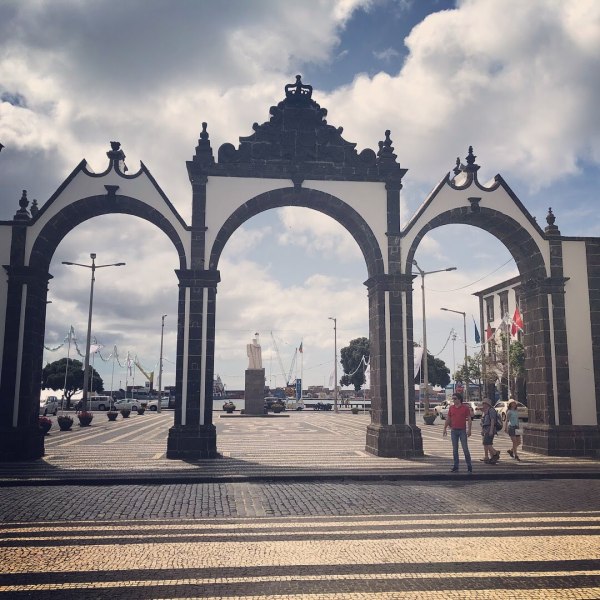
The iconic 18th Century Portas da Cidade (City Gates) in Ponta Delgada, São Miguel. (Photo by Scott Edward Anderson)
Some of you know that I’ve been on a journey the past few years to uncover and explore my familial roots on the island of São Miguel in the Azores, the nine-island archipelago in the Atlantic Ocean between Portugal and the United States.
Last summer, I had a residency on the island with Disquiet International, named for the enigmatic book of prose written by the great Portuguese poet, Fernando Pessoa. The residency in Ponta Delgada took place only 3.7 km from the freguesia (municipal parish) where two of my maternal great-grandparents emigrated in 1906.
Through Disquiet, I was also introduced to poet Lara Gularte, herself of Azorean American ancestry. Her relatives were from Faial, Pico, and Flores, three more of the nine islands in the Azores. Gularte was born in California and grew up in what was then an area of fruit farms known as the Santa Clara Valley (now more famously known as Silicon Valley).
Last month, Lara graciously invited me to read in the series she runs in the Sierra Foothills east of Sacramento, near where she now lives. Along with her husband, Brian—and some good local wine—we spent a wonderful evening discussing our Azorean heritage, poetry, and the dilemma of being generations removed from the places of our origins.
Gularte, who worked for many years as a public servant, finally traveled back to the Azores in 2008—the first of her family to return in four generations. “Before I explored these islands, they were only an abstraction,” Lara told the Portuguese American Journal in June 2018. “I had seen photos and post cards, but nothing prepared me for the natural beauty and complexity of the landscape.”
Her first collection, Kissing the Bee, was published by The Bitter Oleander Press in 2018. Many of the poems in her book speak to what she found on the Azores and the deepening connection which that brought about with her family roots in California’s fertile central valley.
“I was a resident poet at Footpaths to Creativity Center and Artist/Writer Residency on Flores Island in the Azores where this poem was written,” Lara says. “Flores is the island from where my grandfather was born before he emigrated as a young boy to the U.S. He was a stowaway on a ship and disembarked in New Bedford, Mass. He then worked in the cranberry bogs for a few years before traveling to California where he met my grandmother.”
Here is Lara Gularte’s poem, “Flores Island”:
FLORES ISLAND
The place at the beginning
A whale rises up in her mind
turning her thoughts gray.
In port, the ferry of return.
She searches for her grandfather
to discover the shape of his emigration
and finds the plank’s gone, rotted.
At the mercy of rough water and high winds,
he rowed, sinews pulling his dory,
pulling his bones to breaking.
She scans the distance,
says his name out loud, Antonio Henriques,
waits to hear a voice, see a face.
She searches for all the prisoners
of thick mists, others who look like her,
whose foreign tongues speak music to her soul.
Beyond the wake of a rogue wave,
currents and tides ride
on the back of a gray whale.
She sees through the vapor
boats whose nets gather the sky and let go.
Fog falls,
bearing dazed souls back to their home place.
She falls with them.
—Lara Gularte, from Kissing the Bee (The Bitter Oleander Press, 2018). Used by permission of the author.

The author’s Portuguese grandfather, Ed Perry.
My Portuguese grandfather was part of a generation of immigrants who wanted to be completely American.
On that path, he became the first Portuguese member of the Metacomet Country Club in Providence, Rhode Island, and was later two-term president of the club.
He served as secretary of the Rhode Island Golf Association, overseeing thirty years of Rhode Island Championship events. He was chiefly responsible for the establishment of the Northeast Amateur Tournament.
He married into a family that had been in America since 1637, the Burgesses of Sandwich, MA, and made a successful career as a celebrity underwriter for New England Life Insurance Company.
In his striving to assimilate, however, much of what was Portuguese about him was kept under wraps. He embraced America as a nation rather than hyphenation. I favored my mother’s side; my father’s side was Scotch-Irish. I looked more “Portagee” than most of my family. Too often this fact manifested itself in jokes not worth repeating here.
Throughout my childhood, there was little mention of the great Portuguese achievers: the explorers (Henry the Navigator, Magellan, De Gama), painters (Nuno Goncalves, Josefa de Obidos, Viera da Silva, Paula Rego), or writers (Camoes, Pessoa, Saramago). Even if I knew of them, I never thought of them as Portuguese.
Only much later did I understand how rich my heritage was. My grandfather seemed to take pride when, shortly before his death, I pursued him about the family history from his side of the Atlantic. He came from the Azores, the tiny archipelago in the middle of the ocean, which is still a place of myth and magic to me. He called me “amigo – one of us.”
In the search for my “lost” heritage, I discovered the poetry of Fernando Pessoa, Portugal’s great poet of the 20th Century. Pessoa, like his hero Walt Whitman, “contained multitudes.” Only in Pessoa’s case, this was quite literally true. Pessoa took on what he called “heteronyms”: pseudonyms that were more than noms de plume. For each persona, Pessoa created a unique personality, creative style, and body of work.
The most successful of Pessoa’s heteronyms was the shepherd-poet, Alberto Caeiro. Caeiro, like Robert Burns and John Clare before him, was a genius plucked straight from the fields. Whereas Burns and Clare were truly of the fields, Alberto Caeiro sprung from the field of Pessoa’s imagination. Pessoa wrote the poems of Alberto Caeiro from the top of his dresser in a Lisbon apartment.
In many ways, Caeiro in Pessoa’s invention is a pure nature poet. Perhaps only poet Gary Snyder achieves greater reconciliation with nature in his work. One of my favorite Pessoa-Caeiro poems is “Só a Natureza é Divina” (Only Nature is divine…) Here it is in the original Portuguese and in my translation:
| Só a natureza é divina, e ela não é divina…Se falo dela como de um ente É que para falar dela preciso usar da linguagem dos homens Que dá personalidade às cousas, E impõe nome às cousas. Mas as cousas não têm nome nem personalidade: Bendito seja eu por tudo quanto sei. |
*
Only Nature is divine, and she is not divine…
If I speak of her as of an entity
It is for to speak of her it is necessary to use the language of men,
Which gives personality to things,
And imposes names on things.
But things have neither name nor personality:
They exist, just as the sky is big and the land is wide,
And our hearts are the size of a closed fist…
I am blessed by everything as far as I know.
I enjoy everything as one who knows the sun is always there.
–Fernando Pessoa (writing as Alberto Caeiro) translated from the Portuguese by Scott Edward Anderson
 Scott Edward Anderson
 Scott Edward Anderson's Poetry Blog