
View of Mt. Zion from the Moses Montefiore Windmill. Photograph by the author.
Last month, Samantha and I went to Israel. It was my first time in the country and my first visit to the Holy Land.
I was struck by the conundrum that is Israel. On the one hand, there is the history of the land and the history on the land.
Three of the world’s major religions were built from the earth there and sprouted and diverged as any people do, resulting in conflict and misunderstanding.
On the other hand, there is evidence of these religious factions co-existing much like that bumper sticker popular a few years ago featuring the message “Co-Exist” and a pantheon of religious symbols, as if to ask, can’t we all just “get along”?
In Old Jaffa, south of Tel Aviv, for instance, ancient mosques and churches and synagogues sit cheek by jowl along the sea approach. And the market in Jerusalem is filled with Muslim and Jewish merchants distinguished perhaps only by their working hours and some specific merchandise.
Concurrent with this trip, Samantha asked me to write a poem to serve as the peace prayer at her daughter, Erica’s Bat Mitzvah, which happens to be this weekend. I was honored that not only Samantha, but my stepdaughter, too, wanted me to participate in her special day.
I’d been thinking about the subject on my first days in Israel, much of which was spent on my own as Samantha was in a conference.
But it wasn’t until our last day, in Jerusalem, when a tour guide we’d hired read a poem of Yehuda Amichai’s called “An Arab Shepherd is Searching for His Goat on Mt. Zion,” as we stood on a hill under the Moses Montefiore windmill overlooking Mt. Zion, that a poem started to come to me.
(Amichai is significant, too, because I gave Erica’s brother Max a book of Amichai’s poetry for his Bar Mitzvah a few years ago.)
Here is my poem “Peace On Mt. Zion,” which I dedicate to Erica and will read at her ceremony:
PEACE ON MT. ZION
(for Erica, on her Bat Mitzvah)
Peace is such an abstract word,
made concrete by the story
of an Arab shepherd and a Jewish father
told by a guide overlooking
Sultan’s Pool, outside the old city
of Jerusalem, from Amichai’s poem
about searching for a goat
and a child on Mt. Zion.
Their “temporary failure”
strikes me first, a lasting impression
lingering over the ramparts of the old city
–cradle and shelter of all origins.
So much begins searching
for a goat and a child on a mountain—
new religions, sacrifices, whole
cloths to cover the void,
until the child is found and the goat,
hiding together among the bushes.
The father and the shepherd
cry together and laugh,
and for a moment, all is quiet,
except for their voices,
which you can still hear
echoing over centuries of stone.
–Scott Edward Anderson
“52” or What It’s Like to Write a Poem Every Week for a Year
December 20, 2014
 I did it. I wrote a poem every week for an entire year.
(At least, at the time of this posting, I’m working on the penultimate poem of the year and, with one more week to go, I think it’s safe to say I’ll complete it.)
Why? Why the heck did I take on something like this? Why would anyone take on such a task?
Last year I spent the month of April writing a poem a day. That was 30 poems, most of which were quick reflections on what was happening in my life, the world around me or in my mind.
This was different. 52 poems. One per week. And at someone else’s bidding.
That someone else was poet Jo Bell. A year ago, Jo offered a challenge to some of her friends and followers: join a closed group on Facebook wherein poets would be given weekly prompts and asked to write and post their poem to the group. We were also asked to read, comment on, and critique each others work.
The idea was, as Jo herself put it, part of “a range of crowd-sourced projects to raise the standards of, and promote the pleasures of contemporary poetry…52 uses social media to connect writers and to raise their standard of writing through creative friction.”
Every week, Jo posted “a new exercise to help you write a new poem. You write it your way – to the very best of your ability. You improve, you expand, you develop.”
Along with over 540 other members, I took up that challenge. Each Thursday morning (UK time), we were given a new prompt and some examples of how other poets may have tackled the subject. (You can see all the prompts here: 52.)
The prompts were one word or a phrase or just an idea. Some of the challenges were excruciatingly hard, especially those that asked the poet to get out of his or her own skin, style or comfort zone. Others fit nicely into a familiar pattern, yet encouraged the poets take their own style to a new level.
The first observation I have about this group is what a wonderful collection of people Jo attracted. As the year went on, many of us grew close and supportive of each other’s work and struggles. Some of us have became friends outside the group.
The second is how gratifying to get almost instant feedback on a new poem or idea of a poem. 52 was like a private workshop that helped flag lazy writing, praise winning phrases, and challenge each other to improve our work.
The third observation is how HARD this challenge was to accomplish. Some weeks came easier than others — being on vacation, honeymoon, or holiday certainly helped — other times, when the week was particularly busy at work or something else was going on (my wedding!), it was more difficult.
But I did it. I wrote a poem every week. How many of the poems will actually survive is another issue. At least one, “Weather,” from the sixth week of the year, has been accepted for publication. Others I’ve read at readings to some applause.
One poem, “Blended Family,” written in response to the week eleven prompt, “Songs of Praise,” was read at our wedding by Samantha’s eldest daughter. (You can read it here.)
Writing a poem each week was certainly worth doing, but I don’t think I’ll try it again. I don’t write well this way, with the pressure of a looming deadline (poems had to be posted before the following week’s prompt), I prefer to let the poem come to me and steep, and work on it as I see fit.
And yet, this challenge has had a positive impact on my work. It has freed my work somewhat — many of the challenges were not the subject of my past poetry; some forced me to write about things I never thought to tackle in poetry.
I’m grateful to Jo for the challenge and to those who read my work and shared thoughtful comments on my posts — or called me out when I wasn’t hitting the mark.
There’s a handful of members with whom I’ll stay in touch and perhaps even continue to share poems. Most of them I would not have met were it not for Jo’s group and the platform of Facebook.
As for the poems, I plan to spend the next year going over them with a sharp pencil and a sharper eye, finding the gems, excising the fakes, and possibly building this group of 52 poems into something worthy of the group and this very special experience.
Final 5 Questions for Poets
June 13, 2014
 Jonathan Hobratsch, writing in the Huffington Post, celebrated National Poetry Month by posing “5 Questions for Poets” by readers of poetry.
I’ve tried to answer each of his questions (this is the 5th and final). You can find my answers to other sets of questions, here, here, here, and here. Here’s a link to Jonathan’s original Part 5 post and the other poets’ answers: 5 Questions for Poets.
And here are my answers:
1. How hard should you work at a poem?
As hard as it takes to get the poem where it wants to go and get the author out of the way.
2. According to The Atlantic, over 50 percent of people think computers will be able to write great works of literature in 50 years. Do you hold with the majority prognostication?
Great works of literature? I doubt it. But then, when artificial intelligence takes over, great will be defined by a different standard.
3. What would poets like for undergrads to know about poetry?
Poems are pleasure, as Donald Hall wrote in “The Unsayable Said: an essay
4. What interests outside of literature work well with writing poetry?
Many and various interests outside literature work well with poetry, sports, romance, hiking, travel, even work. I found my work with The Nature Conservancy exposed me to so many of nature’s wonders and details that it proved a storehouse of inspiration for my poetry. But even now, when I work for a Big Four firm’s cleantech practice, I’m in one of my most productive periods. It’s all about paying attention.
5. If you were poet during a different era, when/where would you want to exist?
In a workshop long ago Gary Snyder accused me of having a 17th or 18th century sensibility as a poet. So, maybe that’s where I’d find a home. But I’m very happy where I am right here and now.
Yet More 5 Questions for Poets
June 4, 2014
 Jonathan Hobratsch, writing in the Huffington Post, celebrated National Poetry Month by posing “5 Questions for Poets” by readers of poetry.
I’m going to continue to answer these questions (this is Part 3 for me, but out of sequence with the original; you can find my answers to other sets of questions, here, here, and here). Here’s a link to Jonathan’s original Part 4 post and the other poets’ answers: 5 Questions for Poets.
And here are my answers:
1. April 23 was Shakespeare’s 450th anniversary. If you went back in time and could ask him one question, what would that question be?
How the hell did you do it?
2. What bothers you most in your literature community?
That I don’t get to spend more time in it – whether it’s my virtual community “52” or the one where I live in Brooklyn. There are some wonderful poets – wonderful people! – in those communities and I really wish I had more time to hang out with them. In the larger poetry community: careerism, cronysism, and churlishness.
3. Which poets, alive or dead, are overrated/underrated?
I’m sure I’ll offend with this comment but I find Charles Bukowski completely overrated and over-read. And his influence is dreadfully felt. Among contemporaries, I also can’t see what all the fuss is about Dorothea Lasky, there doesn’t seem to be much there there. (I can see the email daggers massing in my in-box or, for that one.)
There are way too many underrated contemporary poets to mention them all, but among the dead Lorine Niedecker, Kenneth Patchen, and Walter Pavlich have always seemed unfairly neglected in my book.
4. Are prizes like Pulitzer, NBA, NBCC are good for poetry. Is there discrimination against women poets, non-white poets, gay poets?
Prizes are for poets, not poetry. It seems like a popularity contest more than anything. I’m sure there is discrimination; you find that wherever there are human beings, cliques, factions, and dominant cultural hierarchies. Others have VIDA stats and ratios to prove it.
5. Is poetry useful?
Poetry is neither as useful as a tool nor as useless as a whim. Of course, I couldn’t live without it.
Wasps, Spiders, and My Poem “Opportunity”
May 22, 2014
 This week’s prompt at 52, the poetry group I joined this year to challenge me to write a poem each week during the year, is about insects.
As Jo Bell writes in her introduction to the prompt, “Insects buzz and flutter and sting the air around us.
“They have us outnumbered, and they will outlast us. Insects thrive in every evolutionary niche – from the bluebottle, living on excrement and unpopular in the kitchen, to the Wandering Violin Mantis (yes, really – watch this to see it and its curious friends).”
As readers of my poetry know, observations in nature are a major subject of mine, especially birds. Whether the moths and butterflies featured in my poem, “The Postlude, or How I Became a Poet,” or the mining bees that open, “Redbud & Pitbull,” or the cecropia moth that is or isn’t the subject of my poem, “Summer Love,” insects are also not strangers to my poetry lens.
“Opportunity,” which appears in my book FALLOW FIELD, was originally published in the journal Blueline. It was prompted by a scene I witnessed in The Nature Conservancy’s Adirondacks office in Keene, New York, in the 1990s.
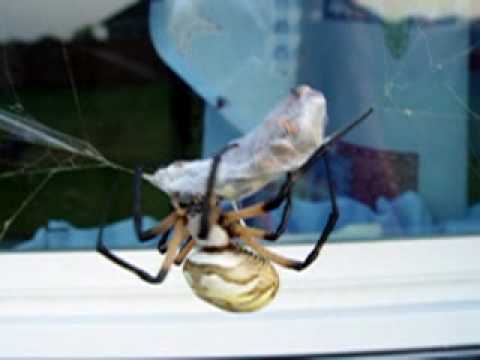
The poem centers around an interaction between an insect (wasp) and an arachnid (spider). Spiders are among the most remarkable predators on the planet. The spider featured in the poem was a web-hunting spider, a form of hunting that requires delicacy, building skills, and not a small amount of patience. (For more on how such spiders catch their prey, check out this illustrated description.)
Here is my poem, “Opportunity”:
A wasp wrestles all day
with the false freedom
of a window pane.
Scaling the glass, then slipping
down, buzzing the cracked paint
of the old window frame.
As if thrumming wings faster
will pull it closer to the blossom,
just beyond its reach.
So determined in its struggle
to get in, to wrest pollen from
the exotic flower on the other side.
A spider sets its dinner table
in the corner of the pane—
–Scott Edward Anderson
Still More 5 Questions for Poets
May 15, 2014
 Jonathan Hobratsch, writing in the Huffington Post, celebrated National Poetry Month by posing “5 Questions for Poets” by readers of poetry.
I’m going to continue to answer these questions (this is Part 3 for me, but out of sequence with the original; you can find my answers to other sets of questions, here and here). Here’s a link to Jonathan’s original Part 2 post and the other poets’ answers: 5 Questions for Poets.
And here are my answers:
1. What qualities or subject matter do you feel is missing in contemporary poetry?
In my humble opinion, there are four things lacking in contemporary (American) poetry: 1.) a sense of the history of poetry before Bukowski and the Beats; 2.) a belief that there are ANY universal truths; 3.) faith in the power of love; and 4.) thinking, deep and critical. Individual poets fill this void, to be sure, but generally speaking, the poetry that gets attention these days seems lacking in many ways.
2. What is your writing and editing process like? How long does it generally take you to finish a poem?
If asked that a year or two ago I would have said, I work late at night, usually while walking, and work on poems a lot in my head before I get anything on paper. When I do get a poem on paper it is long-hand first, then I type it up. Then I revise, revise, revise, until the poem goes where it wants to go.
Lately, however, I’ve completely changed my way of working. In part, because of two experiences: last year I wrote a poem-a -day for National Poetry Month and posted it on my blog: raw, unedited, and “unfinished.” (I’ve since gone over them a bit, but the originals are still up for all to see.)
Then, this year, I joined a poetry group started by Jo Bell in the UK. The group is called “52” and meets virtually, in a closed group on Facebook. It’s called 52 because the challenge is to write a poem a week in response to a prompt posted each Thursday. It’s been remarkably fruitful. Will anything survive the experiment? I already have 2-3 poems I feel are worth continuing to work on, and a few others that served their purpose as occasional verse.
The result is I’m writing quickly, much more quickly than my previous, more methodical efforts, and usually on my iPhone. Is it a better way of working? Only time will tell.
3. What Poets Do You Read?
I read any and all poetry I can get my hands on. I try to buy a handful of poetry books each year – I need to contribute to the poetry economy and, if I’m going to ask others to buy my books, I should support other poets. Most recently, I’ve bought and read collections by Jo Bell, Kathleen Jamie, John Glenday, Ada Limon, Ethan Paquin, Don Paterson, Jo Shapcott, and Robert Wrigley. And I’ve been reading a lot of Tamil poetry, in translation of course, both modern and classical.
I’ve also read Alfred Corn’s last collection, Tables, and thoroughly enjoyed reconnecting with his work this year. I went back to Seamus Heaney’s poetry when he died last summer; such remarkable language and imagery. Jack Gilbert’s Collected Poems, which my mother-in-law gave me for the holidays last year, is still on my bedside table and I dip into it as often as possible. Frederick Seidel captured my attention two years ago. It took me an entire year to get through his Selected Poems, 1959-2009, but it was worth it. He’s a trip.
And, of course, Elizabeth Bishop remains a constant for me. I turn most often to her work.
4. What is an up-and-coming poet?
An up-and-coming poet, I guess by that you mean an emerging poet? It’s funny, when I won the Nebraska Review and Aldrich Emerging Poets awards back in the late 90s, I thought, “Okay, so I’m emerging, now what?” It took 15 more years for my book, FALLOW FIELD, to come out. Am I still emerging? Have I emerged? Am I up-and-coming? I’m glad to be up at all, frankly; as they say, the alternative is much worse.
5. Who is the best living poet?
Up until he died at the end of last summer, I would have said Seamus Heaney.
If by “best” you mean “greatest living,” I’d have to say Derek Walcott, at least in terms of the scope and breadth of his work. There is a real sense of history in his poetry. It is rich and full of traditions and truths that are both global and place-based. His thinking is deep and critical, and his poetry is full of faith in love. Take his “Love After Love”:
The time will come
when, with elation
you will greet yourself arriving
at your own door, in your own mirror
and each will smile at the other’s welcome,
and say, sit here. Eat.
You will love again the stranger who was your self.
Give wine. Give bread. Give back your heart
to itself, to the stranger who has loved you
all your life, whom you ignored
for another, who knows you by heart.
Take down the love letters from the bookshelf,
the photographs, the desperate notes,
peel your own image from the mirror.
Sit. Feast on your life.
–Derek Walcott
5 More Questions for Poets
May 6, 2014
 Jonathan Hobratsch, writing in the Huffington Post, celebrated National Poetry Month by posing “5 Questions for Poets” by readers of poetry.
I’m going to continue to answer these questions (this is Part 2 for me, but out of sequence with the original; you can find my answers to Part 1, here). Here’s a link to Jonathan’s original post and the poets’ answers: 5 Questions for Poets, Part 3.
And here are my answers:
- How many of your poems do you throw away?
I believe, as Paul Valery wrote, “A poem is never finished, only abandoned.” I never throw them away. Sometimes I find lines that are useful elsewhere or I work on them and find a way to let them get where they need to go over a period of years.
Of course, there are many, many that will never find their way and will never see the light of day. I want only those poems that I have “finished” or “abandoned” to represent my work in the world. I’ll be lucky if even one or two survive beyond my lifetime.
- Do you still get poems rejected in poetry journals?
All the time. The ones that hurt the most are the seemingly annual rejections from The New Yorker, POETRY, Ploughshares, The Gettysburg Review, all places where I really want to publish someday, but others as well. I try to move on quickly and send them out again. If a poem gets rejected more than a few times, I’ll pull it out of circulation and take another look at it. I’ve been fortunate to be published in some very fine places, in print and online.
- How many poems do you have memorized?
Only one, I think. “One Art” by Elizabeth Bishop. Oh, and parts of others. I was never good at memorization. I have too much poetry working in my head and my filing system is only big enough for what I’m working on. Although, I did recite Whitman’s “O Captain, My Captain,” when I was nine.
- Are creative writing programs good or bad for literature? Why?
Good and bad. At its best, a creative writing program will encourage writers to hone their craft and voice, to improve their work through revision and paying attention to what a poem needs. At worst, it is a breeding ground for poetry careerism and cronyism and mimicry of the worst sort.
Of course, when I asked Robert Hass whether I should get an MFA, he, in turn, asked me, “Do you want to teach?” I cheekily answered, “No, I don’t think you can teach writing poetry.” He told me to go out and get a real job, to experience life and have something to write about other than academic life, and that has made all the difference to me.
- Do you think the Best of American Poetry, or Best Poems of 20__ and the Pushcart annual are useful indices of the best work now being published?
Obviously not, they’ve never included any of mine – not even some of my better efforts, like “Naming” and “Fallow Field.” The latter was nominated for a Pushcart, but as the title poem of my collection published last fall, not in the year it was published in Blueline.
In all seriousness, these lists or time-sensitive anthologies represent the opinion, taste or whims of an individual or a series of individuals; the editor of the anthology, etc, and those who chose the poems for publication in the first place. Nothing more; nothing less.

Jo Bell; photograph ©Alastair Cook
Quite possibly the best thing about the Internet for a poet is the ease with which one can learn about other poets and their work from far-flung corners of the world.
Over the past few years I’ve come in contact with the poems of some remarkable poets whose work I may not ever have discovered through the traditional means of poetry publication and exchange.
And their work grows increasingly important to me as I get to know it better and, in some cases, get to know the poet through Facebook and other social media.
One of my absolute favorites is Jo Bell, to whose work I was first introduced by Alastair Cook. Alastair, who has made a couple of filmpoems featuring my poetry, has done a few with Jo as well.
Jo holds the unique position of UK Canal Poet Laureate, and lives on a narrow boat, “Tinker,” making her way around England. She’s a self-described “poetry freelancer,” sharing her wares like the tinkers of old their tin works. Only it’s poetry she’s repairing. Her performances are brilliant and enjoyable (see her reading as part of Poets & Players at the Rylands Library).
Her signature verse is “The Shipwright’s Love Song,” and it’s a tour de force: replete with her timeless language, the double entendre of the ship/woman, her deft use of enjambment, such as “rudderless/ and yawing,” and slant rhymes “swell –/the smell,” the exclamation, a kind of gasp of recognition that begins the second stanza, “Oh, her skin was salt!” – and that ending, which you have to hear her read to truly appreciate the rhythm. Simply remarkable.
Much of Jo’s poetry does what poetry should do, makes you see things differently, to notice worlds new to you, and worlds you only thought you knew. Jo’s poems have what all well-written poems have in common, as I’ve written elsewhere: “They sing. They make you dance. And they give you a new way of looking at the world.”
Here is Jo Bell’s poem, “The Shipwright’s Love Song,”
Oh, but the lines of her!
The curve and glinting swell –
the smell, as sweet as pitch pine,
thick and hot as tar.
Oh, I was launched and splashing in the slipway,
happy to be rudderless
and yawing, mast head
touching to the foam.
Oh, but her skin was salt,
was starred with gasping salt beneath my tongue,
and slowly
she came round to me –
bucking and slipping at my touch,
making way in fits and starts
to reach me and be calm.
Later, long before she rocked me into sleep
I saw the seas, saw all of them in one blue ache:
unlandmarked, vast; horizonless.
c) 2003 Jo Bell. Used by permission of the author.
Here is Jo reading the poem: Shipwright on Soundcloud
And here is a videopoem version by Marc Neys (aka Swoon): Shipwright by Swoon
If you enjoy this poem, do yourself (and her) a favor and order Jo’s book, NAVIGATION, which is available through Moormaid Press in the UK: NAVIGATION
The Telegraph has a nice profile of Jo this weekend: Jo Bell in the Telegraph
And, finally, you can follow Jo’s blog, here: Bell Jar Blog
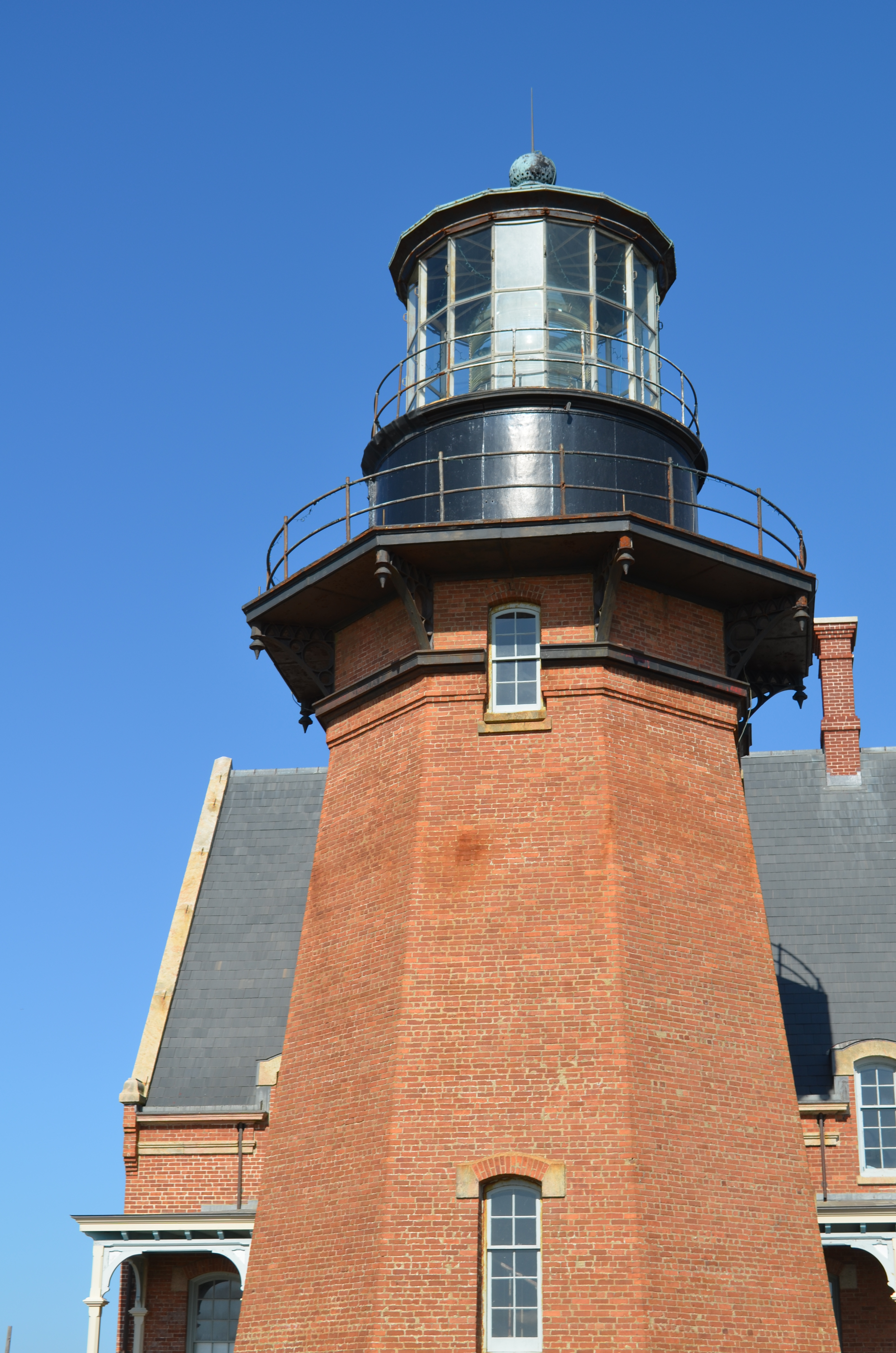
Block Island Southeast Lighthouse, 1875. Photo by SEA.
When you read this, I’ll be on yet another island with Samantha, this time Isla de Vieques, an island-municipality of Puerto Rico in the northeastern Caribbean, part of a group of islands some call the Spanish Virgin Islands.
Much of the island was formerly a bombing range of the US Navy (most of that area is now a National Wildlife Refuge), so much of Vieques was long closed to tourism.
Islands always make me think of lighthouses, of which there are two on Vieques, the ruins of Puerto Ferro and the restored Punta Mulas lighthouse.
Thinking about visiting those lighthouses reminded me of Alfred Corn’s poem, “Lighthouse,” which closes his latest collection, Tables.
I first became aware of Alfred’s poetry when I worked on the editorial staff at Viking Press in the late 1980s. Viking published his collection The West Door and his essay collection, The Metamorphoses of Metaphor. I also worked on his anthology, Incarnation: Contemporary Writers on the New Testament, which featured writers such as Annie Dillard, Robert Hass, Anthony Hecht, and John Hersey.
According to the biographical entry on the Poetry Foundation’s website, “Early in his career, Corn says, he aimed to write poetry that sounded like conversation and to find ‘verbal equivalents for visual realities.’ These conversational patterns have evolved into an attention to rhythm and an eye for detail. He often employs strict formal and metrical devices in his personal and social histories.”
As poet Thomas Disch has written about Corn’s poetry, “It is not the regnant mode among poetry academics at the moment, but since at least the time of Byron and Wordsworth it has been the kind of poetry that most commends itself to readers of poetry.”
I commend to you, dear readers of poetry, Alfred Corn’s poem, “Lighthouse”:
Pilot at the helm of a hidden
headland it steers free
from convergence with the freighter
when fog and storm clouds gather
Sparking communiqué no full stop ends
its broadcast performed in a three-sixty sweep
the cycle burning up five solar seconds
Midnight eye that blinks away
invisibility a high beam
revealing as it scans whatever seas
or ships return terra firma’s landmark gaze
c) 2010 Alfred Corn, used by permission of the author.

Erica reading the poem at the wedding of Samantha and Scott, April 5th, 2014. Photo by David Feldt.
When Samantha and I married last Saturday evening, we weren’t just bringing together our hearts, bodies, minds, and souls; we were bringing together our two families.
Each of us has three children from our previous marriages — my two boys and a girl; her two girls and a boy.
Comparisons to “The Brady Bunch,” the eponymous 1970s TV series, with which we grew up, are ever-present. “Except we don’t have Alice,” we usually reply.
We wanted our children to be incorporated into the ceremony. And they were: my oldest son, Jasper, was best man; Samantha’s oldest son performed “In My Life” by The Beatles on guitar for the processional.
Walker, my younger boy, was ring-bearer, while his twin sister, Elizabeth, and Samantha’s youngest, Sasha, were “bridesmaids bearing flowers,” decidedly not “flower girls.” Samantha’s older daughter, Erica, was asked to give a reading during the community blessings segment of the ceremony.
I was tasked with finding an appropriate poem for Erica to read.
“Perhaps something about a blended family,” Samantha suggested. Scanning the Internet, I came up empty. How could there be no poems about blended families? (Or, at least, poems worthy of the name in this poet’s opinion.)
The poems I found were either over-written, overly sentimental or just plain bad. This seemed a shame in an age when blended families are almost commonplace.
So I wrote one. Luckily, the poetry group to which I belong, “52,” came along with a weekly prompt for a poem on praise.
Erica did an amazing job reading it at the wedding and we were all very proud of her — and not a few of us were moved to tears. This was not so much a validation of the poem’s value, but because she delivered it with so much feeling. I post it here in the hope that other couples on the path of blending their families may be searching for a way to honor such a beautiful and complex union.
Here is my poem in praise of the “Blended Family”:
When families are blended
it’s not like a smoothie,
where all the ingredients
combine to make a new flavor.
In the multiflavored family,
each flavor remains unique,
each name remains its own.
There is joy in blending families,
but sometimes tears, too.
You don’t deny the one for
the other, you are more
together, yet equal apart.
You are “and” rather than “or.”
There is more of you–
So praise our blended family,
let it bring abundance into all our lives.
Let there be strength in our numbers,
as there are now more shoulders
to lean on, more hands to lend,
more hearts to be kept in,
more love to share in its union and bond.
And let each of us
make the best that is all of us
shine more brightly, now, together.
–Scott Edward Anderson
 Scott Edward Anderson's Poetry Blog