
Photo by SEA.
If you’ve been following my blog for the past few years, you know that I’ve been on a journey of rediscovery—rediscovery of my Azorean Portuguese roots and heritage.
I’ve now been back to the island archipelago of my ancestors three times since my first return in 2018.
That first visit was under the auspices of a writing retreat offered by DISQUIET International, an organization that tries to link and foster relationships between Luso-American and Portuguese writers.
This journey has turned out to be more than just a heritage tour, for I’ve made many friends and discovered family I didn’t know I had there. And because I worked in nature conservation for so many years, I couldn’t help falling in love with the islands and their beauty and majesty, but also their fragility.
My own poetry and non-fiction have long been about a few essential themes: a longing for home and an appreciation and concern for the natural world. In the Azores, I’ve come to find a beautiful combination of both.
In addition to that longing (the Portuguese have a word for it, saudade, which I’ve defined elsewhere as a longing for lost things) is the feeling that I’ve found a home there, which I hope to fully realize in the not too distant future.
And my concern for the natural world there—in the face of future impacts of climate change on small island communities like the Azores—as well as the last remaining endemic species, is also deepening my relationship to the islands.
I’ve been exploring my love affair with the Azores in two works-in-progress (although, frankly, it’s showing up in just about everything I write these days): a research-driven memoir of my ancestry and heritage on the islands and a long poem that explores some of the same territory.
Recently, Gávea-Brown, a bilingual journal of Portuguese-American language and studies from Brown University, published an excerpt from my poem, which I’ve been calling “Azorean Suite,” in the original English and in a translation by the Azorean American poet José Francisco Costa.
It’s been an amazing journey thus far and I hope to return to the islands as soon as possible. Meanwhile, here is a section from my “Azorean Suite.”
From “Azorean Suite”
“Is the island a cloud or is the cloud and island?” ~Nemésio
The sea surrounds, is ever-present
endless, the sea surrounds
and sea sounds swirl and sway
humid torpor of temperament
fog enshrouds
clouds caught on peaks
wrapping the mountain
a helmet of white, gray, ash
the ever-present volcanoes
threat of fire and destruction
threat of sea-wind and wave
thread of saudade woven
into the fabric of all life
on the islands—
saudades for the land
enshrouds the land
enshrouds the islanders
surrounded by sea.
#
São Miguel, island of my ancestors
who settled here in the original waves
1450s or earlier, as far as I can tell,
from the Alentejo, they came,
encouraged or escaping
I know not—
São Miguel, the green island,
jewel in the bracelet of archipelago,
formed by two volcanoes
reaching for each other
a chain of eruptions enclosing
the space between them
populated, like that chain, scattered
by wind and sea, until 1906,
when my great-grandparents left
for America—scattered across the sea.
#
My return, over a century later,
fills me with mixed emotions—
have I come “home” or simply returned
to reclaim a lost heritage
something denied to me
by my grandfather’s willingness
to forget the past, to relinquish
the “saudades de terra”
so much a part of the Azorean character—
the phrase can mean “longing for the land”
or “I miss the earth”
which seems so necessary now
with the threat of climate change
added to the island condition—
sea-surge from hurricane Lorenzo overflowing
onto the low-lying streets at sea’s edge
saltwater burning the wine grapes
flooding the edge of the villages
how high will the sea rise in the next century
how will the islanders survive
what becomes of saudades de terra
when the land is swallowed by sea?
and here is José Francisco Costa’s translation into Portuguese:
Excerto de Suite Açoriana
“A ilha é a nuvem ou a nuvem a ilha?” ~Nemésio
O mar é um cerco, é contínua presença
infinita, o mar é um cerco
e os sons do mar rodopiam e arrastam-se
húmido torpor do ser
nevoeiro mortalha
nuvens presas nos cimos
envolvendo a montanha
um capacete de branca, parda, cinza
a inescapável presença dos vulcões
ameaça de fogo e destruição
ameaça de vento e vaga de mar
fio de saudade urdido
no tecido da vida inteira
nas ilhas –
saudades da terra
mortalha da terra
mortalha de ilhéus
por mar cercados.
#
São Miguel, ilha dos meus antepassados
que aqui fizeram morada nas ondas originais
1450 ou antes, tanto quanto sei,
do Alentejo, vieram,
incentivados ou fugidos
Eu não sei—
São Miguel, a ilha verde,
jóia no bracelete do arquipélago
nascida de dois vulcões
no encalce um do outro
corrente de erupções estreitando
o espaço entre eles
povoado, como a tal corrente, espalhado
por vento e mar, até 1906,
quando os meus bisavós partiram
no encalce da América – espalhados em toda a largura do mar.
#
O meu regresso, mais de um século depois,
enche-me de um contraste de emoções –
terei regressado a “casa” ou só voltei
para reclamar uma herança perdida
algo que me foi negado
pela vontade de meu avô
de esquecer o passado, renunciar
às “saudades de terra”
parte tão importante do ser Açoriano —
a frase tanto significa “estar ansioso pela terra”
como “a terra faz-me falta”
o que hoje parece ser tão necessário
com a ameaça das alterações climáticas
a somar à condição de ser ilha —
gigantescas marés provocadas pelo furacão Lorenzo inundando
as ruas baixas à beira do mar
água salgada queimando as vinhas
cobrindo os limites das freguesias
até onde subirá o mar no próximo século
como irão sobreviver os ilhéus
o que resta de saudades de terra
quando a terra é engolida pelo mar?
—Scott Edward Anderson (translation into Portuguese by José Francisco Costa)
This excerpt, from a long poem-in-progress, originally appeared in Gávea-Brown—A Bilingual Journal of Portuguese-American Letters and Studies
(I want to thank Onésimo Teotónio Almeida and Jennifer Currier for publishing my poem, and José Francisco Costa for his translation.)

Poet Serena Fox has been an attending physician in the Intensive Care Units of the Mount Sinai Beth Israel Hospital in NYC for the past 10 years. She works night shifts exclusively.
Since the increase in volume and acuity of respiratory failure related to COVID 19 this past month, the ICU beds have been increased 4-5 times usual, and she reports, they we are usually running full.
Fox worked in a major trauma unit in Washington, DC, until 2007, and launched her career in medicine in the emergency room of New York City’s Bellevue Hospital during the height of the HIV AIDS epidemic. Fox’s experiences there formed the background of poems in her book, Night Shift (Turning Point Books, 2009).
Her poems seem relevant to our historical moment and, with a lot of conversation about the need for ventilators, one poem from her book seems to strike a chord. “All That Separates” is a phrase that is usually associated with the Bible, as in “your iniquities have made a separation between you and your God (Isaiah 59:1-2). In some cases, a ventilator is all that separates a patient from their god.
However, the initial reliance on ventilators to treat patients with Covid-19 has been challenged or at least reconsidered, as moving quickly to ventilation may complicate already existing conditions, further compromising a patient’s health.
And, apparently, intubation and mechanical ventilation may lead to pneumonia because of the invasive nature of their application. A recent study at Rush University Medical Center in Chicago found a promising alternative whereby patients are placed face down on their beds and treated with heated, humidified oxygen for up to sixteen hours.
Here is Serena Fox’s poem, “All That Separates”:
What about respirators?
I can paralyze you with
an index finger, as effortlessly
as I brush your eyelashes,
making sure you’re down.
I set breaths per minute,
by pressing digits in a square.
Another plunge of my finger
slides you beyond consciousness
and memory. I hope sedation
lets you dream, gloriously
and elusively, beyond pain,
so we can turn you, change
the dressings, where your sternum
is no longer intact. A few
millimeters, all that separates
us, phalanx from pectoral flap,
you from me. A thickness worth
pause. More so, if a finger can
change outcome with the number of
your breath.
—Serena Fox from Night Shift (Turning Point Books, 2009) Used by permission of the author.

Photo by Mark Koranda
Recently, a public figure—I won’t name any names—asked why we couldn’t just treat the Covid-19 coronavirus with antibiotics, complaining: “the germ (sic) has gotten so brilliant that the antibiotic can’t keep up with it.”
Now, it’s possible this person— despite his self-proclaimed high-IQ—skipped Biology in high school, for it is in that class that most people learn that antibiotics target bacteria, not viruses.
It’s in this class that students also learn the difference between bacteria and viruses. Bacteria are single-celled organisms, essentially living things that can thrive in a variety of environments. Viruses, on the other hand, require a living host, such as a people, plants, or animals to survive.
With that Biology lesson out of the way, this week’s poem is “Bacterium” by Natalie Eilbert. Eilbert, the author of the remarkable Indictus (Noemi Press, 2018), as well as Swan Feast (Bloof Books, 2015), teaches at the University of Wisconsin–Madison.
She is working on her third poetry collection, “Mediastinum,” and is also studying to become a science journalist. (I note her reference to Ideonella sakaiensis, the bacterium which secretes an enzyme that breaks down plastic, specifically PET (polyethylene terephthalate), in lines 11-12.)
“Bacterium” is a captivating poem, which I first came across in Poetry Magazine. What initially struck me about this poem is its form that I couldn’t quite put my finger on—it has elements of both the pantoum and the villanelle, with its repetition of lines, rhymes, and slant rhymes.
So, I asked the poet and she wrote that the poem is written in “a very loose palindromic form inspired by Natasha Trethewey’s poem, ‘Myth,’ which is, in my mind, a perfect poem that has haunted me since 2007.” In Eilbert’s version, she established “a stable of sentences and then reverse(d) their order.”
And then there is her almost playful exploration of etymology, which helps get at the true meaning of words, such as “graft,” “grifter,” and “to graft,” and, perhaps more importantly, “mother” and “mentor.”
I also love the way Eilbert uses verbs in this poem, often morphing them into their gerund form. “I am very, very conscious of how verbs operate in my poems,” Eilbert wrote to me. “I am fascinated by critiques of writing that point to prioritizing active over passive voice. Sometimes we need the passive voice. It is how I encountered so much of the nurturing in my life.”
For example, Eilbert thinks about the difference between “My mother braids my hair” and “My hair was braided,” saying, “The second one breaks my heart; the first is not an accurate narrative for the neglected child. Mothers and mentors have always been complicated in my life. I wanted to create something of the simulacrum of nurturing but one that is absent of love.”
Here is Natalie Eilbert’s “Bacterium,”
In the last segment, I tried sufficiency. They moved
my femur and a single woman braiding her hair fell
from me. I tried to warn you, this desert editorializes.
A scorpion lifts its tail, braids more active than braiding,
it hisses. I, of all people, get it. In the mornings we wake
to the kind of life we want until we turn our heads east.
The night fills without us but I warned you, I was full
already. A banana inside me blasted open a door,
my thoughts at the threshold of such a door blank. Love
transacts, a figure in the distance crowded with window.
An enzyme eats plastic, but which kind? Synthetic polymer
or the ways you tried to keep me? This is the last segment.
My mother
draws a circle around time and this is an intercourse. My mentor
draws a circle around time and this is an intercourse. I shake
out of bed. Humans continue the first line of their suicide letter.
An enzyme invents us, we invent enzymes. The plastic we make,
we must eat it. Draw a circle around time. We designed us
in simple utterances. The political term graft means political
corruption. The grifter never had an I. In the burn unit, they
place tilapia skins over human scar tissue, the killed form on top
of afflicted form, also a graft. Also a graft of afflicted form,
the killed form on top, they place tilapia skins over human scar
tissue. In the burn unit, I never had a grifter, corruption
means political, graft the political term. In simple utterances
we designed us. Time draws a circle, we must eat it. We make
the plastic, enzymes invent we, us invents an enzyme to continue
the first line of a suicide letter. Out of bed I shake with intercourse.
Time draws a circle around my mentor. Time draws a circle around
my mother.
This is the last segment. The ways you tried to keep me? Synthetic
polymer, but which kind? An enzyme eats plastic, crowded window,
a figure in the distance transacts love. At the threshold of such
a blank door, my thoughts open a door. A banana blasted inside me.
Already I was full but I warned you, the night fills without us.
We turn our heads until we want the kind of life in the mornings
we wake to. I get, of all people, it. It hisses. A scorpion, more active
than braiding, braids its tail, lifts the editorialized desert. You tried
to warn me from me. Her hair fell braiding a single woman. My femur
was moved. They tried sufficiency in the last segment.
Source: Poetry (May 2019)
You can read more about Natalie Eilbert on her website: natalie-eilbert.com and you can order her books there or through the links above.

Aria Aber
Photograph by Nadine Aber
“Afghan-American relations are really complicated and intense,” the poet Aria Aber said in an interview with Poetry magazine’s editorial staff. “The fact that, politically, there is still so much history and still so many things that are going on that we don’t know about, just seems very fertile to me creatively.”
Born and raised in Germany to Afghan refugee parents, Aber writes in English, her third language, and her debut collection, Hard Damage, won the Prairie Schooner Award and was published last year by the University of Nebraska Press.
I want to share Aber’s poem, “The Mother of All Balms,” in part because I love the play on words and sounds and slant rhymes she deploys in an otherwise somber poem, which reminds me a bit of how Elizabeth Bishop used similar strategies in a number of her poems on serious subjects.
“The Mother of All Balms” is, of course, a play on the name of the US-made weapon of mass destruction that was dubbed the “Mother of All Bombs,” and which was dropped over the Nangarhar Province of her parents’ native homeland, Afghanistan, in April 2017.
“English being my third language, I often mishear or mispronounce things,” Aber told Poetry, where the poem originally appeared. “And I am very interested in how that source of humiliation can also be a source of creativity.”
Meditating on the proximity of sound in which “bomb” and “balm” reside, Aber was reminded that in many religions and spiritual traditions “creation” and “destruction” often derive from the same source.
“But the balm is not necessarily something that creates,” says Aber. “It only restores and preserves something that is already there but broken.”
Here is Aria Aber’s “The Mother of All Balms”
Morning she comes, mother of all balms.
Only the news reporter says it wrong:
but aren’t you strung: little ping
and doesn’t memory embalm
your most-hurt city:
those yellow creeks of your rickety holm
where your mater: your salve:
left all her selves behind
so she could surrender to a lifetime
of Septembering: what she members most:
yellow grapes and celeries
and visiting her father’s glove
a balm, to be by absence so enclaved:
your mender
a follower, devoted
to what she cannot see. O air miles,
how can it be real?
How uncertain you should
be if it existed, if there are no photos left
of her playing
on her childhood lawn—
burned are all the documents, or eaten—
this ink,
like memory,
an ancient unguent,
enshrining what cannot be held
of what went missing—the dog, her hat of hay,
one brother. She was in prism,
your mother says—and that’s how you will write her,
atoning her, just in fluorite a figurine caught
to fracture her stolen years,
her brother,
all her once-upon-a-chimes.
Source: Poetry (September 2019)
Here is Aria Aber reading her poem, “The Mother of All Balms”
You can learn more about Aria Aber on her website: ariaaber.com.
A few years ago, a remarkable thing happened to poet Maggie Smith.
As she tells it in a note for the website Women’s Voices for Change, “I tend to labor over poems for weeks, months, even years, revising many, many times, working in different documents and comparing versions.”
This new poem, however, she wrote “in about half an hour in a Starbucks, scrawling it in green ink on a legal pad. I deleted only one word between the first draft and the second (final) draft.”
You’ve likely read this poem—the poem, “Good Bones,” went viral shortly after it was published in Waxwing in June 2016. It appeared the same week of the mass shooting at Pulse Nightclub in Orlando, Florida, and the murder of MP Jo Cox in the UK, when people were struggling to make sense of what was happening in the world.
When a reader posted a screenshot of the poem on Twitter, it was soon picked up by others, retweeted and reposted, and then celebrities got hold of it and started circulating it to their large groups of followers. In short, the poem went viral.
I’m sharing “Good Bones” here in part because it has something we could all use these days: a desire to “believe in the ultimate goodness of the world for the sake of one’s children,” as a reviewer wrote in the Washington Post.
Now, I know this poem is kind of a signature poem of Ms. Smith’s, like Elizabeth Bishop’s “One Art.” (“It’s my ‘Freebird,’” she said in an interview, referring to the ubiquitous Lynyrd Skynyrd song request.)
And she’s probably tired of it being the one Maggie Smith poem so many people know (and she has many others that are fine poems in their own right, so you should check them out: Maggie Smith).
Like “One Art,” however, there’s a reason this poem is so popular: it’s a solid poem that speaks directly to people.
“I wrote the poem in 2015,” Smith says, “and clearly I’d been thinking about what it means to raise children in fraught times: What do we tell them? What do tell ourselves? I continue to grapple with these questions, as a mother and as a poet.”
Maggie Smith is the author of a book of short inspirational prose pieces, Keep Moving (Simon & Schuster, 2020), which originated from her Twitter account @maggiesmithpoet, the eponymous Good Bones (Tupelo Press, 2017), as well as The Well Speaks of Its Own Poison (Tupelo Press, 2015) and Lamp of the Body (Red Hen Press, 2005).
Here is Maggie Smith’s poem “Good Bones”:
Life is short, though I keep this from my children.
Life is short, and I’ve shortened mine
in a thousand delicious, ill-advised ways,
a thousand deliciously ill-advised ways
I’ll keep from my children. The world is at least
fifty percent terrible, and that’s a conservative
estimate, though I keep this from my children.
For every bird there is a stone thrown at a bird.
For every loved child, a child broken, bagged,
sunk in a lake. Life is short and the world
is at least half terrible, and for every kind
stranger, there is one who would break you,
though I keep this from my children. I am trying
to sell them the world. Any decent realtor,
walking you through a real shithole, chirps on
about good bones: This place could be beautiful,
right? You could make this place beautiful.
“Good Bones” is from Good Bones, published by Tupelo Press, copyright © 2017 by Maggie Smith. Used with permission of the author. First published in Waxwing Magazine.
For more on National Poetry Month, go to: poets.org/national-poetry-month
My Interview on Good Poetry Podcast
January 18, 2020

I recently chatted with Andrew Coons of the Good Poetry podcast. I read from my books, Dwelling: an ecopoem and Falling Up: A Memoir of Second Chances, and talk about poetic mentors and influences, conservation, and a range of interrelated topics.
Give a listen:
My Year in Writing: 2019
December 9, 2019

Now is the time of year when I take stock of my writing over the past twelve months.
Here is “My Year in Writing: 2019”:
–FALLING UP: A Memoir of Second Chances published by Homebound Publications in September 2019; book launch party on 10 November in Brooklyn; included on Book Authority’s Best New Family Books list
–DWELLING: an ecotour, including readings in Berkeley, Diamond Springs, and Sacramento, CA, Philadelphia and New Hope, PA, NYC, and at the ASLE Biennial Conference at UC Davis, where I also moderated a panel called “Poetry Can Save the Earth”
-Essay, “Whitman & the Sea,” published in Schuylkill Valley Journal in print and online
-Poem, “Cândido Rondon Remembering Teddy Roosevelt,” published in The Esthetic Apostle
-Revisions to and progress on my #WIP, a research-driven memoir I’m calling THE OTHERS IN ME: A Journey to Discover Ancestry, Identity, and Lost Heritage
-Started a long poem, “Azorean Suite,” a section of which will appear in the upcoming edition of Gávea-Brown: A Bilingual Journal, in my original English and in a Portuguese translation by Azorean poet, José Francisco Costa
-Essay, “My Pessoa,” to appear in Pessoa Plural next June
-Wrote introduction to David Swartz’s English translation of Nuno Júdice’s novella, THE RELIGIOUS MANTLE, which will be published in 2020 by New Meridian Arts
…all in all, not a bad writing year!
FALLING UP Makes List of 30 Best New Family Books To Read in 2020
December 1, 2019


I’m delighted to announce that my latest book, Falling Up: A Memoir of Second Chances, made it to BookAuthority’s Best New Family Books
As featured on CNN, Forbes, and Inc., BookAuthority collects and ranks the best books in the world, and it is a great honor to get this kind of recognition. Thank you for all your support!
The book is available for purchase on Amazon and direct from the publisher Homebound Publications.
Special thanks to Heidi N. Moore for nominating my book to this list.
Today is Pub Day for my new book, FALLING UP: A Memoir of Second Chances
September 10, 2019

“Steve Jobs is dead,” I said.
So begins my new book, Falling Up: A Memoir of Second Chances, which drops today from Homebound Publications as part of their Little Bound Book Essay Series.
When I spoke those words, I was speaking to an audience at the SXSW Eco festival on the morning of 5 October 2011. Jobs had just died and many in the crowd had not heard the news. He was fifty six.
“Fifty-six,” I write in the book. “As I stood on the stage that October morning in 2011, a couple of years shy of fifty myself, I couldn’t help thinking–as perhaps many in the room were thinking, too, in the wake of the example of Jobs–what have I done with my life?”
(You can read more from the opening of the book here.)
Falling Up, my most personal book to date, tells the story of several “second chances” I’ve had in my life, starting with a fall at Letchworth Gorge as a teenager in upstate New York through my most recent change of life, leaving EY after my job was eliminated despite the successful launch of a global technology-as-a-service solution that I led.
Along the way, I explore my original second chance in the wake of that fall in the gorge, my pursuit of art and writing throughout my life, learning to experience nature through the eyes of my children, as well as the story of several entrepreneurial endeavors–successes and failures–and, finally, how I found real and lasting love late in life and learned to embrace it.
Falling Up is about the struggle to become authentic, vulnerable, purpose-driven man in the 21st century and, ultimately, about making one’s dream a reality.
Mark Tercek, the former CEO of The Nature Conservancy–an organization for which I worked over fifteen years and that serves as part of the backdrop for several stories in the memoir–called the book, “An inspiring read for anyone seeking meaning in their work or in their life.”
I hope my little book–only 84 pages and around 10,000 words–lives up to the promise of that advance support and that it helps readers find a way to “fall up” in their own lives.
You can order the book directly from my publisher, Homebound Publications, or through Amazon, and wherever books are sold.
And if you do, please let me know what you think of Falling Up.
National Poetry Month 2019, Week Four: Sophia de Mello Breyner Andresen’s “25 de Abril”
April 25, 2019
(Photo by SEA)
Today, 25 April, marks the 45th Anniversary of Portugal’s “Carnation Revolution,” when a military coup toppled the fascist, authoritarian government, leading to a period of freedom and democracy after 48 years.
In addition to ridding the country of the “Estado Novo” regime, the revolution of 25 April 1974, led to the end of Portuguese colonization and its attendant wars in Africa. Decolonization began shortly after the Carnation Revolution and, by the end of 1975, the former colonies of Angola, Cape Verde, São Tomé, and Mozambique gained independence.
Dubbed the Carnation Revolution because the flowers were offered to military personnel by civilians on the streets of Lisbon as a symbol of the peaceful transition of power, an action initiative by activist Celeste Caeiro. The coup itself was apparently triggered by a Portuguese song featured in the 1974 “Eurovision” song contest—the same contest that launched the Swedish band ABBA, which won that year with “Waterloo.”
Portugal’s entry, a fairly innocuous love-ballad called “E depois do adeus” (“And after the farewell”) by Paulo de Carvalho, was used to signal the rebels, who launched the coup when it was broadcast by a Lisbon radio station at 22:50 on 24 April. A second song, “Grândola Vila Morena” by Zeca Afonso, announced when the coup leaders had seized control. A 2000 film by Maria de Medeiros, Capitães de Abril, dramatizes the story.
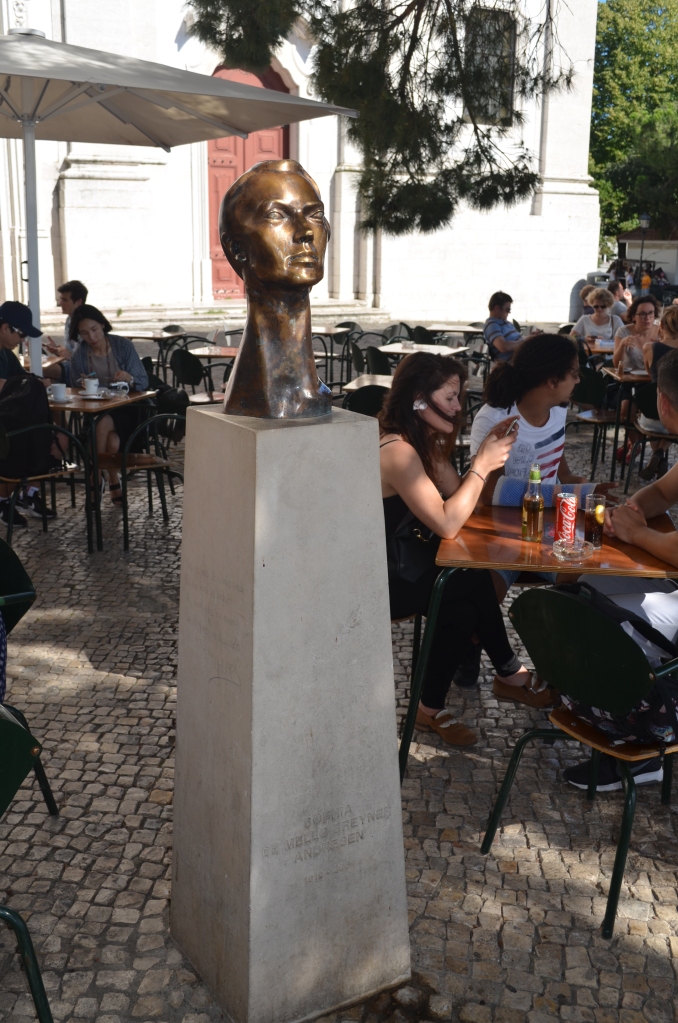
Sophia de Mello Breyner Andresen (1919-2004) is one of the most important Portuguese poets of the 20th century and, in 1999, became the first Portuguese woman to receive the Camões Prize, the most prestigious award in Portuguese literature.
In 2014, ten years after her death—and on the 40th anniversary of the Carnation Revolution—Andresen’s remains were transferred to the Panteão Nacional, in the Church of Santa Engrácia, only the second Portuguese woman to receive this honor. (The other was fado singer Amália Rodrigues.)
“Poetry is my understanding of the universe,” Andresen once said. “My way of relating to things, my participation in reality, my encounter with voices and images.”
Her poem, “25 de Abril,” is the most famous poem of the Carnation Revolution, simple and elegant in its observation of the morning when the country emerged from “the night and the silence” of almost fifty years of authoritarian rule.
Here is Sophia de Mello Breyner Andresen’s “25 de Abril” in the original Portuguese and in my English translation:
“25 de Abril”
Esta é a madrugada que eu esperava
O dia inicial inteiro e limpo
Onde emergimos da noite e do silêncio
E livres habitamos a substância do tempo
—-
“25th of April”
This is the dawn I expected—
the first day, whole and clean,
where we emerge from the night and the silence.
And free, we inhabit the substance of time
(Translation by Scott Edward Anderson)
 Scott Edward Anderson
 Scott Edward Anderson's Poetry Blog