Robert Hass and sharing poetry among generations
May 31, 2010
A curious thing happened to me yesterday in New York City. Robert Hass read at Poets House and gave a program for children in the morning. I took my six-year-old son, Walker, with me because he’s started writing poems (he’s got me beat by 3 years!) and we spent the day in the City alone together.

Bob Hass reading Walker's poem
When I told Walker we were going to see and hear one of my poetry teachers, he said, “That’s cool, because he taught you and now you’re teaching me and when I have children I’ll teach them…it’s like we’re keeping it going.”
Indeed, it felt like that when I introduced Bob to my son. Bob has grandchildren Walker’s age and it wasn’t lost on me that there was something transpiring between our three generations.
Walker brought one of his poems to share with Bob and handed it to him in an envelope. During the program, in which Bob was reading poems by children from his River of Words project, he pulled out Walker’s poem and asked if Walker wanted to read it. Walker shyly declined and Bob asked for permission to read it to the audience. Walker beamed. (So did I.)
Bob read Walker’s poem and declared, “This is a real poem.” We both smiled. It was a magical moment to have a mentor appreciate the work of your son. I was really feeling blessed that morning.

Bob and Walker
Later, after wandering around Tribeca and the wonderful riverside parks along the Hudson, Walker and I sat on the rocks behind Poets House in the newly opened South Teardrop Park and listened to Bob and his wife Brenda Hillman read their poems into the late afternoon. What a magical day.
Here is Walker’s poem, “The Snow I’ve Been Waiting For”:
The Snow that crunches beneath my feet.
Oh the wonderful snow, snow, snow.
The snow that tastes so wonderful.
The snow, the snow, the snow.
The snow I’ve been waiting for all along,
The snow I’ve been waiting for all year.
The snow, the snow, the snow.
The Snow I’ve been waiting for.
–Walker Anderson, 6
Related articles by Zemanta
- On Poetry: Robert Hass’s Empathy and Desire (nytimes.com)
- Editorial Notebook: Further Thoughts of a Novice E-Reader (nytimes.com)
- Poets House Launches New Poetry Project At Five Major Zoos Across America (prweb.com)
![Reblog this post [with Zemanta]](https://i0.wp.com/img.zemanta.com/reblog_e.png)
A poem for Indonesia and victims of terror everywhere
July 18, 2009
I’ve had a love affair with Indonesia for a long time now. Curiously, it started with its poetry long before I ever visited the country. But the people and the place are the real magic for me. Indonesia is a land (and waters) of stunning beauty, a people of peace and wonder, and a remarkable, storied culture.
I long to go back and when something like the bombings in Jakarta this week happens, my heart sinks that Indonesia and its people may suffer.
A few years ago, after the Bali bombings that killed 20 people and injured 129 and reports of other terrorist activities surfaced, I wrote a poem called “Sons of Abraham,” which has not yet been published. It may be too difficult a subject to be published. (Of course, it also may be that it is not yet finished or polished enough for publication!)
I want to share it here in the wake of the Jakarta bombings and in honor and memory of all victims of terrorism everywhere:
SONS OF ABRAHAM
We are all strung together
by thin filaments of air,
fragments of faith and our burning desire
to please God, to engender
a kind of blessing. Time
is the fragrance of one age
evoking another; essence
is our connection on earth.
I harbor neither empathy nor anger
for people who set off bombs in Bali,
only pity. I am sorry for them,
honoring their God in this way:
beheading Christian village leaders,
decapitating young girls
on their way to school or attacking
women because they wear a burqa
or pray to Mecca.
How sad to think God can be appeased
by such actions, that He wants
such a fate for you—
As for God, I forgive His negligence
or lack of supervision, all leaders are flawed.
We are all Sons of Abraham,
that model of faith, and we are all
struck down by hearts of stone,
leaden particles of dust
shattering between us
in the opaque calculation
of suicide bombs—
“Forgive them, Father,
for they know not what they’ve done.”
–Scott Edward Anderson
______________________________________________
(Note: There are families in eastern Indonesia who have married two faiths, Christian and Muslim. The first-born son or daughter is baptized; the next is raised in Islam. We are all connected. I love my Muslim brothers and sisters as well as my Christian, my Jewish, my Buddhist, and my Hindu families. There is only one God.)
Revise, revise, but when is too much?
June 25, 2009
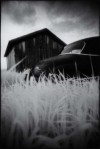
Fallow Field by Joshua Sheldon
In fact, we were both inspired by the same image we saw, one summer driving south out of the Adirondack Mountains. A field, a car, a barn.
I wrote the poem in a quick burst of notes crawling around in the field as Joshua searched for the best angle to capture the scene on film. (See the result at left.)
Joshua’s photograph hangs on my wall and has adorned at least one book (not yet mine). My poem was published in Blueline, a journal published at SUNY Potsdam.
Some time over the years, after its publication, I revised the poem, excising what I thought were superfluous lines that made too fine a point in trying to draw a parallel between the subject’s experience — a woman who ended her marriage abruptly — and the landscape we found. The lines removed are underlined below:
Fallow Field
The old car is there,
where she left it,
out by the old shed,
breeding rust–obscured
from the roadway by the rye grass
that grows up all around.
Long triangular tentacles
blowing and bending
in the hot breeze, as
sunlight filters in
through gathering clouds.
By now the grass has worked
up into the engine block.
The car--an old
Chevrolet or Buick?–
no matter, it’s what
is planted now,
in this fallow field,
awaiting bulldozers.
They call this grass
“poverty grain,” and there’s
no small comfort in the fact
that it’s as tolerant
of poor soils
as she was of the poor soils
of her marriage.
On the day she left,
she packed her whole life
into an old grip: clothing,
framed photographs
of the children, her parents,
the salt cellar she’d bought
on her honeymoon in Rome.
While packing, she’d given
pause that her whole life
had become so
portable, where once there’d
been permanence. And now,
she blows and bends
like this rye grass
on a midsummer afternoon,
so far from home,
so far from the old shed
of her former self.
Joshua’s objections are outlined in the following email:
SEA: Ok, I’ve read and re-read the two versions of Fallow Field and again I want to express my support for the earlier version. There are three changes I’m aware of, two lines in the body and the ending. I don’t feel the two lines alter the poem much but the ending! The ending Scott! It flowed before, it let you down easy, it tied it all up like the well written present that it was.
I agree with Joshua that the old ending tied it all up neatly — just a little too neatly for my taste. I think the newer ending, with its abruptness, speaks more to the experience of the woman in the poem, and is more true to life.
Things don’t always end neatly. In fact, I suggest that most things don’t. Life is full of messy, sudden changes, especially in relationships.
Below is how the revised version of the poem reads today. What do you think?
Fallow Field
The old car is there,
where she left it,
out by the old shed,
breeding rust–obscured
from the roadway by the rye grass
that grows up all around.
Long triangular tentacles
blowing and bending
in the hot breeze, as
sunlight filters in
through gathering clouds.
By now the grass has worked
up into the engine block.
The car
is planted now,
in this fallow field,
awaiting bulldozers.
They call this grass
“poverty grain,” and there’s
no small comfort in the fact
that it’s as tolerant
of poor soils
as she was of her marriage.
On the day she left,
she packed her whole life
into an old grip: clothing,
framed photographs
of the children, her parents,
the salt cellar she’d bought
on her honeymoon in Rome.
While packing, she’d given
pause that her whole life
had become so
portable, where once there’d
been permanence. And now,
she blows and bends–
rye grass on a midsummer afternoon.
##
 Scott Edward Anderson
 Scott Edward Anderson's Poetry Blog