National Poetry Month 2018, Week Three: Ross Gay’s “To the Fig Tree on 9th and Christian”
April 21, 2018

The fig tree at Hutchinson and Christian, South Philadelphia. Photo by Daisy Fried.
Thinking about Philadelphia this past week—a city I lived in for 14 years—in the wake of the incident at Starbucks where two black men waiting on a friend were arrested for basically not ordering a drink—or more to the point, because they were two black men in a Starbucks in a tony, white Philly neighborhood.
“Philly is the City of Brotherly Love…unless you’re a brother,” a friend once said to me.
The incident took place around the same time a Facebook friend shared Ross Gay’s poem, “To the Fig Tree on 9th and Christian,” a poem set in Philadelphia, and which originally appeared in the American Poetry Review, a journal that has been published in Philadelphia since before the country’s bicentennial year.
And I kept coming back to Gay’s poem since I heard the news of Rashon Nelson and Donte Robinson’s arrest.
The poem is set in South Philly, which has had its own share of racial incidents over the years, but describes a different mood in the city, a city, as Gay writes, “like most/ which has murdered its own/ people,” where “strangers maybe/ never again,” are picking figs and feeding figs to each other, sharing food, and rubbing sweaty forearms with sweaty shoulders in a mass of humanity.
This is such a contrast with the experience of the two young entrepreneurs waiting for a business meeting to begin in the overpriced confines of a Starbucks. Gay’s poem offers an aspirational image of a society we should all want to live in: one of cooperation, respect, and understanding rather than hate, fear, and intimidation.
The incident in the Starbucks is not an isolated one; it could be anywhere in the everyday life of black men and women in America these days and that must change.
I keep saying we’re living on the cusp of a great societal transformation, one that will find us—all people—able to share more moments like those in Gay’s poem. I believe the real change is coming and we—or at least our children—will look back on these times as a second American revolution, as revolutionary as what took place in Philadelphia in 1776.
After the arrest, Donte Robinson told the AP “he appreciates the public support the men received but anger and boycotting Starbucks are not the solution. ‘We need a different type of action…not words,’ he said. ‘It’s time to pay attention and understand what’s really going on. We do want a seat at the table.’”
Ross Gay is the author of five books of poetry, including most recently, Catalog of Unabashed Gratitude, which won the 2016 Kingsley Tufts Award and the 2015 National Book Critics Circle Award in Poetry. He teaches at Indiana University in Bloomington, Indiana, and the low-residency MFA in poetry program at Drew University.
Here is Ross Gay’s “To the Fig Tree on 9th and Christian”
Tumbling through the
city in my
mind without once
looking up
the racket in
the lugwork probably
rehearsing some
stupid thing I
said or did
some crime or
other the city they
say is a lonely
place until yes
the sound of sweeping
and a woman
yes with a
broom beneath
which you are now
too the canopy
of a fig its
arms pulling the
September sun to it
and she
has a hose too
and so works hard
rinsing and scrubbing
the walk
lest some poor sod
slip on the silk
of a fig
and break his hip
and not probably
reach over to gobble up
the perpetrator
the light catches
the veins in her hands
when I ask about
the tree they
flutter in the air and
she says take
as much as
you can
help me
so I load my
pockets and mouth
and she points
to the step-ladder against
the wall to
mean more but
I was without a
sack so my meager
plunder would have to
suffice and an old woman
whom gravity
was pulling into
the earth loosed one
from a low slung
branch and its eye
wept like hers
which she dabbed
with a kerchief as she
cleaved the fig with
what remained of her
teeth and soon there were
eight or nine
people gathered beneath
the tree looking into
it like a constellation pointing
do you see it
and I am tall and so
good for these things
and a bald man even
told me so
when I grabbed three
or four for
him reaching into the
giddy throngs of
wasps sugar
stoned which he only
pointed to smiling and
rubbing his stomach
I mean he was really rubbing his stomach
it was hot his
head shone while he
offered recipes to the
group using words which
I couldn’t understand and besides
I was a little
tipsy on the dance
of the velvety heart rolling
in my mouth
pulling me down and
down into the
oldest countries of my
body where I ate my first fig
from the hand of a man who escaped his country
by swimming through the night
and maybe
never said more than
five words to me
at once but gave me
figs and a man on his way
to work hops twice
to reach at last his
fig which he smiles at and calls
baby, c’mere baby,
he says and blows a kiss
to the tree which everyone knows
cannot grow this far north
being Mediterranean
and favoring the rocky, sun-baked soils
of Jordan and Sicily
but no one told the fig tree
or the immigrants
there is a way
the fig tree grows
in groves it wants,
it seems, to hold us,
yes I am anthropomorphizing
goddammit I have twice
in the last thirty seconds
rubbed my sweaty
forearm into someone else’s
sweaty shoulder
gleeful eating out of each other’s hands
on Christian St.
in Philadelphia a city like most
which has murdered its own
people
this is true
we are feeding each other
from a tree
at the corner of Christian and 9th
strangers maybe
never again.
(On another note: poet Daisy Fried identified the fig tree in question, reporting that it “is actually at Hutchinson and Christian, but that would not roll off the tongue nearly as well.” She also says that the scene is “very authentic. Summertimes people do stop randomly, and harvest figs to take with them. The owners are always happy because it means less dropped and rotting fruit.”)
Here is a wonderful reading of the poem by Ross Gay on #OWNSHOW from Oprah Online: Fig on Oprah.
“To the Fig Tree on 9th and Christian” © 2013 by Ross Gay. Originally published in the May-June 2013 issue of American Poetry Review, Volume 42, No, 3. Reprinted from Split This Rock’s The Quarry: A Social Justice Poetry Database.
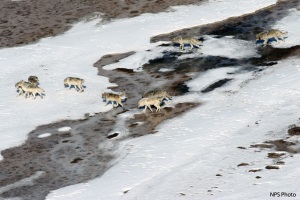
Wolf pack, Yellowstone. (NPS Photo)
In the title poem to her latest book of poems, Trophic Cascade, Camille T. Dungy catalogues the reemergence of species in the wake of the reintroduction of gray wolves to Yellowstone National Park.
In ecology, “trophic” refers to the relationships between species in a food chain or web. While in some respects this is both a list poem and a nature poem, it builds (or cascades) with such a “degree of motion and momentum” (to quote the poet in an essay) that it becomes something more.
Dungy mimics the kind of rhythmic swells leading to a break at the end of her line that one sees or hears in an ocean tide, and it’s the kind of rhythm and cadence the poet says she wants to achieve in her poems. But what I love most about this poem is how Dungy pivots at the end—in a way representative of how so much of her poetry works—with what she calls, in the same essay to which I refer above, an “inevitable surprise.”
“We know the line will break, and we might even have an idea of where and how the physical boundary might present itself on the page, and that is part of the beauty,” Dungy writes. “But for that beauty to work to its full potential there must also be much that comes as a surprise.” That surprise, in this case, puts a whole new perspective on our most basic trophic relationship.
Camille Dungy is the author of three other books of poetry, including Smith Blue, Suck on the Marrow, and What to Eat, What to Drink, What to Leave for Poison, as well as a fabulous memoir-in-essays, Guidebook to Relative Strangers. She also edited the important anthology, Black Nature: Four Centuries of African American Nature Poetry, and has received an American Book Award, two Northern California Book Awards, and an NEA Fellowship.
Here is Camille T. Dungy’s poem, “Trophic Cascade”
After the reintroduction of gray wolves
to Yellowstone and, as anticipated, their culling
of deer, trees grew beyond the deer stunt
of the midcentury. In their up reach
songbirds nested, who scattered
seed for underbrush, and in that cover
warrened snowshoe hare. Weasel and water shrew
returned, also vole, and came soon hawk
and falcon, bald eagle, kestrel, and with them
hawk shadow, falcon shadow. Eagle shade
and kestrel shade haunted newly-berried
runnels where mule deer no longer rummaged, cautious
as they were, now, of being surprised by wolves. Berries
brought bear, while undergrowth and willows, growing now
right down to the river, brought beavers,
who dam. Muskrats came to the dams, and tadpoles.
Came, too, the night song of the fathers
of tadpoles. With water striders, the dark
gray American dipper bobbed in fresh pools
of the river, and fish stayed, and the bear, who
fished, also culled deer fawns and to their kill scraps
came vulture and coyote, long gone in the region
until now, and their scat scattered seed, and more
trees, brush, and berries grew up along the river
that had run straight and so flooded but thus dammed,
compelled to meander, is less prone to overrun. Don’t
you tell me this is not the same as my story. All this
life born from one hungry animal, this whole,
new landscape, the course of the river changed,
I know this. I reintroduced myself to myself, this time
a mother. After which, nothing was ever the same.
c) 2015 Camille T. Dungy, from Trophic Cascade, Wesleyan University Press, 2017
Used by permission of the author.

São Miguel, Azores, Portugal
“I don’t write to say what I think. I write to find out what I’m thinking,” said the poet Gary Snyder. To that I might add, I write to understand who I am.
Lately, I’ve been working on a project—a kind of enhanced memoir—that explores my Portuguese family history. As part of this project, I’ll be going to the Island of São Miguel in the Azores this summer, where two of my maternal great-grandparents came from, for a residency hosted by DISQUIET International, which brings together Portuguese and Portuguese-American writers.
I first started researching my Portuguese roots back in the 90s and, coincidentally, that’s when I met the Portuguese poet, Nuno Júdice. He read at Poets House, along with the translator Richard Zenith, in December of 1994.
The author of over twenty books of poems, Júdice was born in 1949, on the southern coast of Portugal, in the region known as the Algarve. He is currently a professor at Lisbon’s Universidade Nova and directs the Colóquio/Letters program for the Gulbenkian Foundation. I’m hoping to see him in Lisbon when we are on the mainland.
Here is Nuno Júdice’s “Poema” in its original and in a translation by Martin Earl.
POEMA
As coisas mais simples, ouço-as no intervalo
do vento, quando um simples bater de chuva nos
vidros rompe o silêncio da noite, e o seu ritmo
se sobrepõe ao das palavras. Por vezes, é uma
voz cansada, que repete incansavelmente
o que a noite ensina a quem a vive; de outras
vezes, corre, apressada, atropelando sentidos
e frases como se quisesse chegar ao fim, mais
depressa do que a madrugada. São coisas simples
como a areia que se apanha, e escorre por
entre os dedos enquanto os olhos procuram
uma linha nítida no horizonte; ou são as
coisas que subitamente lembramos, quando
o sol emerge num breve rasgão de nuvem.
Estas são as coisas que passam, quando o vento
fica; e são elas que tentamos lembrar, como
se as tivéssemos ouvido, e o ruído da chuva nos
vidros não tivesse apagado a sua voz.
—
POEM
It’s the simplest things that I hear in the wind’s
intervals, when the simple beating of the rain
on the windows breaks the silence of night, and its rhythm
overwhelms that of words. Sometimes, it is a
tired voice, that tirelessly repeats
what the night teaches those who live it; other
times, it runs, hurriedly, mowing down meanings
and phrases as though it wanted to reach the end, more
quickly than the dawn. We’re talking about simple things,
like the sand which is scooped up, and runs
through your fingers while your eyes search
for a clear line on the horizon; or things
that we suddenly remember, when
the sun emerges from a brief tear in the clouds.
These are the things that happen, when the wind
remains; and it is these we try to recall, as though
we had heard them, and the noise of the rain
on the windowpanes had not snuffed out their voice.
© 2006 Nuno Júdice, from As coisas mais simples, Lisbon: Dom Quixote, 2006
Translation © 2007 Martin Earl, first published on Poetry International, 2014
“Poetry As Practice,” A Craft Essay
March 24, 2018
Cleaver Magazine published my craft essay, “Poetry As Practice,” earlier this year:
 POETRY AS PRACTICE
How Paying Attention Helps Us Improve Our Writing in the Age of Distraction
A Craft Essay
by Scott Edward Anderson
In this lyrical essay on the writing life, Scott Edward Anderson shows how poetry can be more than a formal approach to writing, more than an activity of technique, but a way to approach the world, which is good for both the poet and the poem.—Grant Clauser, Editor
Walking in Wissahickon Park after dropping my twins at their school in Philadelphia, I find muddy trails from the night’s heavy rains and temporary streams running along my path. The fuchsia flowers of a redbud tree shine brilliantly against the green of early leafing shrubs. A few chipmunks scurry among leaves on the forest floor. Birdsong is all around me: I note some of the birds—if they are bright enough and close enough to the trail or I recognize their song—the red flash of a cardinal lights on a branch nearby; a robin lands on the trail ahead, scraping his yellow beak against a rock.
Observation like this helps feed my database of images, fragments of music, and overheard speech, which prepares my poetry-brain for the work of choosing words, putting them in a certain order, and forming phrases into lines, stanzas, and eventually entire poems.
Remembering a line I’m working on, I worry it like a dog with a bone, gnawing on the words, their syntax, imagery, sound or feel in my mouth and mind. Playing with the line, I’ll follow it until it leads somewhere or dumps me in a ditch, when I’ll file it away for another day. I’m paying attention to where the poem wants to go. READ MORE
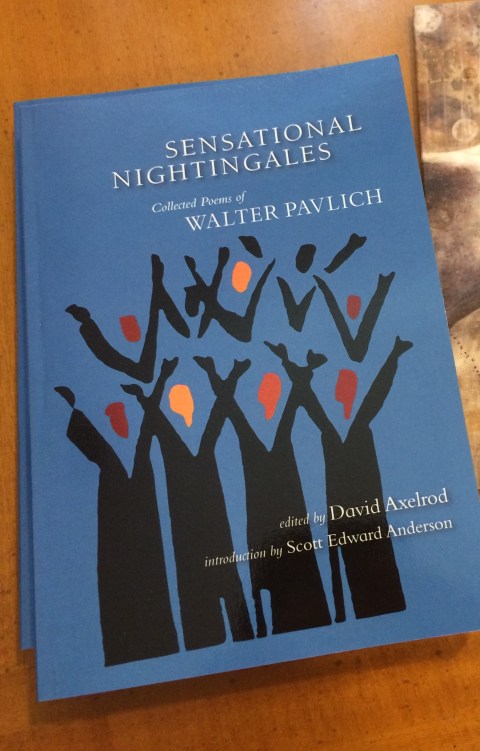
If you don’t know the poetry of Walter Pavlich, you now have the opportunity to explore his work in a new book, Sensational Nightingales: Collected Poems of Walter Pavlich, just published by Lynx House Press and edited by poet David Axelrod.
To whet your appetite, here is an excerpt from the Introduction I wrote for the book (the “Read more” link will take you to the full introduction as it appears on basalt):
“Writing is a way of saying you and the world have a chance,” poet Richard Hugo wrote. Hugo’s student, Walter Pavlich, once said in an interview, “I’ve always tried to define – and celebrate – sort of hard things in life. To try to find beauty in them – or to be more patient and watch the beauty unfold.”
Like Hugo, Pavlich wrote about the western landscapes he inhabited and the people he encountered there, and like Hugo, he was a regionalist in the best sense of the word: someone who knows the place where he lives and writes from that place well-observed.
Hugo’s influence, and by extension Theodore Roethke, with whom Hugo studied, is fairly evident in Pavlich’s work, especially the early poems. Yet, as his widow and soulmate Sandra McPherson wrote to me, Walter “was incredibly rich & rare & doesn’t merely sound like Dick Hugo at all; [he] also had subjects from his engaged life.”
Pavlich’s engaged life included work as a wildfire fighter, “smoke jumper,” and poetry teacher in prisons and schools. Born in Portland, Oregon, Pavlich graduated from the University of Oregon in Eugene and earned an MFA from the University of Montana, and his fondness for the forests and coastal environments of the Pacific Northwest of the United States pervades his poetry.
Something Sandra said to me also seems pervasive in Walter’s poetry: he had “a kind of spiritual isolation or loneliness he’s not explicit about.”
I think of Walter Pavlich as a “soulful traveler”… Read more
The Hamline University English Department recently conducted an in-depth Q&A with me about two of my poems, “Naming” and “Villanesca.”
Here is a link to their blog, Hamline Lit Link, where it was posted: Read more
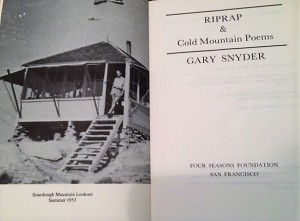
The author’s copy of Riprap & Cold Mountain Poems by Gary Snyder.
Schuykill Valley Journal Online published my essay on Gary Snyder’s “Mid-August at Sourdough Mountain Lookout” last month. Here are the introductory paragraphs and a link to the full essay:
To get to Sourdough Mountain Lookout, you hike a good five miles, gaining 5000 feet or more of elevation. The terrain is rugged and the hiking strenuous, but that’s to be expected in the Northern Cascades. Located 130 miles northeast of Seattle, Washington, the Forest Service opened one of its first lookouts here in 1915.
The view from the lookout station, constructed by the Civilian Conservation Corps in 1933, is a postcard in every direction: Hozomeen Mountain and Desolation Peak looking north, Jack and Crater mountains out east, Pyramid and Colonial peaks to the south with Ross and Diablo lakes directly below, and, as if not to be outdone, the Picket Range is off to the west. This is impressive country and you can understand why it’s been an inspiration to poets and writers for generations.
Poet Gary Snyder was 23 when he worked as a fire-spotter on Sourdough Mountain in 1953.
My poem, “Becoming,” for John Ashbery’s 90th Birthday
July 28, 2017
Whatever you think of John Ashbery’s poetry — and there are opinions for and against, none of which I’m going to get into here — you cannot argue with the fact that he has been a presence in the word of Art and Letters since first emerging on the scene in 1956.
I have a soft spot for Mr. Ashbery, not necessarily because of his poetry or the fact that he hails from Rochester, New York, outside of which I spent my middle and high school years.


Rather, my fondness stems from his selecting one of my poems, “Becoming,” which is part of my Dwelling sequence and appears in my book Fallow Field, to represent the Millay Colony for the Arts, in its 30th Anniversary Exhibit at the Albany (NY) International Airport Gallery, in a juried show, from January-August 2004.
The poem, along with others in the sequence, was written during my residency at the colony in November 2002.
A heady feeling having my poem displayed in this context, adhesive red vinyl letters applied to the thick glass walls overlooking the security area. As I recall, my poem was positioned next to one by Colette Inez, another former resident at the colony, as a dear friend. In a way, it was a bit like being in an Ashbery poem.
(The photos here, blurry and boozily out-of-focus, seem to exemplify that feeling. And I had no idea my scarf was going to mimic the colors of the letters!)
Here is my poem, “Becoming,” with thanks to Mr. Ashbery — on this, his 90th birthday –for recognizing it in the way he did.
Becoming
Say that childhood memory
has more relevance than yesterday–
a moose calf curled up against the side of a house
merely saying it may make it so.
The way a sunflower towers over a child,
each year growing shorter–
a hermit crab crawling out of a coconut
–no, the child growing taller.
a sharp-shinned hawk swooping over a stubble field
imagining the earth, “the earth is all before me,”
blossoming as it stretches to the sun–
a brilliant red eft – baby salamander — held aloft in a small, pink hand
Is home the mother’s embrace?
a white cabbage butterfly flitting atop purple flox
The child sees his world or hers
stroking the furry back of a bumblebee
head full of seed, until it droops,
spent, ready to sow the seeds.
Say that our presence in the world
a millipede curling up at the child’s slightest touch
is making the book of our becoming.
–Scott Edward Anderson

Two Poems by Scott Edward Anderson in The American Poetry Review
Ben Franklin was wrong. Only death is certain; taxes fluctuate — and some even get away without disclosing or paying them.
Last April, my friend the poet A.V. Christie died. It was not entirely a shock, she’d been battling stage 4 cancer for several years, but the fact that she was my age and we’d shared a stage together reading our poems meant it hit close to home.
Four and half months before that, another poet friend, David Simpson, died. I last saw David reading his poems in New York, his book had just come out. He was seriously ill, but celebrating. That was a lesson for me to choose abundance.
Add to that the myriad of more well-known and lesser known poets who die in any given year and it starts to add up: Heaney, Angelou, Kinnell, Waring, Batin, Knott, Strand, Levine, Ritvo, Harrison, Williams, Lux, Tolan, Walcott…the list goes on.
All this death — certain, inevitable death — and a growing number of memorial services and poetry reading “remembrances” over the past few years prompted me do two things: 1.) I started celebrating living poets by acknowledging their birthdays and sharing one of their poems on Facebook; and, 2.) I wrote a poem that tried to shed a little humor on this dark subject.
The poem is called “Deaths of the Poets,” turning on its head the famous Samuel Johnson title, “Lives of the Poets.” I see it as a tribute to the poets who have passed and a kind of companion piece to my poem, “The Poet Gene.”
This poem borrows a few lines from the Lynyrd Skynyrd song, “Free Bird,” which I’ve always wished someone would shout out at one of my readings, as was done at concerts back in the 70s and 80s. (Imagine the lines read in “poet voice,” if you will.)
I threatened to shout for “Free Bird” if my friend the poet Alison Hawthorne Deming didn’t open a recent reading by singing a few bars of “Stairway to Heaven,” which is the title of her new book of poems. She did it brilliantly and I have photo evidence. Alas, no recording.
Here is my poem, “Deaths of the Poets,” which appeared in The American Poetry Review earlier this year:
Deaths of the Poets
Sweet sorrow then, when poets die,
as so many of them have this year.
Goodbye to them, as we linger
over their works, forgiving their deeds,
maleficent or magnanimous.
We remember their kind gestures,
wholesome smiles, constructive criticism,
and witty remarks over drinks or dinner.
We seldom recall what a bore they were at readings,
droning on about their poems or rushing through them,
or how they showed up ill-prepared,
rifling through papers trying to find
the exact poem they wanted to read next
or constantly looking at their watch
and asking the host or hostess,
“How much time do I have?”
Sometimes when I hear poets read in their “poet voice,”
I want to shout out “Free Bird,” like hecklers at old
rock concerts. “Play ‘Free Bird’!” ‘til they recite,
“If I leave here tomorrow
Would you still remember me?
For I must be traveling on, now
‘Cause there’s too many places
I’ve got to see.”
Sweet sorrow in their passing then,
poets gone this year and last and yet to come.
And in our mourning let us not forget
Seamus Heaney’s story about two Scottish poets
at a reading, one on the podium struggling
to find his poems and the other, seated in the front row,
saying, “When they said he was going to read,
I thought they meant read out loud…”
–Scott Edward Anderson
c) 2017 Scott Edward Anderson
First published in The American Poetry Review, Vol. 46, No. 01, January/February 2017
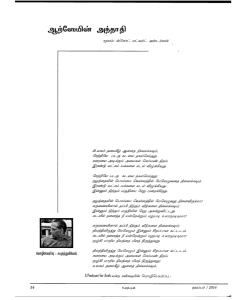
My poem, “Pantoum for Aceh” translated into Tamil by Appadurai Muttulingam, 2014.
A few years ago, my friend and former colleague at The Nature Conservancy, Sanjayan, introduced me to Tamil poetry after a long chat about poetry while we were both speaking at a conference in Aspen.
Sanjayan, a Sri Lanka-born Tamil, recommended I start with Poems of Love and War, selected and translated by A. K. Ramanujan, a remarkable book of Tamil poems from throughout history.
Long-time subscribers to my Poetry Month emails will recall I shared a few poems from the anthology in April 2009. Sanjayan sent my email to his father, Appadurai Muttulingam, who in turn sent me a copy of his own delightful book of short stories.
I responded by sending Appadurai a few of my poems (my book was not yet out) and he offered to translate one of them, “Pantoum for Aceh,” into Tamil for a Canadian-based Tamil-language journal, URAIYAADAL, which was published in 2014 (see photo above). He also sent me an anthology of contemporary poetry in Tamil, which I reviewed on my blog, here.
That post led the Sri Lankan Tamil poet known as ANAR (Issath Rehana Mohamed Azeem), whose poem, “Marutham,” I had called out in my review, to reach out to me earlier this year and send me some of her poems.
How small the world becomes when we are open to discovery and exploring cultures beyond our own. We are a global people and, I’m convinced, the movement to close our borders and shut out “foreign” cultures will soon die, because technology and travel and our future on this planet demands it.
ANAR has been writing poetry in Tamil since the 1990s. Her works include Oviem Varaiyathe Thurikai, Enakkuk Kavithai Mukam, Perunkadal Podukiren, Utal Paccai Vaanam, and Potupotuththa Mazhaiththooththal (a collection of Tamil folk songs from Sri Lanka).
A number of ANAR’s poems have been translated into English and published. Her books have won several awards, most notably the Government of Sri Lanka’s National Literature Award, the Tamil Literary Garden’s (Canada) Poetry Award, the Vijay TV Excellence in the Field of Literature (Sigaram Thotta Pengal) Award, and the Sparrow Literature Award.
ANAR writes regularly on her blog, anarsrilanka.blogspot.com (Google Chrome will translate it for you) and lives with her husband and son in the Eastern Province of Sri Lanka at Sainthamaruthu.
Here is her poem, “The Brightness of Wind,” in an English translation by Professor Jayaraman and its Tamil original:
“The Brightness of Wind”
I allow the wind
To eat me
My eyes
I stroked its cool cheeks
For the first time
Before it showed itself in the wind
Intoxicated I drank the image day and night
Kisses I plucked from the wind
Overflowed as would the floods
These watery fingers
Reaching out from the wind
Play on my flesh
Tunes not known before
My dwelling has turned into a wind
You, the total haughtiness of the wind
You, the never-ending slight of the wind
The expanse of sand has gone dry with joy
Body, the green sky
Face, the blue moon
I saw the brightness of wind
In a flash of lightning
—ANAR
translated into English by Professor Thanga Jayaraman
And in the original (Not sure how the beautiful Tamil script will work in WordPress, we’ll see):
காற்றின் பிரகாசம்
காற்றைத் தின்னவிடுகிறேன்
என்னை …
என் கண்களை …
குளிர்ந்த அதன் கன்னங்களை வருடினேன்
முதல் முறையாக
காற்றில் வெளிப்படுமுன் பிம்பத்தை
பகலிரவாக பருகினேன் போதையுடன்
காற்றினுள்ளிருந்து எடுத்த முத்தங்கள்
வெள்ளமாய் பெருக்கெடுத்திருக்கின்றன
காற்றிலிருந்து நீளும் நீர் விரல்கள்
முன்னறியாத ராகங்களை
இசைக்கிறதென் சதைகளில்
என் வீடு காற்றாக மாறிவிட்டது
காற்றின் முழுமையான அகங்காரம் நீ
நீ காற்றின் முடிவற்ற அலட்சியம்
மகிழ்ச்சியில் உலர்ந்துகிடக்கின்றது மணல்வெளி
உடல் பச்சை வானம்
முகம் நீல நிலவு
நான் பார்த்தேன் காற்றின் பிரகாசத்தை
ஒரு மின்வெட்டுப் பொழுதில்
–ANAR
c) 2007 ANAR, used by permission of the author
(On a side note, you should check out Sanjayan’s new video series on Vox, made in conjunction with the University of California. Here’s a link: Climate Lab.)
 Scott Edward Anderson
 Scott Edward Anderson's Poetry Blog