A poem for Indonesia and victims of terror everywhere
July 18, 2009
I’ve had a love affair with Indonesia for a long time now. Curiously, it started with its poetry long before I ever visited the country. But the people and the place are the real magic for me. Indonesia is a land (and waters) of stunning beauty, a people of peace and wonder, and a remarkable, storied culture.
I long to go back and when something like the bombings in Jakarta this week happens, my heart sinks that Indonesia and its people may suffer.
A few years ago, after the Bali bombings that killed 20 people and injured 129 and reports of other terrorist activities surfaced, I wrote a poem called “Sons of Abraham,” which has not yet been published. It may be too difficult a subject to be published. (Of course, it also may be that it is not yet finished or polished enough for publication!)
I want to share it here in the wake of the Jakarta bombings and in honor and memory of all victims of terrorism everywhere:
SONS OF ABRAHAM
We are all strung together
by thin filaments of air,
fragments of faith and our burning desire
to please God, to engender
a kind of blessing. Time
is the fragrance of one age
evoking another; essence
is our connection on earth.
I harbor neither empathy nor anger
for people who set off bombs in Bali,
only pity. I am sorry for them,
honoring their God in this way:
beheading Christian village leaders,
decapitating young girls
on their way to school or attacking
women because they wear a burqa
or pray to Mecca.
How sad to think God can be appeased
by such actions, that He wants
such a fate for you—
As for God, I forgive His negligence
or lack of supervision, all leaders are flawed.
We are all Sons of Abraham,
that model of faith, and we are all
struck down by hearts of stone,
leaden particles of dust
shattering between us
in the opaque calculation
of suicide bombs—
“Forgive them, Father,
for they know not what they’ve done.”
–Scott Edward Anderson
______________________________________________
(Note: There are families in eastern Indonesia who have married two faiths, Christian and Muslim. The first-born son or daughter is baptized; the next is raised in Islam. We are all connected. I love my Muslim brothers and sisters as well as my Christian, my Jewish, my Buddhist, and my Hindu families. There is only one God.)
![Reblog this post [with Zemanta]](https://i0.wp.com/img.zemanta.com/reblog_e.png)
Revise, revise, but when is too much?
June 25, 2009
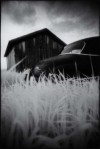
Fallow Field by Joshua Sheldon
In fact, we were both inspired by the same image we saw, one summer driving south out of the Adirondack Mountains. A field, a car, a barn.
I wrote the poem in a quick burst of notes crawling around in the field as Joshua searched for the best angle to capture the scene on film. (See the result at left.)
Joshua’s photograph hangs on my wall and has adorned at least one book (not yet mine). My poem was published in Blueline, a journal published at SUNY Potsdam.
Some time over the years, after its publication, I revised the poem, excising what I thought were superfluous lines that made too fine a point in trying to draw a parallel between the subject’s experience — a woman who ended her marriage abruptly — and the landscape we found. The lines removed are underlined below:
Fallow Field
The old car is there,
where she left it,
out by the old shed,
breeding rust–obscured
from the roadway by the rye grass
that grows up all around.
Long triangular tentacles
blowing and bending
in the hot breeze, as
sunlight filters in
through gathering clouds.
By now the grass has worked
up into the engine block.
The car--an old
Chevrolet or Buick?–
no matter, it’s what
is planted now,
in this fallow field,
awaiting bulldozers.
They call this grass
“poverty grain,” and there’s
no small comfort in the fact
that it’s as tolerant
of poor soils
as she was of the poor soils
of her marriage.
On the day she left,
she packed her whole life
into an old grip: clothing,
framed photographs
of the children, her parents,
the salt cellar she’d bought
on her honeymoon in Rome.
While packing, she’d given
pause that her whole life
had become so
portable, where once there’d
been permanence. And now,
she blows and bends
like this rye grass
on a midsummer afternoon,
so far from home,
so far from the old shed
of her former self.
Joshua’s objections are outlined in the following email:
SEA: Ok, I’ve read and re-read the two versions of Fallow Field and again I want to express my support for the earlier version. There are three changes I’m aware of, two lines in the body and the ending. I don’t feel the two lines alter the poem much but the ending! The ending Scott! It flowed before, it let you down easy, it tied it all up like the well written present that it was.
I agree with Joshua that the old ending tied it all up neatly — just a little too neatly for my taste. I think the newer ending, with its abruptness, speaks more to the experience of the woman in the poem, and is more true to life.
Things don’t always end neatly. In fact, I suggest that most things don’t. Life is full of messy, sudden changes, especially in relationships.
Below is how the revised version of the poem reads today. What do you think?
Fallow Field
The old car is there,
where she left it,
out by the old shed,
breeding rust–obscured
from the roadway by the rye grass
that grows up all around.
Long triangular tentacles
blowing and bending
in the hot breeze, as
sunlight filters in
through gathering clouds.
By now the grass has worked
up into the engine block.
The car
is planted now,
in this fallow field,
awaiting bulldozers.
They call this grass
“poverty grain,” and there’s
no small comfort in the fact
that it’s as tolerant
of poor soils
as she was of her marriage.
On the day she left,
she packed her whole life
into an old grip: clothing,
framed photographs
of the children, her parents,
the salt cellar she’d bought
on her honeymoon in Rome.
While packing, she’d given
pause that her whole life
had become so
portable, where once there’d
been permanence. And now,
she blows and bends–
rye grass on a midsummer afternoon.
##
Paul Muldoon on The Colbert Report, Hilarious
June 23, 2009
If you missed poet Paul Muldoon on The Colbert Report, including the poet and Stephen Colbert reading Muldoon’s poem “Tea,” you must watch it now:
Paul Muldoon on The Colbert Report
Colbert is doing more for bringing poetry to a wider audience than just about anybody. Shall we compare Stephen Colbert to a Summer’s Day?
How to read poetry
May 26, 2009
Want to know how to read poetry? Treat it like you’re sampling perfume, says my friend Molly Cantrell-Kraig:
“It’s like an expensive fragrance: the high notes are what registers first, but as the fragrance adapts to the person’s chemistry and with time, the fragrance develops dimension and a fuller sense of itself.”
In other words, try first letting the poem envelope you with its sounds and its images. Sit with it. Come back to the poem and read it again, this time paying attention to how the poem makes you feel. Pay attention to the nuances in your reading, the patterns that emerge, the sense that emerges. And, finally, how does the poem change the way you look at the world?
In How to Read a Poem and Fall in Love with Poetry, Edward Hirsch writes, “We activate the poem inside us by engaging it as deeply as possible, by bringing our lives to it, our associational memories, our past histories, our vocabularies, by letting its verbal music infiltrate our bodies, its ideas seep into our minds, by discovering its pattern emerging, by entering the echo chamber which is the history of poetry, and most of all, by listening and paying attention. Attentiveness is the natural prayer of the soul.”
C.S. Lewis suggested that “the true reader reads every work seriously, in the sense that he reads it wholeheartedly, makes himself as receptive as he can.”
A poet dreams of such readers.
When a poet goes missing does anyone hear? Yes.
May 11, 2009
This weekend, the Los Angeles Times reported that award-winning poet Craig Arnold, who went missing in Japan in late April, is presumed to have died after a fall.
The American search team, established by his employer, the University of Wyoming after the official Japanese search was ended, tracked Arnold to the edge of “a high and dangerous cliff, and there is virtually no possibility he could have survived the fall,” according to a release quote in the Times.
According to the report, Arnold was fascinated with volcanoes and had traveled to Kuchinoerabu-jima, a tiny Japanese island, to visit the volcano there and was in Japan on a creative exchange fellowship and was blogging about his trip: Volcano Pilgrim.
Reports of his missing buzzed through Twitter a couple of weeks ago after he failed to report after his trip to the volcano.
Very sad news, indeed.
Here is a link to Craig Arnold’s page on the Poetry Foundation web site, which includes several of his poems.
Related articles by Zemanta
- Searchers say they’ve tracked missing professor to ravine (cnn.com)
- US poet missing on Japan volcano (news.bbc.co.uk)
- Missing Poet (papercuts.blogs.nytimes.com)
- Search for U.S. professor in Japan continues (cnn.com)
- U.S. poet disappears on Japan volcano hike (cnn.com)
Who wants to be an Arab poetry millionaire?
May 5, 2009

Gulf poets compete in Millions' Poet competition
A couple of decades ago I had an idea for an all-poetry cable channel. We would have talk shows hosted by and featuring famous poets, films about poets, live readings and workshops, and possibly even feature length movies, dramas, and comedies. (Stephen Dobyns’ Saratoga Hexameter, would have made a good source for a mini-series.)
I shelved the idea after realizing the only way I could afford to develop The Poetry Channel was to develop my other idea — The Disaster Channel. “All disaster, all the time,” was the tag line; 24/7 of disaster coverage, disaster movies, and disaster reporting. My wife said she would divorce me if I went ahead with that idea. (The Weather Channel has since taken the best parts of the format to the bank and is planning to launch a separate channel this spring.)
I now see what my idea was missing: I needed a poetry contest reality show! In the most unlikely of places, Dubai television personality Nashwa Al Ruwaini has launched Millions’ Poet, sort of a Gulf version of American Idol, in which Arab poets battle it out for 5 million United Arab Emirates dirhams (more than $1.3 million). 70 million viewers tuned in to see the finale, according to news sources. Amazing.
Here is what Nashwa Al Ruwaini says about it in an editorial that appeared in today’s Philadelphia Inquirer:
Three years ago, when I devised the format of Millions’ Poet, it was with little more in mind than creating an entertaining, original, and youth-oriented television show. Now in its third season, with more than 15 million viewers each week, the show has become the Gulf countries’ most prestigious poetry competition and a platform for young male and female poets to voice their thoughts before a broad audience. Most unexpectedly, it has also helped spur some progress in the region’s attitudes toward women.
Read the full editorial here: Millions’ Poet
Here is an article about Saudi poetess Ayda Al-Jahani, who is featured in the editorial and who made it to the final four in this usually male-dominated competition: Ayda Al-Jahani
And a link to an NPR Morning Edition story on her: NPR
If anyone has links to English translations of Ayda Al-Jahani’s work, will you please comment below? Thanks.
Carol Ann Duffy Selected as UK Poet Laureate
May 3, 2009

- Image by Getty Images via Daylife
Poet Carol Ann Duffy was nominated for UK Poet Laureate yesterday. Here’s what she had to say about the position, which she had previously poo-poohed:
The appointment of a poet laureate can be seen, quite simply, as a spotlight on the vocation of poetry. I feel privileged to be part of a generation of poets in Britain who serve the vocation of poetry; writers who – in glad company with their readers – regard poetry as the place in language where everything that can be praised is praised, and where what needs to be called into question is so. Perhaps a better word than generation, for our community of poets, readers and listeners, would be family – or, as Ted Hughes had it, tribe. Doris Lessing, too, once described herself as a member of the honourable tribe of storytellers.
Read her remarks in full here.
Here is her poem, “Valentine”:
Not a red rose or a satin heart.
I give you an onion.
It is a moon wrapped in brown paper.
It promises light
like the careful undressing of love.
Here.
It will blind you with tears
like a lover.
It will make your reflection
a wobbling photo of grief.
I am trying to be truthful.
Not a cute card or a kissogram.
I give you an onion.
Its fierce kiss will stay on your lips,
possessive and faithful
as we are,
for as long as we are.
Take it.
Its platinum loops shrink to a wedding-ring,
if you like.
Lethal.
Its scent will cling to your fingers,
cling to your knife.
Related articles by Zemanta
- ‘I still haven’t written the best I can’ (guardian.co.uk)
- Britain Picks 1st Female Poet Laureate (nytimes.com)
- Call for end to Poet Laureate job (news.bbc.co.uk)
- Beneath the laurels (telegraph.co.uk)
- U.K. appoints first-ever female poet laureate (cbc.ca)
- Carol Ann Duffy becomes poet laureate (guardian.co.uk)
- Simon Armitage Not Actually a Sperm Whale (seattlest.com)
Last words of a Poet Laureate: Motion bows out
April 28, 2009
After 10 years, eight royal poems and 700 bottles of sherry as payment, UK Poet Laureate Andrew Motion steps down from the role at the end of April.
He looks back at his experiences while in the post, both good and bad, and offers up a bit of advice for his successor.
Read the interview here: BBC Motion
Related articles by Zemanta
- Last words (news.bbc.co.uk)
- Poet Laureate dedicates first book of poetry in 7 years to his muse (telegraph.co.uk)
- Call for end to Poet Laureate job (news.bbc.co.uk)
- Poet laureate? Why Wendy Cope is right to refuse the idea (guardian.co.uk)
- Poet Laureate: does poetry need one? (telegraph.co.uk)
- Poet Laureate Andrew Motion calls for all children to be taught the Bible (telegraph.co.uk)
Two articles about Afghan poets
April 28, 2009
Two articles about Afghan poets in two days. What are the odds? Yet, here are two stories that, if you care about poetry, you will want to read:
The first, from the Sunday Times of London, is about a 25-year-old woman, the late Nadia Anjuman, a poet who risked her life to keep writing under the Taliban, and who was murdered by her husband after publishing her first book:
The defiant poets’ society. Attending a reading and writing class like this one could end in mutilation or murder for Afghan women — and simply leaving their homes could mean death. Christina Lamb returns to Afghanistan seven years after the fall of the Taliban and finds a country still rife with the persecution of females.
Read the full story here: Nadia Anjuman
The second, from the BBC, is about how the violence in Afghanistan is affecting the themes of contemporary Pashto poets. In a country with a rich poetic tradition, poetry remains relevant and vibrant today:
Afghan poets tackle scars of war by Dawood Azami. The violence in Afghanistan and the Pashtun-inhabited parts of Pakistan is making itself felt on the cultural and social life of the Pashtuns.
Read it here: Pashtun Poetry
Humbled after reading these two stories, in the wake of my post from Saturday whining about not yet having my book published.
For more on Nadia Anjunam’s poetry: Universe
A Poem for Earth Day from the Classical Tamil
April 22, 2009
I can’t think of anything better to say on Earth Day than what the early classical Tamil poet Auvaiyar wrote two millennia ago:
Bless you, earth:
field,
forest,
valley,
or hill,
you are only as good
as the good young men
in each place.
Auvaiyar (Tamil: ஔவையார்)(also Auvayar) was the name of one of the most famous and important female poets of the Tamil canon of southern India. She lived during the Sangam period (c. first and second century C.E.) and wrote 59 poems in Purananuru (புறநானூறு).
Poems translated by A.K. Ramanujan from Poems of Love and War.
 Scott Edward Anderson
 Scott Edward Anderson's Poetry Blog