Help Us Build “The Bridge,” A Community for Poets
October 28, 2013
Last week, while going through some old files, I came across earlier versions of the manuscript that became my new book of poems, FALLOW FIELD.
There were copies of the manuscript with thoughtful edits and suggestions in the margins and on the pages by poetry mentors like Alison Hawthorne Deming and Colette Inez, as well as peers and colleagues like Thomas V Hartman (we were editors together at Painted Bride Quarterly before launching Ducky Magazine in 2000).
I was reminded that we poets don’t work in a vacuum, we work in a community. And I was further reminded that such community isn’t always easy to find. I was lucky to find a community of poets in my own way.
I don’t teach in a university or writing program, so I’ve always been something of an outsider in the poetry world. I had to actively seek out other poets and poetry enthusiasts. Readings, workshops, and open mics helped in the early years or when I moved to new cities.
My work as an editor at Viking Press/Penguin Books put me in contact with a number of poets, as did my volunteering to coordinate the Series at Ceres Gallery in New York in the early 1990s, which paired established and emerging poets who I invited to read together.
Then there were the events and good people at Poets House, first in the Spring Street location and later in Battery Park City, which also gave me exposure to poets, some of whom became good friends over the years.

“The Bridge” from Brooklyn Poets will be a community for poets to share, collaborate, and learn from each other.
Even my work with The Nature Conservancy brought me into contact with writers, artists, and poets, some of whom were also conservation practitioners and activists,
But what of those poets who aren’t so fortunate to come into contact with other poets through their work? Where do they turn for mentorship, camaraderie, constructive criticism, and other support? It can be a daunting prospect.
And what about those poets who want to give back in some way, to help encourage the next generation of poets, to “pay it forward,” as they say.
That’s why I think “The Bridge,” a project of Brooklyn Poets is such a good idea.
It’s more than just a social network, The Bridge will, as the name implies, be a bridge between poets far and wide, young and old, scholar and autodidact, established and emerging, new and, well, you get the picture.
As Brooklyn Poets puts it: “Too many student & mentor poets today are missing each other. We have this thing called the internet to connect them, but no network getting it done.
Until now. For the past year Brooklyn Poets has been designing and laying the groundwork for such a network. In homage to Hart Crane, we call this The Bridge. And you can help build it.”
TWO KEY THINGS THE BRIDGE WILL DO
Help student poets find mentor poets to get critiques of their work without having to go through a workshop structure or writing program.
Help mentor poets find student poets by offering critiquing services — at their own prices.
Students find mentors for less money than a workshop or writing program would cost, and mentors get paid without having to land one of those hard-to-find teaching jobs. It’s that simple.
Students choose mentors based on price, services offered, location and other factors such as skills and stylistic influences. If they like, they can sign up for workshops proposed by mentors–workshops not governed by the mandates of any institution, for however long mentors want, with however many students, at whatever price, online or on site.
AND THAT’S NOT ALL
You’ll have Readers, not Followers.
You’ll create new work. Each week on The Bridge we’ll feature a poetry assignment proposed by a mentor in our community.
Sharing your work will be a creative process. You can choose images to represent your poems and captions to go with them—like book covers for your individual poems. Add tags so readers can find your poems based on similar interests.
Sounds great, right? So join me in supporting and joining “The Bridge,” take a look at their Indiegogo campaign and help build The Bridge!
I Was Brooklyn Poet of the Week, October 14-20, 2013
October 25, 2013
 Brooklyn Poets is a great new organization that hosts a reading series, poetry writing classes and workshops, as well as a monthly “YAWP,” which allows poets to try out new work or share old work.
They also produce some of the coolest t-shirts available.
Each week, they feature a Brooklyn-based poet on their website, Brooklyn Poets, including one of their poems and an interview conducted via email.
I was honored to be Brooklyn Poet of the Week for October 14-20, 2013. They featured my poem “Running,” along with a brief explanation about the writing of the poem, and the interview below.
What are you working on right now?
Promoting my new book of poems, FALLOW FIELD. I have a bunch of poems I wrote last April during National Poetry Month that need my attention soon, and another big poem and prose project I put aside some years ago and need to get back to work on. I also have another book of non-fiction that is in proposal development with my agent.
What’s a good day for you?
A good day is spent with the love of my life, Samantha, doing whatever we want, with or without our kids (we have 6 between us), and always involves some poetry, cooking a good meal, drinking some wine, eating chocolate, plenty of coffee, and a whole lotta love. And, these days, exploring Brooklyn, our home.
How long have you lived in Brooklyn? What neighborhood do you live in? What do you like most about it?
I returned to Brooklyn nearly two years ago and live in Park Slope, although I spend part of every week in Philadelphia, where my kids live. I lived in Carroll Gardens and Bay Ridge years ago. I love Park Slope because it feels like a small town and we’re close to the Park. I love city life, but I need to be close to its nature, too.
Share with us a defining Brooklyn experience, good, bad or in between.
Samantha and I got engaged this spring and when we were looking for a venue for our wedding, we stumbled upon the Green Building in Carroll Gardens. It used to be a brass foundry. When she sent me their website to check out, I noticed the building is located on the corner of Union and Bond. What better place for a wedding? It felt like the Brooklyn gods were shining on us.
Favorite Brooklyn poet(s), dead and/or alive?
Auden, Whitman, Marianne Moore, David Ignatow and Ada Limón. Auden for his variety; Whitman, his YAWP; Moore for her eccentricity; Ignatow for his mundane humor; and Ada for the beauty of her language and vision.
Favorite Brooklyn bookstore(s)?
Greenlight, definitely, for the selection and the layout. Community Bookstore in my hood. Unnameable Books in Prospect Heights, which has a great selection of used poetry books. I’m looking forward to that new poetry-only bookstore, Berl’s. Why? Because we need more bookstores full of poetry. (And the Grolier Bookshop is too far away from Brooklyn.)
Favorite places to read and write in Brooklyn?
Prospect Park. I do a lot of my composing in my head, especially while walking. The park is perfect for wandering. Some of the poems I wrote in April when I was writing a poem each day were composed on my iPhone on the 2 or 3 train. As for reading, I love reading in bed to my fiancée; she falls asleep whenever I start reading to her, but I just keep going.
Favorite places to go in Brooklyn not involving reading or writing?
Prospect Park, Brooklyn Bridge Park, Sharlene’s on Flatbush (a new favorite), the Farmer’s Market in Grand Army Plaza, Little Neck, the 4th Avenue Pub (an old favorite), and of course 61 Local, which I learned about from the Brooklyn Poets YAWP. Our kitchen is one of my favorite places in Brooklyn. I love cooking in our kitchen. My son Jasper says my meals there are “on point AND on point.”
Last awesome book(s)/poem(s) you read?
Ada Limón’s Sharks in the Rivers, Robert Wrigley’s Anatomy of Melancholy, Alfred Corn’s Tables, Frederick Seidel’s Poems 1959-2009, and Kathleen Jamie’s The Overhaul.
Fill in the blanks in these lines by Whitman:
I celebrate food,
And what I love to cook you should love to eat,
For every meal I prepare cheers me as good and good for you.
If you have time, write a nine-line poem using these end-words (in whatever order) from Jay-Z’s “Brooklyn Go Hard”: father, Dodger, jack, rob, sin, pen, love, Brooklyn, Biggie.
My kids got their faith from their fa-ther:
Red Sox fans, not fans of the Dodgers.
Whether living in Alaska, Philly or Brooklyn
And tho’ we show respect when Mo’ comes out the pen,
It’s the “B” and scarlet socks that we’re love-in
And those gold black and white ones once worn by Robby–
Bobby Orr, y’all, to me as a kid he was bigger than Biggie.
When we traded him to Chi’town that was a sin.
Blackhawks didn’t know Bobby and they don’t know Jack.
Why Brooklyn?
My love, Samantha, is here and wherever my love is, that’s my home.
##
Thanks to Jason Koo and Brooklyn Poets for featuring me as Brooklyn Poet of the Week.
Alastair Cook’s Filmpoem of My Poem “Fallow Field”
October 23, 2013

Detail from Alastair Cook’s filmpoem of “Fallow Field.”
My friend the Scottish filmmaker and photographer, Alastair Cook, has created many beautiful filmpoems — 34 to be exact — his latest features the title poem of my collection, “Fallow Field.”
My reading of the poem comes from Kelly Writer’s House at the University of Pennsylvania in Philadelphia, recorded on September 22, 2008.
As with his filmpoem of another of my poems from this collection, “Naming,” Alastair’s vision of my poem is impressionistic rather than literal.
There’s a great synergy between my words and the flow and textures of his film, especially the way the woman’s hair mimics the rye grass waving in the wind and how the occasional flash of her lips seem to kiss goodbye what the subject of my poem never could.
You can watch Alastair’s filmpoem here:
Filmpoem 34/ Fallow Field from Alastair Cook on Vimeo.
And you can read the poem here or in my new book of poems, which you can purchase here.
Pre-order Your Signed Copy of My Collection of Poems, “Fallow Field”
September 16, 2013

This fall, the Aldrich Press is publishing my long-awaited new collection of poetry, FALLOW FIELD.
The book consists of 45 poems, representing my best work from the past quarter century.
You can order your signed copy of FALLOW FIELD here:

My poetry has received the Nebraska Review Award and the Aldrich Emerging Poets Award, and I have been a Concordia Fellow at the Millay Colony for the Arts.
My poems have appeared in magazines, literary journals, and anthologies or online, including the American Poetry Review, Alaska Quarterly Review, Anon, La Petite Zine, Many Mountains Moving, and Terrain, among other publications.
I am also the author of a book of natural history, Walks in Nature’s Empire
The paperback book is 96 pages, including front and back matter, with a gorgeous cover photograph by my good friend Joshua Sheldon (see picture), which was taken at the same time and has the same origin of inspiration as the title poem. (You can read the poem and its story here: “Fallow Field.”)
Here is what others have said about this collection, FALLOW FIELD:
“Scott Edward Anderson’s poems honor the reality that the things of the world – rye grass, fall warblers, ravens, owls, ‘Sargassum drifting/ in a pelagic wave,’ lovers and sourdough bread – speak to and for our innerness. Here the sense of place is not simply a matter of geography, but of feeling one’s way into that sense of becoming that makes one’s path clear. The book’s fourth section is comprised of poems that beautifully embrace the very human need to join the inner and outer, a territory defined, as the poem titles suggest, by ‘Becoming,’ ‘Shapeshifting,’ ‘Cultivating,’ ‘Mapping,’ and ‘Healing.’ Guided since childhood, as the book’s closing long poem relates, by nature’s teaching, Anderson is devoted to finding the words for what it means to dwell mindfully among others on the wounded earth.”
–Alison Hawthorne Deming, author of Rope: Poems
“I was impressed by Anderson’s engagement with nature — especially the way in which his lyrical lines sketch the profound relationship between humans and their environment.”
– Jonathan Galassi, author of Left-handed: Poems
“Wow, Pop, I had no idea you wrote so many poems!”
– Walker Anderson, the author’s 10-year-old son
My poetry is rooted in nature and grounded in what Robert Hass called the “strong central tradition of free verse made out of both romanticism and modernism, split between the impulses of an inward and psychological writing and an outward and realist one, at its best fusing the two.” (Hass, Introduction to Best American Poetry 2001)
I studied with Hass and with Gary Snyder, along with the late Walter Pavlich, and received some great mentoring and advice from poets Alison Hawthorne Deming, Donald Hall, Colette Inez, and Karen Swenson, as well as wonderful friends and readers.
My poetry is informed by a deep engagement with the natural world, attuned to the smallest details and complexities of nature and our experience of place. Attentiveness and mindfulness are critical to my method of working, both as the poem first evolves and later, through the often rigorous process of revision.
I believe poetry is the most direct language with which to approach our place in the world and reconnect us to nature. By nature, I mean not only the natural world, but also the built environment; not only the processes and causal powers of the physical world, but our immediate experience of the spiritual and the non-human.
For the past twenty five years, I have been building a body of poetry that tries to achieve my goal of writing that is open, approachable, and eminently readable, at the same time that it is intellectual and revels in the joy of language. FALLOW FIELD represents the best of my poetry over that time.
Order your signed copy of FALLOW FIELD below:
Much Ado About Nada: Harper’s “Poetry Slam”
June 22, 2013

Harper’s Magazine, July 2013
Okay, so I read the Mark Edmundson article, “Poetry Slam, or the Decline of American Verse.”
The essay was supposed to have all us poets rending our garments and pounding our chests in anger. At least, that’s according to Ron Charles of the Washington Post, whose summation you can read here.
To read the full article, you have to buy the July 2013 issue of Harper’s, because you can’t access it without a subscription. Which begs the question, who subscribes to Harper’s anymore, really?
What I found there was nothing earth shattering. Edmunson, a professor of English at the University of Virginia, makes some fairly common complaints about the baby boomer generation of contemporary poets, a generation of which I am on the cusp. (In the interest of full disclosure, I studied with one of the poets he criticizes and had a poem selected for recognition by another.)
Edmundson offers criticisms of some usual suspects (John Ashbery, Jorie Graham, Robert Hass), a decidedly weak argument against Seamus Heaney, and one of the first, valid pot-shots I’ve seen aimed at Paul Muldoon and his tenure as tastemaker of poetry at The New Yorker.
He also pokes fun at Anne Carson, who is overdue, but for her part has been poking fun at us readers for years, so what’s the point?
Ultimately, Edmundson seems to be arguing for much the same kind of politically aware and socially engaged poet that Ginsberg, Whitman, and Eliot (!) represented. And the sort of heightened language deployed by Robert Lowell in his best days. Edmundson longs for the liberal left, activist branch of poetry — although he admits that Fr. Eliot doesn’t really fit that mold.
In addition, he calls for a poetry that exploits the same veins of popular culture — references to TV shows, the Internet, and current events — that a younger generation has been mining for the past decade.
Reading his essay, I wonder whether Edmundson has read any poet born after, say, the late 1950s? He clearly has not spent any time with poets as pop-culture savvy as Matthew Zapruder, Dorothea Lasky, and Matthew Rohrer.
I doubt Edmundson has read the “unapologetically queer poet activist, ” CA Conrad, who can best be described as the love-child of a ménage à trois between Walt Whitman, Allen Ginsberg, and Anne Waldman wrapped up in glitter, nail polish, and parapsychology. (And I write that with affection for CA and his writing.)
Neither, I suspect, has Edmundson read Natasha Trethewey, who writes about race, identity, and family in much of her work.
If Edmundson really wants to read poets writing about nothing, he should check out what I call the “Seinfeld Generation” of poets: the Dickman twins (one of whom wrote that annoying Clint Eastwood Chrysler Super Bowl commercial, “Halftime in America”) or the over-lauded Timothy Donnelly, whose linguistic pyrotechnics are certainly as “perpetually hedging” as anything Ashbery has written.
Hard for Edmundson to make the argument he’s making while his reading is seemingly so “generationally challenged.”
While I agree with some of what Edmundson says — that much contemporary poetry seems lacking in ambition — his is the same kind of argument critics made of John Lennon’s last solo recordings.
They found Lennon’s mature work — he was 39 — to be more domesticated, self-absorbed, and solipsistic than his earlier, more political solo work, much of which strikes one as facile now. (Does anyone really prefer “Some Time in New York City” to John’s songs on “Double Fantasy”?)
I’ve seen some over the top reactions in defense of “contemporary” poetry resulting from this latest jeremiad about the sorry state of the art, but I suspect they didn’t read past Harper’s pay wall. At least, after reading the complete essay in the magazine, I don’t see how Edmundson’s prose could get any poet’s panties in a twist.
My friend Dan Nester had perhaps the most sober, cogent reaction I’ve read. He wrote entertainingly on the subject as part of his blog’s “Notes” series.
In the end, I applaud Edmundson for caring enough to persuade the editors of this once-relevant magazine to publish his essay about everyone’s favorite, once-relevant art form.
But, really, this essay is much ado about nothing.
Winslow Homer, Masterworks, and My Poem “Bermudiana”
May 21, 2013
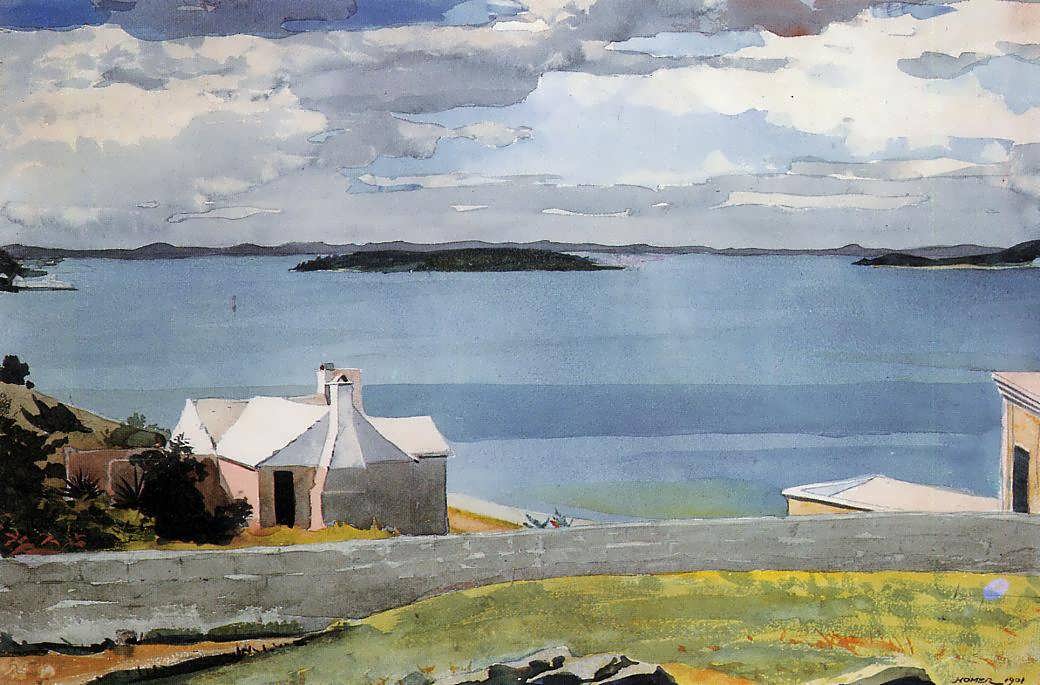
Inland Water by Winslow Homer
We’ve just returned from a remarkable trip to Bermuda, where Samantha and I got engaged, and, frankly, we fell in love with the place.
The colors, the scents, the sounds, and the magical experiences we had — a bit like Alice in her Wonderland, actually, just took us deeper and deeper.
One such experience was meeting Tom Butterfield and Elise Outerbridge of the Masterworks Museum of Bermuda Art, which has as part of its mission the repatriation of works created by world renowned artists in Bermuda.
When we were there, Tom was hanging a show of Brooklyn artist Ogden Pleissner’s watercolors painted at St. George’s on the far eastern part of the country.
He took us down into the archives to see Georgia O’Keefe’s charcoal of a banyan tree, and Winslow Homer’s “Inland Water,” which was painted not far from where we were staying in Warwick Parish.
Samantha challenged me to write poetry inspired by Bermuda — not easy to do after a month of writing a poem-a-day during the month of April. But when we got home, my notes proved to have some gems.
Here is the first that has emerged,
“Bermudiana”
Light refracts off turquoise waters,
But “turquoise waters” sounds so trite
And cliché, until you see it’s true.
Not since Indonesia have I seen such a color.
Then there’s the colorful pastel houses
Of yellow and sea green,
Sage, russet, the occasional purple,
The coral pink ferry stops –
All with whitewashed limestone roofs,
Stepped and sculpted to channel and capture
Rain; the islands’ only source of fresh water.
These islands are awash with color–
Flowers from the tiny, purple-blue Bermudiana
To the brilliant red hubris of Chinese hibiscus,
Shrimp plant, with its shriveled crustacean-hued
Flowers stacked along the stalk,
And morning glories, a soft purple
Bruise against green skin–
Light is texture here, which is perhaps
Precisely why painters, especially
Watercolourists, have been so inspired
By this land- and seascape.
The island across the way from us
Was captured by Winslow Homer,
In the painting we saw at Masterworks.
The perfume of the air, frangipani
(Or was it something else?),
Which scents the towels during our stay.
We find ourselves exploring
All over Bermuda, drinking it in,
With our Dark ‘n’ Stormies.
We will leave a part of ourselves
Here, as we take back memories
Of being transported to the beginning
Of our beautiful engagement.
What a place for a proposal;
What a place to conjure
using all our senses,
and all of our sensibilities.
 Today is poet Gary Snyder’s birthday. He is 83 years old.
I studied with Gary and he had a big impact on my poetry, which I’ve written about elsewhere on this blog.
You won’t find traces of his influence in my work, stylistically at any rate; rather you’ll find it in my deep engagement of nature, in how I pay attention, and “be crafty and get the work done.”
Happy birthday Gary!
Here is Gary Snyder’s poem, “Old Bones”:
Old Bones
Out there walking round, looking out for food,
a rootstock, a birdcall, a seed that you can crack
plucking, digging, snaring, snagging,
barely getting by,
no food out there on dusty slopes of scree—
carry some—look for some,
go for a hungry dream.
Deer bone, Dall sheep,
bones hunger home.
Out there somewhere
a shrine for the old ones,
the dust of the old bones,
old songs and tales.
What we ate—who ate what—
how we all prevailed.
–Gary Snyder
And here is a recording of Gary reading “Old Bones”:

Diana and Actaeon by Titian
I hope you have enjoyed National Poetry Month for 2013 as much as I have. As always, I end with a “bonus poem,” one of my own that I am delighted to share with you.
If you haven’t had enough poetry, you can always check out and even subscribe to this blog below.
I’ve written about ekphrastic poetry before, the art of writing poetry about or inspired by other works of art.
Last September, Samantha and I were in London and went to the National Gallery’s “Metamorphosis: Titian 2012” show.
The multi-arts show brought together a group of specially commissioned works responding to three of Titian’s paintings – “Diana and Actaeon,” “The Death of Actaeon,” and the recently acquired “Diana and Callisto” – all of which depict stories from Ovid’s epic poem “Metamorphoses.”
The three paintings at the heart of the exhibition had not been seen together since the 18th century.
The National Gallery also commissioned poets to write poems inspired by the artworks (you can watch the poets read their poems here, and there was even a Twitter poetry contest.

The Death of Actaeon by Titian
I was inspired to write my own poems in response to the show, one of which explores the relatedness of two paintings, “Diana and Actaeon” and “The Death of Actaeon.”
Here is my poem, “Titian’s Metamorphosis”:
They are twin paintings, really,
Titian’s “Diana and Actaeon” and
The one depicting his death.
Look at the positioning: in
The former, Actaeon, poised
To the left, arm raised parting
The curtain, feet apart, all
Broad shouldered and startled.
Diana, right reclining, as an Odalisque,
Right arm raised and feet, one
Caressed by a handmaid, the
Other dangling to the floor.
Seer and seen, searing gaze
And startled, glance agape.
In the latter, the roles are
Reversed: Diana to the left,
Huntress, bow flexed and ready
To shoot, sharp as her earlier withering
Arrow-glare; Actaeon, already begun
His metamorphosis, stag’s head,
Toppling and startled still,
But this time not by beauty,
By the horror of his own dogs
Ripping at his unrecognizable
Flesh. Look how his upreaching arm
Mimics Diana’s in its twin,
Handmaidens become hounds,
The cadence of his weakness
Coming down with the heaviness
Of his antler rack, head-heavy
All forgotten heedlessness,
Of beauty turned bestial.
“If looks could kill…”
–Scott Edward Anderson
##
30 Poems for National Poetry Month: Day 30
April 30, 2013
This has been an experiment. Although I try to write every day, I have never posted my daily scribblings for the world to see.
This year, in addition to my weekly emails and post for National Poetry Month, I took up the challenge of writing a poem each day to see what I could do.
When you are your own harshest critic, it’s hard to post what you know isn’t ready. Unvarnished, at times raw emotionally and in terms of craft, the poems are here to speak for themselves.
I must thank you, my readers, for your indulgence and your loyalty. Some of you have offered comments and feedback for which I am grateful; others have simply “liked” an individual poem or post, which is also encouragement.
Through it all, I must thank my partner Samantha, for both inspiring me and being patient with my almost poetry diary, which put our life and love on public display.
I’m looking forward to printing out these poems so I can look at them on the page — as a group and individually — and see what comes of them. Let the real work begin!
Here is my poem for Day 30:
And so it ends, this Month of Poetry,
Not with a band, but with a whisper.
Although I wanted to kill that mockingbird
This morning, with his incessant trilling,
Which would have caused excitement,
And made our morning a tad more thrilling.
My love held close to me in the kitchen,
As we were making breakfast,
Her curves beautifully accentuated
In her tight-fitting nightgown.
The kettle whistled, as did I,
When she looked at me so longingly,
And curved her body up to mine.
Ah, if only we had the time
This morning, but the month has come
To an end. Tomorrow we begin again,
Perhaps with fewer daily posts,
But no less poetry in our lives.
–Scott Edward Anderson

30 Poems for National Poetry Month: Day 29
April 29, 2013
Here is my poem for Day 29:
The penultimate day of Poetry Month,
My challenge nearly over.
I’d no idea how much poetry
Would cascade out this month,
Or with so much love therein
Or how easy it would flow–
Of course, time will tell
How much survives,
Revision has always been
The real work to me.
Yet, if one or two live
To tell the tale I have here told,
It was a grand experiment
And one that achieved its goal.
–Scott Edward Anderson
 Scott Edward Anderson
 Scott Edward Anderson's Poetry Blog