If you’ve ever dreamed of exploring the art of writing on an enchanted island, this is your opportunity! Join me for this unique writing retreat in the Azores, Portugal — the “Hawaii of Europe.”
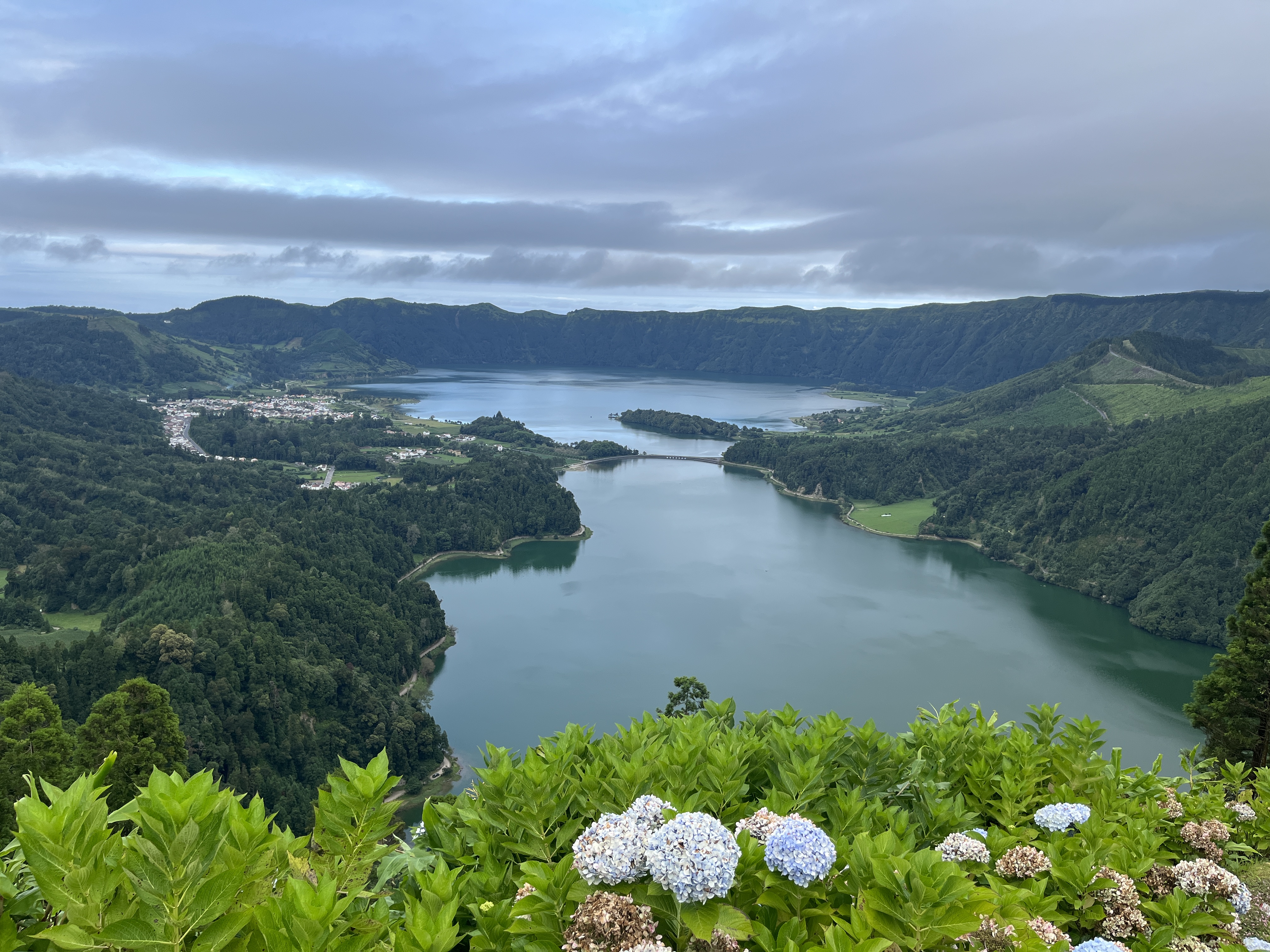
We’ll spend five days on magical São Miguel, one of the nine islands of the Azorean archipelago, “an otherworldly paradise for nature lovers and outdoor adventurers,” as described by Travel & Leisure. We’ll Immerse ourselves in the luxury of one of the island’s most elegant hotels, situated on an 18th century orchard estate, famous among islanders for blending tradition and nature. We’ll savor the cuisine of the island, which fuses farm-to-table and ocean-caught freshness with gourmet takes on traditional Portuguese recipes. And we’ll explore some of the natural wonders of the island, including the hot springs of Furnas, the beauty of the twin volcano lakes at Sete Cidades, and forest bathing in Pinhal da Paz (the pine grove of peace).
During this retreat, you’ll have ample time to write. After a delicious Azorean breakfast, I’ll lead a guided, intention-setting session before you set out to write on your own in the seclusion of the gardens or wherever you choose on the hotel grounds.
I’ll share my mindful approach to writing, what I call “Deep Attention,” a creative practice of looking at the world with intention and without distraction, which I first outlined in this essay. The retreat will incorporate this deep attention practice to help you tap into your creativity, gain new perspectives, and get beyond your daily, habitual obsessions and distractions.

Lunch will be served at the hotel or on guided field trips. After the afternoon field trip, you’ll have an opportunity for another writing session or free time to relax, use the spa, pool, or soak in the heated plunge pool in the pineapple greenhouse. After dinner, you’ll have an opportunity to share your work or reflect upon your experiences.
I’ve designed this retreat to show you some of the best my ancestral island has to offer, and I’ve hand-picked the hotel, restaurants, excursions, and experiences to ensure you will be inspired to write in a relaxed, mindful, and encouraging environment.
Early Bird Discount ends on June 15th, so sign up today!
Find out more: https://www.scottedwardanderson.com/azores-retreat
2018: My Year in Writing Review
November 22, 2018
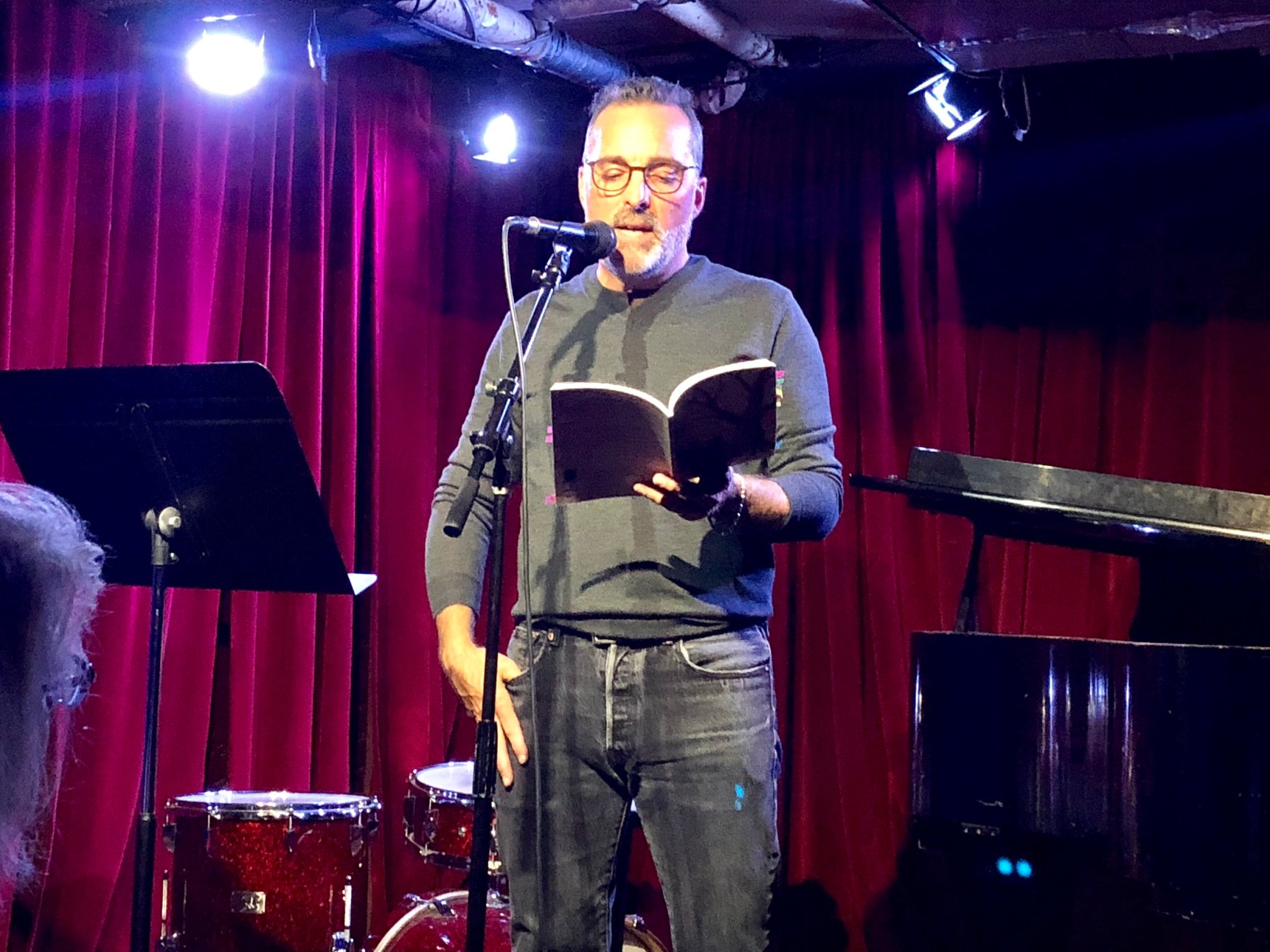
Scott Edward Anderson reading at Cornelia Street Cafe, October 2018. Photo by Den Petrizzo.
This is the time of year when I look back on my writing life over the past twelve months. I’m grateful for all my readers, editors, and listeners in 2018.
As the Walter Lowenfels’s quote at the top of my blog says, “One reader is a miracle; two, a mass movement.” I don’t take any of one of you miracles for granted. Thank you!
January — My craft essay, “Poetry as Practice,” published in Cleaver Magazine. Shanti Arts accepts DWELLING: an ecopoem for release later in year!
February/March — Finish the only poem I complete this year, “Phase Change,” with the help of Alfred Corn, currently on submission. (If you don’t know Alfred’s work, you really should check out his books by following the link above.)
April — My essay on Lowell’s “Skunk Hour” accepted by Schuylkill Valley Journal, published in Spring 2018 issue and online later in the year.
May/June — Write my essay/memoir FALLING UP and submit it to Homebound Publications for their Little Bound Books series. They want it! Will be published in Fall 2019.
July/August — Disquiet Azores residency. Continue research and writing for BELONGING, my “enhanced memoir” of identity, roots, and rediscovering my Azorean-Portuguese heritage.
September — Release of DWELLING: an ecopoem from Shanti Arts.
October — Several readings in support of DWELLING. Present my craft talk, “Making Poems Better: The Process of Revision,” at Boston Book Festival. Appear on “In the Balance” podcast with Susan Lambert.
November — Page proof edits for FALLING UP. Schedule appearances/readings for 2019 in New York, California, and at ASLE 2019. Continue work on BELONGING.
December — Excerpt from “Some Questions of Dwelling,” the prose section of DWELLING: an ecopoem, appears in Still Point Arts Quarterly.
It’s been a good year — thanks everyone for being my miracles!
30 Poems for National Poetry Month: Day 4
April 4, 2013
 Here is my Day 4 poem:
“Happiness is a choice,”
Says my friend Jack.
Whether you choose
To focus on the love
Expressed or the flaws
Hinted at; that’s your choice.
(Okay, you snore.
Is that enough?)
I choose to focus
On thriving, after so long
Languishing. Now
That I have found
The jewel in the crescent
Moon that makes disappear
The flaws in the bezel of my being.
–Scott Edward Anderson
 Writing for posterity may be as old as writing itself. Poets, novelists, essayists, and philosophers all write with the hope that their work will survive them — even if they deny it — living on to touch new readers in distant ages.
Some writers never lived to see their work gain an audience or even a small, devoted readership. Some, like Robert Browning, obsessed about it.
Alas, the quote from Walter Lowenfels that adorns this blog is a daily reminder to me of the fate of almost all of us.
How much of our writing will survive, will last, will live to find readers throughout our lifetime and beyond?
I was struck by this question twice this week.
The first was Tuesday night, having dinner with twin brother poets Dan and David Simpson. We were talking about the fact that none of the three of us had published collections of our work, despite “success” placing individual poems in journals and magazines, and the awards and accolades we’ve received over the years.
David told of an encounter with a writing mentor who reviewed his draft manuscript. The mentor suggested they each go through the script and rate the poems numerically: 1, 2, 3; then they would compare the results and see what came of it.
My friend was dumbfounded that the mentor found so few 1s among the collection — really only a few — and only a few 2s as well. The 3s weren’t even worth mentioning and probably should be discarded, suggested the mentor.
Bruised as David’s ego was by the experience, I found some solace in it.
“How many #1 singles did The Beatles have?” I asked David. (27 is the answer.)
“So, okay, we can agree that none of us are The Beatles,” I offered. “But we could be, say, The Guess Who.” (That group had only had one number 1 single, “American Woman,” for three weeks May 9 -29, 1970, yet we all know the song and you probably have it streaming in your head right now at its mere mention.)
We agreed that we would be lucky to have one “hit” poem continue to be read by people after our deaths. We’d be delighted if a handful survive us, yet it’s helpful to have some perspective.
A few days later I received a request for permission to reprint a piece of writing I did in 1993. This is the most widely reprinted thing I’ve written and, I’m afraid, will likely survive any and all of my creative work.
The piece is a review of N. Scott Momaday‘s In the Presence of the Sun: Stories and Poems, 1961-1991
It’s even been made available for students on such services as eNotes: Scott Edward Anderson (review date 1993).
I re-read the piece this morning — it’s not a bad piece of writing, as reviews go, and certainly lives up to eNotes’ description: “Anderson provides a thematic and stylistic review of In the Presence of the Sun.”
Yet, when I wrote the review, I never imagined it would be my most cited, most reprinted, perhaps even my most read piece of writing.
If only the strong survive may this piece rock on.

 Scott Edward Anderson
 Scott Edward Anderson's Poetry Blog