National Poetry Month 2024, Week Three: Sophia de Mello Breyner Andresen’s “Descobrimento”
April 22, 2024

This Thursday marks the 50th anniversary of the Carnation Revolution, whereby the people of Portugal overthrew the dictatorship under which they had lived for forty-eight years. I have previously shared my translation of Sophia de Mello Breyner Andresen’s poem of the revolution, “25 de Abril” (“25th of April”). Sophia was born in Porto in 1919, she died in 2004 at the age of 84 and is now buried in the National Pantheon in Lisbon, an honor recognizing her as one of Portugal’s greatest poets.
Her work often explored themes of nature, particularly the power and mystery of the sea. Indeed, she can be considered a poet of the sea. One poem that encapsulates her maritime inspiration is “Descobrimento” (“Discovery”). In “Discovery,” Andresen paints a vivid, almost surreal portrait of the ocean through metaphor and visceral imagery. She writes of “An ocean of green muscles/ An idol with as many arms as an octopus/ Incorruptible chaos that erupts/ And orderly turmoil…” [my translation]. This strange yet mesmerizing depiction captures the paradoxical nature of the sea — its turbulent, ungovernable force coexisting with an inherent rhythm and pattern.
The sea represented many things for Andresen beyond its literal presence. As a dedicated Hellenist, she found inspiration in ancient Greek mythology and often blurred the lines between the Atlantic Ocean of her Portuguese homeland and the Mediterranean. The sea became a symbol of renewal, eternity, and the mysteries of life and death.
Her reverence for the ocean likely stemmed from her childhood spent along the coast in Porto, watching the ebb and flow of the tides. The poem evokes her early, formative experiences at Praia de Granja, a beach south of Porto that shaped her poetic vision.
In “Discovery,” Andresen seems to be urging the reader to explore the depths of the ocean and surrender to its “incorruptible chaos.” The sea is both menacing with its crashing waves and comforting in its ceaseless cadence. By wading into those waters, perhaps we can access greater truths about ourselves and the world around us.
With her luminous language and profound naturalism, Sophia de Mello Breyner Andresen invites the reader to discover the ocean anew through her transcendent poetry. “Discovery” reminds us that the seas contain not just thrilling adventures and discoveries, but insights into the very essence of our existence.
Here is my translation of Sophia de Mello Breyner Andresen’s “Descobrimento”:
Discovery
An ocean of green muscles
An idol with as many arms as an octopus
Incorruptible chaos that erupts
And orderly turmoil
Dancer twisted up
Around the outstretched ships
We cross rows of horses
Who shake their manes at the trade winds
The sea suddenly became too young and too old
To show the beaches
And a people
Of newly created men still clay-colored
Still naked, still dazzled
—
Here is the poem in its original Portuguese:
Descobrimento
Um oceano de músculos verdes
Um ídolo de muitos braços como um polvo
Caos incorruptível que irrompe
E tumulto ordenado
Bailarino contorcido
Em redor dos navios esticados
Atravessamos fileiras de cavalos
Que sacudiam as crinas nos alísios
O mar tornou-se de repente muito novo e muito antigo
Para mostrar as praias
E um povo
De homens recém-criados ainda cor de barro
Ainda nus ainda deslumbrados
–Sophia de Mello Breyner Andresen
From Obra Poética III, published by Caminho, Lisboa
To hear Sophia read her poems in 1985: https://www.loc.gov/item/93842563/
My translations of Sophia de Mello Breyner Andresen, along with several other Portuguese poets, appear in my book Wine-Dark Sea: New & Selected Poems & Translations (Shanti Arts, 2022), available through this link or wherever you buy books.
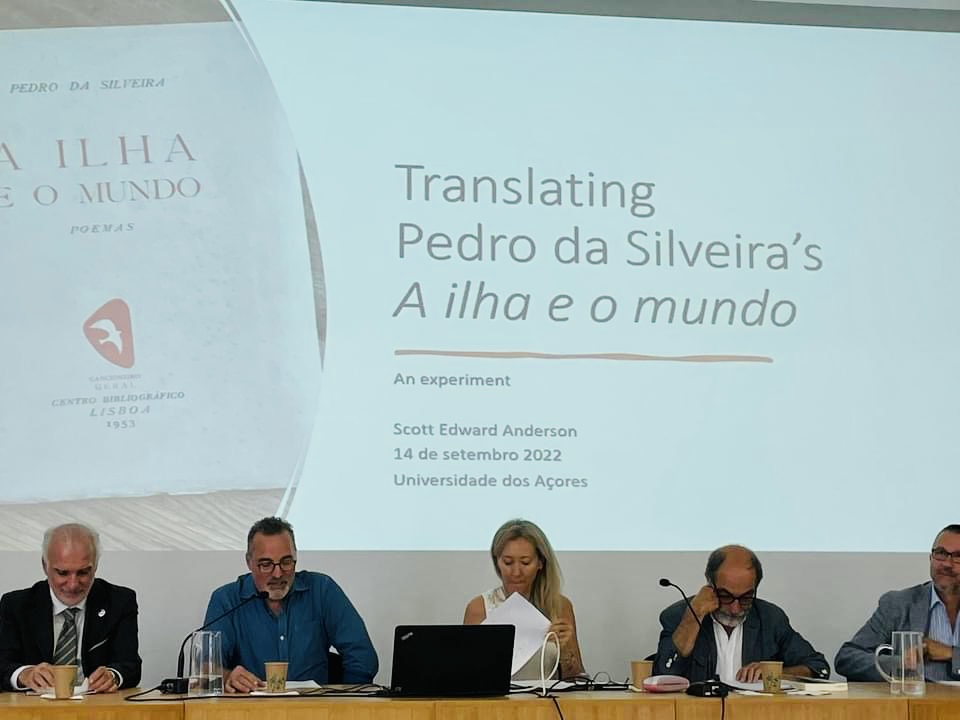
Last summer, I started a project to translate the Azorean poet Pedro da Silveira’s first book A ilha e o mundo (The Island and the World), which came out in 1952.
I had reviewed the late George Monteiro’s translation of Silveira’s last book, published in a bilingual edition by Tagus Press in the States and simultaneously by Letras Lavadas in the Azores in 2019 as Poems in Absentia & Poems from The Island and the World. In fact, the second half of that title was a misnomer; the book included only a few poems from Silveira’s first book–poems that had previously appeared in a Gávea-Brown anthology from the 1980s and sort of slapped on to the end of the book. (Silveira was born on Flores Island in 1922 and died in Lisbon in 2003.)
What struck me immediately about Silveira’s poetry—in Monteiro’s translation first and then in reading the facing Portuguese—was the depth of its feeling, the simplicity and directness of its language, and the brilliant tapestry woven by strands of memory, naming, and observations of nature. Indeed, all aspects that are found in my own poetry; hence, I felt a certain kinship with Silveira’s work straight away.
And yet, I was equally struck by the dearth of his poetry available in translation. How could such a seemingly important poet be so little represented in English translation? How much richer would the world of poetry–and the world of poetry-in-translation–be with Silveira’s body of work. And how much richer would be our lives in the Azorean diaspora with his sentiments, steadfast observations, and steady poetic hand.
I started with the second poem in the book, “Ilha”; this was likely the first poem I ever read by Silveira in translation, from that old Gávea-Brown anthology previously mentioned.
Here is the entire poem in its original Portuguese:
ILHA

Só isto:

                 O céu fechado, uma ganhoa

pairando. Mar. E um barco na distância:

olhos de fome a adivinhar-lhe, à proa,

Califórnias perdidas de abundância.
As I tend to do in my method of translation, I first read the poem straight through and then wrote an impression or literal reading as I understood it:
Just this:

                        The closed sky, a heron

Hovering. Sea. A boat in the distance:

Hungry eyes guessing, at the prow,

Californias lost of abundance.
A bit clunky and prosaic, and probably unworthy. I prefer to not read another’s translation (if there is one) while translating a poem lest I be influenced by it, so Monteiro’s sat on the shelf.
One thing troubled me, however. The bird. Where did that heron come from? Surely, I remembered it from Monteiro’s version. “Ganhoa,” at first, I thought was a misprint of “ganhou” – who won? – but that made absolutely no sense, so I went with heron. But what was a heron doing in this scene? Were herons even found in the Azores?
Reluctantly, I checked Monteiro’s translation. Sure enough, there it was, “heron.” It struck a dissonant chord with me now. A heron. Really? Again, I wondered whether herons were found in the Azores and turned to the Internet.
Yes, there were at least ten species of heron that have been noted on these islands, including great blues and little egrets, which according to the website whalewatchingazores.com have been sighted, but “not regularly”; the species is classified as an “uncommon vagrant” on the islands. And, most recently, a confirmed sighting of another species, the yellow-crowned night heron (Nyctanassa violacea) was described in a scientific paper by João Pedro Barreiros. Most likely, however, this one was blown east by a strong, errant wind from the west. Several herons were known to stop-over on their migratory path from Africa to northern climes and back.
Still, heron didn’t seem correct, to me, given the scene described. The use of Mar all alone. And the boat seemed to imply open waters rather than shoreline.
Herons are marsh-dwelling, shoreline species for the most part, so I was perplexed why they might be hovering “at Sea” or the “open ocean,” as I envisioned it. Were they blown off-course and out of their range? That would surely change the nature of this poem, which I assumed was about emigration or the emigrant returned or the desire to emigrate but also remain tied to the island. If it was not a heron, what was it then? What else might “hover” over the open ocean?
I typed “ganhoa” into Google. The almighty, all-seeing Google asked if I meant “ganhos” earnings; no, I did not. This was not a poem set in the halls of finance or a casino in Monaco. So, I clicked on “search instead for ganhoa” and up came a page from Priberam dicionário. I had my bird! The yellow-legged gull (Larus michahellis atlantis)…surely this bird would hover over the prow or bow of the boat, and even the stern, looking for a handout. A ganhoa recupera os seus ganhos. (The gull recovers its winnings.)
Here is my version of Pedro da Silveira’s “Island”:
Just this:

                    The closed sky, a yellow-legged gull

hovering. Open ocean. And a boat in the distance:

Hungry eyes, at the bow, divining,

lost Californias of plenty.
(Translated from the Portuguese by Scott Edward Anderson)
____
(This text was adapted from a paper delivered at the Colóquio celebrating the 100th anniversary of the birth of Pedro da Silveira, “Pedro da Silveira – faces de um poliedro cultural,” at the University of the Azores in Ponta Delgada, São Miguel, in September 2022.)
Speaking of the Azores: I am excited to host a Writing Retreat there from 13-18 October 2023! Join me for 5 days of writing and immersion in the nature, food, and culture of the Azores. We’ll explore the island, focus with deep attention, expand our horizons, and tap into the stories within. Details and registration at https://www.scottedwardanderson.com/azores-retreat
My friend and colleague Leonor Sampaio da Silva published her first collection of poems last summer, Quase um Carimbo (Companhia das Ilhas, 2022).

Born on the island of São Miguel, Azores, Leonor holds a master’s degree in Anglo-Portuguese Studies from the Universidade Novo de Lisboa and a PhD in Anglo-American Studies from the University of the Azores, where she has taught since 1991.
Having published a number of academic papers and contributions to various books, anthologies, and literary magazines, Leonor made her literary debut with a book of short stories, Mau Tempo e Má Sorte – contos pouco exemplares, which received the Daniel de Sá Humanities Prize in 2014. She is also the author of ABN da Pessoa com Universo ao Fundo (2017) and, with Carlos Carvalho, Pouca Terra – Fotografia e Literatura (2019).
“My idea for [this] book was to talk about the experience of isolation caused by the pandemic,” Leonor explained to me. “In which we lost contact with others and forced ourselves to face situations such as the vulnerability of life, how to make sense of each day, how to live with routine.”
Some of the poems read like diary entries, the poetic voice spoken by characters representing, as Leonor notes, “the others that exist within and outside of oneself.”
“Carimbo,” it may be useful to note, means “stamp,” the kind used to mark or authenticate official or private papers. Another meaning of the word, however, is “timestamp” (although usually written as “carimbo de data/hora.”) and, in this collection, each poem is marked by a timestamp: morning, afternoon, or night, as well as an action–I wake up, I sit down, I get up–as if to indicate stage direction.
It’s as if the characters in the poems are actors in their own play, marking their time, the pandemic imbuing even the most mundane tasks with the aspects of a theatrical production.
The book title translates as “Almost a Stamp,” which leads the reader to a question: if it is “almost,” what is it? An approximation? What is reality? The questions are heightened by the ending of the book where the theatrical stage suddenly becomes cinematic, play becomes film, language shifts in tone, the curtain falls, a wind picks up, a torrential rain pours down, and fallen leaves return to their trees. The speaker remains lonely. The book ends with one last action: “Adormeço” (I fall asleep).
“Poetry,” Leonor argues, “is a way of putting us in touch with each other and exploring new languages.” She carries this thread throughout the collection, whether using “the more intimate language of the diary/newspaper” or “the more social language of the theater,” demonstrating that “everything happens as if on a stage” and shielding us from loneliness and death.
Quase um Carimbo is an impressive debut poetry collection and I hope to translate more of it in the future.
Here are two poems by Leonor Sampaio da Silva in the original Portuguese and my translations into English:
manhã
acordo
uma personagem pragueja baixinho
pela noite mal dormida
o que farei se um Comboio transformar
a geografia deste lugar?
pensar no improvável tem sido
passatempo habitual
quase uma Obsessão
preocupa-me em demasia
a falta de uma Estação
—
morning
I wake up
a character curses softly
over the sleepless night
what will I do if a train transforms
the geography of this place?
thinking about the improbable has been
a regular hobby
almost an obsession
it worries me too much
the lack of a station
________
manhã
acordo
deve estar um dia quente a avaliar pela
temperatura do quarto
o corpo, o que é um corpo?
uma madeixa cortada
vivendo por um fio
enquanto aguarda reunir-se
à cabeça que dela se esqueceu
uma madeixa que se deixa
varrer
alisar
torcer em caracol
alourar ao sol
o sol, o que é o sol?
um corpo
—
morning
I wake up
it must be a hot day judging by
the temperature of the room
a body, what is a body?
a severed lock
living by a thread
while waiting to be reunited
with the head that has forgotten it
a lock that lets itself
sweep
smooth
twists into a curl
glistening in the sun
the sun, what is the sun?
a body
–Leonor Sampaio da Silva, from Quase um Carimbo
(translated from the Portuguese by Scott Edward Anderson)
___
Speaking of the island of São Miguel: I am excited to host a Writing Retreat there from 13-18 October 2023! Join me for 5 days of writing and immersion in the nature, food, and culture of the Azores. We’ll explore the island, focus with deep attention, expand our horizons, and tap into the stories within. Details and registration at https://www.scottedwardanderson.com/azores-retreat

São Miguel, Azores, Portugal
“I don’t write to say what I think. I write to find out what I’m thinking,” said the poet Gary Snyder. To that I might add, I write to understand who I am.
Lately, I’ve been working on a project—a kind of enhanced memoir—that explores my Portuguese family history. As part of this project, I’ll be going to the Island of São Miguel in the Azores this summer, where two of my maternal great-grandparents came from, for a residency hosted by DISQUIET International, which brings together Portuguese and Portuguese-American writers.
I first started researching my Portuguese roots back in the 90s and, coincidentally, that’s when I met the Portuguese poet, Nuno Júdice. He read at Poets House, along with the translator Richard Zenith, in December of 1994.
The author of over twenty books of poems, Júdice was born in 1949, on the southern coast of Portugal, in the region known as the Algarve. He is currently a professor at Lisbon’s Universidade Nova and directs the Colóquio/Letters program for the Gulbenkian Foundation. I’m hoping to see him in Lisbon when we are on the mainland.
Here is Nuno Júdice’s “Poema” in its original and in a translation by Martin Earl.
POEMA
As coisas mais simples, ouço-as no intervalo
do vento, quando um simples bater de chuva nos
vidros rompe o silêncio da noite, e o seu ritmo
se sobrepõe ao das palavras. Por vezes, é uma
voz cansada, que repete incansavelmente
o que a noite ensina a quem a vive; de outras
vezes, corre, apressada, atropelando sentidos
e frases como se quisesse chegar ao fim, mais
depressa do que a madrugada. São coisas simples
como a areia que se apanha, e escorre por
entre os dedos enquanto os olhos procuram
uma linha nítida no horizonte; ou são as
coisas que subitamente lembramos, quando
o sol emerge num breve rasgão de nuvem.
Estas são as coisas que passam, quando o vento
fica; e são elas que tentamos lembrar, como
se as tivéssemos ouvido, e o ruído da chuva nos
vidros não tivesse apagado a sua voz.
—
POEM
It’s the simplest things that I hear in the wind’s
intervals, when the simple beating of the rain
on the windows breaks the silence of night, and its rhythm
overwhelms that of words. Sometimes, it is a
tired voice, that tirelessly repeats
what the night teaches those who live it; other
times, it runs, hurriedly, mowing down meanings
and phrases as though it wanted to reach the end, more
quickly than the dawn. We’re talking about simple things,
like the sand which is scooped up, and runs
through your fingers while your eyes search
for a clear line on the horizon; or things
that we suddenly remember, when
the sun emerges from a brief tear in the clouds.
These are the things that happen, when the wind
remains; and it is these we try to recall, as though
we had heard them, and the noise of the rain
on the windowpanes had not snuffed out their voice.
© 2006 Nuno Júdice, from As coisas mais simples, Lisbon: Dom Quixote, 2006
Translation © 2007 Martin Earl, first published on Poetry International, 2014
 Scott Edward Anderson
 Scott Edward Anderson's Poetry Blog