National Poetry Month 2016, Week Five: My poem “Villanesca”
April 29, 2016
 For the fifth and final week of National Poetry Month this year, I’m featuring one of my own poem, “Villanesca.”
This poem was published last summer in Cimarron Review, thanks to poet Alfred Corn, who chose the poem in his role as a contributing editor.
Alfred also provided some critical guidance to help me finish this poem, which I’d been working on for several years. The poem sprang from a conversation overheard between my friend and colleague, Jan Almquist, and his daughter on the train to DC a decade ago.
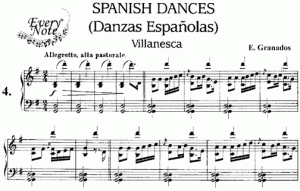
We were traveling down to pitch the design of The Nature Conservancy’s Annual Report when Jan got a call from his then teenage daughter about leaving her score for Enrique Granados’s “Spanish Dances,” at home and asking him to bring it to her. That was all I needed to prompt the poem, although it obviously went in a different direction.
Sometime later, after boarding a plane, I found a program of Granados on the audio channel featuring the fabulous interpretations of De Larrocha. Obviously, I had to get that into the poem somehow and it helped build another layer.
As mentioned in last week’s post, I shared this poem with poet A.V. Christie a few months before her death. I was very touched by her response to the poem. She wrote, “I love the tone of this poem & the subtle/textured types of communication it’s built up out of…I experience it…it’s so active & in motion…”
Here is my poem, “Villanesca,”
Before the cabin door shuts, I check messages.
You forgot your score for “Spanish Dances” on the piano,
left open at the “Villanesca,” a piece with pastoral repetitions
you found hard to reproduce. Your rough interpretation
reminds me of your voice and its effect (or its affect).
Headphones on, I listen to Alicia de Larrocha
performing Granados. The program host has a soothing lisp,
enunciating every syl – la – ble, like a reporter on NPR.
Quoting from a review, she says De Larrocha’s playing speaks
to “a glorious inevitability achieved through immense discipline.”
“Can you bring the score to my rehearsal?” you ask
via voice mail, forgetting my flight this afternoon.
Unlike De Larrocha you always forget the score,
ignore signals, struggle to find the right notes, refuse
to face the music of our own inglorious inevitability.
I press delete, choosing not to repeat past mistakes;
at least, for the duration of my flight.
–Scott Edward Anderson
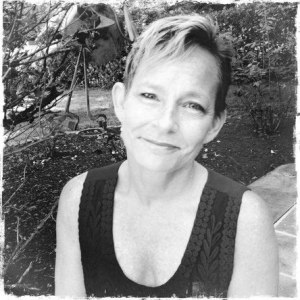
A.V. Christie
(Photo: Darcie Goldberg)
Poet A.V. Christie died this month. Poets die all the time – celebrities, too, and friends, family members. Death is inevitable. We are all dying as we go on living.
Over the past two years there have been countless poets passing, some well-known, such as Seamus Heaney, Galway Kinnell, and Philip Levine; some not as known as they should be: Belle Waring, Wendy Batin, and David Simpson.
Somehow, though, Ann Christie’s death hit home more than the others. Perhaps because she was my age; perhaps because I was in Philadelphia when I heard the news, across the river from where she lived. Perhaps, too, because we’d read together over the years in different venues in the Philadelphia area.
But also because we had just corresponded a few months back via Facebook, as she continued to battle Stage 4 cancer. When I asked if there was anything I could do to help her with her struggle, she asked me to send a recent poem. (I did and will share it you next week.)
Ann was generous like that and cared deeply about poetry and people. She experienced a great deal of pain in her life – her brother committed suicide when he was 32, which she wrote about so eloquently and forcefully in her first book, Nine Skies (University of Illinois Press, 1997).
I’ve been re-reading Ann’s work the past week or so, and eagerly awaiting the publication next month of her last chapbook, And I Began to Entertain Doubts, coming out from Folded Word Press. Her other books include, The Housing (The Ashland Poetry Press, 2004) and The Wonders (Seven Kitchens Press, 2014).
In thinking about a poem of hers to share, it suddenly dawned on me – actually, as I struggled to fold a fitted sheet in our laundry room the other night — that a poem that shows off the facets of Ann’s poetry jewels is her poem on that subject, “Folding the Fitted Sheet,” which of course is about more than that, but it made me smile thinking of and reading it again, which is what her poems do best: rouse us out of our everyday reality.
Her poems make us feel something new, look at things a different way – from heartache to routines – they challenge our perspective on the world. This, in the end, is what great poetry is supposed to do.
Here is A.V. Christie’s poem, “Folding the Fitted Sheet”:
There is a way to do this.
The sheet stiff from the line
and king-size overwhelming as an hour can be.
Arms outstretched.
She apes a stance that looks like welcoming.
This obstinate sea!
The day has been so far fear and syllables rippling.
So commence to fit each messy gather
one to the next—.
Pulled to, like a widespread inner panic managed
repeatedly.
One corner puckers, then droops— a sun
that, disaffected, simply drops from out of the sky.
In this method the right side and the wrong
confound. She says aloud the words Counterpane—
Horizon— thinks out the demands of tomorrow’s
presentation, velocity, the power-point resources
circulating and the cool weight
of what gets infolded.
We watch her,
the one moving deeply along a nerve—
toward some far city or god.
-A.V. Christie (1963-2016)
Source: Cave Wall (2009)
You can learn more about A.V. Christie’s poetry here: http://www.avchristie.com/
A Memorial reading will take place at Moonstone @ Brandywine Workshop in Philadelphia on 26 May.
National Poetry Month 2016, Week Three: Gregory Pardlo’s “Epistemology of the Phone Booth”
April 15, 2016
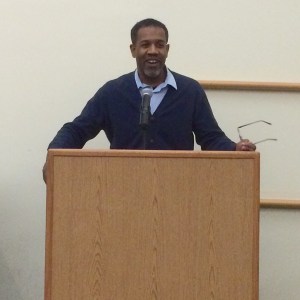
Gregory Pardlo reading at LIU Brooklyn. Photo by SEA
When I heard that Gregory Pardlo won the Pulitzer Prize last year for his poetry collection, Digest, I thought about the phrase “booty call.”
That’s right, booty call.
I had this memory of meeting Gregory Pardlo in Camden, NJ, sometime in the early 2000s, standing out front of a bar with Daniel Nester and Tom Hartman after a reading or an editorial session of Painted Bride Quarterly, which I helped edit at the time.
We were discussing the poetical possibilities of the phrase. I’m not sure where the conversation went after that; there were other phrases we thought had a natural tone and scanned well, but this was before phrases like “person of interest” and “shelter in place” became well known.
Pardlo, who was born in Philadelphia, but grew up in Willingboro, NJ, earned his BA from Rutgers-Camden and later got an MFA at NYU. Somehow I missed his first collection, Totem, which won the APR/Honickman Prize and was published by Copper Canyon Press in 2007. Digest seemed to come out of nowhere to nab the Pulitzer.
So when Pardlo read at the Brooklyn campus of Long Island University this past February, I had to answer the call and go hear him. I was not disappointed.
Pardlo has an engaging reading style that is part college professor, part Brooklyn stoop-storyteller. And the complexity and tenderness of his poems, what one critic called “both dense and accessible, literary yet urban,” is captivating.
In his poem “Epistemology of the Phone Booth,” a fourteen-year-old boy uses a prepaid phone card, the back pages of a local free weekly, and a phone booth to seek a knowledge of the unknown and, perhaps, unknowable. He’s on the brink of discovery and, simultaneously, on the verge of repentance only to find that the ability to acquire knowledge in this manner may be finite. It’s a kind of “booty call” about the nature of knowledge.
Here is Gregory Pardlo’s poem, “Epistemology of the Phone Booth”:
I found the scrap of City Paper
classified, the 1-900 number and photos
like candidates there, in love’s voting machine.
Discomfort station. No pissoir. Hothouse maybe for
a fourteenth-year sprig: me. Light box
to slideshow the introvert
cloaked in a prepaid identity
discreet as a shirttail in the fly.
Ma Bell’s shelter
was brutal & snug. I’d heard the ram’s horn hum.
A hymn. Just like prayer I thought. No answer.
Clack’d the splendid tongue
and bloom!
Salutations rose like pollen, prepped me for
the inverse of police
sketch artists, the one who would evoke so I could render,
in my mind, the enigma of the wanted; one to source
the vacuum wrenching stutters like rivets
off my tongue.
Plink. Into the sewer of the mouthpiece.
Then the universal ballad of the waiting room.
Casiotone.
Hold (me) music.
No orgone
closet. More like that other-lonely doom—the body
encapsulated, its inventory ever unknown. Dantean vestibule.
Anti-chat room.
When the genderless voice beyond
began to lavish I grew ears all over,
inner ears
swiveling from one tepid libretto to the next
tuning for some satin frequency the culture
promised until, I repent (forgive me father), the card went bust.
–Gregory Pardlo
Copyright @ 2014 by Gregory Pardlo. Used with permission of the author.
Read more about Gregory Pardlo and his work at http://www.pardlo.com/
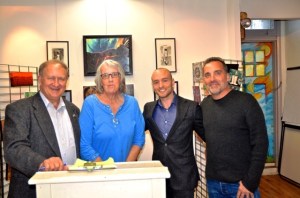
Peter Krok, Eileen Moeller, Cameron Conaway, and Scott Edward Anderson at MRAC, November 2015. Photo: Ron Howard
Late last year I read at the Manayunk-Roxborough Arts Center in Philadelphia. The event was billed as “Poets with a Cause” and featured two other poets neither of whom were familiar to me, Cameron Conaway and Eileen Moeller.
There were some common themes in our work – nature, travel, and spirituality — and, after the reading Eileen and I exchanged books, as poets often do.
As with my book, Fallow Field, which compiled work written over a 25-year period, the poems in Eileen’s book, Firefly, Brightly Burning were written over many years.
“When I first put the manuscript together, it seemed like a patchwork of unlike things, perhaps because it contains a number of serial pieces,” Moeller said in an interview. “Many of the poems come from a fictional, narrative impulse, though certainly not all.”
One series, the “Anna God” poems, Moeller relates in the interview, “were instigated by a photo in the newspaper of a college girl asleep on a couch in a triangle of sunlight. Her name was, yes, you guessed it, Anna God.”
Moeller’s Anna God poems at first seem surreal: a smitten skunk follows Anna around; she gets a “B” for a fifth-grade diorama of a clay man “throwing paper girls/ across the sky like tiny airplanes”; Death comes to visit and asks for a better contract; “she thinks of each leg hair as a redwood tree” and she can’t find a razor big enough to do the job.
“My aim in the poems is to catch the reader in an erotics of sound, story, and feeling,” says Moeller in an artist’s statement about her work overall. “The web that stretches between the poles of lyric and narrative. I look for surprises, wait for them to leap up out of the quotidian, like fish breaking the surface of the poem at its ruptures of juxtaposition and metaphor. We read the world through the lens of the body, and I try to ride its hungers, triumphs, joys, follies, wounds, even its decay. So, the soul evolves in its salt brine of words.”
Here is Eileen Moeller’s poem “Anna God Remembers,” which I find particularly haunting:
Ann God Remembers
the time she followed in
her father’s footsteps,
tiptoeing through the night
behind him as he left for the barn.
She was only two years old but she remembers
how the front door locked behind her
and he went off to do the milking,
not even seeing her standing there
in her little coat and rubber boots.
She remembers singing to herself
as she curled up on the front porch
to get out of the wind.
But her mother never heard her over the wailing.
The rest she only knows from stories:
how she froze like a porcelain doll there,
on a night that dipped to eight below.
(Her mother always cried at the part
where she found Anna blue as skim milk,
and drove her to the hospital,
dead and stiff on the back seat.
Anna would cry too, over how
the Doctors swore and wept and pleaded,
thawing her out, coaxing her heart into beating again).
It’s fuzzy, but Anna remembers
being startled awake by warm hands
kneading her arms and legs,
and the voices saying: Come on, open your eyes.
Once in awhile she dreams she is her father again:
dozing in the straw against the kindly beasts,
warm as a newborn calf.
–Eileen Moeller
from Firefly, Brightly Burning (Grayson Books, 2015)
Used by permission of the author.
You can read more about Eileen and her work at http://eileenmoeller.blogspot.com/
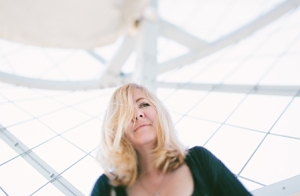
Erin Belieu
(photo by Gesi Schilling)
Erin Belieu is one of the poets of my generation whose work I turn to most.
Ever since her first collection, Infanta, came out in 1995, Belieu consistently impresses me with her witty, philosophical, and deceptively conversational poems that are actually the result of rigorous revision.
“I’m very much a sculptor with my poems,” Belieu said in an interview. “It’s getting it on the page where the ditch digging begins.” That may be one aspect of her work that attracts me – although it flows on the page as naturally as a phone conversation, I know it’s the result of much effort.
Another aspect is her clarity of language – she has an “aversion to artifice” and “can’t abide pretension,” as two critics have said of her work. Her humor and pathos and contrariness keep bringing me back to the poems, where I also find moments of real vulnerability.
“You’d hope we’re something/ more than a sack of impulse, of soul defined/ by random gristle,” she writes in “The Body is a Big Sagacity.” Nietzsche’s phrase, from the “Despisers of the Body” section of Thus Spoke Zarathustra, reads “The body is a big sagacity, a plurality with one sense, a war and a peace, a flock and a shepherd.”
Yet, while Nietzsche espouses a vision where there is no difference between the physical and psychological ability of the body, where a human being’s purpose is to surpass itself, Belieu’s “little man, with itty hands” requires a giant, superhuman truck to surpass the abilities or limitations of his own body.
In a poet of lesser gifts, Belieu’s wry observations may seem mean-spirited; and then she counts herself among the challenged, claiming her own body “once was whole, symmetrical, was/ actually beautiful for three consecutive years,” to reveal where her sympathies lie.
Belieu once said she was “under no illusion that the world can’t sleep without the next Erin Belieu poem.” There are many among us who beg to disagree. Here is Erin Belieu’s poem, “The Body is a Big Sagacity”:
The Body Is a Big Sagacity
is another thing Nietzsche said
that hits me as pretty specious,
while sitting in my car in the Costco
parking lot, listening to the Ballet
mécanique of metal buggies shrieking,
as each super, singular, and self-contained
wisdom of this Monday morning rumbles
its jumbo packs of toilet paper and Diet Coke
up the sidewalk. So count me a Despiser
of the Body, though I didn’t generate this
woe any more than the little man parked
next to me, now attempting the descent from
his giant truck, behemoth whose Hemi roars
like a melting reactor and stands
as the ego’s corrective to the base methods
by which the body lets the spirit down.
Buzz-clipped, tidy as an otter, he’s high and
tight in his riding heels. Pearl snaps on
the little man’s shirt throw tiny lasers
when he passes. But who isn’t more war
than peace? And how ridiculous to suffer
this: to be a little man, with itty hands
and bitty feet, to know yourself lethal, but
Krazy Glued for life to the most laughable
engine. Recycled, rewired, product of
genes and whatever our mamas thought
to smoke: the spirit gets no vote, Fred.
My body once was whole, symmetrical, was
actually beautiful for three consecutive years,
expensive as a rented palace, and yet I blew
that measly era watching my clock hands move,
as if I were the trigger rigged to homemade
dynamite. But if you would look inside me,
into all the lonely seeming folks here loading
their heavy bags, you’d hope we’re something
more than a sack of impulse, of soul defined
by random gristle. Which is why the little man
pauses on the sidewalk, why he stops to look at
me looking at him: this pocket-size person,
whose gaze unkinks a low, hairy voltage from
my coccyx. And thus speaks Zarathustra,
You Great Star,
what would Your happiness be
had You not those for whom
You shine?
Ask the little man, neither ghost nor plant,
his bootheels ringing down the concrete.
–Erin Belieu
from Slant Six (Copper Canyon Press)
Copyright © 2015 by Erin Belieu
All rights reserved. Used by permission of the author.
On Becoming the Subject: When Someone Writes About Your Work
January 10, 2016
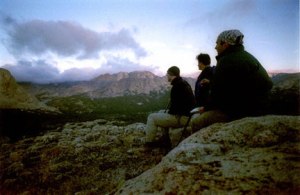
The poet (in bandanna) and pals, Wind River Range, Wyoming, Summer 2001. Photo by Joshua Sheldon.
“I never read my reviews,” the novelist Pat Conroy once said. “Not even the good ones. Barbra Streisand once told me, if just one person in the audience doesn’t applaud, it bothers her. I’m the same way. I’d be devastated to read that someone didn’t like my work.”
Back in 2001, a young woman named Veronika Linhartova Morley, then a student at De Anza College in Cupertino, California, contacted me by email. She wanted to write about my poetry for a class assignment on contemporary American poets.
She told me she’d read a poem of mine called “Carpentry” in the Boston Review and had found a number of other poems on line. I was flattered. Only, I never wrote a poem with that title and I’ve not yet published in the Boston Review. I looked up the poem, which was written by a Scott Anderson (see the link above) and thought, I could have written it, but I didn’t.
I hated to disappoint Ms. Morley, but broke the news to her by reply email. She was embarrassed; however, it turned out that all the other poems she’d found were indeed mine, and she still wanted to write about my work. We had a nice correspondence and she wrote a delightful little essay about my poetry and the influence of Elizabeth Bishop and Donald Hall on my work.
Her essay begins with a lengthy quote from a lecture I gave at the University of Alaska some years before:
“The contemporary poet of my choice, Scott Edward Anderson, once wrote in his essay ‘Making Poems Better: The Process of Revision’: ‘…writing poems is a lot like cooking. We bring everything we know about cooking and about what foods go well together to preparing a meal, just as we bring all we’ve learned or read or practiced to writing a poem. Sometimes, it’s just luck that we get the right combination of ingredients, but much of the time a fine meal is made from good ingredients being put together by a well-practiced chef.'”
She went on to make some good observations about my work and points about what I learned from both Bishop and Hall. She also identified a spiritual note in my work and my conflicting feelings about “the way we treat our world.”
In all, it’s a pretty accurate picture of my work, its process and two of my biggest influences. And the last line of her essay would make any poet proud. She writes that through her assignment and correspondence with me, she “not only learned about the process of writing poetry, but also learned to appreciate poetry even more.”
I don’t know how the essay was graded. I still have a copy. Veronika came to this country from Czechoslovakia in the late 1990s, as she told me, to get the kind of education unavailable in her own country. Some time ago, she gave me permission to reprint the essay, which you can read in full here.
My Poem “Deserted Sheep”
January 7, 2016

Sheep in the Scottish Borderlands, August 2014. Photo by SEA
Twice in my life I wanted to raise sheep. I’m not sure why. Perhaps it is an interest stemming from deep within my Scottish and Portuguese heritage.
The first time, I was as a teenager outside of Rochester, New York. I considered enrolling in the organic agriculture program at Goddard College in Vermont, where I’d learn animal husbandry and then get a piece of land where I could raise a flock. I heard that Canada had a generous homesteader program and wrote to various provincial governments. (I still have a couple of their responses.)
The second time was in 1992, I had just moved to Garrison, New York, into a converted ice house on the old Vanderbilt-Webb estate. I bought Raising Sheep the Modern Way by Paula Simmons and a few other books and looked into buying a few starter sheep from a neighbor. (I still can’t part with my copy of Simmons’s book.)
While my poem, “Deserted Sheep,” which was part of a group of three poems that won the Nebraska Review Award in 1997, was certainly influenced by my experiences in New York’s countryside, thinking about raising sheep, it was a very different landscape that provided the inspiration.
I was walking the hills outside of Giessen, in what was then West Germany, in the spring of 1987, when I stumbled upon the sheepfold described in the poem. The sheep were alone, except for each other, grazing within a small, orange plastic enclosure.
Like many of the poems I wrote at the time, the early drafts were heavily influenced by my attempts to learn the German language through reading its poetry — no easy task. This course of study had a deleterious effect on my writing at the time, as I’ve described elsewhere, and it took me a long time to get my native tongue back to its proper place; not to mention my syntax, grammar, and word order!
By the time I arrived at the version that appeared in the Nebraska Review and, later, in my book Fallow Field, the result was very different, after many stumbles and headlong bumps like those lambs in the poem.
Perhaps one day I will retire to the Azores and raise sheep. Now that my wife, Samantha, has taken up knitting we could use the extra wool and lamb kofta is a favorite dish of ours. Here is my poem,
Deserted Sheep
Lambs, jostled, forgive
the wolf, break
its taste in lamb
into a toddler’s gallop,
bumping headlong
into thick-piled ewes–
lanolin slicking their noses, as
they stumble on the fescue
dotting the valley,
a pointillist’s landscape.
No shepherd, no sheep dog,
no gate to enter; a small,
orange plastic snow fence,
neatly staked at four corners
with steel posts,
gives form to the sheepcote.
The last ounce of sun
a violet tremor the wolf
forgives, lingering
along the western ridge,
the shepherd’s fear
returning to the valley.
A ram, brown and flocculent,
secures a silent corner
of the fold — eyes intent
upon a slow-moving shadow.
–Scott Edward Anderson
My Poem “For T—“
August 26, 2015
 I’m not one for “What might have beens.”
Frankly, it always seems a waste of time to think about life that way. Last year, however, while I was writing poems in response to weekly prompts as part of the “52” poetry group, I wrote a poem to the prompt, “So Near and Yet…”
If I recall correctly, the idea was to “think about something that nearly happened…” (I can’t verify because the prompts on the 52 site have been removed as its curator/founder Jo Bell compiles them into a book.)
Participating in 52, as I’ve written earlier, took me out of my comfort zone — both in method and subject matter. Several of the poems I wrote that year are more open and honest, at least in a self-referential way, than much of my earlier work. Almost I want to call them confessional.
In part this is because I rarely, if ever, write about myself in my poems. The prompts prompted that, but so did the honest and constructive feedback of the group. I felt safe to explore this other dimension and see where it took my work.
All of this leads me to my poem, “For T—,” which tells the story of an encounter that could have changed my life, but didn’t (or did it?). It’s not an incident about which I’m particularly proud.
And yet, as the material for a poem it worked in a strange way. At least my fellow 52ers felt so, as did the editors of the Yellow Chair Review, who published it in their latest issue.
Here is the poem:
For T—
I asked her to dance at a black tie dinner for Literacy.
She said she didn’t dance; I’d have to teach her.
Her friend, sitting next seat over, who later played
Hagrid in the Harry Potter films, cautioned,
“Be gentle with her now or you’ll be answering to me.”
She smiled when I bowed before taking her hand.
She was light on her feet and let me lead.
No one had moved her that way before,
so in control, she whispered in my ear.
And when the dance was over, I bowed again.
She thanked me, asked did I want to come
see her in “Hamlet” on Broadway? I did.
I brought flowers, met her backstage;
she came out with me; later, I put her in a cab.
“Do you fancy coming uptown?”
I demurred, made some excuse.
Perhaps another time, I suggested,
knowing there would be none.
(I’d no business being there in the first:
I was married; unhappily, but still.)
It couldn’t have ended well. No doubt,
we’d divorce after a few violent years.
She moving on to stage and screen;
me, the scapegoat in the press,
spilling popcorn on myself in the house seats.
–Scott Edward Anderson
To read the full Issue #3 of Yellow Chair Review, which has some fantastic poems by other poets from 52 and elsewhere, go here.
And you can read a selection of the poems from the 52 group in this Nine Arches Press book, here.
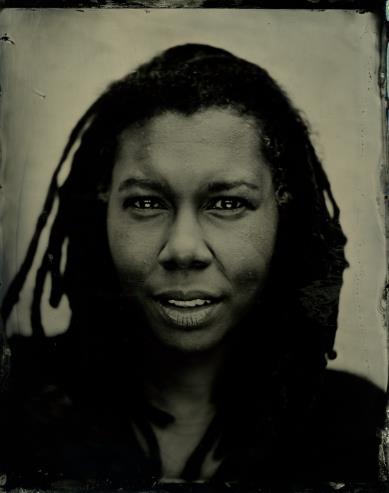
Sheree Mack c) 2012 Alastair Cook
Every month it seems there is another flashpoint of tensions between police and black communities in cities around the United States.
From Ferguson to Baltimore, our country seems ready to tear at the seams from a volatile combination of racial prejudice, police militarism, and the systemic poverty and disenfranchisement black people feel in America today.
It is impossible to ignore this critical issue of our day – we ignore it at our peril – even in a forum such as this.
In that light, I asked poet Sheree Mack if I could feature one of her poems for this final week of National Poetry Month. I was thinking we’d choose one from her remarkable new book, Laventille, which I’ve just started reading.
But Sheree asked if I’d rather have a new poem, one where she is trying “to get my head around the issue of race in America now with #BlackLivesMatter and how things haven’t changed much since lynching was another arm of the ‘law’.”
When she sent me, “Called Witness,” I jumped at the chance to share it, with its unflinching mixture of found texts (from a source cited below) and its paraphrase of Billie Holiday’s “Strange Fruit” in line 8.
Sheree Mack was born in 1971 in Bradford, England, to a Trinidadian father and a “Geordie” mother of Ghanaian and Bajan ancestry. She worked as a teacher for several years before studying for a PhD on black British women poets.
Sheree now dedicates her life to “fostering creativity in everyone’s life” working with communities of women and young writers, and currently lives in Tynemouth. She is the author of two collections, Family Album (Flambard Press, 2011) and Laventille (Smokestack Books, 2015).
I met Sheree Mack through the group “52,” which I participated in last year. Members of “52” wrote poems each week to prompts supplied by the group’s founder, Jo Bell, and commented upon each other’s work in a closed group on Facebook. (See my blog post on the subject here.)
Sheree’s poetry rose to the surface in my mind for its clarity, craft, and complexity of vision. Mack’s poems “lament, rage and mourn,” as the publisher says about her latest book. “But they also offer a song of healing, a celebration of survival, a glimmer of the flames that burn in the hearts of a people still living in slavery’s dark shadow. “
Her perceptive comments on a number of poems (mine and others) flagged her as one of those people you want to spend time with, even if the only opportunity is through the auspices of a virtual poetry workshop.
It was only later that I realized she was also the subject of my friend Alastair Cook’s stunning collodion portrait of a striking woman with captivating eyes, that I’d seen as part of his McArthur’s Store exhibition. There is something haunting about this portrait, as is the case of much of Alastair’s work in the medium.
The image is timeless or time-bound or both simultaneously. It could just as easily be a photograph of someone from Trinidad and Tobago at the time of the 1970 student uprisings in Laventille (the subject of her book) or an image from an even earlier era.
In short, the photo is a bit like Sheree Mack’s poetry: a bit timeless, a bit time-bound, but always unflinching and intriguing.
Here is Sheree Mack’s poem, “Called Witness”:
The exhibition opened in a small New York gallery.
The crowds came, self-righteous and proud.
Assembled and displayed were sixty photographs,
collected from family albums, attic trunks, flea markets.
Small, black-and-white postcards,
not more than a few inches long and wide,
depicting African-American men in Jim Crow
South; black bodies swinging from poplar trees.
Long lines stood for hours on the wintry
sidewalk, waiting for their view.
Once inside, bodies overwhelmed the intimate space.
Images laid flat on display tables or assembled
in tight groupings tacked to light-coloured walls.
Tattered, faded and worn, neither retouched nor restored.
Nor framed, matted, or captioned. Instead offered
as artefacts, not fine art objects. None for sale.
Visitor huddled close, hunched over tables,
faces pushed up against the walls, they felt
the warmth and proximity of others, jostling
and angling their bodies for a better look.
Through generations, onlookers enticed to the scene
by the spectacle of mutilated, dangling bodies.
c) 2015 Sheree Mack
Used by permission of the author.
_________________
Text cited: Lynching Photographs by Dora Apel and Shawn Michelle Smith,
University of California Press, Berkeley and Los Angeles, California, 2007

Table Mountain, Cape Town, South Africa. Photo by the author.
As some of you know, my new role in my day job at EY involves helping globalize prepaid smart metering programs for municipal utilities in emerging markets.
It’s a project that started in South Africa, and I think it’s pretty cool to be exporting an innovation from the African continent rather than imposing it from outside.
Traveling to South Africa, I’ve begun to explore the literature and art of the country over the last 20 years since the end of apartheid.
Thinking about poets whose work I could share, I thought about the work of Isobel Dixon. I know Isobel chiefly through social media — I believe it was Jo Bell or the Scottish Poetry Library who first introduced me to her work.
Dixon lives in London, but was born in Umtata, South Africa, and grew up in the semi-desert region known as the Karoo. She studied in the South African winelands country of Stellenbosch (where I was with my wife Samantha in January) and in Edinburgh.
In 2000, Dixon won the Sanlam Literary Award for her then unpublished collection of poetry Weather Eye, which was subsequently published by Carapace Poets (2001). She is also the author two collections, The Tempest Prognosticator and A Fold in the Map, both published by Salt in the UK. You can read more of her work at isobeldixon.com
I love the rhythms and musicality of Isobel Dixon’s poem, “She Comes Swimming,” and the mix of history and mythology that unfolds as we read. Of the poem Dixon wrote in an email to me,
“This is a poem very close to my heart, about my beloved country, South Africa. I wrote it in my first years abroad, feeling very keenly what it means to live far from the motherland, to yearn for it – and yet to fear that time away will change you, or change others’ perceptions of you, so that you might be perceived as an outsider, in spite of all you feel and are.”

Winelands, South Africa. Photo by the author.
Dixon “won a scholarship to do postgraduate study in my father’s native Scotland, the realisation of a dream, but at a time when I’d rather have stayed in South Africa – the momentous year of the first democratic elections.”
Another aspect of the poem that I particularly admire is what Dixon explains as “This sense of rueful distance, of vivid longing, and an awareness of the complex histories and hybrid mythologies of my faraway homeland, all fed into a poem about my imagined journey southwards, swimming back in time and language too.”
Dixon also told me that the poem has a central place in her Salt collection, A Fold in the Map, a collection that looks at the traveler’s state of “in-betweenness,” caught between lives and countries.
“The poem flowed onto the page in something of a hypnotic state,” Dixon wrote. “One of those poems you look at the day after and think, ‘Where did that come from, and how?’ Wherever it summoned itself from, I’m glad it did.” We are too.
Here is Isobel Dixon’s poem, SHE COMES SWIMMING
She comes swimming to you, following
da Gama’s wake. The twisting Nile
won’t take her halfway far enough.
No, don’t imagine sirens – mermaid
beauty is too delicate and quick.
Nor does she have that radiance,
Botticelli’s Venus glow. No golden
goddess, she’s a southern
selkie-sister, dusky otter-girl
who breasts the cold Benguela, rides
the rough Atlantic swell, its chilly
tides, for leagues and leagues.
Her pelt is salty, soaked. Worn out,
she floats, a dark Ophelia, thinking
what it feels like just to sink
caressed by seaweed, nibbled by
a school of jewel-plated fish.
But with her chin tipped skyward
she can’t miss the Southern Cross
which now looks newly down on her,
a buttress for the roof of her familiar
hemisphere. She’s nearly there.
With wrinkled fingertips, she strokes
her rosary of ivory, bone and horn
and some black seed or stone
she can’t recall the name of,
only knows its rubbed-down feel.
And then she thanks her stars,
the ones she’s always known,
and flips herself, to find her rhythm
and her course again. On, southwards,
yes, much further south than this.
This time she’ll pay attention
to the names – not just the English,
Portuguese and Dutch, the splicings
and accretions of the years. She’ll search
for first names in that Urworld, find
her heart-land’s mother tongue.
Perhaps there’s no such language,
only touch – but that’s at least a dialect
still spoken there. She knows when she
arrives she’ll have to learn again,
so much forgotten, lost. And when
they put her to the test she fears
she’ll be found wanting, out of step.
But now what she must do is swim,
stay focused on each stroke,
until she feels the landshelf
far beneath her rise, a gentle slope
up to the rock, the Cape,
the Fairest Cape. Her Mother City
and its mountain, waiting, wrapped
in veils of cloud and smoke.
Then she must concentrate, dodge
nets and wrack, a plastic bag afloat –
a flaccid, shrunk albino ray –
until she’s close enough to touch
down on the seabed, stumble
to the beach – the glistening sand
as great a treasure as her Milky Way –
fall on her knees and plant a kiss
and her old string of beads,
her own explorer’s cross
into the cruel, fruitful earth at last.
She’s at your feet. Her heart
is beating fast. Her limbs are weak.
Make her look up. Tell her she’s home.
Don’t send her on her way again.
© 2001, Isobel Dixon
Used by permission of the author.
 Scott Edward Anderson
 Scott Edward Anderson's Poetry Blog