Much Ado About Nada: Harper’s “Poetry Slam”
June 22, 2013

Harper’s Magazine, July 2013
Okay, so I read the Mark Edmundson article, “Poetry Slam, or the Decline of American Verse.”
The essay was supposed to have all us poets rending our garments and pounding our chests in anger. At least, that’s according to Ron Charles of the Washington Post, whose summation you can read here.
To read the full article, you have to buy the July 2013 issue of Harper’s, because you can’t access it without a subscription. Which begs the question, who subscribes to Harper’s anymore, really?
What I found there was nothing earth shattering. Edmunson, a professor of English at the University of Virginia, makes some fairly common complaints about the baby boomer generation of contemporary poets, a generation of which I am on the cusp. (In the interest of full disclosure, I studied with one of the poets he criticizes and had a poem selected for recognition by another.)
Edmundson offers criticisms of some usual suspects (John Ashbery, Jorie Graham, Robert Hass), a decidedly weak argument against Seamus Heaney, and one of the first, valid pot-shots I’ve seen aimed at Paul Muldoon and his tenure as tastemaker of poetry at The New Yorker.
He also pokes fun at Anne Carson, who is overdue, but for her part has been poking fun at us readers for years, so what’s the point?
Ultimately, Edmundson seems to be arguing for much the same kind of politically aware and socially engaged poet that Ginsberg, Whitman, and Eliot (!) represented. And the sort of heightened language deployed by Robert Lowell in his best days. Edmundson longs for the liberal left, activist branch of poetry — although he admits that Fr. Eliot doesn’t really fit that mold.
In addition, he calls for a poetry that exploits the same veins of popular culture — references to TV shows, the Internet, and current events — that a younger generation has been mining for the past decade.
Reading his essay, I wonder whether Edmundson has read any poet born after, say, the late 1950s? He clearly has not spent any time with poets as pop-culture savvy as Matthew Zapruder, Dorothea Lasky, and Matthew Rohrer.
I doubt Edmundson has read the “unapologetically queer poet activist, ” CA Conrad, who can best be described as the love-child of a ménage à trois between Walt Whitman, Allen Ginsberg, and Anne Waldman wrapped up in glitter, nail polish, and parapsychology. (And I write that with affection for CA and his writing.)
Neither, I suspect, has Edmundson read Natasha Trethewey, who writes about race, identity, and family in much of her work.
If Edmundson really wants to read poets writing about nothing, he should check out what I call the “Seinfeld Generation” of poets: the Dickman twins (one of whom wrote that annoying Clint Eastwood Chrysler Super Bowl commercial, “Halftime in America”) or the over-lauded Timothy Donnelly, whose linguistic pyrotechnics are certainly as “perpetually hedging” as anything Ashbery has written.
Hard for Edmundson to make the argument he’s making while his reading is seemingly so “generationally challenged.”
While I agree with some of what Edmundson says — that much contemporary poetry seems lacking in ambition — his is the same kind of argument critics made of John Lennon’s last solo recordings.
They found Lennon’s mature work — he was 39 — to be more domesticated, self-absorbed, and solipsistic than his earlier, more political solo work, much of which strikes one as facile now. (Does anyone really prefer “Some Time in New York City” to John’s songs on “Double Fantasy”?)
I’ve seen some over the top reactions in defense of “contemporary” poetry resulting from this latest jeremiad about the sorry state of the art, but I suspect they didn’t read past Harper’s pay wall. At least, after reading the complete essay in the magazine, I don’t see how Edmundson’s prose could get any poet’s panties in a twist.
My friend Dan Nester had perhaps the most sober, cogent reaction I’ve read. He wrote entertainingly on the subject as part of his blog’s “Notes” series.
In the end, I applaud Edmundson for caring enough to persuade the editors of this once-relevant magazine to publish his essay about everyone’s favorite, once-relevant art form.
But, really, this essay is much ado about nothing.
Winslow Homer, Masterworks, and My Poem “Bermudiana”
May 21, 2013
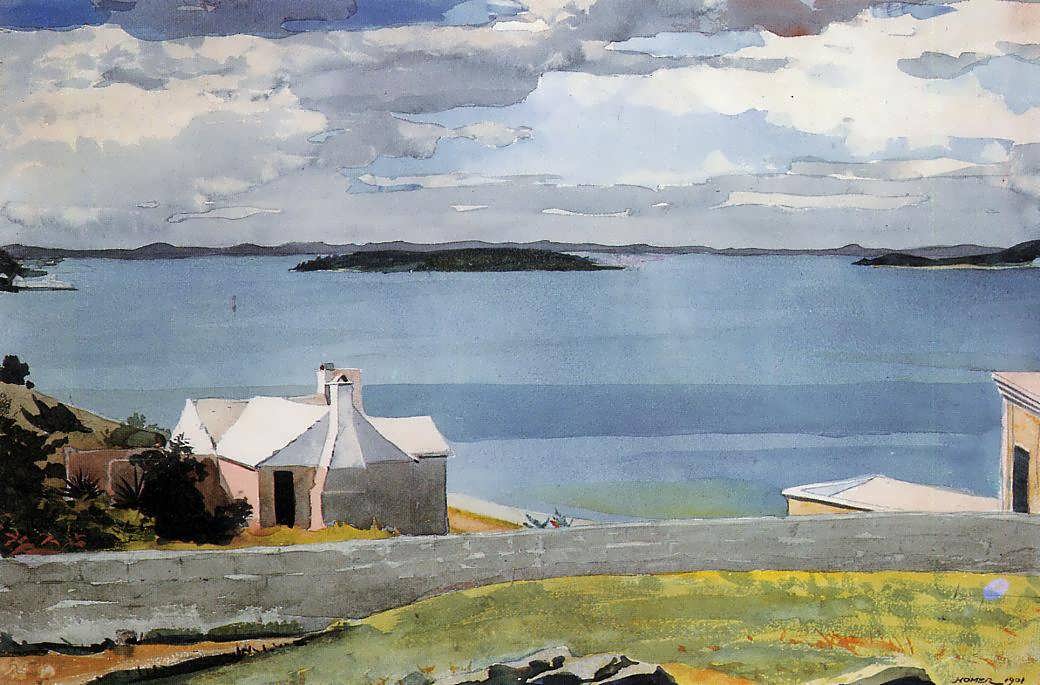
Inland Water by Winslow Homer
We’ve just returned from a remarkable trip to Bermuda, where Samantha and I got engaged, and, frankly, we fell in love with the place.
The colors, the scents, the sounds, and the magical experiences we had — a bit like Alice in her Wonderland, actually, just took us deeper and deeper.
One such experience was meeting Tom Butterfield and Elise Outerbridge of the Masterworks Museum of Bermuda Art, which has as part of its mission the repatriation of works created by world renowned artists in Bermuda.
When we were there, Tom was hanging a show of Brooklyn artist Ogden Pleissner’s watercolors painted at St. George’s on the far eastern part of the country.
He took us down into the archives to see Georgia O’Keefe’s charcoal of a banyan tree, and Winslow Homer’s “Inland Water,” which was painted not far from where we were staying in Warwick Parish.
Samantha challenged me to write poetry inspired by Bermuda — not easy to do after a month of writing a poem-a-day during the month of April. But when we got home, my notes proved to have some gems.
Here is the first that has emerged,
“Bermudiana”
Light refracts off turquoise waters,
But “turquoise waters” sounds so trite
And cliché, until you see it’s true.
Not since Indonesia have I seen such a color.
Then there’s the colorful pastel houses
Of yellow and sea green,
Sage, russet, the occasional purple,
The coral pink ferry stops –
All with whitewashed limestone roofs,
Stepped and sculpted to channel and capture
Rain; the islands’ only source of fresh water.
These islands are awash with color–
Flowers from the tiny, purple-blue Bermudiana
To the brilliant red hubris of Chinese hibiscus,
Shrimp plant, with its shriveled crustacean-hued
Flowers stacked along the stalk,
And morning glories, a soft purple
Bruise against green skin–
Light is texture here, which is perhaps
Precisely why painters, especially
Watercolourists, have been so inspired
By this land- and seascape.
The island across the way from us
Was captured by Winslow Homer,
In the painting we saw at Masterworks.
The perfume of the air, frangipani
(Or was it something else?),
Which scents the towels during our stay.
We find ourselves exploring
All over Bermuda, drinking it in,
With our Dark ‘n’ Stormies.
We will leave a part of ourselves
Here, as we take back memories
Of being transported to the beginning
Of our beautiful engagement.
What a place for a proposal;
What a place to conjure
using all our senses,
and all of our sensibilities.
 Today is poet Gary Snyder’s birthday. He is 83 years old.
I studied with Gary and he had a big impact on my poetry, which I’ve written about elsewhere on this blog.
You won’t find traces of his influence in my work, stylistically at any rate; rather you’ll find it in my deep engagement of nature, in how I pay attention, and “be crafty and get the work done.”
Happy birthday Gary!
Here is Gary Snyder’s poem, “Old Bones”:
Old Bones
Out there walking round, looking out for food,
a rootstock, a birdcall, a seed that you can crack
plucking, digging, snaring, snagging,
barely getting by,
no food out there on dusty slopes of scree—
carry some—look for some,
go for a hungry dream.
Deer bone, Dall sheep,
bones hunger home.
Out there somewhere
a shrine for the old ones,
the dust of the old bones,
old songs and tales.
What we ate—who ate what—
how we all prevailed.
–Gary Snyder
And here is a recording of Gary reading “Old Bones”:

Diana and Actaeon by Titian
I hope you have enjoyed National Poetry Month for 2013 as much as I have. As always, I end with a “bonus poem,” one of my own that I am delighted to share with you.
If you haven’t had enough poetry, you can always check out and even subscribe to this blog below.
I’ve written about ekphrastic poetry before, the art of writing poetry about or inspired by other works of art.
Last September, Samantha and I were in London and went to the National Gallery’s “Metamorphosis: Titian 2012” show.
The multi-arts show brought together a group of specially commissioned works responding to three of Titian’s paintings – “Diana and Actaeon,” “The Death of Actaeon,” and the recently acquired “Diana and Callisto” – all of which depict stories from Ovid’s epic poem “Metamorphoses.”
The three paintings at the heart of the exhibition had not been seen together since the 18th century.
The National Gallery also commissioned poets to write poems inspired by the artworks (you can watch the poets read their poems here, and there was even a Twitter poetry contest.

The Death of Actaeon by Titian
I was inspired to write my own poems in response to the show, one of which explores the relatedness of two paintings, “Diana and Actaeon” and “The Death of Actaeon.”
Here is my poem, “Titian’s Metamorphosis”:
They are twin paintings, really,
Titian’s “Diana and Actaeon” and
The one depicting his death.
Look at the positioning: in
The former, Actaeon, poised
To the left, arm raised parting
The curtain, feet apart, all
Broad shouldered and startled.
Diana, right reclining, as an Odalisque,
Right arm raised and feet, one
Caressed by a handmaid, the
Other dangling to the floor.
Seer and seen, searing gaze
And startled, glance agape.
In the latter, the roles are
Reversed: Diana to the left,
Huntress, bow flexed and ready
To shoot, sharp as her earlier withering
Arrow-glare; Actaeon, already begun
His metamorphosis, stag’s head,
Toppling and startled still,
But this time not by beauty,
By the horror of his own dogs
Ripping at his unrecognizable
Flesh. Look how his upreaching arm
Mimics Diana’s in its twin,
Handmaidens become hounds,
The cadence of his weakness
Coming down with the heaviness
Of his antler rack, head-heavy
All forgotten heedlessness,
Of beauty turned bestial.
“If looks could kill…”
–Scott Edward Anderson
##
30 Poems for National Poetry Month: Day 30
April 30, 2013
This has been an experiment. Although I try to write every day, I have never posted my daily scribblings for the world to see.
This year, in addition to my weekly emails and post for National Poetry Month, I took up the challenge of writing a poem each day to see what I could do.
When you are your own harshest critic, it’s hard to post what you know isn’t ready. Unvarnished, at times raw emotionally and in terms of craft, the poems are here to speak for themselves.
I must thank you, my readers, for your indulgence and your loyalty. Some of you have offered comments and feedback for which I am grateful; others have simply “liked” an individual poem or post, which is also encouragement.
Through it all, I must thank my partner Samantha, for both inspiring me and being patient with my almost poetry diary, which put our life and love on public display.
I’m looking forward to printing out these poems so I can look at them on the page — as a group and individually — and see what comes of them. Let the real work begin!
Here is my poem for Day 30:
And so it ends, this Month of Poetry,
Not with a band, but with a whisper.
Although I wanted to kill that mockingbird
This morning, with his incessant trilling,
Which would have caused excitement,
And made our morning a tad more thrilling.
My love held close to me in the kitchen,
As we were making breakfast,
Her curves beautifully accentuated
In her tight-fitting nightgown.
The kettle whistled, as did I,
When she looked at me so longingly,
And curved her body up to mine.
Ah, if only we had the time
This morning, but the month has come
To an end. Tomorrow we begin again,
Perhaps with fewer daily posts,
But no less poetry in our lives.
–Scott Edward Anderson

30 Poems for National Poetry Month: Day 29
April 29, 2013
Here is my poem for Day 29:
The penultimate day of Poetry Month,
My challenge nearly over.
I’d no idea how much poetry
Would cascade out this month,
Or with so much love therein
Or how easy it would flow–
Of course, time will tell
How much survives,
Revision has always been
The real work to me.
Yet, if one or two live
To tell the tale I have here told,
It was a grand experiment
And one that achieved its goal.
–Scott Edward Anderson
30 Poems for National Poetry Month: Day 28
April 28, 2013
Here is my poem for Day 28:
Breakfast on the deck in the morning sun.
Spinach-feta-egg-white omelette,
The last of the rosemary bread toasted,
French-pressed coffee, the Times.
Proving to ourselves at least,
Civilized life can continue,
Even with the hoard of kids
(The smallest perfect number)
Looming in their beds.
–Scott Edward Anderson

 Ada Limón’s poetic world is one where dislocation leads to an opening up rather than a shutting down, an unfolding rather than sequestration, and where doors are open, not closed. She isn’t afraid to confront her emotions or to let the reader in to observe her reactions to those emotions.
Yet, Limón’s is not a confessional poetry or, at least, not in the derogatory sense of that word. Limón tells stories and she’s proud of that fact.
“It’s ingrained in human nature to crave stories,” Limón explained in an interview. “We want them read to us as children, to be told around the fire, we want to see ourselves, our lives in these stories, and to have a sense of both escapism and transformation. People don’t know that poetry can do that, because they have the preconceived notion that poems take a tremendous amount of work to even comprehend, let alone be moved by.”
Her poems are not meant solely for the page, but to be read aloud. Her language is fluid, whether describing dreams or reality or the blurring between the two.
As Jeffrey Cyphers Wright wrote in The Brooklyn Rail, “She personalizes her homilies, stamping them with the authenticity of invention and self-discovery.”
Born March 28, 1976, Ada Limón is originally from Sonoma, California, and now divides her time between there and Lexington, Kentucky. Her first collection of poetry, lucky wreck, won the 2005 Autumn House Poetry Prize. She is also the author of This Big Fake World, winner of the 2005 Pearl Poetry Prize, and Sharks in the Rivers (Milkweed Editions, 2010).
Here is Ada Limón’s poem, “Sharks in the Rivers”:
We’ll say unbelievable things
to each other in the early morning—
our blue coming up from our roots,
our water rising in our extraordinary limbs.
All night I dreamt of bonfires and burn piles
and ghosts of men, and spirits
behind those birds of flame.
I cannot tell anymore when a door opens or closes,
I can only hear the frame saying, Walk through.
It is a short walkway—
into another bedroom.
Consider the handle. Consider the key.
I say to a friend, how scared I am of sharks.
How I thought I saw them in the creek
across from my street.
I once watched for them, holding a bundle
of rattlesnake grass in my hand,
shaking like a weak-leaf girl.
She sends me an article from a recent National Geographic that says,
Sharks bite fewer people each year than
New Yorkers do, according to Health Department records.
Then she sends me on my way. Into the City of Sharks.
Through another doorway, I walk to the East River saying,
Sharks are people too.
Sharks are people too.
Sharks are people too.
I write all the things I need on the bottom
of my tennis shoes. I say, Let’s walk together.
The sun behind me is like a fire.
Tiny flames in the river’s ripples.
I say something to God, but he’s not a living thing,
so I say it to the river, I say,
I want to walk through this doorway
But without all those ghosts on the edge,
I want them to stay here.
I want them to go on without me.
I want them to burn in the water.
–Ada Limón
#
30 Poems for National Poetry Month: Day 27
April 27, 2013
Here is my poem for Day 27:
That’s an unattached male
Mockingbird who sings
At 3AM, hidden somewhere
In the magnolia behind our
Building. He wants a mate.
I’ve got a mate, lying next to me,
And she rolls over and remarks
About the bird, asks why
He is singing now, before dawn.
It’s a strategy mockers have developed,
Taking advantage of silence,
As if in competition with the night.
Waiting will not do for the mocker,
Who has already stolen other birds’
Songs, he now wants to win
A heart of his own–
What he doesn’t realize is
It’s as annoying to the females
As it is to us trying to sleep.
–Scott Edward Anderson

30 Poems for National Poetry Month: Day 26
April 26, 2013
Here is my poem for Day 26:
Last night’s full moon
Appeared further away
Than usual, reminding me
That it is moving away
From us an inch and a half
Every year. Its pull
Stretches us thin
And complicates
Our emotions.
The “pink” moon angles
Through our window
And across our white
Sheets. Your tangle
Of red hair on the pillow
Reflects tiny lights
Neither high nor low,
As if your dreams
Escape into the night.
–Scott Edward Anderson

 Scott Edward Anderson's Poetry Blog