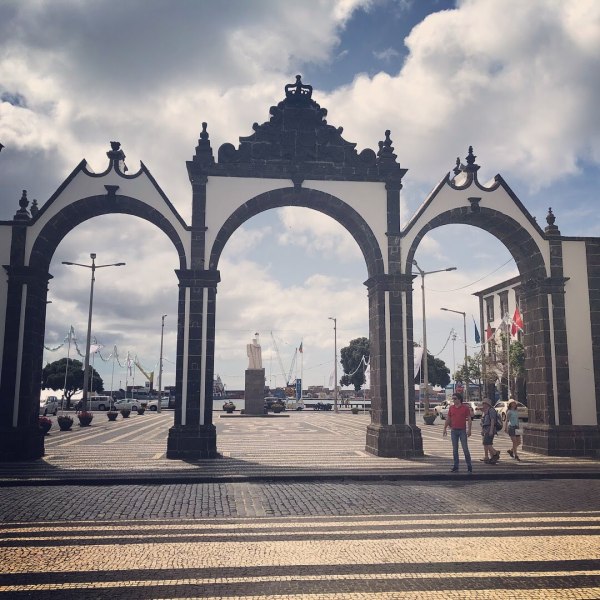
The iconic 18th Century Portas da Cidade (City Gates) in Ponta Delgada, São Miguel. (Photo by Scott Edward Anderson)
Some of you know that I’ve been on a journey the past few years to uncover and explore my familial roots on the island of São Miguel in the Azores, the nine-island archipelago in the Atlantic Ocean between Portugal and the United States.
Last summer, I had a residency on the island with Disquiet International, named for the enigmatic book of prose written by the great Portuguese poet, Fernando Pessoa. The residency in Ponta Delgada took place only 3.7 km from the freguesia (municipal parish) where two of my maternal great-grandparents emigrated in 1906.
Through Disquiet, I was also introduced to poet Lara Gularte, herself of Azorean American ancestry. Her relatives were from Faial, Pico, and Flores, three more of the nine islands in the Azores. Gularte was born in California and grew up in what was then an area of fruit farms known as the Santa Clara Valley (now more famously known as Silicon Valley).
Last month, Lara graciously invited me to read in the series she runs in the Sierra Foothills east of Sacramento, near where she now lives. Along with her husband, Brian—and some good local wine—we spent a wonderful evening discussing our Azorean heritage, poetry, and the dilemma of being generations removed from the places of our origins.
Gularte, who worked for many years as a public servant, finally traveled back to the Azores in 2008—the first of her family to return in four generations. “Before I explored these islands, they were only an abstraction,” Lara told the Portuguese American Journal in June 2018. “I had seen photos and post cards, but nothing prepared me for the natural beauty and complexity of the landscape.”
Her first collection, Kissing the Bee, was published by The Bitter Oleander Press in 2018. Many of the poems in her book speak to what she found on the Azores and the deepening connection which that brought about with her family roots in California’s fertile central valley.
“I was a resident poet at Footpaths to Creativity Center and Artist/Writer Residency on Flores Island in the Azores where this poem was written,” Lara says. “Flores is the island from where my grandfather was born before he emigrated as a young boy to the U.S. He was a stowaway on a ship and disembarked in New Bedford, Mass. He then worked in the cranberry bogs for a few years before traveling to California where he met my grandmother.”
Here is Lara Gularte’s poem, “Flores Island”:
FLORES ISLAND
The place at the beginning
A whale rises up in her mind
turning her thoughts gray.
In port, the ferry of return.
She searches for her grandfather
to discover the shape of his emigration
and finds the plank’s gone, rotted.
At the mercy of rough water and high winds,
he rowed, sinews pulling his dory,
pulling his bones to breaking.
She scans the distance,
says his name out loud, Antonio Henriques,
waits to hear a voice, see a face.
She searches for all the prisoners
of thick mists, others who look like her,
whose foreign tongues speak music to her soul.
Beyond the wake of a rogue wave,
currents and tides ride
on the back of a gray whale.
She sees through the vapor
boats whose nets gather the sky and let go.
Fog falls,
bearing dazed souls back to their home place.
She falls with them.
—Lara Gularte, from Kissing the Bee (The Bitter Oleander Press, 2018). Used by permission of the author.

São Miguel, Azores, Portugal
“I don’t write to say what I think. I write to find out what I’m thinking,” said the poet Gary Snyder. To that I might add, I write to understand who I am.
Lately, I’ve been working on a project—a kind of enhanced memoir—that explores my Portuguese family history. As part of this project, I’ll be going to the Island of São Miguel in the Azores this summer, where two of my maternal great-grandparents came from, for a residency hosted by DISQUIET International, which brings together Portuguese and Portuguese-American writers.
I first started researching my Portuguese roots back in the 90s and, coincidentally, that’s when I met the Portuguese poet, Nuno Júdice. He read at Poets House, along with the translator Richard Zenith, in December of 1994.
The author of over twenty books of poems, Júdice was born in 1949, on the southern coast of Portugal, in the region known as the Algarve. He is currently a professor at Lisbon’s Universidade Nova and directs the Colóquio/Letters program for the Gulbenkian Foundation. I’m hoping to see him in Lisbon when we are on the mainland.
Here is Nuno Júdice’s “Poema” in its original and in a translation by Martin Earl.
POEMA
As coisas mais simples, ouço-as no intervalo
do vento, quando um simples bater de chuva nos
vidros rompe o silêncio da noite, e o seu ritmo
se sobrepõe ao das palavras. Por vezes, é uma
voz cansada, que repete incansavelmente
o que a noite ensina a quem a vive; de outras
vezes, corre, apressada, atropelando sentidos
e frases como se quisesse chegar ao fim, mais
depressa do que a madrugada. São coisas simples
como a areia que se apanha, e escorre por
entre os dedos enquanto os olhos procuram
uma linha nítida no horizonte; ou são as
coisas que subitamente lembramos, quando
o sol emerge num breve rasgão de nuvem.
Estas são as coisas que passam, quando o vento
fica; e são elas que tentamos lembrar, como
se as tivéssemos ouvido, e o ruído da chuva nos
vidros não tivesse apagado a sua voz.
—
POEM
It’s the simplest things that I hear in the wind’s
intervals, when the simple beating of the rain
on the windows breaks the silence of night, and its rhythm
overwhelms that of words. Sometimes, it is a
tired voice, that tirelessly repeats
what the night teaches those who live it; other
times, it runs, hurriedly, mowing down meanings
and phrases as though it wanted to reach the end, more
quickly than the dawn. We’re talking about simple things,
like the sand which is scooped up, and runs
through your fingers while your eyes search
for a clear line on the horizon; or things
that we suddenly remember, when
the sun emerges from a brief tear in the clouds.
These are the things that happen, when the wind
remains; and it is these we try to recall, as though
we had heard them, and the noise of the rain
on the windowpanes had not snuffed out their voice.
© 2006 Nuno Júdice, from As coisas mais simples, Lisbon: Dom Quixote, 2006
Translation © 2007 Martin Earl, first published on Poetry International, 2014
 Scott Edward Anderson
 Scott Edward Anderson's Poetry Blog