My dog Calvin died this year. He was fifteen and losing his ability to move. The last time I saw him, he was responsive, yet it was clear he was increasingly uncomfortable in his body. He always lit up when he saw me; sadly, I think he was always thinking, “At last you’ve come home.” I was not.

In fact, I lost Calvin in my divorce over 10 years ago and, after a few years of occasional visits in Brooklyn, I stopped getting to spend regular time with him. I know we both missed each other. (I’ve had a number of dogs in my life; we got Beverley in 2015 and, when she does something I wish she wouldn’t, I remind her that she’s neither my first dog nor my last.)
I wrote two poems about Calvin, both of which appear in the anthology, Dogs Singing. One, in the voice of Calvin, recounts his origin story, based upon what we were told by the PASPCA. The other is not so much about Calvin as about my growing restlessness in the home of my previous marriage. Calvin serves as a character, if not a symbol, along with mining bees and a redbud tree.
Because Calvin was put down earlier this year, Emily Berry’s poem, “Dream of a Dog,” which appeared originally in Granta last February and in her most recent collection, Unexhausted Time, struck a particular chord in me when I read it. Berry’s poem appears about a quarter of the way through the book and, after a series of untitled poems, it is the first poem with a title in the book and closes the book’s first, unnumbered section. (As readers, poets always look for things like this in a collection; there is usually a significance to such placements, signaling an intention on the part of the poet, as if to say, “pay attention to this one.”)
It’s also one of the few poems in the collection where, in the words of critic Steven Lovatt, writing in The Friday Poem, “the tone is for once gentle, undemonstrative and open to outside impressions.” Berry’s work has always struck me as characterized by a so-called “flat style,” which Noreen Masud, in an article in the journal Textual Practice, explains “involves postures of poetic melodrama which state themselves ‘flatly’, without apology.”
Berry’s “Dream of a Dog,” while it does use a flat style, also consists of one long sentence, or rather a fragment of a sentence, for it ends not with a full-stop period, but an ellipsis. The ellipsis hints there is more to come or, perhaps, that the reader could circle back to the beginning of the poem for it ends where it begins, with the words, “My life” as if the poem could be an endlessly cycling dream.
It also causes me to question, is it the “dream of a dog,” as in, the speaker is dreaming of a dog (line 19 begins, “if I had a dog”) or is it a dream a dog is having, complete with its sighs. (My dog Beverley barks in her dreams, along with sighs, and chases things; I wish I knew what.)
Emily Berry is the author of three poetry books published by Faber in the UK: Unexhausted Time (2022), Stranger, Baby (2017) and Dear Boy (2013). You can read more about her and her work at: https://www.emilyberry.co.uk/
Here is her poem, “Dream of a Dog”:
Dream of a Dog
My life, and all our lives, I said sleepily,
so soft now, like the neck of a sleeping dog,
I lay my hand on it, as you have lain your hand
on mine (on my life), this tenderly, as the dog
noses deeper into sleep, as she sighs the way
a dreaming dog does, I wish my life was in
your dream, dog, I think it is, and she turns
onto her back so her stomach rises pale and
softly furred, and your words are travelling
through me, or, no, they travel over me, the
way a breeze makes fabric touch us, the fabric
of half-drawn curtains billowing from an open
window, as I pass and glance out on such
a day, the dog whimpering softly in sleep;
perhaps it’s that you say I should have faith,
or that you have faith, in increments, while
my shoes are nosing through leaves and the
dog is alert or disappears (but she comes back),
if I had a dog she would be a kind of faith,
I would lift her onto my shoulder, the points
of her ears very elfin and her face, serious,
tilted to regard you, she would listen and run
and then, from a distance, up a slight incline,
when I call her, look back, then run on,
and I do believe in increments, as when
the dog brings me, in her dream, pinecones,
when she wriggles in my arms, her ribcage
strung like an archer’s bow, when her paws
bend at the wrist in supplication, I do not see
the slow wheels in my blood turning, but
I ride them, I do not see what I know
and everything beneath that, which I may
come to know, or may not, the slow slow
discernment of the deep layer, air bubbles
rising from the dead zone, the dog in her
dream talismanic on a hilltop, the soft tips
of her ears in sleep, a slight sigh, all my life.
–Emily Berry, from Unexhausted Time

Catherine Ayres
Poets who can say much with few words are rare. Writing is hard; concision even harder. When these poets are funny, touching, sad, and poignant all in very few lines, the reader marvels. Catherine Ayres is such a poet.
I met Catherine Ayres through Jo Bell’s “52” poetry group three years ago. 52 was a private group of poets Jo organized from England, but which soon expanded around the globe.
Each week, Jo fed us a poetry prompt and some of us who were insane enough to take up her suggestion and write a poem each week for the entire year. Then we shared our poem with the group and received comments and criticism, parsing and praise.
Some of us stuck with 52 the entire year. Some became and remained friends on Facebook after the year ended. We watched as poem after poem by our 52 mates got published, won awards, and became a part of collections.
One such poem was Catherine Ayres’s “Silence,” which like many of the poems in what became her first collection, Amazon, deals with illness and survival, the body and our perception of our own bodies head-on and with unflinching wisdom, humor, and pathos.
Catherine’s poems impressed me each week. There was something timeless and yet timely about her poems, with their heady mix of myth and “medicalia,” to coin a phrase, Her poems were the real deal. When I heard she was publishing her first book, I ordered it straightaway from the small UK-based publisher, Indigo Dreams. I was not disappointed.
Catherine Ayres is a teacher from Northumberland – Basil Bunting territory – her poem, “Silence,” won the Elbow Room Prize in 2016. Here is Catherine Ayres’s “Silence”:
“Silence”
The last man to touch my breast held a knife.
My lover said nothing;
his eyes told me to wear a vest
Sometimes I spread my hand over the scar
to feel its cage
How does a woman speak
with a closed mouth on her chest?
She unpicks in silence
until the rain comes
like burst stitches on the glass
– Catherine Ayres
Used by permission of the author. You can order Catherine Ayres’s Amazon (and you should) directly from the publisher http://www.indigodreams.co.uk/catherine-ayres/4593286356
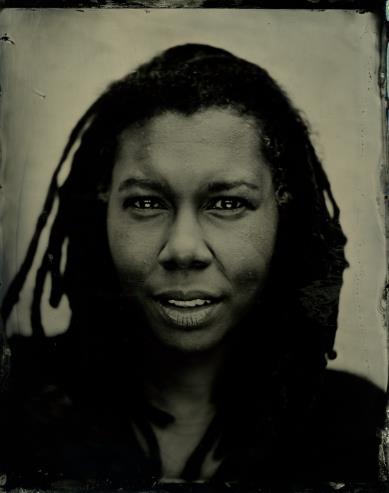
Sheree Mack c) 2012 Alastair Cook
Every month it seems there is another flashpoint of tensions between police and black communities in cities around the United States.
From Ferguson to Baltimore, our country seems ready to tear at the seams from a volatile combination of racial prejudice, police militarism, and the systemic poverty and disenfranchisement black people feel in America today.
It is impossible to ignore this critical issue of our day – we ignore it at our peril – even in a forum such as this.
In that light, I asked poet Sheree Mack if I could feature one of her poems for this final week of National Poetry Month. I was thinking we’d choose one from her remarkable new book, Laventille, which I’ve just started reading.
But Sheree asked if I’d rather have a new poem, one where she is trying “to get my head around the issue of race in America now with #BlackLivesMatter and how things haven’t changed much since lynching was another arm of the ‘law’.”
When she sent me, “Called Witness,” I jumped at the chance to share it, with its unflinching mixture of found texts (from a source cited below) and its paraphrase of Billie Holiday’s “Strange Fruit” in line 8.
Sheree Mack was born in 1971 in Bradford, England, to a Trinidadian father and a “Geordie” mother of Ghanaian and Bajan ancestry. She worked as a teacher for several years before studying for a PhD on black British women poets.
Sheree now dedicates her life to “fostering creativity in everyone’s life” working with communities of women and young writers, and currently lives in Tynemouth. She is the author of two collections, Family Album (Flambard Press, 2011) and Laventille (Smokestack Books, 2015).
I met Sheree Mack through the group “52,” which I participated in last year. Members of “52” wrote poems each week to prompts supplied by the group’s founder, Jo Bell, and commented upon each other’s work in a closed group on Facebook. (See my blog post on the subject here.)
Sheree’s poetry rose to the surface in my mind for its clarity, craft, and complexity of vision. Mack’s poems “lament, rage and mourn,” as the publisher says about her latest book. “But they also offer a song of healing, a celebration of survival, a glimmer of the flames that burn in the hearts of a people still living in slavery’s dark shadow. “
Her perceptive comments on a number of poems (mine and others) flagged her as one of those people you want to spend time with, even if the only opportunity is through the auspices of a virtual poetry workshop.
It was only later that I realized she was also the subject of my friend Alastair Cook’s stunning collodion portrait of a striking woman with captivating eyes, that I’d seen as part of his McArthur’s Store exhibition. There is something haunting about this portrait, as is the case of much of Alastair’s work in the medium.
The image is timeless or time-bound or both simultaneously. It could just as easily be a photograph of someone from Trinidad and Tobago at the time of the 1970 student uprisings in Laventille (the subject of her book) or an image from an even earlier era.
In short, the photo is a bit like Sheree Mack’s poetry: a bit timeless, a bit time-bound, but always unflinching and intriguing.
Here is Sheree Mack’s poem, “Called Witness”:
The exhibition opened in a small New York gallery.
The crowds came, self-righteous and proud.
Assembled and displayed were sixty photographs,
collected from family albums, attic trunks, flea markets.
Small, black-and-white postcards,
not more than a few inches long and wide,
depicting African-American men in Jim Crow
South; black bodies swinging from poplar trees.
Long lines stood for hours on the wintry
sidewalk, waiting for their view.
Once inside, bodies overwhelmed the intimate space.
Images laid flat on display tables or assembled
in tight groupings tacked to light-coloured walls.
Tattered, faded and worn, neither retouched nor restored.
Nor framed, matted, or captioned. Instead offered
as artefacts, not fine art objects. None for sale.
Visitor huddled close, hunched over tables,
faces pushed up against the walls, they felt
the warmth and proximity of others, jostling
and angling their bodies for a better look.
Through generations, onlookers enticed to the scene
by the spectacle of mutilated, dangling bodies.
c) 2015 Sheree Mack
Used by permission of the author.
_________________
Text cited: Lynching Photographs by Dora Apel and Shawn Michelle Smith,
University of California Press, Berkeley and Los Angeles, California, 2007

Jo Bell; photograph ©Alastair Cook
Quite possibly the best thing about the Internet for a poet is the ease with which one can learn about other poets and their work from far-flung corners of the world.
Over the past few years I’ve come in contact with the poems of some remarkable poets whose work I may not ever have discovered through the traditional means of poetry publication and exchange.
And their work grows increasingly important to me as I get to know it better and, in some cases, get to know the poet through Facebook and other social media.
One of my absolute favorites is Jo Bell, to whose work I was first introduced by Alastair Cook. Alastair, who has made a couple of filmpoems featuring my poetry, has done a few with Jo as well.
Jo holds the unique position of UK Canal Poet Laureate, and lives on a narrow boat, “Tinker,” making her way around England. She’s a self-described “poetry freelancer,” sharing her wares like the tinkers of old their tin works. Only it’s poetry she’s repairing. Her performances are brilliant and enjoyable (see her reading as part of Poets & Players at the Rylands Library).
Her signature verse is “The Shipwright’s Love Song,” and it’s a tour de force: replete with her timeless language, the double entendre of the ship/woman, her deft use of enjambment, such as “rudderless/ and yawing,” and slant rhymes “swell –/the smell,” the exclamation, a kind of gasp of recognition that begins the second stanza, “Oh, her skin was salt!” – and that ending, which you have to hear her read to truly appreciate the rhythm. Simply remarkable.
Much of Jo’s poetry does what poetry should do, makes you see things differently, to notice worlds new to you, and worlds you only thought you knew. Jo’s poems have what all well-written poems have in common, as I’ve written elsewhere: “They sing. They make you dance. And they give you a new way of looking at the world.”
Here is Jo Bell’s poem, “The Shipwright’s Love Song,”
Oh, but the lines of her!
The curve and glinting swell –
the smell, as sweet as pitch pine,
thick and hot as tar.
Oh, I was launched and splashing in the slipway,
happy to be rudderless
and yawing, mast head
touching to the foam.
Oh, but her skin was salt,
was starred with gasping salt beneath my tongue,
and slowly
she came round to me –
bucking and slipping at my touch,
making way in fits and starts
to reach me and be calm.
Later, long before she rocked me into sleep
I saw the seas, saw all of them in one blue ache:
unlandmarked, vast; horizonless.
c) 2003 Jo Bell. Used by permission of the author.
Here is Jo reading the poem: Shipwright on Soundcloud
And here is a videopoem version by Marc Neys (aka Swoon): Shipwright by Swoon
If you enjoy this poem, do yourself (and her) a favor and order Jo’s book, NAVIGATION, which is available through Moormaid Press in the UK: NAVIGATION
The Telegraph has a nice profile of Jo this weekend: Jo Bell in the Telegraph
And, finally, you can follow Jo’s blog, here: Bell Jar Blog
 Scott Edward Anderson
 Scott Edward Anderson's Poetry Blog