30 Poems for National Poetry Month: Day One & Two
April 2, 2013
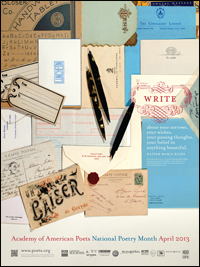 The challenge is to write a poem every day for National Poetry Month.
I’ve never cared for these daily, quick-writ challenges, preferring to let a poem mull and steep rather than be cast onto the page too quickly like a gambler shooting dice out of a cup.
But, yesterday, sitting in Bryant Park eating my lunch, I was inspired to give it a go. And then again this morning on the subway heading from Brooklyn into Manhattan.
So, here are my first two entries:
1
April Fools the fool that fools
With the sun on the first day
Of baseball season.
They’ve laid new grass down
On the lawn at Bryant Park.
Sign reading: “Lawn Closed”–
Where just a month ago
There was a skating rink.
“The new sod is establishing
Its roots.”
2
Our blended family whorled
Back from Disney World,
Dispersed to their other
Homes, to come together
Later in this month of poetry.
Our fantasy become reality.
–Scott Edward Anderson

Elijah icon by Fr. William Hart McNichols
Alfred Corn posted the phrase “still, small voice” on Facebook yesterday and it reminded me of a poem I wrote over 20 years ago, called “Spring Storm.”
The phrase comes from the story of Elijah’s encounter with God on Mt. Horeb (Sinai), which appears in 1 Kings.
Fleeing Jezebel and Ahab, Elijah travels on foot from Mt. Carmel to Be’er Sheva (about a 39 hour walk, as Google Maps would have it).
Along the way he is fed by ravens in the wilderness and, eventually, continues on to the same mountain where God spoke to another, earlier prophet.
He takes refuge in the cave until he is called to stand before God as He “passes by.”
God’s idea of passing by is, of course, in the form of wind, an earthquake, and fire.
After that, Elijah hears “a still, small voice” – actually, it was probably tinnitus from such a raucous display – which gave him further instruction from God about anointing his successor as prophet, Elisha.
So, was it the sound of the sudden silence or a whisper that Elijah heard? Or could it have been his own voice from within, full of the wisdom from his meditation in the cave?
Hard to say, but the idea of a still, small voice that speaks to us resonates with me.
Sometimes, it can be a frustrating voice, seeding jealousy, resentment, and loneliness.
More often than not, if we listen closely and in mindfulness, it is a voice full of goodwill, forbearance, and companionship.
I suggest in the poem that the still, small voice is nearly always an echo of something within us, imploring us to act, to be moved – to love.
Here is my poem, “Spring Storm”:
The rain comes with the familiar cadence
of an old friend chattering-on
about nothing in particular.
And the still, small voice
comes from out of nowhere
–an unlikely sound in a spring storm.
No thunder, no trumpet:
“So this is your house and how you keep it.”
The house, lived in for years,
perhaps recently swept clean
–I keep a house fit for spiders.
And the still, small voice that resonates
below thunder, comes with a calm,
moves like an undulance in a pine floor,
reaching under the rain
to take part in the holy chorus,
encircling in a pool of slow-moving glory.
We talk about redemption,
talk about the need for the personal,
and then go quietly about our work.
When the storm ends,
it’s with a murmur, “Peace be with you.”
Sing praises, now, for that stillness
and for the need to make out the sound;
sing praises, now, for the thunder,
which did not come with the rain,
but that filled our hearts
of a spring evening, in our repose.
It is our own voices calling to us,
and we must take heed.
–Scott Edward Anderson
This poem first appeared in A New Song
International Polar Bear Day and My Poem “Disappearance”
February 27, 2013

Photograph by Steven Kazlowski, Alaska Stock Images/National Geographic
Today is International Polar Bear Day, celebrating the world’s largest carnivore.
I’ve shared my poem the “Ten-legged Polar Bear” with readers in the past, but there’s another poem I wrote about the species, which is a kind of totem for me.
I wrote this poem for my oldest son, Jasper, several years ago, as he was distressing about the plight of the polar bear.
He was born in Alaska and has always had a special affinity with these bears. He had heard reports of a polar bear seen swimming in circles some 60 miles from the nearest shoreline.
International Polar Bear Day was started by Polar Bears International to raise awareness about the plight of these remarkable bears. You haven’t lived until you’ve felt the power and presence of this bear, which is a potent reminder that we are not at the top of the food chain. (If you want a sense of what a polar bear encounter is like, watch this video of a BBC reporter.)
Polar bears are found in only five countries in the circumpolar north, including the US, Canada, Russia, Greenland, and Norway. According to researchers there are only 19 wild populations of polar bears remaining — probably less that 25,000 individual bears.
The rapid loss of sea-ice in the Arctic is the major threat to polar bears, but they are also subject to pollution, industrial development, and even poaching.
Here is my poem, “Disappearance”
In the distance we see what appears to be floating sea-ice,
calved from ragged ice-edge, only it’s rounded, tensile, mammalian—
Hollow points of light emanating from softly echoing,
transparent follicles; then a broad back surfaces, inanimate—
“Oh my god, it’s a bear!” someone shouts, pointing
to a floating carcass now seen clearly: not sea-ice,
but sea-bear—Urus maritimus—dead-man’s floating
miles and miles from the nearest shore,
face staring deep beneath the surface, massive front paws
spent from stretching, from reaching for ice-edge,
exhausted from swimming panicky circles,
finding only heavy arctic seawater, viscous oil, adrenaline ooze.
Think of a fight-weary heavyweight, no longer at the top of his game,
up against a nimble, invisible opponent, now down for the count.
–Scott Edward Anderson
On Robert Frost, Electric Cars, and Poetry
January 30, 2013
Poet Robert Frost died 50 years ago yesterday, and Poets & Writers magazine offered the challenge of writing a poem using Frost’s “Stopping by the Woods on a Snowy Evening” as a model.
 |
| Robert Frost |
Frost was born in 1874, some time after Robert Anderson (a suspected relation to this author) invented a crude electric carriage in Scotland, and some 39 years after Thomas Davenport of Brandon, Vermont, built his own small-scale electric car. Davenport also invented the first American-built DC electric motor.
 |
| Robert Anderson’s Electric Carriage, circa 1832 |
Perhaps because I was working on some electric vehicle materials in my day-job yesterday, I couldn’t resist penning this over lunch, with apologies to the poet:
“Stopping by the Roadside on a Snowy Evening”
Whose car this is I think I know;
No keys I need to make it go.
You may not hear me driving by
‘Cause electric cars are soft as snow.
My finger on the button here
Will make the engine start and gear
And waken not the woods and lake
–the quietest engine of the year.
I give the foot-pedal a tiny tap
And feel the seat belt on my lap.
The only other sound’s the hush
Of lofty wind and goosewing flap.
The road is lively, quick, and steep.
But I have batteries to keep,
And miles to drive before I sleep,
And miles to drive before I sleep.
–Scott Edward Anderson
##
 |
| Davenport’s Electric Car, 1835 |
On Being a Tourist: My Poem “Village, Batanta Island”
January 19, 2013

Children on Batanta Island, Indonesia. Photo by SE
There’s a difference between experiencing the world as a tourist and a traveler.
In my work with organizations like The Nature Conservancy and Ashoka, I’ve had occasion to do both and to notice the differences.
As a traveler, you become part of the landscape, access the culture in a way that changes your own perspective on the world, and if you can’t quite become native to the place, you at least get to know real people and have deeper experiences.
As a tourist, you are more an observer and your experiences are from outside rather than within. It feels more superficial and distant, like you are collecting experience rather than living it, if that makes sense.
A donor trip to Indonesia in February 2005 was more of a tourist experience than other trips I’d taken where I stayed with locals and worked with colleagues and partners on strategy over longer periods of time.
Not to say that traveling as a tourist isn’t valid. Sometimes you can observe things more clearly as an outsider rather than as an insider living in a place. During this particular donor trip, I wrote a poem about a visit to a small island in the Raja Ampat region of far eastern part of the country.
The poem appeared in OCHO #24, which was edited by Collin Kelly and included poets who were active on Twitter (you can find me there @greenskeptic).
Writing about poetry and technology in The Best American Poetry Blog, poet Julie Bloemeke, writes, “In ‘Village, Batanta Island,’ Scott Edward Anderson creates a world where children interact because they can see themselves in a digital camera.”
I’m not sure how often tourists visited that island or how frequently its children interacted with the likes of us. The exchange we had was genuine and fun, but like the picture I took in the moment (see above), there was definitely a fence between us, both real and imaginary.
Here is my poem, “Village, Batanta Island”:
To the young girl staring at me,
in a village on the island
of Batanta, I have an amusing,
open face; my big eyes,
skin paler than her experience.
I catch her looking at me.
She turns, giggles, whispers
to her friend. Funny gringo
in Ex Officio.
About twenty, twenty-five kids,
crowd around us; all under the age
of ten, most under five.
They pose for pictures
with our digital cameras.
Their scrubbed faces and hand-washed
clothes make neat subjects.
They giggle at the pictures
captured on the viewing screens;
tuck in a stray hair or shirt,
teasing each other.
A long, driftwood fence
lines each side of the one path
through the village. Whitewashed
church, houses with careful,
ornate carvings on the facades.
Neat rows of houses with neat
rows of cassava planted out back,
mango trees and papaya; sand
as white as those houses.
The villagers eat fresh-caught fish
from the sea behind their houses.
One of the men says they must now
go further out each day to find a good catch.
How many people can such a village
support before reaching its limit?
One of my companions,
a businessman from Jakarta,
quickly answers, “One thousand.”
–One thousand. What happens then?
He does not answer; I too am silenced.
Now he turns to the children,
speaks in bahasa Indonesian,
steadies to take another picture.
Ten yards away,
by a thatch-roofed house,
stands another girl,
not more than sixteen,
laundry tub at her hip:
already she is pregnant.
–Scott Edward Anderson, OCHO #24
How the Internet Gave Me a Voice: Skepticism and Poetry
January 18, 2013
 |
| Craig Newmark via Paper Camera |
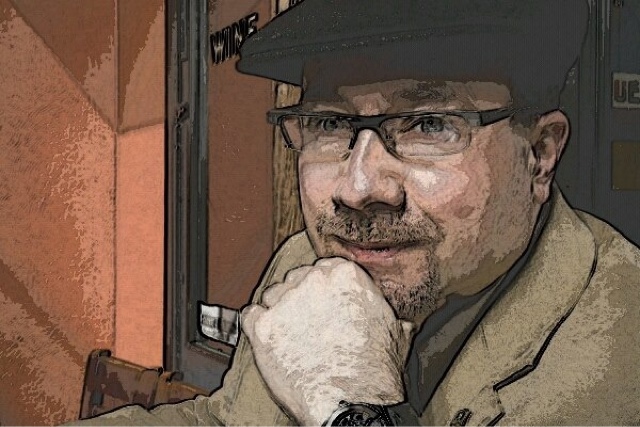
Today is Internet Freedom Day and Craig Newmark asks “How does the Internet give you a voice?”
When Craig asks something, I feel compelled to respond. Not because he is the founder of Craigslist or because he posts some awesome photos of birds or because Leonard Cohen is his Rabbi.
Rather, it’s because he is a champion of causes like veteran’s issues and Internet Freedom. (Well, maybe his bird photos do have a special appeal.)
The Internet gave me a voice — actually two voices. One for my skepticism and another for my poetry.
First, the poetry. It was the late 1990s when I first realized the power of the Internet to give voice to my poetry or, more to the point, gave me an audience.
My poems had recently won the Nebraska Review Award and Aldrich Emerging Poets Award, but you couldn’t find the winning poems anywhere. The Nebraska Review had to scrap the initial printing of the issue with my winning poems because of a printing error.
Then I got an email from an undergraduate student at a small liberal arts college in Cupertino, California. She had found some of my poetry on the Internet and wanted to write about my work for her assignment. (You can read her essay here: Essay on the Poetry of Scott Edward Anderson)
A total stranger all the way across country found my writing on the Internet.
And now, all these years later, many more have read my work through online magazines and journals and my poetry blog: Seapoetry
More readers have read my poetry on the Internet than ever could read it in the Nebraska Review or almost any other print publication.
And since 2004 my blog, The Green Skeptic, provided a platform to question the assumptions we make about how we conserve the earth’s resources and invest in green technology.
The Internet is many things. At its best, it is a community of voices where there was formerly silence.
Like any community, to paraphrase Parker Palmer, it is where the some of the writers you least want to read do their blogging. But the community of the Internet is richer for the diversity of its voices.
Visit Craig’s call to action here: Craig Connects
How does the Internet give you a voice?
2012 in review for my poetry blog
December 30, 2012
The WordPress.com stats helper monkeys prepared a 2012 annual report for this blog.

Here’s an excerpt:
600 people reached the top of Mt. Everest in 2012. This blog got about 11,000 views in 2012. If every person who reached the top of Mt. Everest viewed this blog, it would have taken 18 years to get that many views.

The author’s Portuguese grandfather, Ed Perry.
My Portuguese grandfather was part of a generation of immigrants who wanted to be completely American.
On that path, he became the first Portuguese member of the Metacomet Country Club in Providence, Rhode Island, and was later two-term president of the club.
He served as secretary of the Rhode Island Golf Association, overseeing thirty years of Rhode Island Championship events. He was chiefly responsible for the establishment of the Northeast Amateur Tournament.
He married into a family that had been in America since 1637, the Burgesses of Sandwich, MA, and made a successful career as a celebrity underwriter for New England Life Insurance Company.
In his striving to assimilate, however, much of what was Portuguese about him was kept under wraps. He embraced America as a nation rather than hyphenation. I favored my mother’s side; my father’s side was Scotch-Irish. I looked more “Portagee” than most of my family. Too often this fact manifested itself in jokes not worth repeating here.
Throughout my childhood, there was little mention of the great Portuguese achievers: the explorers (Henry the Navigator, Magellan, De Gama), painters (Nuno Goncalves, Josefa de Obidos, Viera da Silva, Paula Rego), or writers (Camoes, Pessoa, Saramago). Even if I knew of them, I never thought of them as Portuguese.
Only much later did I understand how rich my heritage was. My grandfather seemed to take pride when, shortly before his death, I pursued him about the family history from his side of the Atlantic. He came from the Azores, the tiny archipelago in the middle of the ocean, which is still a place of myth and magic to me. He called me “amigo – one of us.”
In the search for my “lost” heritage, I discovered the poetry of Fernando Pessoa, Portugal’s great poet of the 20th Century. Pessoa, like his hero Walt Whitman, “contained multitudes.” Only in Pessoa’s case, this was quite literally true. Pessoa took on what he called “heteronyms”: pseudonyms that were more than noms de plume. For each persona, Pessoa created a unique personality, creative style, and body of work.
The most successful of Pessoa’s heteronyms was the shepherd-poet, Alberto Caeiro. Caeiro, like Robert Burns and John Clare before him, was a genius plucked straight from the fields. Whereas Burns and Clare were truly of the fields, Alberto Caeiro sprung from the field of Pessoa’s imagination. Pessoa wrote the poems of Alberto Caeiro from the top of his dresser in a Lisbon apartment.
In many ways, Caeiro in Pessoa’s invention is a pure nature poet. Perhaps only poet Gary Snyder achieves greater reconciliation with nature in his work. One of my favorite Pessoa-Caeiro poems is “Só a Natureza é Divina” (Only Nature is divine…) Here it is in the original Portuguese and in my translation:
| Só a natureza é divina, e ela não é divina…Se falo dela como de um ente É que para falar dela preciso usar da linguagem dos homens Que dá personalidade às cousas, E impõe nome às cousas. Mas as cousas não têm nome nem personalidade: Bendito seja eu por tudo quanto sei. |
*
Only Nature is divine, and she is not divine…
If I speak of her as of an entity
It is for to speak of her it is necessary to use the language of men,
Which gives personality to things,
And imposes names on things.
But things have neither name nor personality:
They exist, just as the sky is big and the land is wide,
And our hearts are the size of a closed fist…
I am blessed by everything as far as I know.
I enjoy everything as one who knows the sun is always there.
–Fernando Pessoa (writing as Alberto Caeiro) translated from the Portuguese by Scott Edward Anderson

The Lounge at New York Central
I had a meeting yesterday with a European colleague at the Grand Hyatt in New York. We were introduced by a mutual acquaintance from outside the firm for which we both work.
As we met and ascended the stairs to the Lounge at New York Central, I was reminded of a poem I wrote in that bar many years ago, while working for an international publishing agency.
“Drink Meeting at the Grand Hyatt Sun Garden” wasn’t a very good poem, I think, but it well illustrated my discomfort at the time, as an artist in a business setting.
I used this poem in a talk called “Poetry & Business Life,” which was about the long tradition of poet-business people (Wallace Stevens, T.S. Eliot, James Dickey, Dana Gioia, etc.), and which I wrote about previously on this blog.
The name of the bar has changed, as has my comfort level with business life over the years. Here is my poem. “Drink Meeting at the Grand Hyatt Sun Garden”:
Jazz standards fill the atrium,
black and white and one uniform shade of gray
—is this a Woody Allen film?
I’m waiting for Soandso on business,
not my business,
but the people I work for, theirs—
Any moment Woody will walk in
with Mia Farrow or Somebody,
an entourage, paparazzi.
He’ll head straight for my table,
and shake my hand;
the press will want to know
who I am, and I’ll no longer
be “a minor poet, not very conspicuous.”
I fight the urge to bolt
out of the Sun Garden bar
and find some dark, unmonikered pub,
like those my father frequented.
I realize the discomfort he must have felt
when he’d visit the clean, well-lighted
establishments of Tokyo, or LA, or Miami
on business, not his
but the people he worked for, theirs—
This is not my world:
a foreign post for a poet
and accidental businessman.
I suspect they’d throw me out
if not for my Brooks Brothers suit
and American Express card, not mine
but the people I work for, theirs—
Soandso is late, or lost,
or has forgotten…no,
it turns out she’s been waiting
in the lobby, fifteen minutes, twenty,
only just now thought
to check the bar—“Silly me…”
No Woody, no Mia, no Diane Keaton.
(But wait, isn’t that Mr. Shawn by the piano?
And isn’t that Donald Trump on the divan?)
Just a meeting, information shared—
perhaps, one day, we could be friends—
business transacted,
not my business,
but what has become mine—
I light a cigarette after Soandso has gone.
“Are you finished with this one, sir?”
I order another drink
and finish my poem. This
is my business.
The world is my office.
–Scott Edward Anderson
##
On Falling in Love at Middle Age: From Adrienne Rich’s “21 Love Poems”
September 26, 2012

Teatro Greco, Taormina, Sicily. Photo by the author.
I’ve just returned from a trip to London and Sicily with my partner Samantha. It was our first trip overseas together, although we have both traveled extensively and each has lived in Europe at different times in our lives.
While traveling, we shared with each other memories of our past lives on and visits to the continent; some happy, some not so happy.
We couldn’t help wondering what our lives would have been like had we met earlier, say, in our 20s.
Of course, this is folly, we can never reclaim those years – neither would we want to lose the gifts that were given to us by those years, especially our children from previous marriages. We were also very different people then and, perhaps, we weren’t ready for each other.
This line of thinking, however, brought to mind Adrienne Rich’s wonderful “21 Love Poems,” especially poem number three, which is about falling in love at middle age.
As the poet and critic Claire Keyes has written, “When one is middle-aged, falling in love contains a quality of excitement and joy unavailable to the young.”
It is, in many ways, a quality driven by temporal finiteness. Again, Keyes notes, ”No longer young, the lovers must make up for time lost when they were not loving each other. They must not waste time because they do not possess the luxury of unspent decades. Yet this is not a lover’s complaint, but a paean to love at forty-five, a reciprocated love that gives birth to the image of the beloved’s eyes, which are “everlasting.”
Here is poem number three from Adrienne Rich’s “21 Love Poems”:
III.
Since we’re not young, weeks have to do time
for years of missing each other. Yet only this odd warp
in time tells me we’re not young.
Did I ever walk the morning streets at twenty,
my limbs streaming with a purer joy?
Did I lean from any window over the city
listening for the future
as I listened here with nerves tuned for your ring?
And you, you move toward me with the same tempo.
Your eyes are everlasting, the green spark
of the blue-eyed grass of early summer,
the green-blue wild cress washed by the spring.
At twenty, yes: we thought we’d live forever.
At forty-five, I want to know even our limits.
I touch you knowing we weren’t born tomorrow,
and somehow, each of us will help the other live,
and somewhere, each of us must help the other die.
–Adrienne Rich, from “21 Love Poems”
##
 Scott Edward Anderson
 Scott Edward Anderson's Poetry Blog