National Poetry Month 2024, Week Three: Sophia de Mello Breyner Andresen’s “Descobrimento”
April 22, 2024

This Thursday marks the 50th anniversary of the Carnation Revolution, whereby the people of Portugal overthrew the dictatorship under which they had lived for forty-eight years. I have previously shared my translation of Sophia de Mello Breyner Andresen’s poem of the revolution, “25 de Abril” (“25th of April”). Sophia was born in Porto in 1919, she died in 2004 at the age of 84 and is now buried in the National Pantheon in Lisbon, an honor recognizing her as one of Portugal’s greatest poets.
Her work often explored themes of nature, particularly the power and mystery of the sea. Indeed, she can be considered a poet of the sea. One poem that encapsulates her maritime inspiration is “Descobrimento” (“Discovery”). In “Discovery,” Andresen paints a vivid, almost surreal portrait of the ocean through metaphor and visceral imagery. She writes of “An ocean of green muscles/ An idol with as many arms as an octopus/ Incorruptible chaos that erupts/ And orderly turmoil…” [my translation]. This strange yet mesmerizing depiction captures the paradoxical nature of the sea — its turbulent, ungovernable force coexisting with an inherent rhythm and pattern.
The sea represented many things for Andresen beyond its literal presence. As a dedicated Hellenist, she found inspiration in ancient Greek mythology and often blurred the lines between the Atlantic Ocean of her Portuguese homeland and the Mediterranean. The sea became a symbol of renewal, eternity, and the mysteries of life and death.
Her reverence for the ocean likely stemmed from her childhood spent along the coast in Porto, watching the ebb and flow of the tides. The poem evokes her early, formative experiences at Praia de Granja, a beach south of Porto that shaped her poetic vision.
In “Discovery,” Andresen seems to be urging the reader to explore the depths of the ocean and surrender to its “incorruptible chaos.” The sea is both menacing with its crashing waves and comforting in its ceaseless cadence. By wading into those waters, perhaps we can access greater truths about ourselves and the world around us.
With her luminous language and profound naturalism, Sophia de Mello Breyner Andresen invites the reader to discover the ocean anew through her transcendent poetry. “Discovery” reminds us that the seas contain not just thrilling adventures and discoveries, but insights into the very essence of our existence.
Here is my translation of Sophia de Mello Breyner Andresen’s “Descobrimento”:
Discovery
An ocean of green muscles
An idol with as many arms as an octopus
Incorruptible chaos that erupts
And orderly turmoil
Dancer twisted up
Around the outstretched ships
We cross rows of horses
Who shake their manes at the trade winds
The sea suddenly became too young and too old
To show the beaches
And a people
Of newly created men still clay-colored
Still naked, still dazzled
—
Here is the poem in its original Portuguese:
Descobrimento
Um oceano de músculos verdes
Um ídolo de muitos braços como um polvo
Caos incorruptível que irrompe
E tumulto ordenado
Bailarino contorcido
Em redor dos navios esticados
Atravessamos fileiras de cavalos
Que sacudiam as crinas nos alísios
O mar tornou-se de repente muito novo e muito antigo
Para mostrar as praias
E um povo
De homens recém-criados ainda cor de barro
Ainda nus ainda deslumbrados
–Sophia de Mello Breyner Andresen
From Obra Poética III, published by Caminho, Lisboa
To hear Sophia read her poems in 1985: https://www.loc.gov/item/93842563/
My translations of Sophia de Mello Breyner Andresen, along with several other Portuguese poets, appear in my book Wine-Dark Sea: New & Selected Poems & Translations (Shanti Arts, 2022), available through this link or wherever you buy books.
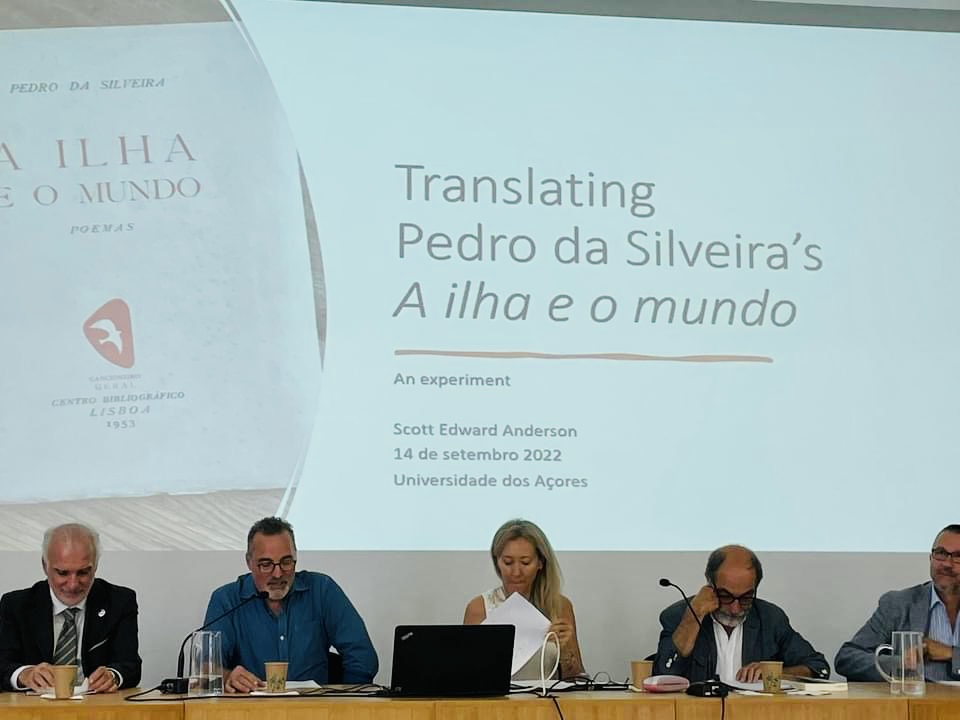
Last summer, I started a project to translate the Azorean poet Pedro da Silveira’s first book A ilha e o mundo (The Island and the World), which came out in 1952.
I had reviewed the late George Monteiro’s translation of Silveira’s last book, published in a bilingual edition by Tagus Press in the States and simultaneously by Letras Lavadas in the Azores in 2019 as Poems in Absentia & Poems from The Island and the World. In fact, the second half of that title was a misnomer; the book included only a few poems from Silveira’s first book–poems that had previously appeared in a Gávea-Brown anthology from the 1980s and sort of slapped on to the end of the book. (Silveira was born on Flores Island in 1922 and died in Lisbon in 2003.)
What struck me immediately about Silveira’s poetry—in Monteiro’s translation first and then in reading the facing Portuguese—was the depth of its feeling, the simplicity and directness of its language, and the brilliant tapestry woven by strands of memory, naming, and observations of nature. Indeed, all aspects that are found in my own poetry; hence, I felt a certain kinship with Silveira’s work straight away.
And yet, I was equally struck by the dearth of his poetry available in translation. How could such a seemingly important poet be so little represented in English translation? How much richer would the world of poetry–and the world of poetry-in-translation–be with Silveira’s body of work. And how much richer would be our lives in the Azorean diaspora with his sentiments, steadfast observations, and steady poetic hand.
I started with the second poem in the book, “Ilha”; this was likely the first poem I ever read by Silveira in translation, from that old Gávea-Brown anthology previously mentioned.
Here is the entire poem in its original Portuguese:
ILHA

Só isto:

                 O céu fechado, uma ganhoa

pairando. Mar. E um barco na distância:

olhos de fome a adivinhar-lhe, à proa,

Califórnias perdidas de abundância.
As I tend to do in my method of translation, I first read the poem straight through and then wrote an impression or literal reading as I understood it:
Just this:

                        The closed sky, a heron

Hovering. Sea. A boat in the distance:

Hungry eyes guessing, at the prow,

Californias lost of abundance.
A bit clunky and prosaic, and probably unworthy. I prefer to not read another’s translation (if there is one) while translating a poem lest I be influenced by it, so Monteiro’s sat on the shelf.
One thing troubled me, however. The bird. Where did that heron come from? Surely, I remembered it from Monteiro’s version. “Ganhoa,” at first, I thought was a misprint of “ganhou” – who won? – but that made absolutely no sense, so I went with heron. But what was a heron doing in this scene? Were herons even found in the Azores?
Reluctantly, I checked Monteiro’s translation. Sure enough, there it was, “heron.” It struck a dissonant chord with me now. A heron. Really? Again, I wondered whether herons were found in the Azores and turned to the Internet.
Yes, there were at least ten species of heron that have been noted on these islands, including great blues and little egrets, which according to the website whalewatchingazores.com have been sighted, but “not regularly”; the species is classified as an “uncommon vagrant” on the islands. And, most recently, a confirmed sighting of another species, the yellow-crowned night heron (Nyctanassa violacea) was described in a scientific paper by João Pedro Barreiros. Most likely, however, this one was blown east by a strong, errant wind from the west. Several herons were known to stop-over on their migratory path from Africa to northern climes and back.
Still, heron didn’t seem correct, to me, given the scene described. The use of Mar all alone. And the boat seemed to imply open waters rather than shoreline.
Herons are marsh-dwelling, shoreline species for the most part, so I was perplexed why they might be hovering “at Sea” or the “open ocean,” as I envisioned it. Were they blown off-course and out of their range? That would surely change the nature of this poem, which I assumed was about emigration or the emigrant returned or the desire to emigrate but also remain tied to the island. If it was not a heron, what was it then? What else might “hover” over the open ocean?
I typed “ganhoa” into Google. The almighty, all-seeing Google asked if I meant “ganhos” earnings; no, I did not. This was not a poem set in the halls of finance or a casino in Monaco. So, I clicked on “search instead for ganhoa” and up came a page from Priberam dicionário. I had my bird! The yellow-legged gull (Larus michahellis atlantis)…surely this bird would hover over the prow or bow of the boat, and even the stern, looking for a handout. A ganhoa recupera os seus ganhos. (The gull recovers its winnings.)
Here is my version of Pedro da Silveira’s “Island”:
Just this:

                    The closed sky, a yellow-legged gull

hovering. Open ocean. And a boat in the distance:

Hungry eyes, at the bow, divining,

lost Californias of plenty.
(Translated from the Portuguese by Scott Edward Anderson)
____
(This text was adapted from a paper delivered at the Colóquio celebrating the 100th anniversary of the birth of Pedro da Silveira, “Pedro da Silveira – faces de um poliedro cultural,” at the University of the Azores in Ponta Delgada, São Miguel, in September 2022.)
Speaking of the Azores: I am excited to host a Writing Retreat there from 13-18 October 2023! Join me for 5 days of writing and immersion in the nature, food, and culture of the Azores. We’ll explore the island, focus with deep attention, expand our horizons, and tap into the stories within. Details and registration at https://www.scottedwardanderson.com/azores-retreat
My friend and colleague Leonor Sampaio da Silva published her first collection of poems last summer, Quase um Carimbo (Companhia das Ilhas, 2022).

Born on the island of São Miguel, Azores, Leonor holds a master’s degree in Anglo-Portuguese Studies from the Universidade Novo de Lisboa and a PhD in Anglo-American Studies from the University of the Azores, where she has taught since 1991.
Having published a number of academic papers and contributions to various books, anthologies, and literary magazines, Leonor made her literary debut with a book of short stories, Mau Tempo e Má Sorte – contos pouco exemplares, which received the Daniel de Sá Humanities Prize in 2014. She is also the author of ABN da Pessoa com Universo ao Fundo (2017) and, with Carlos Carvalho, Pouca Terra – Fotografia e Literatura (2019).
“My idea for [this] book was to talk about the experience of isolation caused by the pandemic,” Leonor explained to me. “In which we lost contact with others and forced ourselves to face situations such as the vulnerability of life, how to make sense of each day, how to live with routine.”
Some of the poems read like diary entries, the poetic voice spoken by characters representing, as Leonor notes, “the others that exist within and outside of oneself.”
“Carimbo,” it may be useful to note, means “stamp,” the kind used to mark or authenticate official or private papers. Another meaning of the word, however, is “timestamp” (although usually written as “carimbo de data/hora.”) and, in this collection, each poem is marked by a timestamp: morning, afternoon, or night, as well as an action–I wake up, I sit down, I get up–as if to indicate stage direction.
It’s as if the characters in the poems are actors in their own play, marking their time, the pandemic imbuing even the most mundane tasks with the aspects of a theatrical production.
The book title translates as “Almost a Stamp,” which leads the reader to a question: if it is “almost,” what is it? An approximation? What is reality? The questions are heightened by the ending of the book where the theatrical stage suddenly becomes cinematic, play becomes film, language shifts in tone, the curtain falls, a wind picks up, a torrential rain pours down, and fallen leaves return to their trees. The speaker remains lonely. The book ends with one last action: “Adormeço” (I fall asleep).
“Poetry,” Leonor argues, “is a way of putting us in touch with each other and exploring new languages.” She carries this thread throughout the collection, whether using “the more intimate language of the diary/newspaper” or “the more social language of the theater,” demonstrating that “everything happens as if on a stage” and shielding us from loneliness and death.
Quase um Carimbo is an impressive debut poetry collection and I hope to translate more of it in the future.
Here are two poems by Leonor Sampaio da Silva in the original Portuguese and my translations into English:
manhã
acordo
uma personagem pragueja baixinho
pela noite mal dormida
o que farei se um Comboio transformar
a geografia deste lugar?
pensar no improvável tem sido
passatempo habitual
quase uma Obsessão
preocupa-me em demasia
a falta de uma Estação
—
morning
I wake up
a character curses softly
over the sleepless night
what will I do if a train transforms
the geography of this place?
thinking about the improbable has been
a regular hobby
almost an obsession
it worries me too much
the lack of a station
________
manhã
acordo
deve estar um dia quente a avaliar pela
temperatura do quarto
o corpo, o que é um corpo?
uma madeixa cortada
vivendo por um fio
enquanto aguarda reunir-se
à cabeça que dela se esqueceu
uma madeixa que se deixa
varrer
alisar
torcer em caracol
alourar ao sol
o sol, o que é o sol?
um corpo
—
morning
I wake up
it must be a hot day judging by
the temperature of the room
a body, what is a body?
a severed lock
living by a thread
while waiting to be reunited
with the head that has forgotten it
a lock that lets itself
sweep
smooth
twists into a curl
glistening in the sun
the sun, what is the sun?
a body
–Leonor Sampaio da Silva, from Quase um Carimbo
(translated from the Portuguese by Scott Edward Anderson)
___
Speaking of the island of São Miguel: I am excited to host a Writing Retreat there from 13-18 October 2023! Join me for 5 days of writing and immersion in the nature, food, and culture of the Azores. We’ll explore the island, focus with deep attention, expand our horizons, and tap into the stories within. Details and registration at https://www.scottedwardanderson.com/azores-retreat
National Poetry Month 2019, Week Four: Sophia de Mello Breyner Andresen’s “25 de Abril”
April 25, 2019
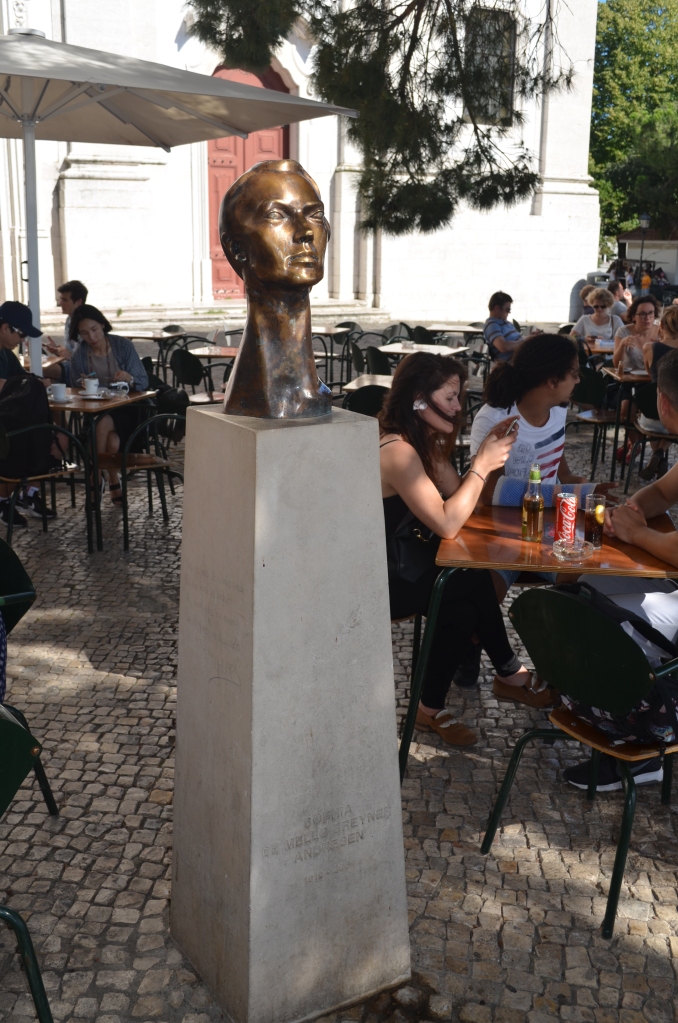
(Photo by SEA)
Today, 25 April, marks the 45th Anniversary of Portugal’s “Carnation Revolution,” when a military coup toppled the fascist, authoritarian government, leading to a period of freedom and democracy after 48 years.
In addition to ridding the country of the “Estado Novo” regime, the revolution of 25 April 1974, led to the end of Portuguese colonization and its attendant wars in Africa. Decolonization began shortly after the Carnation Revolution and, by the end of 1975, the former colonies of Angola, Cape Verde, São Tomé, and Mozambique gained independence.
Dubbed the Carnation Revolution because the flowers were offered to military personnel by civilians on the streets of Lisbon as a symbol of the peaceful transition of power, an action initiative by activist Celeste Caeiro. The coup itself was apparently triggered by a Portuguese song featured in the 1974 “Eurovision” song contest—the same contest that launched the Swedish band ABBA, which won that year with “Waterloo.”
Portugal’s entry, a fairly innocuous love-ballad called “E depois do adeus” (“And after the farewell”) by Paulo de Carvalho, was used to signal the rebels, who launched the coup when it was broadcast by a Lisbon radio station at 22:50 on 24 April. A second song, “Grândola Vila Morena” by Zeca Afonso, announced when the coup leaders had seized control. A 2000 film by Maria de Medeiros, Capitães de Abril, dramatizes the story.
Sophia de Mello Breyner Andresen (1919-2004) is one of the most important Portuguese poets of the 20th century and, in 1999, became the first Portuguese woman to receive the Camões Prize, the most prestigious award in Portuguese literature.
In 2014, ten years after her death—and on the 40th anniversary of the Carnation Revolution—Andresen’s remains were transferred to the Panteão Nacional, in the Church of Santa Engrácia, only the second Portuguese woman to receive this honor. (The other was fado singer Amália Rodrigues.)
“Poetry is my understanding of the universe,” Andresen once said. “My way of relating to things, my participation in reality, my encounter with voices and images.”
Her poem, “25 de Abril,” is the most famous poem of the Carnation Revolution, simple and elegant in its observation of the morning when the country emerged from “the night and the silence” of almost fifty years of authoritarian rule.
Here is Sophia de Mello Breyner Andresen’s “25 de Abril” in the original Portuguese and in my English translation:
“25 de Abril”
Esta é a madrugada que eu esperava
O dia inicial inteiro e limpo
Onde emergimos da noite e do silêncio
E livres habitamos a substância do tempo
—-
“25th of April”
This is the dawn I expected—
the first day, whole and clean,
where we emerge from the night and the silence.
And free, we inhabit the substance of time
(Translation by Scott Edward Anderson)

São Miguel, Azores, Portugal
“I don’t write to say what I think. I write to find out what I’m thinking,” said the poet Gary Snyder. To that I might add, I write to understand who I am.
Lately, I’ve been working on a project—a kind of enhanced memoir—that explores my Portuguese family history. As part of this project, I’ll be going to the Island of São Miguel in the Azores this summer, where two of my maternal great-grandparents came from, for a residency hosted by DISQUIET International, which brings together Portuguese and Portuguese-American writers.
I first started researching my Portuguese roots back in the 90s and, coincidentally, that’s when I met the Portuguese poet, Nuno Júdice. He read at Poets House, along with the translator Richard Zenith, in December of 1994.
The author of over twenty books of poems, Júdice was born in 1949, on the southern coast of Portugal, in the region known as the Algarve. He is currently a professor at Lisbon’s Universidade Nova and directs the Colóquio/Letters program for the Gulbenkian Foundation. I’m hoping to see him in Lisbon when we are on the mainland.
Here is Nuno Júdice’s “Poema” in its original and in a translation by Martin Earl.
POEMA
As coisas mais simples, ouço-as no intervalo
do vento, quando um simples bater de chuva nos
vidros rompe o silêncio da noite, e o seu ritmo
se sobrepõe ao das palavras. Por vezes, é uma
voz cansada, que repete incansavelmente
o que a noite ensina a quem a vive; de outras
vezes, corre, apressada, atropelando sentidos
e frases como se quisesse chegar ao fim, mais
depressa do que a madrugada. São coisas simples
como a areia que se apanha, e escorre por
entre os dedos enquanto os olhos procuram
uma linha nítida no horizonte; ou são as
coisas que subitamente lembramos, quando
o sol emerge num breve rasgão de nuvem.
Estas são as coisas que passam, quando o vento
fica; e são elas que tentamos lembrar, como
se as tivéssemos ouvido, e o ruído da chuva nos
vidros não tivesse apagado a sua voz.
—
POEM
It’s the simplest things that I hear in the wind’s
intervals, when the simple beating of the rain
on the windows breaks the silence of night, and its rhythm
overwhelms that of words. Sometimes, it is a
tired voice, that tirelessly repeats
what the night teaches those who live it; other
times, it runs, hurriedly, mowing down meanings
and phrases as though it wanted to reach the end, more
quickly than the dawn. We’re talking about simple things,
like the sand which is scooped up, and runs
through your fingers while your eyes search
for a clear line on the horizon; or things
that we suddenly remember, when
the sun emerges from a brief tear in the clouds.
These are the things that happen, when the wind
remains; and it is these we try to recall, as though
we had heard them, and the noise of the rain
on the windowpanes had not snuffed out their voice.
© 2006 Nuno Júdice, from As coisas mais simples, Lisbon: Dom Quixote, 2006
Translation © 2007 Martin Earl, first published on Poetry International, 2014
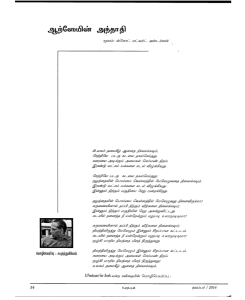
My poem, “Pantoum for Aceh” translated into Tamil by Appadurai Muttulingam, 2014.
A few years ago, my friend and former colleague at The Nature Conservancy, Sanjayan, introduced me to Tamil poetry after a long chat about poetry while we were both speaking at a conference in Aspen.
Sanjayan, a Sri Lanka-born Tamil, recommended I start with Poems of Love and War, selected and translated by A. K. Ramanujan, a remarkable book of Tamil poems from throughout history.
Long-time subscribers to my Poetry Month emails will recall I shared a few poems from the anthology in April 2009. Sanjayan sent my email to his father, Appadurai Muttulingam, who in turn sent me a copy of his own delightful book of short stories.
I responded by sending Appadurai a few of my poems (my book was not yet out) and he offered to translate one of them, “Pantoum for Aceh,” into Tamil for a Canadian-based Tamil-language journal, URAIYAADAL, which was published in 2014 (see photo above). He also sent me an anthology of contemporary poetry in Tamil, which I reviewed on my blog, here.
That post led the Sri Lankan Tamil poet known as ANAR (Issath Rehana Mohamed Azeem), whose poem, “Marutham,” I had called out in my review, to reach out to me earlier this year and send me some of her poems.
How small the world becomes when we are open to discovery and exploring cultures beyond our own. We are a global people and, I’m convinced, the movement to close our borders and shut out “foreign” cultures will soon die, because technology and travel and our future on this planet demands it.
ANAR has been writing poetry in Tamil since the 1990s. Her works include Oviem Varaiyathe Thurikai, Enakkuk Kavithai Mukam, Perunkadal Podukiren, Utal Paccai Vaanam, and Potupotuththa Mazhaiththooththal (a collection of Tamil folk songs from Sri Lanka).
A number of ANAR’s poems have been translated into English and published. Her books have won several awards, most notably the Government of Sri Lanka’s National Literature Award, the Tamil Literary Garden’s (Canada) Poetry Award, the Vijay TV Excellence in the Field of Literature (Sigaram Thotta Pengal) Award, and the Sparrow Literature Award.
ANAR writes regularly on her blog, anarsrilanka.blogspot.com (Google Chrome will translate it for you) and lives with her husband and son in the Eastern Province of Sri Lanka at Sainthamaruthu.
Here is her poem, “The Brightness of Wind,” in an English translation by Professor Jayaraman and its Tamil original:
“The Brightness of Wind”
I allow the wind
To eat me
My eyes
I stroked its cool cheeks
For the first time
Before it showed itself in the wind
Intoxicated I drank the image day and night
Kisses I plucked from the wind
Overflowed as would the floods
These watery fingers
Reaching out from the wind
Play on my flesh
Tunes not known before
My dwelling has turned into a wind
You, the total haughtiness of the wind
You, the never-ending slight of the wind
The expanse of sand has gone dry with joy
Body, the green sky
Face, the blue moon
I saw the brightness of wind
In a flash of lightning
—ANAR
translated into English by Professor Thanga Jayaraman
And in the original (Not sure how the beautiful Tamil script will work in WordPress, we’ll see):
காற்றின் பிரகாசம்
காற்றைத் தின்னவிடுகிறேன்
என்னை …
என் கண்களை …
குளிர்ந்த அதன் கன்னங்களை வருடினேன்
முதல் முறையாக
காற்றில் வெளிப்படுமுன் பிம்பத்தை
பகலிரவாக பருகினேன் போதையுடன்
காற்றினுள்ளிருந்து எடுத்த முத்தங்கள்
வெள்ளமாய் பெருக்கெடுத்திருக்கின்றன
காற்றிலிருந்து நீளும் நீர் விரல்கள்
முன்னறியாத ராகங்களை
இசைக்கிறதென் சதைகளில்
என் வீடு காற்றாக மாறிவிட்டது
காற்றின் முழுமையான அகங்காரம் நீ
நீ காற்றின் முடிவற்ற அலட்சியம்
மகிழ்ச்சியில் உலர்ந்துகிடக்கின்றது மணல்வெளி
உடல் பச்சை வானம்
முகம் நீல நிலவு
நான் பார்த்தேன் காற்றின் பிரகாசத்தை
ஒரு மின்வெட்டுப் பொழுதில்
–ANAR
c) 2007 ANAR, used by permission of the author
(On a side note, you should check out Sanjayan’s new video series on Vox, made in conjunction with the University of California. Here’s a link: Climate Lab.)
My poem “Villanelle on a Line Hated by Auden”
January 7, 2017
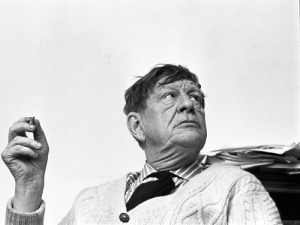
W.H. Auden
“September 1, 1939” is one of the most famous poems by W. H. Auden. He wrote the poem after learning the news of Hitler’s invasion of Poland at the start of World War II, published it a month later in The New Republic magazine, and reprinted it in his collection, Another Time, the following year.
Despite – or perhaps because of — rushing it into print, Auden appeared to dislike the poem almost as soon as it was published. As little as five years later, reprinting the poem in The Collected Poetry of W. H. Auden (1945), he cut the stanza with its most famous line, “We must love one another or die.”
“Between you and me, I loathe that poem,” he wrote to the critic Laurence Lerner, and resolved to keep it out of future collections of his work during his lifetime. He relented in 1955, allowing Oscar Williams to include it in his New Pocket Anthology of American Verse, but only with the proviso that the last line be edited to “We must love one another and die.”
Why did he hate this line – and the poem — so much? He claimed in a preface to the 1965 edition of his Collected Poems, “Some poems which I wrote and, unfortunately, published, I have thrown out because they were dishonest, or bad-mannered, or boring.”
In a Penguin anthology the previous year, the poem and four others were included along with a caveat: “Mr. W. H. Auden considers these five poems to be trash which he is ashamed to have written.”
What was it about the poem and, in particular, this line that Auden didn’t like? Was he embarrassed by its earnestness and sentiment, as some have suggested? Did he feel it was sappy and self-indulgent, as others would have it? Or was it “the most dishonest poem I have ever written,” as he put it?
And yet, the last line endures and the poem remains one of Auden’s most famous, surviving even today as one of the most eloquent pleas for empathy and peace in the face of totalitarianism. The poem even resurfaced as a touchstone for people in the wake of 9/11, as I have written elsewhere.
I wrote “Villanelle on a Line Hated by Auden” on 3 September 2014 as part of Jo Bell’s “52” experiment, and it was recently published in The Road Not Taken: The Journal of Formal Poetry.
Here is my poem, “Villanelle on a Line Hated by Auden”:
“We must love one another or die,”
The poet instructs, though doesn’t believe it.
“We must love one another and die.”
Revised to inclusive and on another try,
Then repudiated the poem, banning it.
He who must love another or die.
“Ours is not to reason why,”
Another poet said with the soul of wit.
Ours is to love one another. We die.
Changing a word makes meaning fly
To the far reaches of our minds and sit.
Must we, really, love one another or die?
Can we exist without knowing why–
Knowledge straining at the bit–
Until we can only love each other and die?
When we live without love, we die.
At least, those of us who desire it.
We must love one another or die.
We must love one another and die.
–Scott Edward Anderson
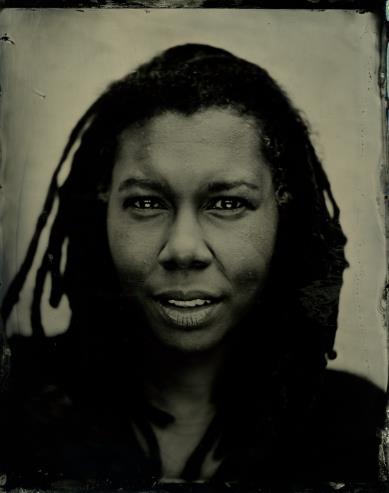
Sheree Mack c) 2012 Alastair Cook
Every month it seems there is another flashpoint of tensions between police and black communities in cities around the United States.
From Ferguson to Baltimore, our country seems ready to tear at the seams from a volatile combination of racial prejudice, police militarism, and the systemic poverty and disenfranchisement black people feel in America today.
It is impossible to ignore this critical issue of our day – we ignore it at our peril – even in a forum such as this.
In that light, I asked poet Sheree Mack if I could feature one of her poems for this final week of National Poetry Month. I was thinking we’d choose one from her remarkable new book, Laventille, which I’ve just started reading.
But Sheree asked if I’d rather have a new poem, one where she is trying “to get my head around the issue of race in America now with #BlackLivesMatter and how things haven’t changed much since lynching was another arm of the ‘law’.”
When she sent me, “Called Witness,” I jumped at the chance to share it, with its unflinching mixture of found texts (from a source cited below) and its paraphrase of Billie Holiday’s “Strange Fruit” in line 8.
Sheree Mack was born in 1971 in Bradford, England, to a Trinidadian father and a “Geordie” mother of Ghanaian and Bajan ancestry. She worked as a teacher for several years before studying for a PhD on black British women poets.
Sheree now dedicates her life to “fostering creativity in everyone’s life” working with communities of women and young writers, and currently lives in Tynemouth. She is the author of two collections, Family Album (Flambard Press, 2011) and Laventille (Smokestack Books, 2015).
I met Sheree Mack through the group “52,” which I participated in last year. Members of “52” wrote poems each week to prompts supplied by the group’s founder, Jo Bell, and commented upon each other’s work in a closed group on Facebook. (See my blog post on the subject here.)
Sheree’s poetry rose to the surface in my mind for its clarity, craft, and complexity of vision. Mack’s poems “lament, rage and mourn,” as the publisher says about her latest book. “But they also offer a song of healing, a celebration of survival, a glimmer of the flames that burn in the hearts of a people still living in slavery’s dark shadow. “
Her perceptive comments on a number of poems (mine and others) flagged her as one of those people you want to spend time with, even if the only opportunity is through the auspices of a virtual poetry workshop.
It was only later that I realized she was also the subject of my friend Alastair Cook’s stunning collodion portrait of a striking woman with captivating eyes, that I’d seen as part of his McArthur’s Store exhibition. There is something haunting about this portrait, as is the case of much of Alastair’s work in the medium.
The image is timeless or time-bound or both simultaneously. It could just as easily be a photograph of someone from Trinidad and Tobago at the time of the 1970 student uprisings in Laventille (the subject of her book) or an image from an even earlier era.
In short, the photo is a bit like Sheree Mack’s poetry: a bit timeless, a bit time-bound, but always unflinching and intriguing.
Here is Sheree Mack’s poem, “Called Witness”:
The exhibition opened in a small New York gallery.
The crowds came, self-righteous and proud.
Assembled and displayed were sixty photographs,
collected from family albums, attic trunks, flea markets.
Small, black-and-white postcards,
not more than a few inches long and wide,
depicting African-American men in Jim Crow
South; black bodies swinging from poplar trees.
Long lines stood for hours on the wintry
sidewalk, waiting for their view.
Once inside, bodies overwhelmed the intimate space.
Images laid flat on display tables or assembled
in tight groupings tacked to light-coloured walls.
Tattered, faded and worn, neither retouched nor restored.
Nor framed, matted, or captioned. Instead offered
as artefacts, not fine art objects. None for sale.
Visitor huddled close, hunched over tables,
faces pushed up against the walls, they felt
the warmth and proximity of others, jostling
and angling their bodies for a better look.
Through generations, onlookers enticed to the scene
by the spectacle of mutilated, dangling bodies.
c) 2015 Sheree Mack
Used by permission of the author.
_________________
Text cited: Lynching Photographs by Dora Apel and Shawn Michelle Smith,
University of California Press, Berkeley and Los Angeles, California, 2007

Table Mountain, Cape Town, South Africa. Photo by the author.
As some of you know, my new role in my day job at EY involves helping globalize prepaid smart metering programs for municipal utilities in emerging markets.
It’s a project that started in South Africa, and I think it’s pretty cool to be exporting an innovation from the African continent rather than imposing it from outside.
Traveling to South Africa, I’ve begun to explore the literature and art of the country over the last 20 years since the end of apartheid.
Thinking about poets whose work I could share, I thought about the work of Isobel Dixon. I know Isobel chiefly through social media — I believe it was Jo Bell or the Scottish Poetry Library who first introduced me to her work.
Dixon lives in London, but was born in Umtata, South Africa, and grew up in the semi-desert region known as the Karoo. She studied in the South African winelands country of Stellenbosch (where I was with my wife Samantha in January) and in Edinburgh.
In 2000, Dixon won the Sanlam Literary Award for her then unpublished collection of poetry Weather Eye, which was subsequently published by Carapace Poets (2001). She is also the author two collections, The Tempest Prognosticator and A Fold in the Map, both published by Salt in the UK. You can read more of her work at isobeldixon.com
I love the rhythms and musicality of Isobel Dixon’s poem, “She Comes Swimming,” and the mix of history and mythology that unfolds as we read. Of the poem Dixon wrote in an email to me,
“This is a poem very close to my heart, about my beloved country, South Africa. I wrote it in my first years abroad, feeling very keenly what it means to live far from the motherland, to yearn for it – and yet to fear that time away will change you, or change others’ perceptions of you, so that you might be perceived as an outsider, in spite of all you feel and are.”

Winelands, South Africa. Photo by the author.
Dixon “won a scholarship to do postgraduate study in my father’s native Scotland, the realisation of a dream, but at a time when I’d rather have stayed in South Africa – the momentous year of the first democratic elections.”
Another aspect of the poem that I particularly admire is what Dixon explains as “This sense of rueful distance, of vivid longing, and an awareness of the complex histories and hybrid mythologies of my faraway homeland, all fed into a poem about my imagined journey southwards, swimming back in time and language too.”
Dixon also told me that the poem has a central place in her Salt collection, A Fold in the Map, a collection that looks at the traveler’s state of “in-betweenness,” caught between lives and countries.
“The poem flowed onto the page in something of a hypnotic state,” Dixon wrote. “One of those poems you look at the day after and think, ‘Where did that come from, and how?’ Wherever it summoned itself from, I’m glad it did.” We are too.
Here is Isobel Dixon’s poem, SHE COMES SWIMMING
She comes swimming to you, following
da Gama’s wake. The twisting Nile
won’t take her halfway far enough.
No, don’t imagine sirens – mermaid
beauty is too delicate and quick.
Nor does she have that radiance,
Botticelli’s Venus glow. No golden
goddess, she’s a southern
selkie-sister, dusky otter-girl
who breasts the cold Benguela, rides
the rough Atlantic swell, its chilly
tides, for leagues and leagues.
Her pelt is salty, soaked. Worn out,
she floats, a dark Ophelia, thinking
what it feels like just to sink
caressed by seaweed, nibbled by
a school of jewel-plated fish.
But with her chin tipped skyward
she can’t miss the Southern Cross
which now looks newly down on her,
a buttress for the roof of her familiar
hemisphere. She’s nearly there.
With wrinkled fingertips, she strokes
her rosary of ivory, bone and horn
and some black seed or stone
she can’t recall the name of,
only knows its rubbed-down feel.
And then she thanks her stars,
the ones she’s always known,
and flips herself, to find her rhythm
and her course again. On, southwards,
yes, much further south than this.
This time she’ll pay attention
to the names – not just the English,
Portuguese and Dutch, the splicings
and accretions of the years. She’ll search
for first names in that Urworld, find
her heart-land’s mother tongue.
Perhaps there’s no such language,
only touch – but that’s at least a dialect
still spoken there. She knows when she
arrives she’ll have to learn again,
so much forgotten, lost. And when
they put her to the test she fears
she’ll be found wanting, out of step.
But now what she must do is swim,
stay focused on each stroke,
until she feels the landshelf
far beneath her rise, a gentle slope
up to the rock, the Cape,
the Fairest Cape. Her Mother City
and its mountain, waiting, wrapped
in veils of cloud and smoke.
Then she must concentrate, dodge
nets and wrack, a plastic bag afloat –
a flaccid, shrunk albino ray –
until she’s close enough to touch
down on the seabed, stumble
to the beach – the glistening sand
as great a treasure as her Milky Way –
fall on her knees and plant a kiss
and her old string of beads,
her own explorer’s cross
into the cruel, fruitful earth at last.
She’s at your feet. Her heart
is beating fast. Her limbs are weak.
Make her look up. Tell her she’s home.
Don’t send her on her way again.
© 2001, Isobel Dixon
Used by permission of the author.
Poems of Displacement, Love, and Other Modern Tamil Concerns
March 23, 2014
 IN OUR TRANSLATED WORLD: Contemporary Global Tamil Poetry, edited by Chelva Kanaganayakam (TSAR Publications, Toronto, Canada)
My first encounter with Tamil poetry came in the form of a short poem by Auvaiyar, written two millennium ago:
Bless you, earth:
field,
forest,
valley,
or hill,you are only as good
as the good young men
in each place.
This poem appeared in a book of classical Tamil poetry called Poems of Love and War from the Eight Anthologies and the Ten Long Poems of Classical Tamil, selected and translated by A.K. Ramanujan, which featured poems from around 100 BC to AD 250, and late classical poems from the 5th and 6th centuries.
The poems were divided into two distinct sections, “Akam” (pronounced “aham”) which were love poems, and “Puram,” which were about heroes and battles. Akam means heart or household, and the poems are distinguished by the landscape each poem evokes and, in turn, the particular experience of love each landscape connotes. The Tamil called this “Tinai” in their poetics.
The subtropical climate of Tamil Nadu in southern India ranges from seaside to mountains, agricultural fields to forests, and desert. Each landscape is associated with a certain mood and the poems typically feature a flower, tree or plant of the corresponding biome. For example, as Ramanujan points out in his translator’s note, “Kurinci, a mountain flower; neytal, blue lily; mullai, jasmine; maratam, queen’s flower; palai, a desert tree.”
The poems are distinguished by straight-forward emotions and plain language (at least in translation), with a simplicity rivaling Chinese and Japanese poetry.
Take Kapilar’s poem of longing, “What She Said to her friend” (p. 13):
You ask me to forget him,
How can I?
His mountain,
wearing its dark raincloud
white-crested
as a bean flower
the east wind opens,
his mountain,
that blue sapphire,
is never out of sight.
We know from the Tinai that each landscape corresponds to a phase or experience of love: union/mountains; separation/desert; patience waiting/forest; anxious waiting/seaside; and infidelity and resentment/lowland farms. In the poem above, the speaker is clearly longing for the union or reunion with her lover on his mountain, which she keeps in her memory.
Tamils have a strong attachment to their language, which is central to their identity. Many refer to it as Tamil̲an̲n̲ai, “the Tamil mother.” It is one of the oldest surviving classical languages in the world, and written Tamil is a beautiful Brahmic script. Thankfully, this anthology is bilingual, which allows the reader to see the poems (if not read them) in their original form.
Poets such as Mahakavi Bharathiyar and Bharathidasan — the latter a kind of Tamil Fernando Pessoa who wrote many of his poems in various pseudonyms — brought Tamil poetry into the modern era. Their work gave Tamil poets freedom from the constraints of traditional Tamil poetics and expanded the subject matter available to Tamil poets.
In Our Translated World: Contemporary Global Tamil Poetry is a recent anthology of contemporary global Tamil poetry, published by the Tamil Literary Garden of Canada and TSAR Publications in Toronto. The work of the Tamil poets in this anthology clearly bears the mark of its modern predecessors, but also the influence of modern and contemporary poetry from Europe and Asia.
Not surprising, given the book is a selection of recent poems from Tamils around the world. Indeed, the anthology, edited by Chelva Kanaganayakam, features around 80 poems from Tamil Nadu, Sri Lanka, Malaysia, Singapore, and the Tamil diaspora in England, Canada, and elsewhere.
As Chelva writes in the introduction, “for Tamils, particularly in the last three decades, the experiences have been one of displacement, trauma, nostalgia, and despair.” This is especially true of Sri Lankan Tamils, as many tried to escape ethnic conflicts on that island nation.
For some Sri Lankans, such conflict breeds a conflicting nature. For example, Chandra Bose Sudhakar, who defends his choosing a life of books,
Life began with some books:
that the words in books
produce no rice became
the problem of our lives.
For Sudhakar, “books swallow the howls/ of my tormented heart” and offer the Sri Lankan poet, who was killed by armed men in his house in 2007, a kind of acknowledgment he couldn’t find elsewhere.
Some poems in the collection have echoes, intentional or not, of classical Akam poems, such as this one by Majeed, which sounds to me like a desert or separation poem:
You live on
in the empty spaces
that cannot be filled
with anything else.
Or consider the seaside imagery of another poem by Auzhiyaal, which could be in the voice of an anxious lover trying to find solace in the littoral environment:
At the end of each day
our minute secrets
rise again
a pregnant silver fish
a sea weed
a pink sea rock.
The freedom afforded by contemporary poetics may bely an ignorance of Tamil classical themes and symbolism, as some of the poets freely mix landscapes, emotions, and place, such as in this poem by Rashmy,
Parting is always bitter;
everywhere, eventually brackish;
trembling flesh,
nerves starved with lust,
the soul’s love
draining, filled to the brim.
From our paddy fields
gold-hued grains
we will harvest
the day after yesterday.
Others call out the connection, such as Anar does in her poem “Marutham,” with its rich depiction of the farm fields and rice paddies indicative of the agricultural landscape and a hint of possible infidelity in the lines,
The fragrant smell of
ripe paddy in the fields,
offers a giddy sense of joy.
As much as the poets in this collection have deep memories of their Tamil past and poetry, the poems in this collection are, as the editor writes in his introduction, “a form of transformation, a gesture about the future. Whether the poems are ostensibly realistic or self-consciously fantastic, the poems move beyond ethnographic detail to offer an imaginative sense of the Tamil experience.”
And for poetry readers, the Tamil experience is a rich and rewarding one in the hands of the poets, translators, and editor of In Our Translated World.
##
 Scott Edward Anderson
 Scott Edward Anderson's Poetry Blog