In December 1994, I attended a poetry reading at Poets House in New York by two Portuguese poets, Nuno Júdice and Pedro Tamen, along with the translator, Richard Zenith. Little did I know that this event would have an impact on the profound journey into my ancestral roots in Portugal and the Azores.
After my Portuguese grandfather passed away in September 1993, I was at a loss to uncover our family’s history, which he had been reluctant to share. Hearing Júdice and Tamen read their poems in Portuguese the following December was a revelation of sorts—here were real, live Portuguese poets speaking the language of my ancestors.
The dearth of first-hand accounts and available source materials kept me from learning my family’s Portuguese Azorean history for many years and, frankly, life got in the way of digging deeper. When my father died in 2016, I realized that all my family’s histories were available to me, except one part—the Portuguese. By then, Ancestry.com had made many research materials available online for the first time, and a group of Azorean Genealogists gathered on a listserv to share information, leads, and help translate documents from the Azores, much of which had also become available online in the form of scanned records from the parish archives from the Azores. Suddenly, my research got easier.
In 2018, I made my first trip to the Azores and Portugal, and before going, I reached out to Nuno Júdice, whose contact information I had kept from that poetry reading decades ago.
To my surprise, Nuno remembered me, and we arranged to meet during my visit to Lisbon in July of that year. We spent a delightful evening together, with Nuno sharing insights into Portuguese poetry, history, and culture. Our connection deepened further when he invited me to write a foreword for David Swartz’s English translation of his novella, The Religious Mantle, and later, he published several of my poems in a literary journal he edited.

In 2020, Nuno graciously provided a blurb for my book Azorean Suite/Suite Açoriana, celebrating the work as a poetic exploration of ancestral memory and the experiences of Portuguese emigrants.
Our paths continued to intertwine as the translator Margarida Vale de Gato, whom Nuno had earlier recommended for my poems, agreed to translate my book Dwelling: an ecopoem into Portuguese. Nuno even agreed to help launch the translated edition, Habitar: um ecopoema, in Lisbon in September 2022. In many ways, this felt like coming full circle from our initial encounter at that poetry reading nearly three decades ago.
In a serendipitous twist, Júdice revealed that he had met one of my teachers, the renowned poet Gary Snyder, whom Margarida had also translated, in Madrid in the 1980s. He even shared a draft of a poem he had written about that encounter, further solidifying the interconnectedness of our poetic journeys. When Nuno Júdice passed away last month unexpectedly, I was deeply sad to hear the news from David Swartz; I had just been thinking about Nuno and had planned to write to him. He would have turned 75 years old later this month.
Here is Nuno Júdice’s poem, “Madrid, Anos 80” and my translation from the Portuguese:
MADRID, ANOS 80
Cruzei-me uma vez com Gary Snyder nas Bellas Artes
de Madrid. Eu vinha com livros espanhóis – poesia, e algum
Borges, onde há sempre coisas novas – e cruzei-me com Gary
Snyder, que vinha de ler poemas, mas quando o soube já
a leitura tinha acabado. Também não sei se o iria ouvir: não é
todos os dias que se está em Madrid, com tempo para ir
às livrarias e espreitar museus; e ouvir Gary Snyder pode
não dar jeito ou, pelo menos, obrigar a que se perca alguma coisa
que tão cedo não se voltará a ver. Foi assim que, antes de ir à livraria,
eu tinha passado pelo Caspar David Friedrich, no Prado,
perseguindo montanhas e ruínas da velha Alemanha. Ao sair dali,
com os olhos enevoados pelo mar do Norte, como iria
entrar numa sala para ouvir Gary Snyder? Da próxima vez
que estiver em Madrid, porém, não vai ser assim: e se me cruzar,
nas Bellas Artes, com um poeta que acabe de ler poemas,
mesmo que eu venha da livraria, e tenha passado pelo Prado,
vou arranjar tempo para o ouvir – em homenagem a
Gary Snyder, que não tive tempo
para ouvir.
Nuno Júdice, 26-11-2000
__
MADRID, 80’s
I crossed paths with Gary Snyder once, at Bellas Artes
in Madrid. I was carrying Spanish books – poetry, and some
Borges, where there are always new things – and I bumped into Gary
Snyder, who came to read poems, but by the time I found out
the reading was over. I didn’t know if I would listen to him either: it isn’t
every day that you’re in Madrid, with time to go
to bookstores and look around museums; and listening to Gary Snyder might
not be useful or, at least, make you miss something
that you won’t see again anytime soon. So, before going to the bookstore,
I had passed by Caspar David Friedrich, in the Prado,
chasing mountains and ruins of old Germany. As I left,
with eyes clouded by the North Sea, how was I going to
walk into a room to listen to Gary Snyder? The next time
when I’m in Madrid, however, it won’t be like that: and if you bump into me,
in Bellas Artes, with a poet who has just finished reading poems,
even if I’m coming from the bookstore, and have just passed through the Prado,
I will make time to listen – in honor of
Gary Snyder, who I didn’t have time
to hear.
Translated from the Portuguese by Scott Edward Anderson


Photo by SEA.
If you’ve been following my blog for the past few years, you know that I’ve been on a journey of rediscovery—rediscovery of my Azorean Portuguese roots and heritage.
I’ve now been back to the island archipelago of my ancestors three times since my first return in 2018.
That first visit was under the auspices of a writing retreat offered by DISQUIET International, an organization that tries to link and foster relationships between Luso-American and Portuguese writers.
This journey has turned out to be more than just a heritage tour, for I’ve made many friends and discovered family I didn’t know I had there. And because I worked in nature conservation for so many years, I couldn’t help falling in love with the islands and their beauty and majesty, but also their fragility.
My own poetry and non-fiction have long been about a few essential themes: a longing for home and an appreciation and concern for the natural world. In the Azores, I’ve come to find a beautiful combination of both.
In addition to that longing (the Portuguese have a word for it, saudade, which I’ve defined elsewhere as a longing for lost things) is the feeling that I’ve found a home there, which I hope to fully realize in the not too distant future.
And my concern for the natural world there—in the face of future impacts of climate change on small island communities like the Azores—as well as the last remaining endemic species, is also deepening my relationship to the islands.
I’ve been exploring my love affair with the Azores in two works-in-progress (although, frankly, it’s showing up in just about everything I write these days): a research-driven memoir of my ancestry and heritage on the islands and a long poem that explores some of the same territory.
Recently, Gávea-Brown, a bilingual journal of Portuguese-American language and studies from Brown University, published an excerpt from my poem, which I’ve been calling “Azorean Suite,” in the original English and in a translation by the Azorean American poet José Francisco Costa.
It’s been an amazing journey thus far and I hope to return to the islands as soon as possible. Meanwhile, here is a section from my “Azorean Suite.”
From “Azorean Suite”
“Is the island a cloud or is the cloud and island?” ~Nemésio
The sea surrounds, is ever-present
endless, the sea surrounds
and sea sounds swirl and sway
humid torpor of temperament
fog enshrouds
clouds caught on peaks
wrapping the mountain
a helmet of white, gray, ash
the ever-present volcanoes
threat of fire and destruction
threat of sea-wind and wave
thread of saudade woven
into the fabric of all life
on the islands—
saudades for the land
enshrouds the land
enshrouds the islanders
surrounded by sea.
#
São Miguel, island of my ancestors
who settled here in the original waves
1450s or earlier, as far as I can tell,
from the Alentejo, they came,
encouraged or escaping
I know not—
São Miguel, the green island,
jewel in the bracelet of archipelago,
formed by two volcanoes
reaching for each other
a chain of eruptions enclosing
the space between them
populated, like that chain, scattered
by wind and sea, until 1906,
when my great-grandparents left
for America—scattered across the sea.
#
My return, over a century later,
fills me with mixed emotions—
have I come “home” or simply returned
to reclaim a lost heritage
something denied to me
by my grandfather’s willingness
to forget the past, to relinquish
the “saudades de terra”
so much a part of the Azorean character—
the phrase can mean “longing for the land”
or “I miss the earth”
which seems so necessary now
with the threat of climate change
added to the island condition—
sea-surge from hurricane Lorenzo overflowing
onto the low-lying streets at sea’s edge
saltwater burning the wine grapes
flooding the edge of the villages
how high will the sea rise in the next century
how will the islanders survive
what becomes of saudades de terra
when the land is swallowed by sea?
and here is José Francisco Costa’s translation into Portuguese:
Excerto de Suite Açoriana
“A ilha é a nuvem ou a nuvem a ilha?” ~Nemésio
O mar é um cerco, é contínua presença
infinita, o mar é um cerco
e os sons do mar rodopiam e arrastam-se
húmido torpor do ser
nevoeiro mortalha
nuvens presas nos cimos
envolvendo a montanha
um capacete de branca, parda, cinza
a inescapável presença dos vulcões
ameaça de fogo e destruição
ameaça de vento e vaga de mar
fio de saudade urdido
no tecido da vida inteira
nas ilhas –
saudades da terra
mortalha da terra
mortalha de ilhéus
por mar cercados.
#
São Miguel, ilha dos meus antepassados
que aqui fizeram morada nas ondas originais
1450 ou antes, tanto quanto sei,
do Alentejo, vieram,
incentivados ou fugidos
Eu não sei—
São Miguel, a ilha verde,
jóia no bracelete do arquipélago
nascida de dois vulcões
no encalce um do outro
corrente de erupções estreitando
o espaço entre eles
povoado, como a tal corrente, espalhado
por vento e mar, até 1906,
quando os meus bisavós partiram
no encalce da América – espalhados em toda a largura do mar.
#
O meu regresso, mais de um século depois,
enche-me de um contraste de emoções –
terei regressado a “casa” ou só voltei
para reclamar uma herança perdida
algo que me foi negado
pela vontade de meu avô
de esquecer o passado, renunciar
às “saudades de terra”
parte tão importante do ser Açoriano —
a frase tanto significa “estar ansioso pela terra”
como “a terra faz-me falta”
o que hoje parece ser tão necessário
com a ameaça das alterações climáticas
a somar à condição de ser ilha —
gigantescas marés provocadas pelo furacão Lorenzo inundando
as ruas baixas à beira do mar
água salgada queimando as vinhas
cobrindo os limites das freguesias
até onde subirá o mar no próximo século
como irão sobreviver os ilhéus
o que resta de saudades de terra
quando a terra é engolida pelo mar?
—Scott Edward Anderson (translation into Portuguese by José Francisco Costa)
This excerpt, from a long poem-in-progress, originally appeared in Gávea-Brown—A Bilingual Journal of Portuguese-American Letters and Studies
(I want to thank Onésimo Teotónio Almeida and Jennifer Currier for publishing my poem, and José Francisco Costa for his translation.)
National Poetry Month 2019, Week Four: Sophia de Mello Breyner Andresen’s “25 de Abril”
April 25, 2019
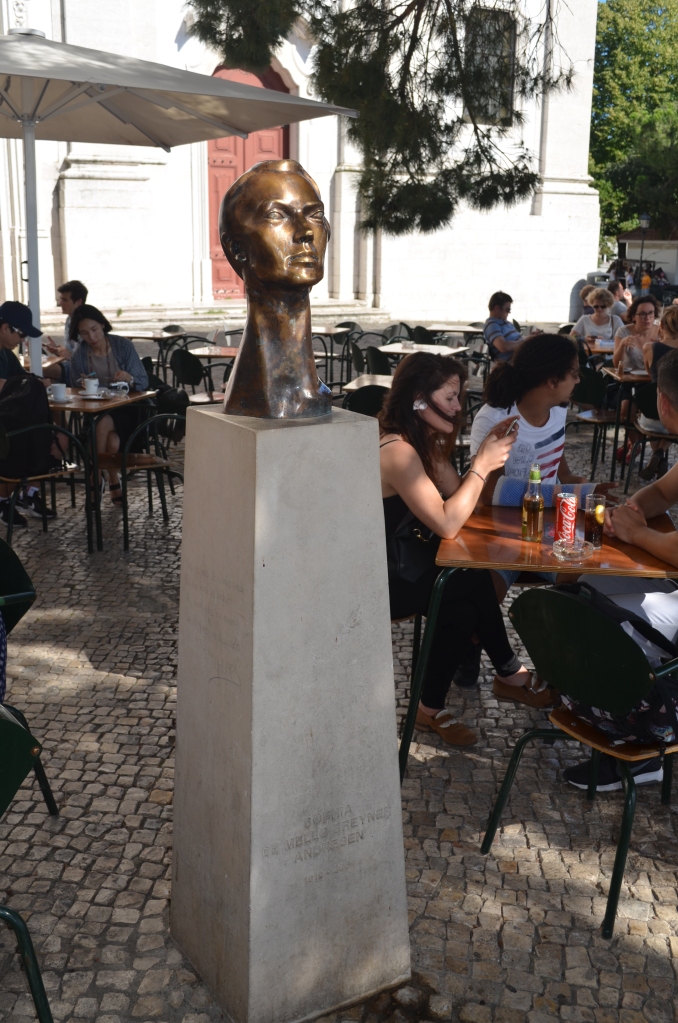
(Photo by SEA)
Today, 25 April, marks the 45th Anniversary of Portugal’s “Carnation Revolution,” when a military coup toppled the fascist, authoritarian government, leading to a period of freedom and democracy after 48 years.
In addition to ridding the country of the “Estado Novo” regime, the revolution of 25 April 1974, led to the end of Portuguese colonization and its attendant wars in Africa. Decolonization began shortly after the Carnation Revolution and, by the end of 1975, the former colonies of Angola, Cape Verde, São Tomé, and Mozambique gained independence.
Dubbed the Carnation Revolution because the flowers were offered to military personnel by civilians on the streets of Lisbon as a symbol of the peaceful transition of power, an action initiative by activist Celeste Caeiro. The coup itself was apparently triggered by a Portuguese song featured in the 1974 “Eurovision” song contest—the same contest that launched the Swedish band ABBA, which won that year with “Waterloo.”
Portugal’s entry, a fairly innocuous love-ballad called “E depois do adeus” (“And after the farewell”) by Paulo de Carvalho, was used to signal the rebels, who launched the coup when it was broadcast by a Lisbon radio station at 22:50 on 24 April. A second song, “Grândola Vila Morena” by Zeca Afonso, announced when the coup leaders had seized control. A 2000 film by Maria de Medeiros, Capitães de Abril, dramatizes the story.
Sophia de Mello Breyner Andresen (1919-2004) is one of the most important Portuguese poets of the 20th century and, in 1999, became the first Portuguese woman to receive the Camões Prize, the most prestigious award in Portuguese literature.
In 2014, ten years after her death—and on the 40th anniversary of the Carnation Revolution—Andresen’s remains were transferred to the Panteão Nacional, in the Church of Santa Engrácia, only the second Portuguese woman to receive this honor. (The other was fado singer Amália Rodrigues.)
“Poetry is my understanding of the universe,” Andresen once said. “My way of relating to things, my participation in reality, my encounter with voices and images.”
Her poem, “25 de Abril,” is the most famous poem of the Carnation Revolution, simple and elegant in its observation of the morning when the country emerged from “the night and the silence” of almost fifty years of authoritarian rule.
Here is Sophia de Mello Breyner Andresen’s “25 de Abril” in the original Portuguese and in my English translation:
“25 de Abril”
Esta é a madrugada que eu esperava
O dia inicial inteiro e limpo
Onde emergimos da noite e do silêncio
E livres habitamos a substância do tempo
—-
“25th of April”
This is the dawn I expected—
the first day, whole and clean,
where we emerge from the night and the silence.
And free, we inhabit the substance of time
(Translation by Scott Edward Anderson)
 Scott Edward Anderson
 Scott Edward Anderson's Poetry Blog