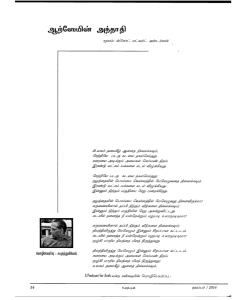
My poem, “Pantoum for Aceh” translated into Tamil by Appadurai Muttulingam, 2014.
A few years ago, my friend and former colleague at The Nature Conservancy, Sanjayan, introduced me to Tamil poetry after a long chat about poetry while we were both speaking at a conference in Aspen.
Sanjayan, a Sri Lanka-born Tamil, recommended I start with Poems of Love and War, selected and translated by A. K. Ramanujan, a remarkable book of Tamil poems from throughout history.
Long-time subscribers to my Poetry Month emails will recall I shared a few poems from the anthology in April 2009. Sanjayan sent my email to his father, Appadurai Muttulingam, who in turn sent me a copy of his own delightful book of short stories.
I responded by sending Appadurai a few of my poems (my book was not yet out) and he offered to translate one of them, “Pantoum for Aceh,” into Tamil for a Canadian-based Tamil-language journal, URAIYAADAL, which was published in 2014 (see photo above). He also sent me an anthology of contemporary poetry in Tamil, which I reviewed on my blog, here.
That post led the Sri Lankan Tamil poet known as ANAR (Issath Rehana Mohamed Azeem), whose poem, “Marutham,” I had called out in my review, to reach out to me earlier this year and send me some of her poems.
How small the world becomes when we are open to discovery and exploring cultures beyond our own. We are a global people and, I’m convinced, the movement to close our borders and shut out “foreign” cultures will soon die, because technology and travel and our future on this planet demands it.
ANAR has been writing poetry in Tamil since the 1990s. Her works include Oviem Varaiyathe Thurikai, Enakkuk Kavithai Mukam, Perunkadal Podukiren, Utal Paccai Vaanam, and Potupotuththa Mazhaiththooththal (a collection of Tamil folk songs from Sri Lanka).
A number of ANAR’s poems have been translated into English and published. Her books have won several awards, most notably the Government of Sri Lanka’s National Literature Award, the Tamil Literary Garden’s (Canada) Poetry Award, the Vijay TV Excellence in the Field of Literature (Sigaram Thotta Pengal) Award, and the Sparrow Literature Award.
ANAR writes regularly on her blog, anarsrilanka.blogspot.com (Google Chrome will translate it for you) and lives with her husband and son in the Eastern Province of Sri Lanka at Sainthamaruthu.
Here is her poem, “The Brightness of Wind,” in an English translation by Professor Jayaraman and its Tamil original:
“The Brightness of Wind”
I allow the wind
To eat me
My eyes
I stroked its cool cheeks
For the first time
Before it showed itself in the wind
Intoxicated I drank the image day and night
Kisses I plucked from the wind
Overflowed as would the floods
These watery fingers
Reaching out from the wind
Play on my flesh
Tunes not known before
My dwelling has turned into a wind
You, the total haughtiness of the wind
You, the never-ending slight of the wind
The expanse of sand has gone dry with joy
Body, the green sky
Face, the blue moon
I saw the brightness of wind
In a flash of lightning
—ANAR
translated into English by Professor Thanga Jayaraman
And in the original (Not sure how the beautiful Tamil script will work in WordPress, we’ll see):
காற்றின் பிரகாசம்
காற்றைத் தின்னவிடுகிறேன்
என்னை …
என் கண்களை …
குளிர்ந்த அதன் கன்னங்களை வருடினேன்
முதல் முறையாக
காற்றில் வெளிப்படுமுன் பிம்பத்தை
பகலிரவாக பருகினேன் போதையுடன்
காற்றினுள்ளிருந்து எடுத்த முத்தங்கள்
வெள்ளமாய் பெருக்கெடுத்திருக்கின்றன
காற்றிலிருந்து நீளும் நீர் விரல்கள்
முன்னறியாத ராகங்களை
இசைக்கிறதென் சதைகளில்
என் வீடு காற்றாக மாறிவிட்டது
காற்றின் முழுமையான அகங்காரம் நீ
நீ காற்றின் முடிவற்ற அலட்சியம்
மகிழ்ச்சியில் உலர்ந்துகிடக்கின்றது மணல்வெளி
உடல் பச்சை வானம்
முகம் நீல நிலவு
நான் பார்த்தேன் காற்றின் பிரகாசத்தை
ஒரு மின்வெட்டுப் பொழுதில்
–ANAR
c) 2007 ANAR, used by permission of the author
(On a side note, you should check out Sanjayan’s new video series on Vox, made in conjunction with the University of California. Here’s a link: Climate Lab.)

Table Mountain, Cape Town, South Africa. Photo by the author.
As some of you know, my new role in my day job at EY involves helping globalize prepaid smart metering programs for municipal utilities in emerging markets.
It’s a project that started in South Africa, and I think it’s pretty cool to be exporting an innovation from the African continent rather than imposing it from outside.
Traveling to South Africa, I’ve begun to explore the literature and art of the country over the last 20 years since the end of apartheid.
Thinking about poets whose work I could share, I thought about the work of Isobel Dixon. I know Isobel chiefly through social media — I believe it was Jo Bell or the Scottish Poetry Library who first introduced me to her work.
Dixon lives in London, but was born in Umtata, South Africa, and grew up in the semi-desert region known as the Karoo. She studied in the South African winelands country of Stellenbosch (where I was with my wife Samantha in January) and in Edinburgh.
In 2000, Dixon won the Sanlam Literary Award for her then unpublished collection of poetry Weather Eye, which was subsequently published by Carapace Poets (2001). She is also the author two collections, The Tempest Prognosticator and A Fold in the Map, both published by Salt in the UK. You can read more of her work at isobeldixon.com
I love the rhythms and musicality of Isobel Dixon’s poem, “She Comes Swimming,” and the mix of history and mythology that unfolds as we read. Of the poem Dixon wrote in an email to me,
“This is a poem very close to my heart, about my beloved country, South Africa. I wrote it in my first years abroad, feeling very keenly what it means to live far from the motherland, to yearn for it – and yet to fear that time away will change you, or change others’ perceptions of you, so that you might be perceived as an outsider, in spite of all you feel and are.”

Winelands, South Africa. Photo by the author.
Dixon “won a scholarship to do postgraduate study in my father’s native Scotland, the realisation of a dream, but at a time when I’d rather have stayed in South Africa – the momentous year of the first democratic elections.”
Another aspect of the poem that I particularly admire is what Dixon explains as “This sense of rueful distance, of vivid longing, and an awareness of the complex histories and hybrid mythologies of my faraway homeland, all fed into a poem about my imagined journey southwards, swimming back in time and language too.”
Dixon also told me that the poem has a central place in her Salt collection, A Fold in the Map, a collection that looks at the traveler’s state of “in-betweenness,” caught between lives and countries.
“The poem flowed onto the page in something of a hypnotic state,” Dixon wrote. “One of those poems you look at the day after and think, ‘Where did that come from, and how?’ Wherever it summoned itself from, I’m glad it did.” We are too.
Here is Isobel Dixon’s poem, SHE COMES SWIMMING
She comes swimming to you, following
da Gama’s wake. The twisting Nile
won’t take her halfway far enough.
No, don’t imagine sirens – mermaid
beauty is too delicate and quick.
Nor does she have that radiance,
Botticelli’s Venus glow. No golden
goddess, she’s a southern
selkie-sister, dusky otter-girl
who breasts the cold Benguela, rides
the rough Atlantic swell, its chilly
tides, for leagues and leagues.
Her pelt is salty, soaked. Worn out,
she floats, a dark Ophelia, thinking
what it feels like just to sink
caressed by seaweed, nibbled by
a school of jewel-plated fish.
But with her chin tipped skyward
she can’t miss the Southern Cross
which now looks newly down on her,
a buttress for the roof of her familiar
hemisphere. She’s nearly there.
With wrinkled fingertips, she strokes
her rosary of ivory, bone and horn
and some black seed or stone
she can’t recall the name of,
only knows its rubbed-down feel.
And then she thanks her stars,
the ones she’s always known,
and flips herself, to find her rhythm
and her course again. On, southwards,
yes, much further south than this.
This time she’ll pay attention
to the names – not just the English,
Portuguese and Dutch, the splicings
and accretions of the years. She’ll search
for first names in that Urworld, find
her heart-land’s mother tongue.
Perhaps there’s no such language,
only touch – but that’s at least a dialect
still spoken there. She knows when she
arrives she’ll have to learn again,
so much forgotten, lost. And when
they put her to the test she fears
she’ll be found wanting, out of step.
But now what she must do is swim,
stay focused on each stroke,
until she feels the landshelf
far beneath her rise, a gentle slope
up to the rock, the Cape,
the Fairest Cape. Her Mother City
and its mountain, waiting, wrapped
in veils of cloud and smoke.
Then she must concentrate, dodge
nets and wrack, a plastic bag afloat –
a flaccid, shrunk albino ray –
until she’s close enough to touch
down on the seabed, stumble
to the beach – the glistening sand
as great a treasure as her Milky Way –
fall on her knees and plant a kiss
and her old string of beads,
her own explorer’s cross
into the cruel, fruitful earth at last.
She’s at your feet. Her heart
is beating fast. Her limbs are weak.
Make her look up. Tell her she’s home.
Don’t send her on her way again.
© 2001, Isobel Dixon
Used by permission of the author.
Poems of Displacement, Love, and Other Modern Tamil Concerns
March 23, 2014
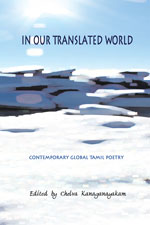 IN OUR TRANSLATED WORLD: Contemporary Global Tamil Poetry, edited by Chelva Kanaganayakam (TSAR Publications, Toronto, Canada)
My first encounter with Tamil poetry came in the form of a short poem by Auvaiyar, written two millennium ago:
Bless you, earth:
field,
forest,
valley,
or hill,you are only as good
as the good young men
in each place.
This poem appeared in a book of classical Tamil poetry called Poems of Love and War from the Eight Anthologies and the Ten Long Poems of Classical Tamil, selected and translated by A.K. Ramanujan, which featured poems from around 100 BC to AD 250, and late classical poems from the 5th and 6th centuries.
The poems were divided into two distinct sections, “Akam” (pronounced “aham”) which were love poems, and “Puram,” which were about heroes and battles. Akam means heart or household, and the poems are distinguished by the landscape each poem evokes and, in turn, the particular experience of love each landscape connotes. The Tamil called this “Tinai” in their poetics.
The subtropical climate of Tamil Nadu in southern India ranges from seaside to mountains, agricultural fields to forests, and desert. Each landscape is associated with a certain mood and the poems typically feature a flower, tree or plant of the corresponding biome. For example, as Ramanujan points out in his translator’s note, “Kurinci, a mountain flower; neytal, blue lily; mullai, jasmine; maratam, queen’s flower; palai, a desert tree.”
The poems are distinguished by straight-forward emotions and plain language (at least in translation), with a simplicity rivaling Chinese and Japanese poetry.
Take Kapilar’s poem of longing, “What She Said to her friend” (p. 13):
You ask me to forget him,
How can I?
His mountain,
wearing its dark raincloud
white-crested
as a bean flower
the east wind opens,
his mountain,
that blue sapphire,
is never out of sight.
We know from the Tinai that each landscape corresponds to a phase or experience of love: union/mountains; separation/desert; patience waiting/forest; anxious waiting/seaside; and infidelity and resentment/lowland farms. In the poem above, the speaker is clearly longing for the union or reunion with her lover on his mountain, which she keeps in her memory.
Tamils have a strong attachment to their language, which is central to their identity. Many refer to it as Tamil̲an̲n̲ai, “the Tamil mother.” It is one of the oldest surviving classical languages in the world, and written Tamil is a beautiful Brahmic script. Thankfully, this anthology is bilingual, which allows the reader to see the poems (if not read them) in their original form.
Poets such as Mahakavi Bharathiyar and Bharathidasan — the latter a kind of Tamil Fernando Pessoa who wrote many of his poems in various pseudonyms — brought Tamil poetry into the modern era. Their work gave Tamil poets freedom from the constraints of traditional Tamil poetics and expanded the subject matter available to Tamil poets.
In Our Translated World: Contemporary Global Tamil Poetry is a recent anthology of contemporary global Tamil poetry, published by the Tamil Literary Garden of Canada and TSAR Publications in Toronto. The work of the Tamil poets in this anthology clearly bears the mark of its modern predecessors, but also the influence of modern and contemporary poetry from Europe and Asia.
Not surprising, given the book is a selection of recent poems from Tamils around the world. Indeed, the anthology, edited by Chelva Kanaganayakam, features around 80 poems from Tamil Nadu, Sri Lanka, Malaysia, Singapore, and the Tamil diaspora in England, Canada, and elsewhere.
As Chelva writes in the introduction, “for Tamils, particularly in the last three decades, the experiences have been one of displacement, trauma, nostalgia, and despair.” This is especially true of Sri Lankan Tamils, as many tried to escape ethnic conflicts on that island nation.
For some Sri Lankans, such conflict breeds a conflicting nature. For example, Chandra Bose Sudhakar, who defends his choosing a life of books,
Life began with some books:
that the words in books
produce no rice became
the problem of our lives.
For Sudhakar, “books swallow the howls/ of my tormented heart” and offer the Sri Lankan poet, who was killed by armed men in his house in 2007, a kind of acknowledgment he couldn’t find elsewhere.
Some poems in the collection have echoes, intentional or not, of classical Akam poems, such as this one by Majeed, which sounds to me like a desert or separation poem:
You live on
in the empty spaces
that cannot be filled
with anything else.
Or consider the seaside imagery of another poem by Auzhiyaal, which could be in the voice of an anxious lover trying to find solace in the littoral environment:
At the end of each day
our minute secrets
rise again
a pregnant silver fish
a sea weed
a pink sea rock.
The freedom afforded by contemporary poetics may bely an ignorance of Tamil classical themes and symbolism, as some of the poets freely mix landscapes, emotions, and place, such as in this poem by Rashmy,
Parting is always bitter;
everywhere, eventually brackish;
trembling flesh,
nerves starved with lust,
the soul’s love
draining, filled to the brim.
From our paddy fields
gold-hued grains
we will harvest
the day after yesterday.
Others call out the connection, such as Anar does in her poem “Marutham,” with its rich depiction of the farm fields and rice paddies indicative of the agricultural landscape and a hint of possible infidelity in the lines,
The fragrant smell of
ripe paddy in the fields,
offers a giddy sense of joy.
As much as the poets in this collection have deep memories of their Tamil past and poetry, the poems in this collection are, as the editor writes in his introduction, “a form of transformation, a gesture about the future. Whether the poems are ostensibly realistic or self-consciously fantastic, the poems move beyond ethnographic detail to offer an imaginative sense of the Tamil experience.”
And for poetry readers, the Tamil experience is a rich and rewarding one in the hands of the poets, translators, and editor of In Our Translated World.
##
 Scott Edward Anderson
 Scott Edward Anderson's Poetry Blog